
NuPrime IDA-8 Review
The NuPrime IDA-8 is an integrated amplifier with a built-in DAC, employing a hybrid Class A+D amplifier circuit. It boasts multiple digital inputs, including USB, alongside analog inputs. Wireless streaming is also supported via Bluetooth or optional WiFi, offering versatile and rich applications. Its half-size chassis and affordable price point make it ideal for smaller spaces or those new to audiophile sound. Let’s delve into its performance in this review.
Concise and Versatile Functionality
The packaging design is modern, evoking the feeling of purchasing a high-end smartphone. It highlights the ultra-low noise Class A+D integrated amplifier and DAC, and notes “wireless PORT,” indicating an external port for wireless connectivity rather than a built-in module.
The rear of the box directly presents key features and connection possibilities through text and diagrams. It clearly shows compatibility with players, computers, NAS, TVs, DVDs, and mobile devices, with outputs for speakers and subwoofers. Each application’s corresponding terminal is also clearly labeled.
High-Resolution Audio Specifications
The input and output specifications are clearly listed on the side of the packaging.
**Inputs:**
* 1 x USB: PCM up to 384kHz, DSD up to DSD256
* 1 x SPDIF Coaxial: PCM up to 192kHz, DSD up to DSD64 (DoP)
* 1 x SPDIF Optical: PCM up to 192kHz, DSD up to DSD64 (DoP)
* 1 x Bluetooth receiver module (standard), 1 x WiFi receiver module (optional)
* 1 x RCA Analog
**Outputs:**
* 1 x Stereo Subwoofer RCA Analog
* 1 x Stereo Speaker Terminals
The other side provides more detailed specifications.
* Bit Rate: 16~32bits
* Amplifier Power: 100 Watts x 2
* Distortion Rate: 0.005%
* Peak Output: 280 Watts
Upon opening the package, you’ll find the manual and the main unit, with accessories neatly tucked away in cardboard compartments on either side.
The unit’s dimensions occupy about half the width of a standard audio rack, slightly wider than an A4 sheet of paper.
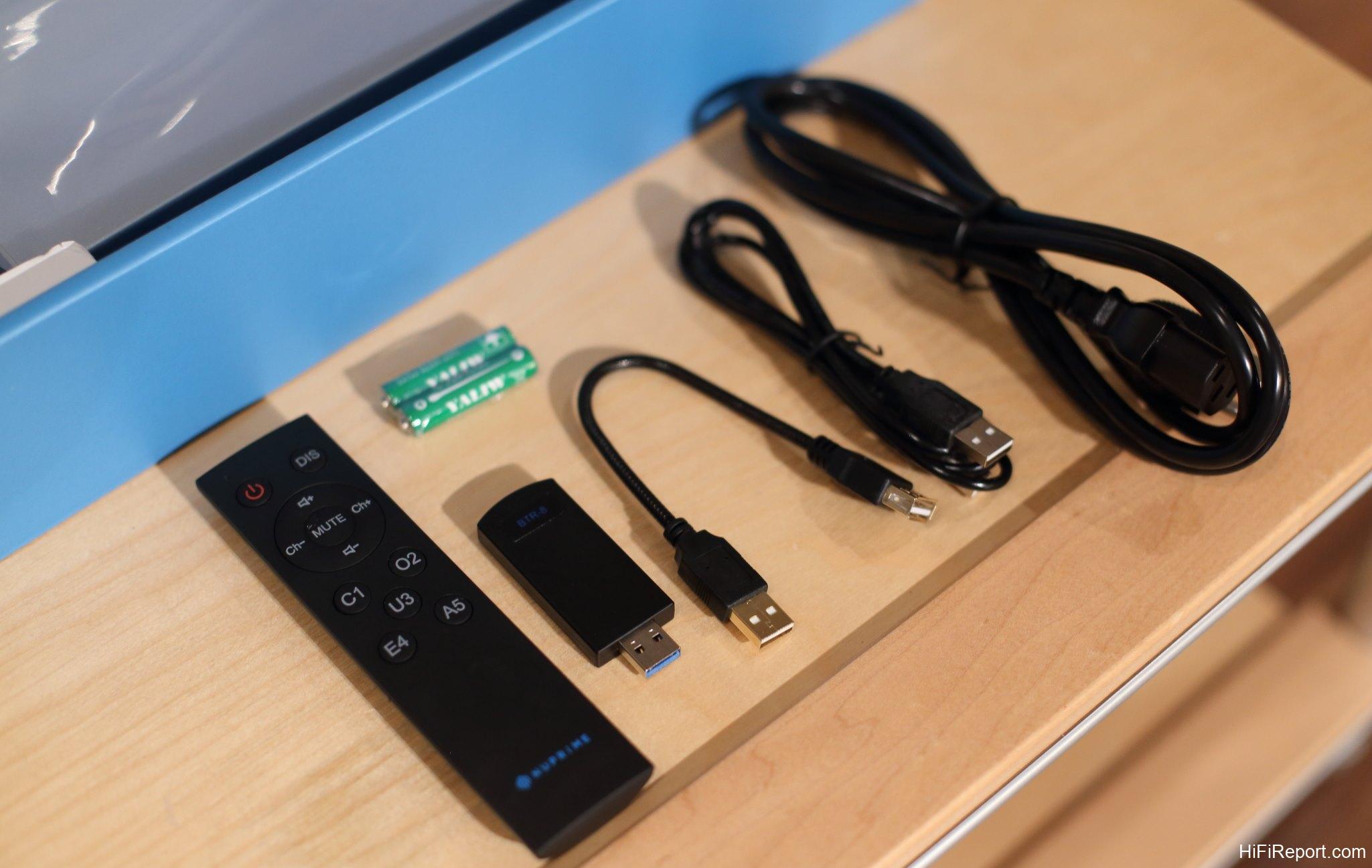
The included accessories are comprehensive. From left to right: the remote control, the standard Bluetooth receiver module (a WiFi receiver module is available separately), two USB cables, and a standard power cord.
Premium Build Quality
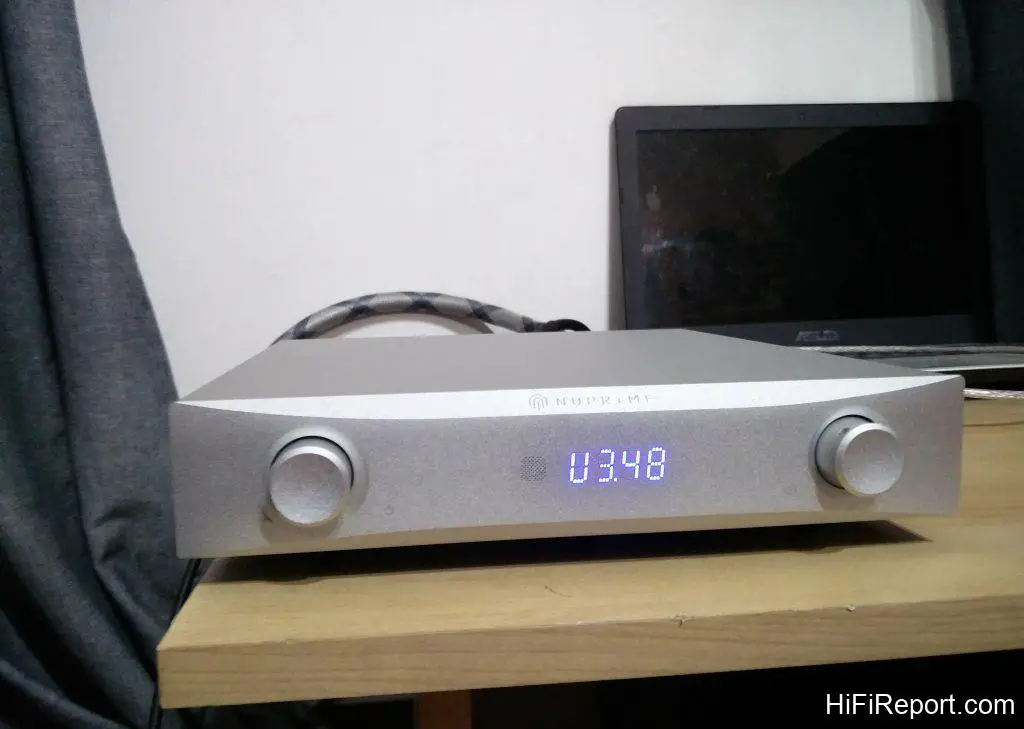
The IDA-8’s front panel is remarkably clean and simple – indeed, the overall design is minimalist. The aluminum chassis boasts an anodized finish, lending it a premium feel. On the left is the input selector knob, which also serves as the power on/off switch when pressed. To the right is the volume knob, which rotates with a smooth, finely-stepped action, indicating excellent build quality. A central display shows the current input and volume level.
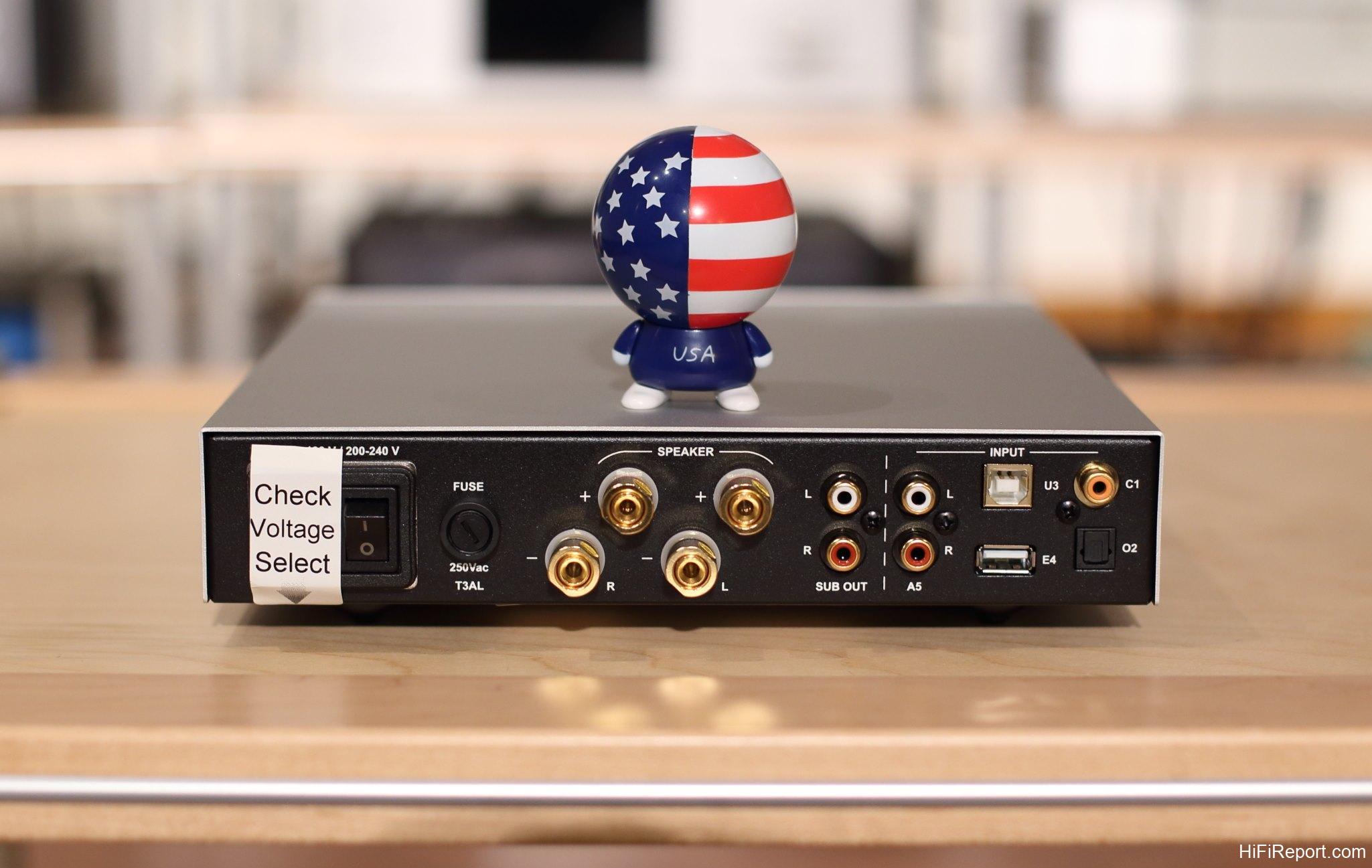
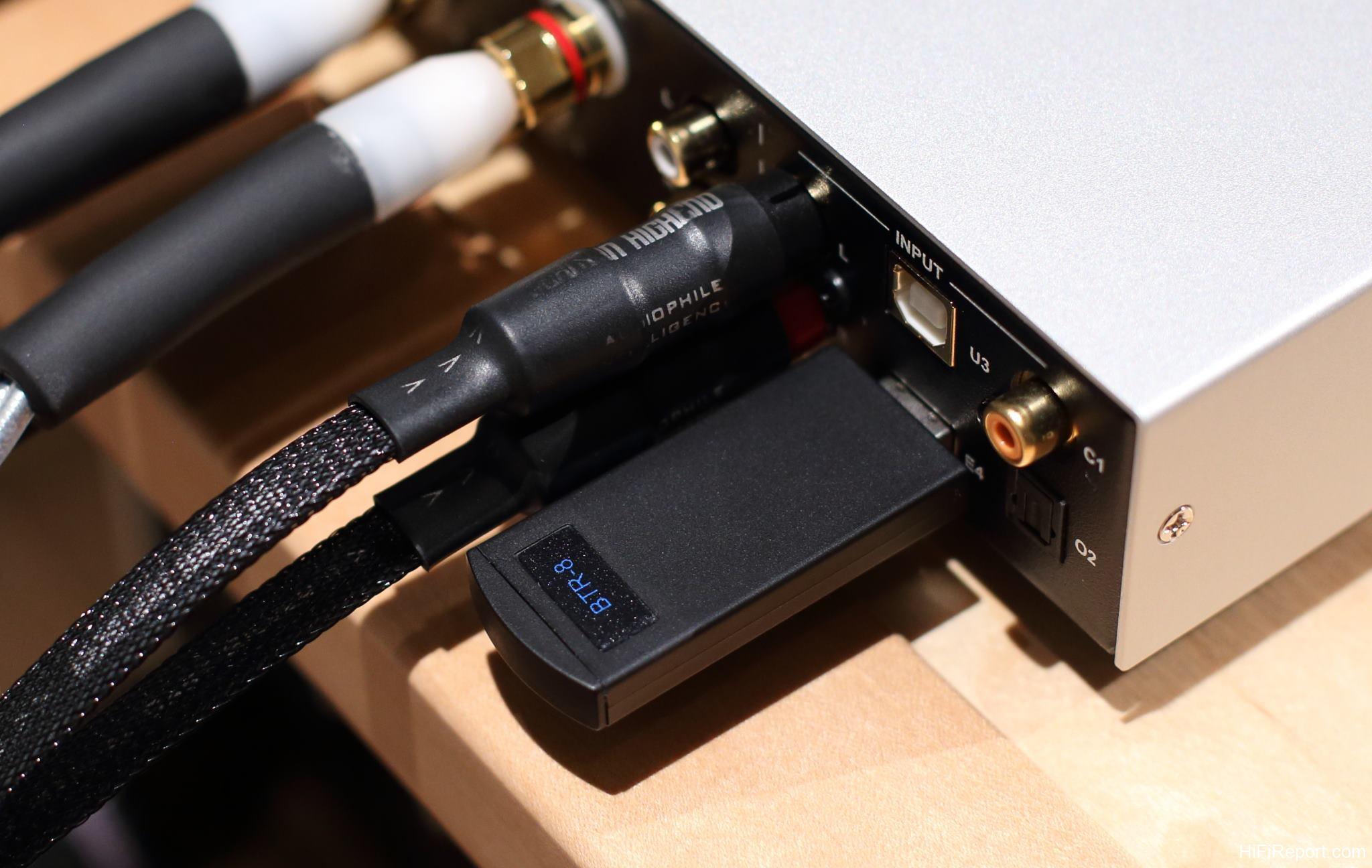
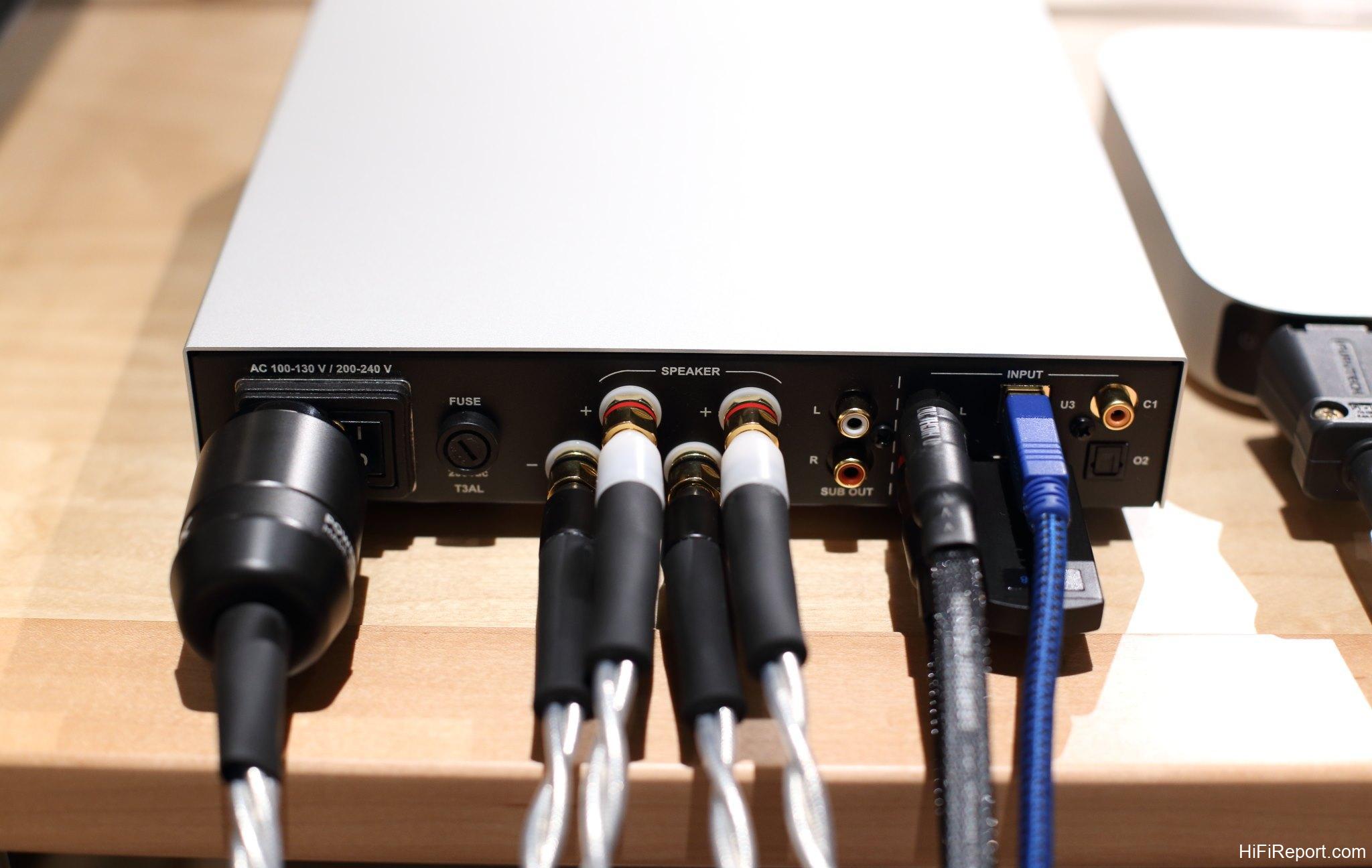
Moving to the rear panel terminals, the input section is on the right. It includes coaxial, optical, and two USB inputs – U3 for connecting to a computer and E4 for the Bluetooth or WiFi receiver module. There’s also a set of RCA stereo analog inputs. The central section houses the output terminals: speaker binding posts and a line-level output for a subwoofer.
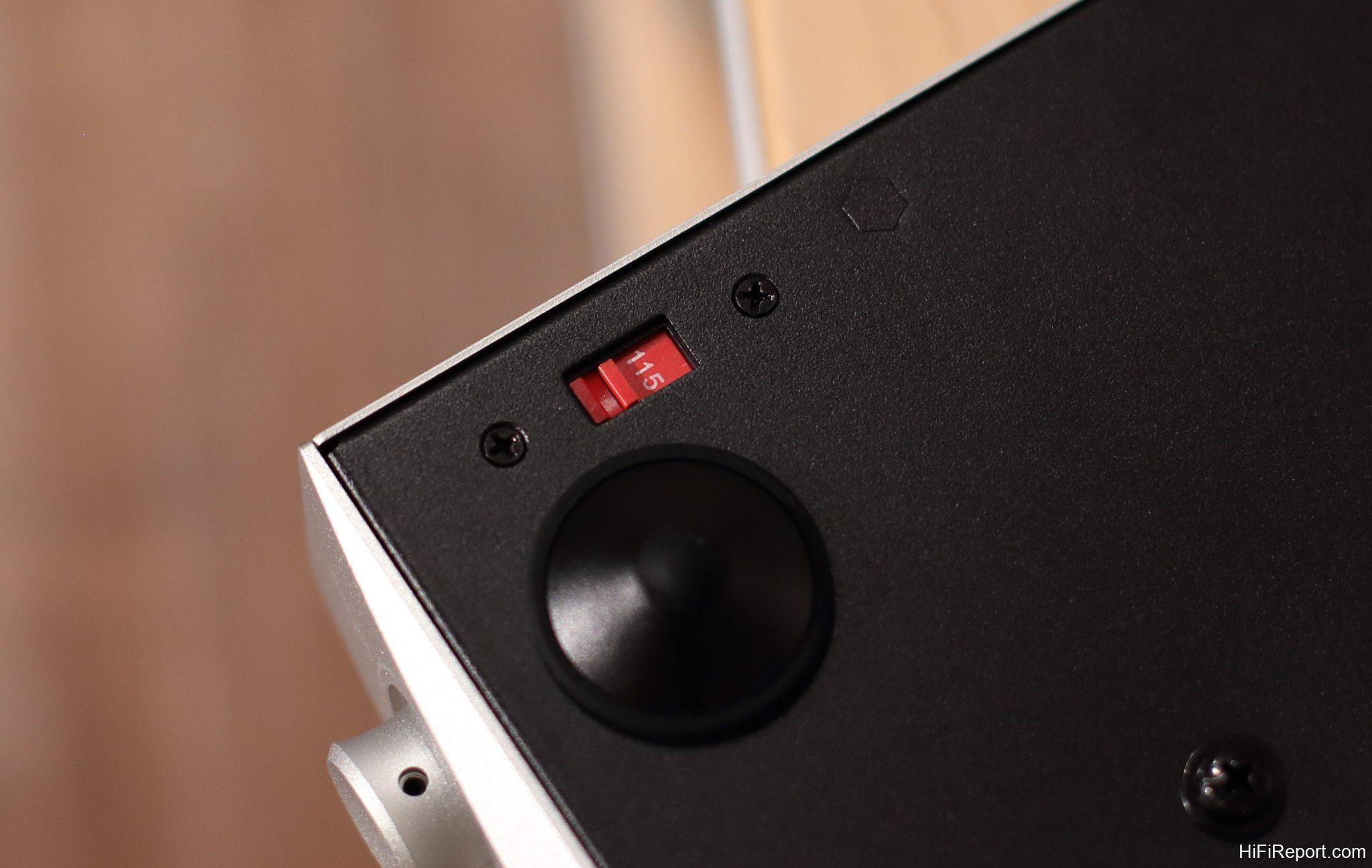
On the left is the power section, with a sticker deliberately placed over the AC socket, reminding users to check and set the voltage selector to the correct setting before use.
Flipping the unit over reveals the voltage selector switch on the bottom panel. It can be easily toggled with a fingernail, offering options for 230V and 115V.
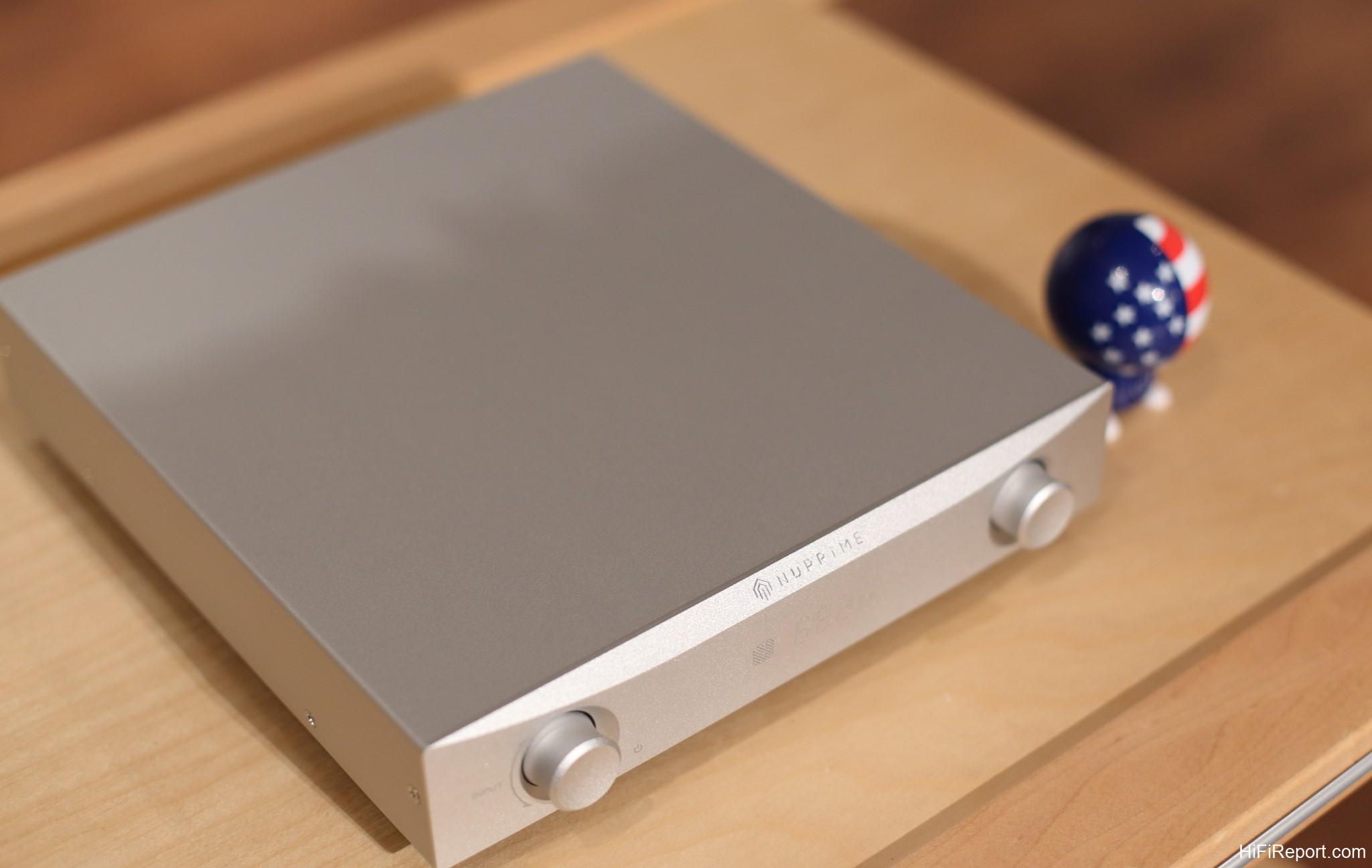
From a top-down view, the overall design is clean and streamlined. The front panel features subtle bevels and curves, showcasing meticulous craftsmanship.
Patented Vibration-Damping Feet
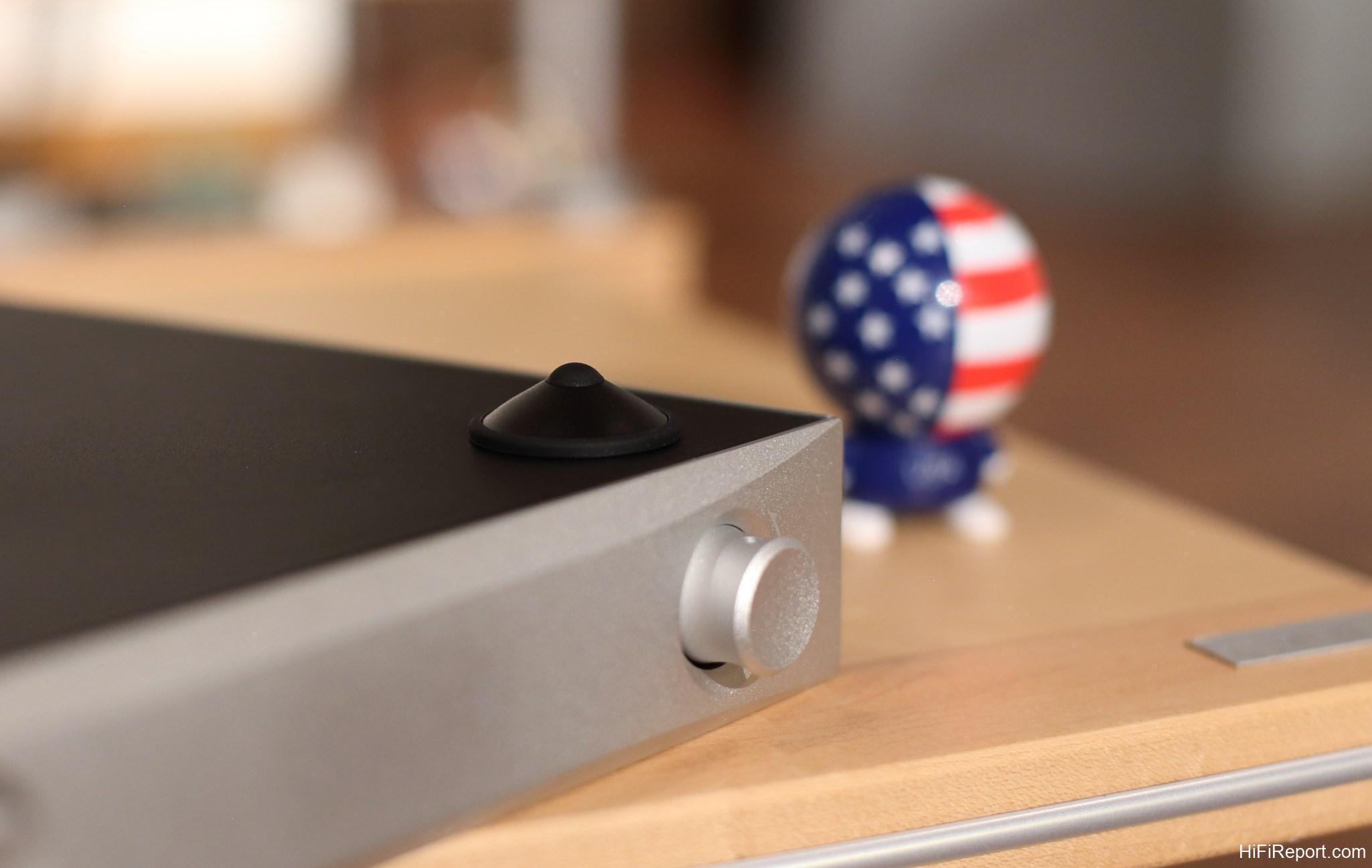
The four damping feet on the bottom are a patented design, effectively minimizing vibrations. They are officially named “NuPrime vibration-free isolation feet.”
Class A and Class D Amplification Synergies
The IDA-8 utilizes an amplifier circuit known as Ultra-Linear Class A Module (ULCAM). Its internal preamp stage employs Class A amplification, known for its warm, low-distortion sound. The power amplifier stage utilizes Class D amplification, prized for its dynamics, speed, and efficiency. This hybrid approach aims to deliver high power output while maintaining sonic refinement and extremely low noise.
Ultimately, this results in a distortion rate of less than 0.0015% and a signal-to-noise ratio of -130dB. Furthermore, the Class D stage employs a high-speed switching frequency of 600Hz, compared to the typical 300Hz in conventional Class D designs, enabling a waveform closer to the original analog signal.
Precision Volume Control Design
The IDA-8 incorporates an SRC IC chip that provides FPGA programming for ultra-low jitter and distortion. The power supply utilizes a high-efficiency toroidal transformer to minimize high-frequency noise and enhance low-frequency performance. The DAC supports PCM up to 384kHz/32bits and DSD256, and can also handle DSD over PCM (DoP) via coaxial or optical inputs.
IDA-8’s volume control is a thin-film resistor-switched design. It places a switched resistor in each volume path and uses FPGA control to achieve precise and minute volume adjustments. Volume changes are finely graded in 0.5dB increments, totaling 99 steps. The internal circuit layout also adopts a shortest path design to minimize signal loss and interference caused by long pathways.
Upon powering up the IDA-8, the central display shows the current input and volume level. There are five input indicators on the left, corresponding to the input sources. The volume level is displayed on the right. The volume setting for each input source is independently memorized.
Initially, I connected the speaker cables and set up RCA analog and USB computer inputs. The Bluetooth receiver module was also installed. At this stage, music could be played through a computer, CD player, and mobile devices. Later, I also connected the coaxial input to allow the IDA-8 to decode music signals directly from a CD player.
The Bluetooth receiver module.
Connecting via traditional wired methods is straightforward. Simply connect the cables and switch the input to the corresponding source. Photos of each input indicator are shown.
Quick and Easy Bluetooth Connection
I’ll demonstrate the Bluetooth wireless connection below, which is also very easy. Install the receiver on the E4 port on the back of the IDA-8 and switch to the corresponding input. I used an iPad for connection, as shown in the screenshots. Turning on Bluetooth on the iPad automatically searches for the “NuPrime BTR 8” Bluetooth device.
After selecting it, a confirmation code will appear. If this is the only NuPrime Bluetooth device in your space, you shouldn’t have any pairing issues. The connection is now complete.
Any audio from the iPad will be transmitted to the IDA-8 and played through the speakers.
Playing Tidal directly via iPad.
Satisfying Sound Quality: A Quality Component
I meticulously tested almost every connection method on the NuPrime IDA-8 and listened for an extended period. I believe this is an exceptionally valuable piece of equipment, and you absolutely can’t go wrong with it in this price range. Whether using SPDIF coaxial input, computer USB input, or RCA analog input, the sound quality is excellent.
The coaxial input yielded the best sound, while the USB input from a MAC computer for decoding also delivered impressive performance, showcasing the IDA-8’s high-quality DAC capabilities. The RCA analog input, of course, depends on the decoding capabilities of the source. I used a high-end source, which naturally resulted in excellent sound quality, but it also demonstrated the prowess of the IDA-8’s amplifier circuitry.
For wireless transmission, the IDA-8 employs external receiver modules, offering both Bluetooth and WiFi options. I only tested the Bluetooth module this time, primarily focusing on convenience. However, whether users utilize Bluetooth transmission or not, the IDA-8’s traditional wired decoding and amplification circuits alone are enough to warrant high praise.
Warm and Engaging Sound Signature
I first used the HiFiReport’s reference CD player as a source, using coaxial digital output to let the IDA-8 handle the subsequent processing and directly output the signal to the speakers. Listening to “Kissed By A Song,” the sound performance exceeded my expectations. Resolution and musicality were both excellent, quite unlike what you’d expect from a product in this price range.
Vocals had both richness and warmth, never sounding harsh, strident, or cold, while maintaining ample resolution, distinct imaging, and a decent soundstage width. This is a demanding audiophile album that emphasizes emotional expression, largely featuring simple instrumentation and vocals. The IDA-8 delivered on this, and listening to just this album alone was enough to convince me that this is a component worth taking home.
Fast, Clean, and Precise
Playing “Hi Fi Flamenco” tested the IDA-8’s speed and transient response. Despite using relatively inefficient speakers, the IDA-8 still demonstrated ample power and control. I sensed the warmth of Class A amplification from the previous album and now experienced the speed and responsiveness of Class D in this one, while maintaining solid sonic substance.
In the 5th track, “ZAMBRA,” the proportions of instruments, vocals, and percussive footwork were well-balanced, occurring simultaneously or alternating, all while maintaining clarity, soundstage spaciousness, and distinct imaging. Crucially, the mid-bass speed response was sufficient, preventing the overall rhythm from dragging. Notes started and stopped precisely, clean and crisp.
Clean Background, Truly Low Noise Floor
Moving on to Michael Jackson’s “Bad,” a pop masterpiece, this album is full of energy, with fast and heavy rhythms, rich and layered effects, and Michael’s unique vocals, making each track powerful. System quietness is paramount when listening to albums like this. The music should be lively where it’s meant to be, and quiet where it needs to be even quieter, otherwise, this genre can be difficult to listen to enjoyably. The IDA-8 showcased Michael’s music admirably.
Clarity remained excellent, handling even the most complex layers of sound effects without sounding messy or chaotic, and the background was remarkably clean.
Digital Inputs for Limitless Convenience
Next, I used a MAC as a source, providing signals to the IDA-8 via USB for decoding and playback. In addition to music stored on the computer, I also used Tidal as a music source. Tidal’s music accessibility is incredibly convenient, allowing for a wide range of listening across genres like pop, classical, and jazz, with respectable sound quality.
Input Method Comparisons
I first played music files stored on the computer, selecting Diana Krall’s “Live In Paris.” This album is also a reference for me when comparing various input methods. I listened through computer, Tidal streaming, digital streaming player, NAS, and CD, all in turn. The USB input from the computer delivered good resolution and ample bandwidth, with strong dynamics. The CD player’s coaxial output offered superior musicality, with a gentler, smoother sound and a noticeably lower noise floor.
Therefore, the CD player’s coaxial transmission was still overall superior. However, the IDA-8’s USB input remained very capable and definitely sufficient for enjoying music. When playing Tidal, the smoothness was closer to CD playback, but it fell slightly short in soundstage extension, solidity, and dynamics.
IDA-8: A Must-Consider Value Proposition
Overall, the NuPrime IDA-8 is an excellent piece of equipment. It offers a wide range of wired connection options, including coaxial, optical, USB, and analog inputs. The decoded sound quality and resolution are remarkably high for its class. The amplifier stage provides ample power and a warm sonic character. Most importantly, it’s not expensive, making it highly recommended for those with space or budget constraints.
NuPrime IDA-8 DAC Integrated Amplifier Highlights
* Hybrid Class A+D amplifier circuit
* Coaxial, optical, USB multiple digital inputs, RCA analog input
* DAC decoding up to PCM 384kHz and DSD 256
* Optional wireless transmission modules available
* Ideal for pairing with CAS or digital streaming players
* Affordable price, exceptional value
Special Feature: User Listening Impressions
After our in-house review, we offered digital users the opportunity to take the Nuprime IDA-8 home and test it with their own systems. Below are the listening impressions shared by three users.
**[Listening Share 1, Mr. Sheng]**
First, I’d like to thank HiFiReport for providing this opportunity for users to audition the Nuprime IDA-8 digital integrated amplifier. This isn’t my first encounter with Nuprime products. Several years ago, I acquired Nuprime’s first product – the uDSD. I still vividly remember its performance. The uDSD, about the size of a cigarette box, combined DAC and headphone amplifier functions, offering specifications and sound quality comparable to desktop units, which was astonishing.
Due to certain reasons, this unit has been in and out of my home twice. Despite changes in time and equipment, my second experience with it was still very satisfying.
My second interaction with Nuprime was a direct jump to the DAC-10H DAC preamp and ST-10 power amplifier. This combination has garnered rave reviews in the audio world. My experience lived up to expectations, delivering precision and rich musicality rarely found at this price point. The DAC-10H’s diverse functions and high specifications make it a well-rounded DAC preamp. The ST-10’s Class D amplification power is even more impressive.
Although I didn’t use it with large floor-standing speakers, the auditory experience was indeed more controlled and punchy than high-end surround sound receivers. I actually regretted selling it later, but my personality is just to keep changing things around – audioholic tendencies, I guess! Speaking of the IDA-8, I originally intended to buy one to try out. After some consideration, I felt this unit didn’t quite meet my personal standards for an integrated amplifier.
It lacks a headphone jack, phono stage, and left/right channel balance adjustments, and the number of digital inputs is also a bit limited, so I never pulled the trigger. However, it’s a bit funny, but upon receiving the test unit provided by HiFiReport, I had a kind of “aha!” moment. It turns out this unit is unexpectedly small. No wonder it couldn’t fit all the features I wanted! From photos, I never realized the IDA-8 would be this small. 100 watts per channel? Really?
Let’s connect it to speakers and see. Because the listening time was limited, I couldn’t savor each CD slowly. So I used music I was personally familiar with for testing, which allowed me to better discern the differences between this unit and my current and previous Nuprime equipment.
In fact, after listening to two or three tracks, I could roughly confirm that its sound signature retains Nuprime’s consistent tradition: clear, clean, strong bass. The 100 watts of power is unleashed to its fullest in this small unit. To be honest, my personal requirements for equipment aren’t very high, but I must absolutely avoid “fat,” “thick,” “muddy,” and “turbid” sonic flaws. The IDA-8 clearly meets these standards. Take Mike Garson’s “Serendipity” as an example.
The saxophone part in the first track must convey the reed’s sonic texture to be considered passable, and it passed smoothly. Pat Coil’s “Steps” has the characteristic drum sound resilience of Sheffield Lab recordings, and the IDA-8 also performed well. Although it didn’t quite match the power I remembered from the ST-10, under non-AB test conditions, I was already very satisfied.
The Australian Chamber Orchestra’s performance of Respighi’s “The Birds,” the truly realistic string sound at the beginning of the third movement also resonated with me.
In conclusion, the IDA-8 is indeed a DA+integrated amplifier with exceptional value for money. From a simple music listening perspective, it should have no rivals at this price point. But personally, I secretly hope Nuprime will release an IDA-10 or IDA-8 MK2 or similar product in the future, adding back some traditional integrated amplifier features, which would be perfect.
**[Listening Share 2, Mr. Yang]**
When I was looking for speakers for my study, I chose a pair of small bookshelf speakers, ProAc Tablette 10, balancing size and sound quality. These speakers are sealed-box design, 86dB sensitivity, 10-ohm impedance, and the 5-inch woofer is coated with a special damping material. These small speakers have quite a few factors making them difficult to drive. I’ve been wanting to find an amplifier to pair with them.
My options included NAD units, Quad Vena, Cyrus One, and Nuprime series STA-9, IDA-8, IDA-16. The British amps were chosen for their sound signature matching, while the Nuprime options were for their Class D high power. But I got busy and the amplifier search was put on hold. Oh, my DAC is an Audiobyte Black Dragon, originally used in my SENNHEISER HD800 system.
One morning, a friend sent me a HiFiReport FB post about applying for an IDA-8 audition. The unit arrived at my place within a week. Some of the Nuprime units were on my list because Nuprime is highly praised by friends – IDA-16 recommended by speaker enthusiasts, DAC-10H recommended by headphone enthusiasts. I thought Nuprime’s famous Class D amplification technology and the compact size of their units, making them easy to place, were advantages I could imagine from the product appearance.
Additionally, the IDA series comes with a built-in DAC, saving the cost of a source cable, and the budget can be used to find more beloved speakers. However, I still held onto some negative impressions of low-priced Class D amplifiers from a few years ago – digital sound, thin, lacking substance. Otherwise, I would have bought an entry-level STA-9 to pair with my DAC’s preamp output long ago.
This time, I received the IDA-8 sent by MY HiEND, and since it wasn’t something I bought myself, I couldn’t do an unboxing review. After listening for a few days, I’ll describe my listening impressions using the following tracks. Chen Qi Zhen – “Next Week to England.” In this song, Chen Qi Zhen’s voice is slightly sweet and transparent, with a smaller image. The guitar plucking sounds are very moving, but the cabinet resonance could be better.
However, the sound attack and decay are very appropriate, which is quite rare. Crossover Cello – “Sweet Sounds.” Compared to Schiit Ragnarok, I feel the IDA-8 is not warm enough, but the details are much better than my original all-in-one unit. The instrument scale is a bit smaller, but the Ragnarok originally had a big problem – when the percussion orchestra comes in at 2 minutes, the soundstage becomes a mess. The IDA-8 doesn’t become messy, which surprised me greatly.
I previously borrowed a Goldmund to drive ProAc small speakers, and the soundstage also didn’t get messy. This makes me think the IDA-8 has excellent control. Radetzky-Marsch. The Vienna New Year’s Concert is a piece I often listen to with headphones. HD800 interprets this type of music very well. If the system performance is too poor, I can’t stand listening to it, so I’ve never been able to listen to it with speakers.
However, the IDA-8 can control the speakers even at low volumes and still present details. Finally, I can walk around and listen to Strauss. Finally, thank you MY HiEND for providing the audition. You ask me if I would buy the IDA-8? Hmm, the answer is probably no, because I want to buy the IDA-16, ha.
**[Listening Share 3, Mr. Zhuang]**
As an office worker and two-channel user, building a simple and user-friendly system has always been a very important goal for me. A pair of speakers, an integrated amplifier with a DAC, power cable, speaker cable, USB cable, and a computer as a source solves everything. And the integrated amplifier plays a very important role in this. To achieve my goal of simply enjoying music, the journey of searching for a quality integrated amplifier (the upgrade bug) has never stopped.
Let me briefly describe my current system: Speakers: Revel Concerta2 M16 Integrated Amplifier: TEAC AI-501DA The Revel Concerta2 M16 is a pair of speakers with a 1-inch aluminum dome tweeter and a 6.5-inch woofer, with 86dB sensitivity. The AI501D is a great amplifier, achieving excellent results with previous pairs of speakers that had coaxial or smaller-sized drivers. Although wattage isn’t everything, the original 40W power output always felt a bit lacking.
I originally targeted the Nuprime IDA-16 with 200W of Class D power, but before I could buy it, I saw this HiFiReport IDA-8 audition opportunity. Although it’s not the top-choice big brother IDA-16, taking advantage of the audition opportunity to understand Nuprime’s direction is a good preparation for my next move!
First Impressions Upon receiving the package sent by HiFiReport, my first impression of the IDA-8 was its “mini” size. Although people often have stereotypes about equipment based on its appearance, the silver-white unit felt weighty in my hand, reminding me not to underestimate it. I quickly connected it to my system to enjoy it. The Best of Blue Note The first impression upon turning it on was a slightly warmer sound compared to my original equipment.
Initially, the “quantity” of bass seemed reduced, but when the bass parts of the music came in, my feeling was that it went deeper but without being muddy. The 100W of ample power and precise control demonstrated the accurate bass performance it should have. Song Dongye – “Anhe Bridge North” To test vocal performance, I played the album by well-known Chinese folk singer Song Dongye. The biggest difference from the past was that the vocals suddenly became very forward.
From previously performing on stage with the band, now it was like taking a big step forward, standing under the spotlight.
You ask if this performance is balanced, and I would say it’s a very pleasing sound, especially for those who like to listen to vocals. High-Resolution Audio File Support The DAC section, because this integrated amplifier was released earlier, only supports up to 24bit/192kHz, and cannot support high-resolution music like DSD. The IDA-8 supports PCM up to 384kHz and DSD up to DSD256. After some settings, I finally witnessed the power of high-resolution audio files.
Finally, thank you HiFiReport for providing this opportunity! Now I’m starting to covet the even more outstanding performance of the IDA-16 (or the flagship Reference 20)!
NuPrime IDA-8 DAC Integrated Amplifier Specifications
**Inputs:**
* 1 x USB PCM / DSD Digital Transmission (PCM up to 384kHz & DSD up to DSD256)
* 1 x Coaxial S/PDIF Digital Transmission (PCM up to 192K, supports DoP transmission DSD64)
* 1 x Optical S/PDIF Digital Transmission (PCM up to 192K, supports DoP transmission DSD64)
* 1 x Bluetooth (standard) or WiFi receiver (optional)
* 1 x Analog Stereo RCA
**Outputs:**
* 1 x Stereo Speaker Output
* 1 x Stereo RCA (2V), Variable Output
* USB Sampling Rates: 44.1KHz, 48KHz, 88.2KHz, 96KHz, 176.4KHz, 192KHz, 352.8KHz, 384KHz and DSD 2.8MHz, 5.6MHz, 11.2MHz
* S/PDIF Sampling Rates: 44.1KHz, 48KHz, 88.2KHz, 96, 176.4KHz, 192KHz, 384KHz (Coaxial)
* Bit Rate: 16-32-bits
* Power Output: 100W x 2 @ 8 Ohms; 100W x 2 @ 4 Ohms
* Distortion Rate: 0.005%
* Signal-to-Noise Ratio: 95dB
* Peak Output Power: 280w
* Frequency Response: 10Hz to 50kHz
* AC Voltage: (90VAC~130VAC // 210VAC~ 250VAC) With Voltage Select Switch
* AC Fuse: Slow-blow, 3A, 250VA
“`