
Oehlbach Stream Primus Cat 8.1 Review
In the realm of streaming audio and video, the network cable holds an undeniably crucial position. It serves as the essential conduit through which all streaming video and audio signals flow into your home system.
Regardless of how high-end your television, how top-tier your AV receiver, or how numerous your multichannel speakers, if the network cable quality is subpar, it effectively bottlenecks the signal quality at the source, severely hindering your AV equipment’s ability to perform at its best.
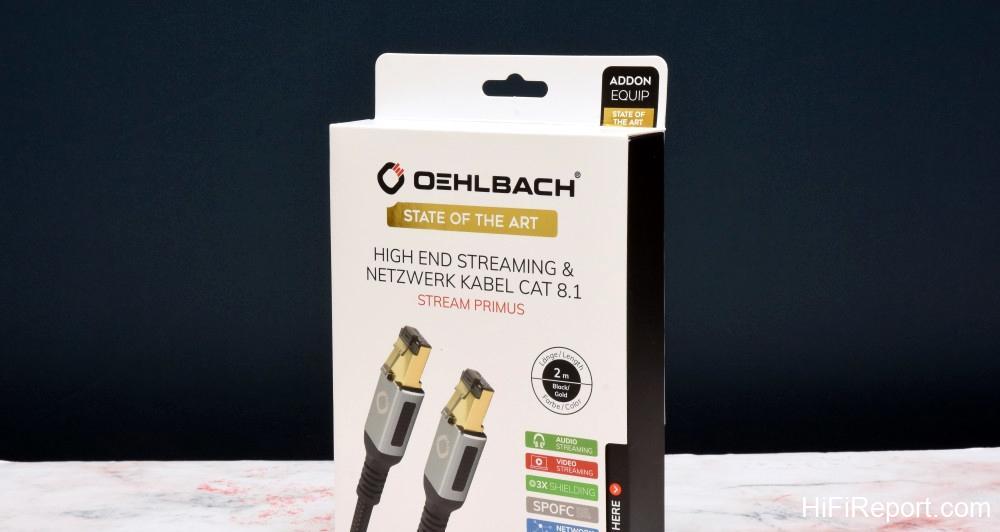
Recognizing the paramount importance of network cables for AV systems, Oehlbach treats them with the same reverence typically reserved for audiophile-grade audio cables. The Stream Primus, featured in this review, represents their flagship offering, belonging to the elite State of the ART product line.
Oehlbach’s product description labels it a “High End Streaming Network Cable Cat 8.1,” clearly positioning it as a high-end solution tailored for streaming and conforming to the cutting-edge Cat 8.1 standard.

Design and Build Quality
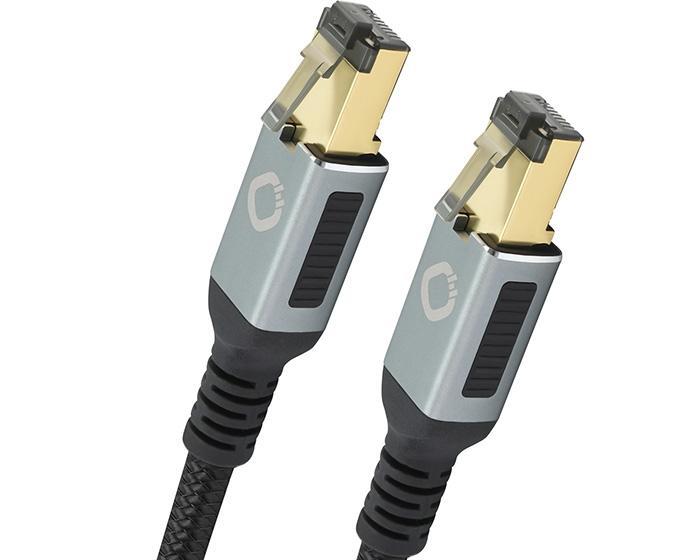
Unlike ordinary network cables that employ basic copper conductors, the Stream Primus utilizes a foundation of oxygen-free copper (OFC) with a silver plating on the surface. This construction method is typically found only in high-end audiophile cables, suggesting its potential for sonic improvement even before listening. The conductors are configured as twisted pairs, further enhanced by triple shielding comprising one layer of aluminum foil and two layers of copper braid.
This sophisticated shielding ensures not only excellent conductivity but also superior immunity to interference. For the connectors, 24K gold-plated plugs are employed, prioritizing performance and reliability—a design feature not commonly seen on standard IT network cables.
With this level of meticulous engineering, the Stream Primus naturally fulfills all the requirements of the Cat 8.1 specification, capable of handling data transmission speeds up to 40 GBit/s. The Stream Primus is available in multiple lengths. Oehlbach’s official website lists options including 0.25m, 0.5m, 1m, 2m, 3m, 5m, 7.5m, 10m, and 15m. The cable uses the ubiquitous RJ45 connector, ensuring backward compatibility with Cat6, 6A, 5, and other network equipment.
These design choices ensure the Stream Primus offers maximum versatility, supporting today’s demanding music streaming, video streaming, gaming, and various other applications.
Audio Performance
Turning to the listening experience, the unit tested here was the 2-meter version. I first assessed the sonic differences using front-end equipment including a Luxman NT-07 streaming transport, paired with our reference speakers to form a streaming music system. I began by listening through a standard network cable, then switched to the Stream Primus for an immediate A/B comparison. This direct comparison revealed a significantly noticeable improvement in sound quality.
For instance, when playing Mozart’s String Quintets K.515 & K.516 from the Qobuz streaming platform, an album featuring multiple instruments playing simultaneously, switching to the Stream Primus elevated the resolution and texture of each individual instrument. The cello gained a noticeably stronger sense of bow-on-string texture, while the violin became more soaring and delicate, with a distinct increase in perceived detail.
Simultaneously, the sound felt cleaner, and image localization became more precise. There was a heightened sense of transparency into the performance space, allowing for effortless identification of each instrument’s position. Crucially, this wasn’t limited to left/right placement; there was also a clear difference in front-to-back depth, indicating that a more distinct, three-dimensional soundstage emerged behind the speakers.
Throughout this experience, the Stream Primus exhibited no discernible negative side effects or sonic coloration. Instead of adding artificial flavor, it enhanced the music’s resolution, sharpened the delineation of sonic outlines, and made the performance feel richer and more intricate.
Given the Stream Primus’s excellent ability to reveal detail, I sought out a piece rich in intricate textures. I played Fink’s live performance of “Perfect Darkness.” This track inherently possesses a strong sense of live atmosphere, which I anticipated would be captivating with the Stream Primus. The cable did not disappoint. Upon swapping cables, the increase in detail was immediately apparent.
Whether it was the murmur of the live audience, the instruments, or the vocals, everything felt imbued with a greater wealth of information. Even better, I also noticed a subtle increase in body. Both the striking of the drumsticks and Fink’s voice acquired a slightly thickened, more rounded, and more elastic quality, making the entire track sound more engaging. Throughout this, the overall balance remained unchanged; the presentation was still very neutral, devoid of noticeable coloration.
Next, I tried something with more complex layering: Saint-Saëns’ *Danse Macabre*, performed by the Montreal Symphony Orchestra. The piece begins with a quiet, slow introduction, during which many background noises from the venue are audible, such as the clear stirrings of the audience. With the Stream Primus, these sounds became more numerous and nuanced, heightening the sense of being present at the performance.
The violin entering shortly after also exhibited a different texture—not only finer but also possessing better body. By comparison, the violin through the reference cable sounded somewhat drier. When the string section entered, they produced remarkably harmonious phrasing. Even when multiple string sections played together, it was possible to clearly distinguish the performance of each group; they layered and blended but remained clean and distinct, without any blurring or ambiguity.
As the piece built to its climax, it showcased significant dynamic range, delivered with potent energy.
Video Performance
Having completed the audio evaluation, I also tested its performance with streaming video. I directly connected the Stream Primus between my router and a Sony 4K OLED television, using this simple, direct path to minimize potential interference. I then compared the difference between this cable and a reference cable.
The differences in video quality were less dramatic than those observed in audio, but careful, focused viewing revealed subtle distinctions, primarily in contrast and color. With the Stream Primus, highlights appeared brighter, and shadows deeper, increasing the overall contrast. This enhanced contrast contributed to a better sense of three-dimensionality and surface texture in objects. Colors also seemed slightly more saturated.
The combination of these factors made the image more visually captivating. While there wasn’t a sense of details appearing out of nowhere, subtle nuances seemed to capture the eye’s attention more effectively. However, overall, the most significant change was still in the audio. Throughout the video viewing, the television’s speakers kept reminding me that the sound had changed. I believe even an inexperienced listener would notice the audio improvement.
Conclusion
After a comprehensive round of testing, I confirmed that the Stream Primus is indeed an excellent companion for the streaming AV era. Compared to common network cables, it delivers superior audio and video performance. Notably, it provides a neutral, beneficial uplift to the sound, allowing you to hear cleaner, more refined details while slightly enhancing body and density. This makes streaming audio and video significantly more engaging. Investing in it is undoubtedly a worthwhile decision.
Specifications
* Supported Standards: 10Base-T, 10GBase-T, 25GBase-T, 40GBase-T, 100Base-T, 1000Base-T, RJ45 – Twisted Pair
* Color Scheme: Black/Gold
* Inner Conductors: SPC/OFC Silver-plated high-purity oxygen-free copper
* Shielding: Triple shielding (one layer aluminum foil, two layers copper braid)
* Cable Cross-section: Round
* Length Tested: 2 meters