
Optoma CinemaX D2+ Review
Optoma’s 4K laser TV for this year, the CinemaX D2+, marks a significant upgrade in smart features and gaming performance compared to its predecessor, the P2. Optoma has positioned this laser TV squarely in the Android TV ecosystem. To achieve this, they’ve partnered with HAKO, a smart TV box brand, including a bundled HAKO mini smart TV box that connects via HDMI. This brings officially certified Google Android TV services to the CinemaX D2+.
Smart Features and Android TV Integration
This integration means you’re not limited to watching streaming platforms like Netflix, YouTube, Disney+, prime video, and AppleTV. Just like a standard smart TV, you can download various apps from the Google Play Store. Plus, you get built-in Android TV features like Chromecast and Google Assistant. This approach to smart functionality should undoubtedly make Optoma’s laser TVs more aligned with consumer expectations for usability.
Enhanced Gaming Performance
Beyond laser TVs, Optoma has also significantly ramped up development efforts in gaming projectors over the past few years. Popular models like the UHD33, UHD35+, UHD55, and UHC50 are known for supporting high refresh rates up to 240Hz, paired with ultra-low input lag. This is designed to provide gamers with fluid motion and highly synchronized control inputs, even on a large projected screen.
Given that laser TVs are increasingly seen as direct replacements for traditional flat-panel TVs, the likelihood of users connecting game consoles is higher. Consequently, Optoma has transplanted the gaming performance prowess from their dedicated gaming projectors onto the CinemaX D2+.
In the enhanced gaming mode (supported only on HDMI 1), the input lag is a mere 16.9ms at 4K/60Hz and an incredibly low 4ms at 1080p/240Hz. This means when you connect your game console and game at 1080p/240Hz, you’ll experience perhaps the best input lag performance currently available in the laser TV market. Whether you’re into racing, sports, or first-person shooters, you’ll get a gaming experience where commands and on-screen actions feel instantly connected.
Core Projection Capabilities
Let’s circle back to the core projection capabilities of the CinemaX D2+. It utilizes the same 4K DLP display technology as the P2, combined with a laser light source rated for up to 30,000 hours in Eco mode. It also features a sealed optical engine with an IP5X dust-resistant rating. This design significantly reduces maintenance costs and carbon emissions while providing users with a long-lasting, eco-friendly viewing experience.
The projector maintains a light output of 3000 lumens. When using dynamic aperture, the projector automatically controls the lamp power output and adjusts for optimal grayscale based on scene changes, achieving a dynamic contrast ratio of 1,800,000:1. HDR support includes both HDR10 and HLG formats. Paired with an ambient light rejecting (ALR) screen, the D2+ can deliver bright and clear 4K images even in rooms with some ambient light.
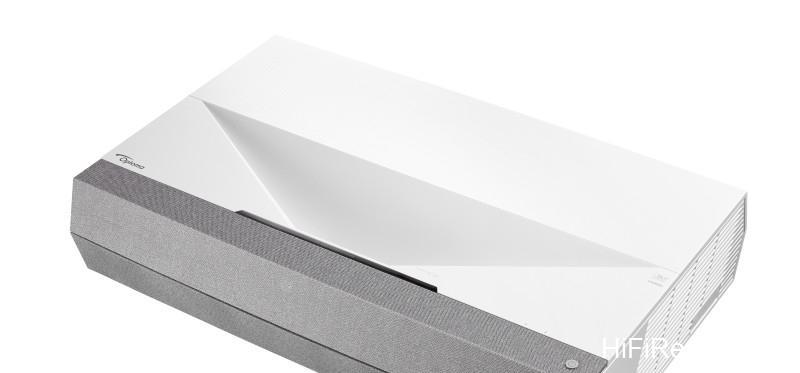
Lens, Setup, and Physical Features
The lens offers a 0.25:1 throw ratio, allowing for a 100-inch image from a distance of about 30cm (approx. 12 inches) from the screen. As with previous laser TVs, the CinemaX D2+ allows for focus adjustment via the menu, simply by pressing the left/right buttons on the remote. The PIR sensor found in earlier generations is also retained; it automatically reduces the laser light intensity when it detects an object approaching, protecting eyes from direct exposure to the strong light.
In the early days, adjusting the image on ultra-short throw projectors could be quite cumbersome. However, manufacturers have worked hard to design features that make screen adjustment easier for laser TVs targeting the home market. Before using the CinemaX D2+, you’ll place it on a level surface in front of your ALR screen. You can adjust the projected size by moving the unit forward or backward.

The CinemaX D2+’s feet are also adjustable (rotatable and height-adjustable), allowing you to make horizontal corrections depending on the placement. Furthermore, the projector includes features like four-corner correction and horizontal/vertical keystone correction, making the setup process even more convenient. Like the P2, it also supports 3×3 grid curved surface adjustment, adding value by enabling use on various non-flat projection surfaces.
Picture Quality and Color Performance
Optoma projectors are known for their distinctive color tuning style. They often leverage the characteristics of the color wheel to enhance the red spectrum, resulting in vibrant images with a rich red base. This style has been consistent across their home theater projectors and previous P1 and P2 laser TVs, and the CinemaX D2+ is no exception. Its 3000-lumen output, when used with an ALR screen, creates a very clear picture even in normally lit rooms.

The colors are not only highly discernible, but transitions in color gradients and light/shadow are also rendered with remarkable clarity.
My own measurements show the CinemaX D2+’s color gamut (in Cinema mode) closely matches the standard Rec.709 range, with a particularly wide display range for reds. This translates directly to the actual image. When displaying scenes with red flowers, red fruits, or palettes with many red tones, you can observe incredibly subtle variations in shade and intensity.

Combined with the precise resolution of 4K, which restores tiny details like water droplets or surface fibers, and the solid imaging of DLP, the picture gains a strong sense of dimensionality and realism.
This color style also provides an excellent viewing experience for dramas and movies. Simply using the projector’s standard color temperature setting, you’ll notice a warm tone to the image. Characters, vehicles, furniture, trees, plants, and the blue sky in the scene are rendered with rich, saturated colors. If you prefer higher brightness or better contrast for movies and shows, you can enable HDR mode to enhance various aspects of the image performance.

Furthermore, like several of Optoma’s gaming projectors, the CinemaX D2+ boasts high refresh rates and low input lag. When gaming, you can combine the picture quality described above with fluid motion and extremely low latency to enjoy fast-paced gaming visuals. Overall, whether you’re catching up on shows, watching movies, or playing games, the CinemaX D2+ can meet your various home entertainment needs.
User Experience and Conclusion
Observing the performance improvements in the CinemaX D2+, it’s clear that Optoma has a strong understanding of how consumers use smart projectors. While they had successfully developed their own smart TV system in the past, to make laser TVs more accessible and usable like traditional TVs, the CinemaX D2+ adopts a new Android TV service architecture. Simultaneously, they’ve optimized gaming motion and input lag.

The goal is simple: they want you to be able to use this laser TV just like a television, enjoying the high-quality large screen it provides for a better overall user experience.
Specifications
* Type: 4K DLP Ultra Short Throw Projector
* Resolution: 3840×2160
* Light Source Type: DuraCore Laser
* Light Output: 3,000 ANSI Lumens
* Contrast Ratio: 1,800,000:1
* Light Source Life: 30,000 hours (Eco mode)
* Color Display: 10bit
* Throw Ratio: 0.25:1
* Lens: F=2.04, f=525mm
* Keystone Correction: Vertical ±10° / Horizontal ±10°
* Digital Zoom: 80% – 200%
* Terminals: HDMI×3 (HDMI 1 supports eARC), USB-A×1, RJ45×1, S/PDIF×1, Audio Output×1
* Speakers: 10W×2
* Picture Modes: Cinema, HDR, HLG, HDR SIM., Game, Standard, Bright, User, 3D
* Unique Features: Bundled HAKO mini smart TV box for genuine Google authorized Android TV services, Supports 240Hz@1080p / 60Hz@4K refresh rate, 4ms ultra-low input lag
* Dimensions: 576×383×115mm (WHD)
* Weight: 8.4 kg