
Pegaso Audio P50A Integrated Tube Amplifier Review
Pegaso Audio, a fresh name in the Hi-Fi world, was established in Italy in 2017. Despite its youth, Pegaso Audio’s design pedigree is far from inexperienced.
Pegaso Audio is part of the AF Group SRL, which also owns Audio Analogue, a brand known for its solid-state amplifier designs. Building upon the existing design expertise and market presence of Audio Analogue, Pegaso Audio was created with the addition of tube specialists. This new brand focuses solely on tube amplifiers, a strategy that differentiates it from Audio Analogue while streamlining its product line. This dual-brand approach allows them to cater to both the solid-state and tube amplifier markets, aiming for a mutually beneficial outcome.
Currently, Pegaso Audio’s lineup features a single, standout product: the P50A integrated tube amplifier, boasting a practical 50 watts of power.
The Winged Horse from Tuscany
The Pegaso Audio logo, besides the Pegaso name, features a winged horse. What is the significance? “Pegaso” is the Italian word for Pegasus, a symbol of Tuscany. Since Audio Analogue originates from Tuscany, the new brand’s name, Pegaso, not only evokes the rich cultural and artistic heritage of the Renaissance but also symbolizes vitality and freedom, suggesting that the brand has the power to break free from constraints and deliver a distinctive listening experience.
The P50A’s design departs significantly from the traditional tube amplifier aesthetic. Without prior knowledge, one would easily mistake it for a solid-state amplifier.
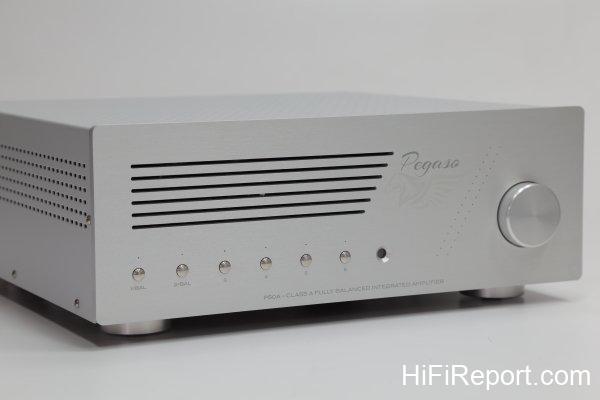
This is because the P50A cleverly conceals components typically exposed in tube amplifiers – the power transformer, output transformers, and tubes – within a meticulously crafted metal chassis perforated with small holes.
The front panel of the P50A features six source selector buttons and a large volume knob. However, a power switch is nowhere to be seen. To maintain the minimalist design, the P50A integrates the volume knob and power switch. A single press of the knob initiates the power-on sequence, and the amp. powers down when the button is held for about 5 seconds.
Two rows of LEDs, angling upwards from left to right to the left of the knob, display the volume level, allowing for easy visibility from a distance.
The P50A offers six inputs, including two XLR balanced inputs and four RCA single-ended inputs, selectable via the six buttons on the left side of the panel. Input 3 (RCA) can be set to bypass mode, bypassing volume control, and seamlessly integrating the stereo P50A into a home theater multi-channel system.

Adding to the convenience, the P50A comes with a full-function, high-quality, all-metal remote control that controls all aspects of the amplifier.
Four Volume Adjustment Modes
To ensure optimal pairing with speakers of varying efficiency, the P50A includes a handy feature: four volume adjustment modes (Volume Scale). These modes differ in the slope of the volume increase curve.
What’s the purpose? Mode One, the factory default, is suitable for speakers with typical efficiency. It features a steeper gain in the initial range, a design choice that suits the user’s listening habits.
Mode Two is better suited for high-efficiency speakers. This mode provides a gentler volume increase from the initial to the mid-range, the curve only becoming steeper at high volume.
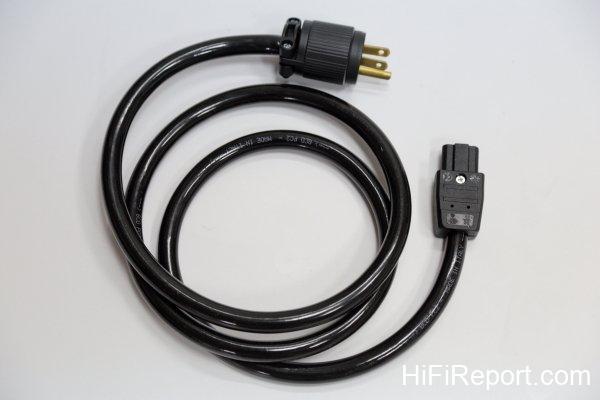
Mode Three caters to those who prefer listening at medium volume levels. Its mid-range volume increase is more gradual, allowing for smooth, meticulous adjustments within this range.
Mode Four presents a uniform slope throughout the entire range, accommodating users with specific needs.
Additionally, the P50A allows for left and right channel balance adjustment, offering a comprehensive set of features.
Now, let’s explore the internal design.

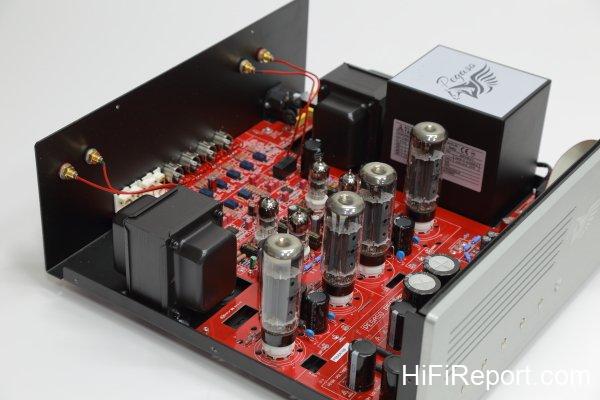
The P50A integrates all components except for the control circuitry onto a single, large, eye-catching red circuit board that occupies all the space inside the chassis, except for the transformer.
The power transformer is encased in a square metal shell to minimize magnetic leakage and interference. With premium parts throughout, the quality is obvious..
The circuit design of the Pegaso is elegant in its simplicity. Essentially, the preamp section handles only input selection and volume control, without gain. The power amplification section utilizes four ECC88 signal tubes and four KT90 power tubes, forming a fully balanced push-pull circuit that delivers a robust 50 watts of output power per channel.
Furthermore, Pegaso emphasizes that audio-grade components and durable parts are used in critical areas of the P50A, such as audio-grade capacitors and large military-grade through-hole resistors. This not only enhances sonic performance, but also ensures prolonged lifespan and reliability, even under high-temperature operating conditions.

The Appeal of Natural Beauty
The listening tests were conducted in the HiFiReport listening room, paired with a North Star Design USB DAC32 and Dynaudio Contour 60 speakers. The source was a Windows laptop.
You might wonder if the P50A’s 50 watts of power is sufficient for speakers as large as the Contour 60s. Based on my extensive experience with the Contour 60s, they are not difficult to drive. Unless deliberately pushing the limits of driving power, most amplifiers paired with the Contour 60s achieve excellent results. This held true for the P50A, delivering outstanding performance in high and low-frequency extension, low-frequency imaging, stability, liveliness, and soundstage layering, showcasing its impressive driving capabilities.
However, one aspect requires attention during setup: proper ventilation.
The components of the P50A are enclosed within the chassis, and the heat generated by the tubes during Class A operation can only dissipate through the chassis and its perforations. Therefore, ample airflow around the amplifier is crucial. It is highly recommended to place the P50A on an open shelf, avoiding enclosed cabinets.

Regarding sound performance, the P50A leaves a lasting impression of refinement, brilliance, clarity, and prominence, a stark contrast to its simple and understated exterior.
For instance, when playing the album “Some Other Time” by cellist Zuill Bailey and pianist Lara Downes, featuring works by Bernstein and Samuel Barber, the cello and piano shimmered with a beautiful gloss. The sound was transparent and clean, with a crystalline quality, akin to finely polished jade..
Importantly, the refined and beautiful timbre of the P50A is not artificially crafted but possesses a natural beauty with a sense of authenticity, captivating the listener more and more with each listen.
Another major advantage of the P50A is its clear imaging. This made the cello and piano sound small and precise, with ultra-sharp and prominent outlines. As a result, the separation between the two instruments was exceptional, and the soundstage was both deep and expansive, demonstrating the strengths of tube amplification.
An Addictive Performer
The P50A’s high-frequency performance is exceptional. The mid and low frequencies also boast excellent quality, though the quantity is not overly abundant. By avoiding excessively wide speaker placement, a satisfying fullness and low-frequency quantity can easily be achieved.
Using track 2, “Did Trouble Me,” from the test disc “The Dali CD Volume 4” as an example, Tom Jones’s chest resonance, while not particularly thick, possessed a dense texture, a clear outline, rich vocal nuances, and distinct variations in vibrato, seemingly with an endless supply of detail.
This track also revealed the P50A’s excellent low-frequency control.
Facing the Contour 60’s two 10-inch woofers, the double bass plucks and bass drum kicks produced clear imaging and trajectories, without any signs of muddiness or smearing. The low-frequency downward extension felt natural and effortless, free from bloating or premature decay, resulting in a stable and lively musical presentation.
Furthermore, I heard a correct balance between different instruments and different frequency ranges, giving the entire soundstage a well-defined form. All of this highlights that despite being the brand’s debut product, Pegaso’s design capabilities are far from novice.
Moving on to the Ebene Quartet’s album of works by Ravel, Debussy, and Fauré, the P50A’s clean and elegant sound gave me the impression of listening to a single-ended tube amplifier. The soundstage was deep, with the four instruments clearly positioned behind the speakers, allowing me to easily “pinpoint” each one. Such separation and localization deserve nothing less than praise. If you’re a soundstage enthusiast, the P50A will undoubtedly satisfy you.
However, when matching components, it’s worth noting that the P50A’s timbre is relatively firm, and its line delineation is slightly sharp. It’s recommended to choose speakers or cables that are softer, more relaxed, or warmer in tone to achieve a more mellow and enduring sound.
Like Audio Analogue, the Pegaso P50A, also from Tuscany, Italy, possesses a dazzling brilliance and an outstanding expressiveness that immediately captures your attention, making you instantly addicted.
Specifications
* Type: Vacuum tube integrated amplifier
* Output Power: 50 watts
* Tubes: ECC88 × 4, KT90 × 4
* Input Impedance: 100k ohms
* Frequency Response: 10Hz – 100KHz (0.5dB/1W)
* Signal-to-Noise Ratio: 83dB
* Total Harmonic Distortion: 0.3% (10W)
* Inputs: XLR × 2, RCA × 4
* Dimensions: 455 × 175 × 472 mm (W × H × D)
* Net Weight: 26 Kg