
Pioneer VSX-935 Review
Many consumers new to home theater, often constrained by limited listening space and budget, typically start with a soundbar. However, I’ve seen many players discover after purchasing a soundbar that the audio performance doesn’t meet expectations. Take a friend of mine, for example. He recently bought a new digital TV and finally experienced the power of streaming content from services like Netflix and Disney+.
Not only is there an endless amount of movies and shows, but many films now offer Dolby Atmos audio formats. His old soundbar’s virtual surround sound couldn’t satisfy his needs anymore, prompting him to consider upgrading to an AV receiver.
As a budget-conscious enthusiast, his primary consideration was, of course, price. Second, the receiver needed to support the Atmos audio format for streaming media. Given his limited space, he also wanted a virtual soundfield function to compensate for not being able to install height speakers currently. Beyond watching movies and shows, he also enjoys gaming and hoped the receiver’s video processing could meet the demanding standards of high-quality, low-latency gaming.
An entry-level AV receiver fulfilling these requirements might have seemed like a pipe dream in the past. However, home theater enthusiasts know that the AV receiver market is an endless specification war; entry-level models only get more powerful in features and more affordable in price.
Meeting Modern Home Theater Needs
For instance, the Pioneer VSX-935, an entry-level model I’m reviewing here, perfectly meets his needs. It not only boasts standard 7.2-channel Atmos theater specifications but also offers extensive streaming support and top-tier 8K video capabilities, fully addressing the audio-visual demands of modern consumers.
For newcomers, this allows them to experience the rich functionality and audio charm of an AV receiver with a minimal budget.
The VSX-935 is positioned as a high-end model within Pioneer’s entry-level AV receiver series, sitting above the VSX-535. This series is below the “LX” series, which we recently reviewed, and is more budget-friendly. This unit supports 7.2-channel output and audio formats like Dolby Atmos and DTS:X, allowing for the construction of a standard 5.1.2 channel Dolby Atmos theater system.
If installing height speakers is inconvenient at home, you can use its Dolby Atmos Height Virtualization virtual soundfield function to simulate the three-dimensional effect of Atmos sound from conventional flat-plane channels. Furthermore, the Zone B function allows you to connect another pair of speakers for music sharing purposes.
When watching two-channel music videos on YouTube, you can also use its DTS Neural:X function to upmix older audio formats like 2.0 or 5.1, “making all speakers produce sound,” thus providing better utilization of your theater system.
Comprehensive Video Capabilities
Regarding video, the VSX-935 is equipped with 6 HDMI inputs and 2 outputs, three of which are HDMI 2.1 compliant, supporting 8K/60P and 4K/120P passthrough. It also supports high dynamic range formats like HDR10, HDR10+, HLG, and Dolby Vision. It features Ultra HD video upscaling, capable of upconverting 1080P to 4K or 4K to 8K video.
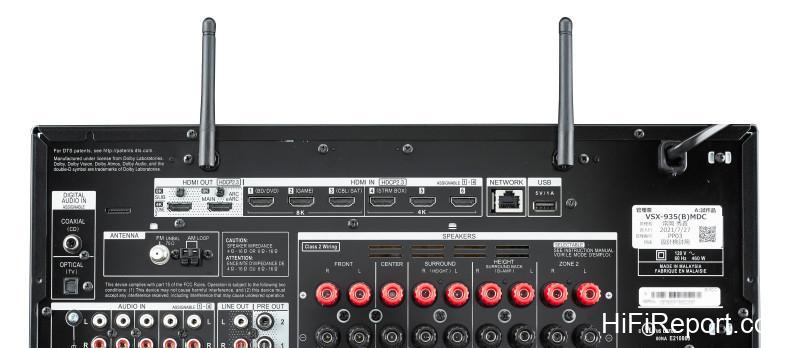
The HDMI outputs also feature eARC audio return functionality, ensuring full compatibility when watching multi-channel Dolby Atmos audio provided by streaming platforms like Disney+ and Netflix. For gamers, the VSX-935 includes several game-related video features such as Variable Refresh Rate (VRR), Auto Low Latency Mode (ALLM), and Quick Frame Transport (QFT), which reduce input lag and stuttering, providing a smoother gaming experience.
User Experience and Advanced Calibration
You might think that entry-level AV receivers generally offer similar levels of support, but Pioneer makes me feel this one is particularly good value. Firstly, it provides a better user experience. The VSX-935 shares the same setup interface as higher-end models. Everything from channel configuration to level and crossover adjustments is displayed with beautiful graphical representations, making it very intuitive and pleasant for even beginners to use.
Furthermore, its supported MCACC automatic room calibration is more sophisticated than that of other AV receiver brands. It can precisely analyze the relative positions of speakers and perform functions like “Auto Phase Control,” “Subwoofer Equalization,” and “Multi-Point Standing Wave Control” to correct the speaker’s full-range response and phase differences. The resulting audio precision and transparency are beyond what typical entry-level receivers can achieve.
Extensive Streaming and Connectivity Options
The advantages of Pioneer AV receivers don’t stop there. They can be operated with the proprietary Pioneer Remote App, allowing full control and access to rich streaming music features without needing the remote control. Like the VSX-935, it supports Chromecast built-in and AirPlay 2, enabling you to mirror and stream music or videos from your mobile device to the AV receiver.
It also features powerful DTS Play-Fi functionality, allowing playback from various streaming platforms like Tidal, Spotify, and internet radio stations, all controllable via the app. If you have music collections on your PC or NAS, you can also play music from these devices via UPnP/DLNA.
In environments without network access, it can connect to a USB flash drive to play music. The built-in decoder supports high-resolution files up to PCM 192kHz/24bit and DSD 11.2MHz. Finally, the VSX-935 also features bidirectional Bluetooth with aptX HD high-quality transmission, allowing you to play music directly from your phone and also transmit audio to Bluetooth speakers or headphones.
Wired headphones can also be connected to the 6.3mm headphone output on the front panel, covering almost all methods of listening to music.
Internal Design and Power Output
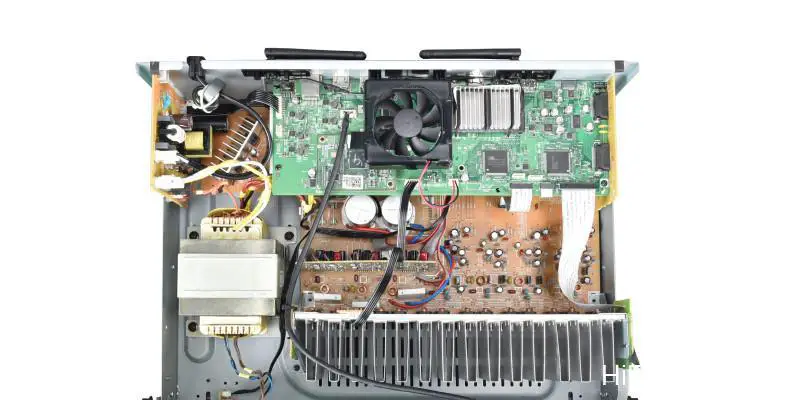
The circuit structure of the VSX-935 essentially inherits designs from higher-end models. Firstly, an EI transformer and two filter capacitors are responsible for powering the audio circuits. Additionally, a separate switching power supply powers secondary components like video processing and the display screen, implementing the consistent power separation design found in AV receivers.
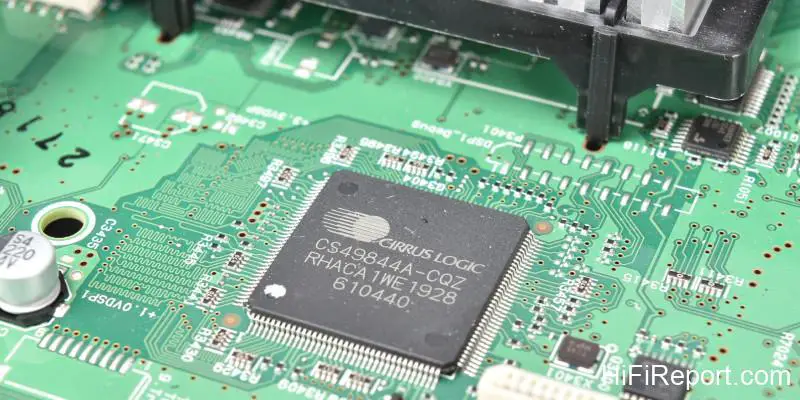
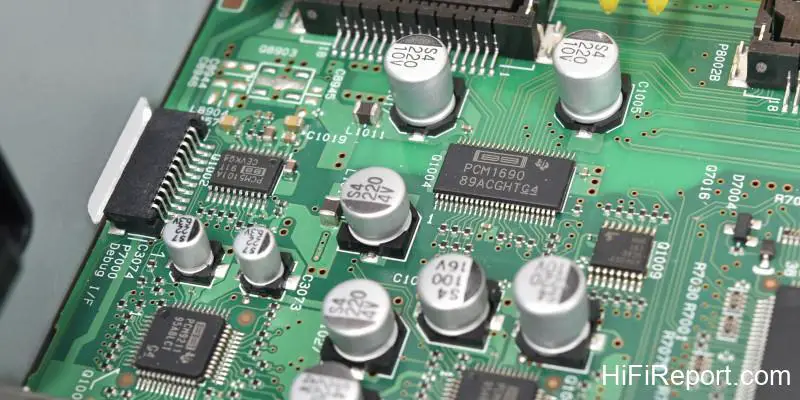
Downstream from the power supply, the main board features a Cirrus Logic CS49844A 4-core 32-bit DSP chip, responsible for audio upsampling, MCACC room calibration, and digital upscaling.
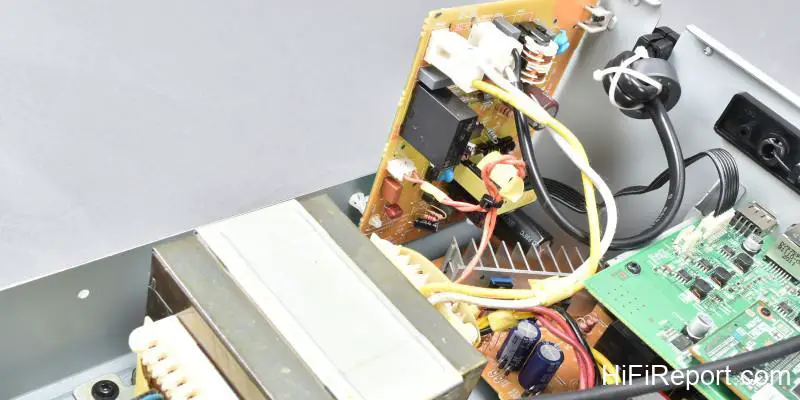
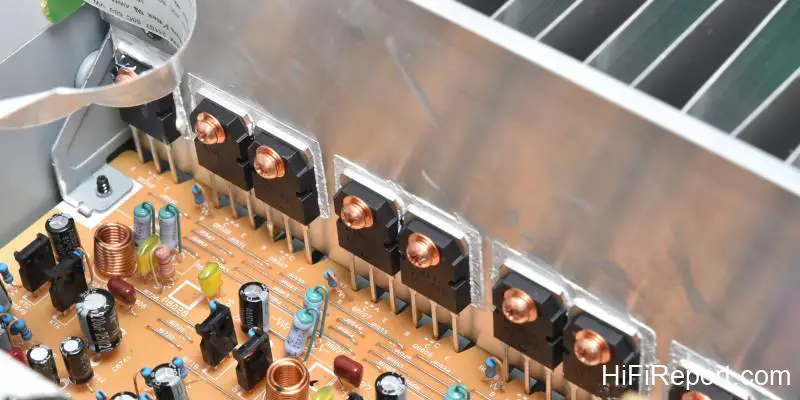
The digital-to-analog conversion section utilizes a 24-bit 8-channel Burr-Brown PCM1690 DAC chip for the main channels and a Burr-Brown PCM5101A for the secondary channels’ DAC conversion. Reaching the bottom layer, the amplifier circuit, this unit employs Pioneer’s renowned Direct Energy technology. The Class A/B amplifier circuit features a pair of discrete power transistors per channel and includes a large heat sink to ensure stable operating efficiency of the amplifier circuit.
It still delivers 80 watts per channel (8 ohms, 2 channels driven), which, while not exceptionally powerful, reaches a peak power of 170 watts in mono configuration. This is sufficient to drive most small to medium-sized theater speakers and produce ample dynamic effects.
Music Listening Performance
For the actual testing, I first located the unit using the Pioneer Remote App and then played the Tidal streaming service through the App. The experience was smooth and intuitive. Initially, I set the AV receiver to Pure Direct mode for listening. From the sound signature of the VSX-935, it’s evident that Pioneer’s entry-level models are increasingly aligning with their high-end counterparts.
Although this unit might lack some of the solidity in sound density compared to higher-end models, its sound quality still aims for a direct, low-coloration target. Compared to most budget theater-oriented AV receivers, the sound has less artificial enhancement and can more faithfully reproduce the original flavor and beauty of the music itself.
Playing “Birds” from Canadian soul singer Dominique Fils-Aimé’s album “Nameless,” I could discern the unit’s excellent dynamics. The double bass at the beginning had a solid texture, and the transients were sharp, completely free from any blurring or bloating. The musical background was also quite quiet, which made the details of vocals and instruments more distinct. The sense of the vocal image was very focused and appropriately sized, not overly expanded.
The song’s normally languid singing style felt much more energetic, with the nuances of lip, teeth, and throat sounds having a more prominent presence. The separation of harmonies was better, fully showcasing the delicate sound quality of high-resolution streaming music.
Multi-channel Movie Performance
Next, I connected a 5.1.2 configuration, using the company’s Pioneer Excellence multi-channel speakers for the five flat channels, Monitor Audio in-ceiling speakers for the height channels, and an SVS active subwoofer. The source was the company’s Sony A80J 4K OLED TV outputting via HDMI eARC.
First, I played the movie “6 Underground” from Netflix. In the opening car chase sequence, I could distinctly feel the movement of vehicles constantly weaving around me. When the helicopter flew overhead, its sound location was easily discernible without intense concentration, and the transitions between effects were quite natural. When encountering car crash scenes, the swift speed is this unit’s strong point.
Aided by the subwoofer, the dynamic effects felt controlled, delivering just the right amount of impact and weight. Even amidst a complex series of sound effects, the unit’s detail portrayal was commendable. I could hear the sounds of broken parts and scattered glass fragments flying towards me after a collision. The sense of positioning between different sound images was quite clear, without any feeling of clutter.
Similarly, watching the animated film “The Garden of Words” on Netflix, the unit’s sound details were notably fine. For instance, when the protagonist was drawing, the friction sound of the pencil, and the subtle sounds of footsteps while walking, were clearly reproduced. During the scene where the male and female leads take shelter from the rain in a pavilion, I noticed the unit’s excellent sense of space. Enhanced by MCACC, it created a more open and transparent scene for the movie.
As the heavy rain approached from the distant sky towards the listening position, it generated a sweeping sense of sound envelopment. The rain sound effects were also free from harshness or stickiness, exhibiting excellent separation, which is quite impressive for an entry-level unit!
Conclusion: High Value for Entry-Level
This VSX-935 offers refined sound and swift speed. When paired with a powerful active subwoofer, it simultaneously achieves both quality and explosive dynamics, providing an audio comprehensiveness rarely found in comparable theater systems. Furthermore, its neutral, low-coloration style allows beginners to hear more accurate sound quality with a reasonable budget. Whether you’re pursuing audio detail or accuracy, the VSX-935 is a high-value product that can both attack and defend.
Specifications
* **Type:** 7.2 Channel AV Receiver
* **Output Power:** 100W + 100W (8 ohms, 1 kHz, THD 0.08%, 2ch Driven)
* **Audio Formats:** MP3, WMA, AAC, ALAC, WAV, FLAC, AIFF, DSD
* **DAC Decoding:** PCM 192kHz/24bit, DSD 11.2MHz
* **Connectivity:** Speaker Terminals ×9, USB Terminals ×2, 6.3mm Headphone Output ×1, Subwoofer Output ×2, HDMI Terminals (6 In, 2 Out), Zone B Pre-out ×2, 2-channel Analog Input ×5 (including PHONO)
* **Digital Inputs:** Optical ×1, Coaxial ×1
* **Antenna Terminals:** FM/AM ×1 each
* **LAN Terminal:** ×1
* **Wi-Fi Frequency:** 5 GHz/2.4GHz
* **Bluetooth Version:** 4.2 (supports aptX HD)
* **Dimensions (W.H.D.):** 435×173×370.5 mm
* **Weight:** 9.6 kg