
Proton PT-WS168 Review
Taiwan boasts numerous brands producing wireless microphones today, many of which are internationally recognized manufacturers. When purchasing such products, consumers often gravitate towards these major players, seeking not just reliable quality but often a complete audio solution integrated by a system integrator. However, for the average consumer looking to buy a wireless microphone system for home use, challenges can arise.
High-end, professional-grade models, while excellent, are often overly complex and expensive, with intricate setup processes creating a high barrier to entry. Conversely, cheaper alternatives frequently lack essential features for practical application. Is there a balance point, a wireless microphone that offers both value and usability? Absolutely. This month, we’re introducing the Proton PT-WS168, an excellent example that fits this description.
Proton’s Vision for Home Karaoke
Following a brand integration effort in recent years, Proton has embarked on ambitious product development. They’ve launched multiple large-screen display series, aiming to recapture the international prestige their televisions once held. For the home karaoke market, they’ve actively developed products better suited for consumer use, including new types of companion speakers and a significant range of high-power, high-current amplifiers with excellent digital reverb effects.
The recently unveiled Proton PT-WS168, their first wireless microphone, completes the final piece of Proton’s karaoke kingdom puzzle.
The PT-WS168: Overview and Design
The PT-WS168 is a product priced at less than NT$20,000 (approximately $600 USD). For many other brands, this price point often buys you only a basic single-channel unit. However, the PT-WS168 is a fully featured dual-channel UHF wireless microphone system. It utilizes a standard 1U metal chassis, which is slim, sturdy, and easily rack-mountable in equipment cabinets. The system operates within the 626-698MHz frequency range and employs a dual-channel architecture for channel allocation.
Operation is remarkably simple: power on the receiver and transmitters (microphones), bring their infrared sensing areas close together, and frequency pairing is complete. While other brands require pressing a SYNC button, Proton uses contactless sensing – even more convenient.
Receiver Features
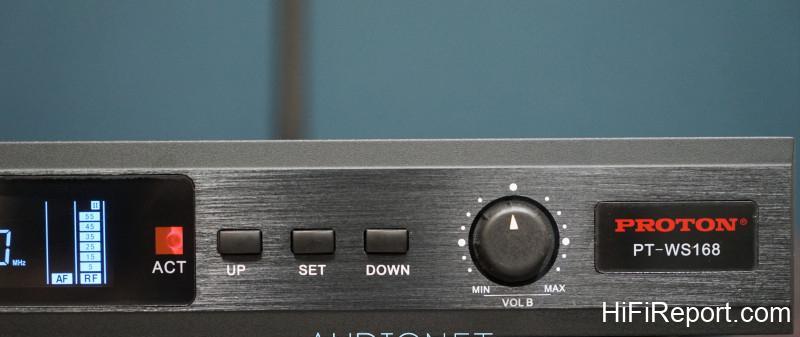
The unit’s automatic scanning function is also highly convenient. After powering on, simultaneously short-press the two “Down” buttons on the front panel, and the system will automatically scan frequencies to quickly find interference-free, usable channels. The two “Set” buttons on the front panel allow you to adjust EQ settings for each channel independently. Using the adjacent “Up/Down” buttons, you can fine-tune the treble and bass across 16 steps from -5 to +10.
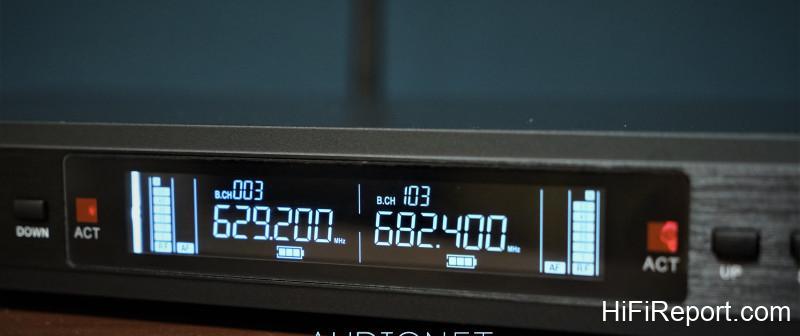
Each channel also features an independent volume knob for intuitive and convenient adjustment. All channel information and setting details are clearly displayed on the PT-WS168’s elongated LCD screen. Large digits make data easily legible, and electronic meters on either side allow you to monitor RF and AF signal strength at a glance.
Connectivity and Microphones
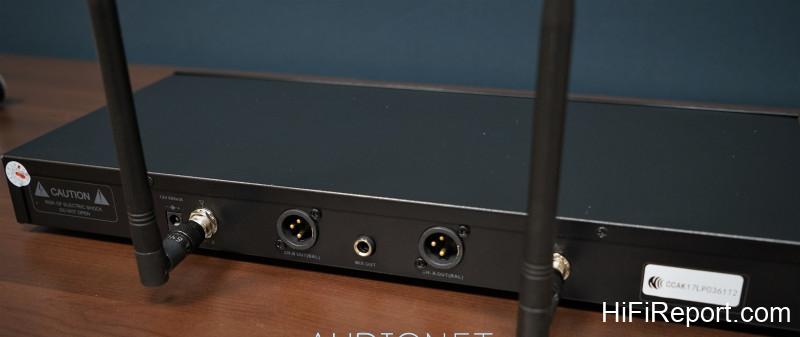
The rear panel layout is equally straightforward, featuring two TNC antenna connectors, a pair of XLR balanced audio outputs, and a central 6.35mm mixed audio output. This allows the wireless microphone main unit to connect to an amplifier or other digital mixing equipment. The overall design is minimalistic yet meets the needs of most applications. The PT-WS168 comes paired with two handheld microphones.
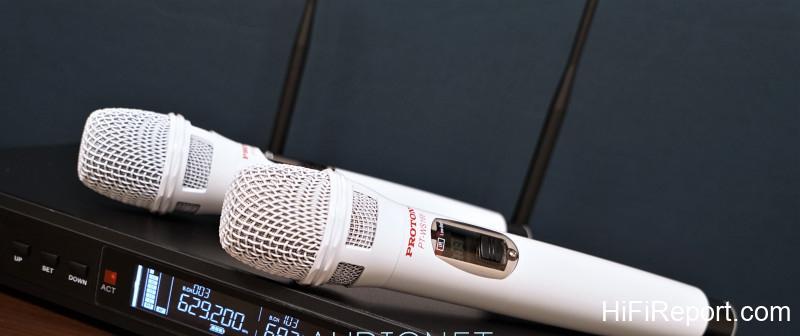
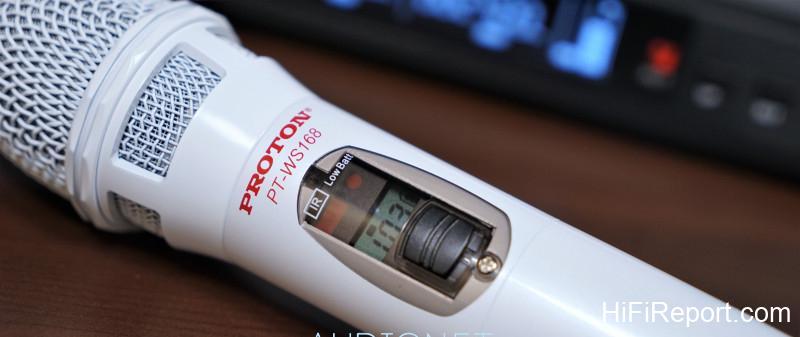
These microphones, featuring elegant all-white barrels, are not only visually appealing but also equipped with high-performance dynamic capsules. They offer high sensitivity and can reproduce a wide frequency range, faithfully rendering the unique characteristics of each person’s speaking or singing voice.
A mini LCD screen on the microphone body displays the paired channel information during operation, along with a battery level indicator, keeping you informed of the microphone’s remaining power.
Performance and Flexibility
Beyond its simple and intuitive operation, you’ll discover that this wireless microphone system delivers surprisingly strong performance in actual use. Whether speaking or singing casually, it produces a sound that is detailed, with clear sibilance and distinct vocal textures. Although the manufacturer doesn’t specifically highlight it, during my testing, I found the microphones’ anti-pop effect to be quite effective, and their low handling noise performance was also commendable.
This likely stems from the solid construction of both the metal grille head and the internal capsule structure. Naturally, if you have other microphone needs, the system can also be used with a bodypack transmitter combined with a lavalier or headset microphone, offering considerable flexibility in usage.
Conclusion
Compared to many well-known microphone brands on the market, Proton may be a relative newcomer, and currently, the PT-WS168 is their sole model in this category. However, upon using it, you’ll find that this seemingly simple wireless microphone delivers a very satisfying user experience for a highly competitive price.
Especially now, as home karaoke equipment increasingly emphasizes ease of use, the PT-WS168’s clear product characteristics allow for quicker integration with cloud-based karaoke systems and karaoke amplifiers. It offers the simplest way to set up and sing along to your favorite melodies.
Specifications
* Type: UHF Dual-Channel Wireless Microphone System