
PS Audio Aspen FR10 Floorstanding Speakers Review
What’s the easiest audio equipment to make? Arguably, it’s speakers. Even without circuit knowledge, mount drivers in a wooden box, connect them to an amplifier with wires, and you’ll get sound – perhaps even something listenable.
Conversely, what’s the hardest? Also speakers. Speaker design involves countless trade-offs and compromises. Crafting a speaker that excels in every aspect, striving for perfection, is truly an art form. Perhaps this is why PS Audio, a company with 50 years of experience building electronics, only recently introduced their first loudspeaker series – the Aspen range.
Proprietary Drivers
The Aspen series debuted roughly three years ago, starting with the imposing flagship, the Aspen FR30. This was followed by the near-flagship FR20, then the subject of this review, the smaller FR10 floorstander, and finally, the recently launched FR5 bookshelf speaker. The Aspen lineup was released from largest to smallest, hinting at technology trickling down from the top tier.
Visually, the FR10 maintains the design language established by the FR30, featuring a distinctive curved base supported by metal outriggers for floor coupling, resulting in a unique and avant-garde appearance.

Another eye-catching feature of the FR10 is its use of planar-magnetic drivers for both the tweeter and midrange, eschewing traditional cone designs. The tweeter is a 2.5-inch unit, while the midrange is 8 inches. This design mirrors the FR30 and FR20, albeit with different driver sizes.
PS Audio refers to these drivers as Teonex planar-magnetic diaphragms. They employ neodymium magnet structures on both sides of the membrane, using a symmetrical “push-pull” motion to directly drive the ultra-light, large-area diaphragm. This design ensures highly linear operation and avoids many issues associated with traditional cones, such as cone breakup, inductance modulation, and hysteresis distortion. According to PS Audio, Teonex planar diaphragms combine the speed of electrostatic drivers with the dynamics of cone drivers, achieving extremely low distortion and coloration for outstanding performance.
To ensure the bass keeps pace with the responsive mid and high frequencies, PS Audio developed a dedicated 6.5-inch woofer specifically for the FR10. This driver features a sandwich cone comprising non-woven carbon fiber and Rohacell foam, paired with an advanced Nomex spider and a robust cast frame, designed to withstand long excursions and high dynamics. To further reduce distortion, the woofer’s motor structure has a unique design optimized to lower linear inductance and extend bandwidth.

The FR10 incorporates two 6.5-inch woofers on the front baffle and three 6×9-inch elliptical passive radiators on the rear. This configuration allows the bass extension to reach down to 25Hz (-6dB).
Exquisite Cabinet Finish
The FR10’s cabinet is constructed from MDF with extensive internal bracing to minimize resonance. The front baffle is made from a high-tech thermoset glass-fiber and resin composite material, chosen for its high rigidity and excellent damping properties, further reducing vibration.
This composite baffle also serves a crucial function: it forms integral waveguides around the tweeter, midrange, and woofers, allowing for more controlled dispersion and frequency response, resulting in smoother sound. The magnetic grille design eliminates the need for mounting holes on the seamless front baffle, maintaining a clean and aesthetic look.
The FR10 is available in two finishes: Satin Black and Satin White. The paintwork involves up to twenty layers of hand-rubbed finish, resulting in a remarkably smooth and tactile surface that resists fingerprints.
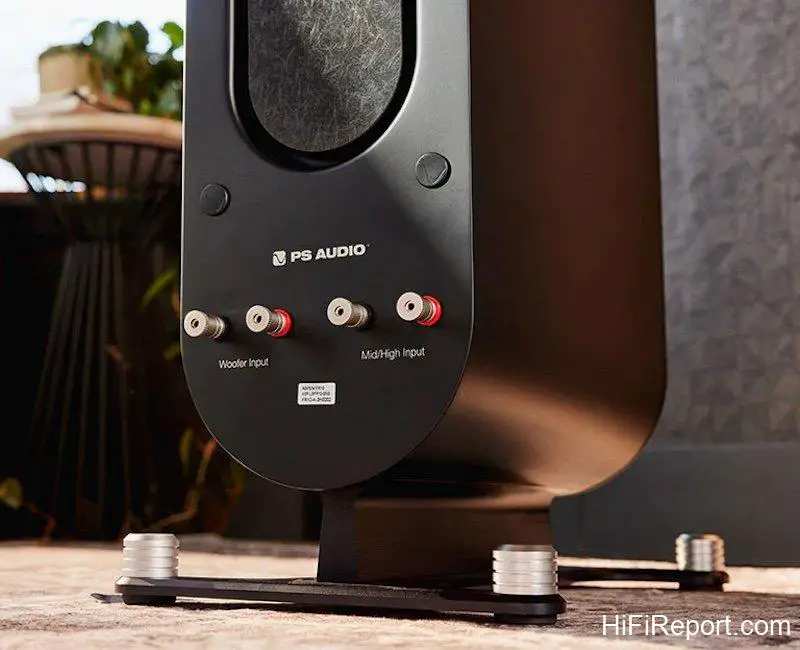
Thanks to its curved base and metal outriggers, the FR10 appears to float, giving it a surprisingly light visual presence, despite weighing a substantial 34 kilograms (about 75 lbs). To facilitate self-installation, even for online purchases (a necessity in vast countries like the US), PS Audio designed clever packaging that makes unpacking easy – no need to lift the speaker out of the box – and allows a single person to maneuver the speaker into position.
Another thoughtful design detail is the dual-purpose spikes. These combine stainless steel spikes and rubber feet. For carpeted or tiled floors, the spikes can be used directly. For wooden floors, the metal spikes can be removed, allowing the speaker to rest on the rubber feet to prevent scratching the floor.

Quality Speaker Jumpers Included
Regarding the crossover, the FR10 is a three-way design with a fourth-order crossover network. This precise approach minimizes overlap between driver frequency bands. Given the number of components in a fourth-order crossover, the FR10’s relatively modest sensitivity of 86.5dB is expected. A significant advantage is its stable impedance, averaging 4 ohms and dipping no lower than 3.3 ohms, making it relatively easy for amplifiers to drive.
The FR10 features bi-wireable speaker terminals, separating connections for the high and low frequencies, offering audiophiles the option for bi-wiring or bi-amping. For single-wire connection, PS Audio includes a set of high-quality wire jumpers, which look much more substantial than typical metal plates or rods, potentially saving users the need to purchase aftermarket alternatives.
Textural Clarity
The listening test was conducted in the HiFiReport listening room using equipment including a Rockna Wavelight Server, Rockna Wavelight DAC, Linear Acoustic LA V5 preamp, and Linear Acoustic LA 200 power amplifier. With an output of over 200 watts per channel into 8Ω, the LA 200 was a perfect match for the FR10’s recommended power handling of up to 200 watts.

Knowing the FR10 uses planar-magnetic drivers for both tweeter and midrange, I anticipated exceptional mid and high-frequency detail, but also potentially a somewhat thin sound. Listening to the FR10, however, proved this assumption wrong – it sounded quite substantial! For example, listening to Arrau playing Chopin Waltzes, I previously heard his touch as light and agile, with a bright and clear tone and relatively small piano image. Through the FR10, the piano notes gained more weight, the tone was warmer, adding depth, and the attack had more power. Crucially, the sense of transparency and clarity remained excellent. This newfound substance didn’t feel like added coloration; it came from the texture and detail within the music itself, meaning the recording’s nuances were being fully revealed, not obscuring the sound’s transparency.
I also noted that while the FR10 uses a planar tweeter, the high frequencies are slightly understated, which enhances the richness of the “wooden timbre” – a term I use to describe a certain resonant warmth and texture – making the tone quite captivating. Another noticeable characteristic is the generous image size. Instruments and voices are rendered with clear outlines and a larger-than-average presence, giving the piano, for instance, a more substantial and concrete scale.
Rich Detail Retrieval
The captivating tone made me want to listen to more piano recordings. Taking track 3, Bruckner’s “Fantasia in G Major,” from the 2017 Audio Show commemorative CD, the piece begins with a rhythmic left-hand accompaniment supporting the right-hand melody. Here, I heard the left-hand chords producing a rich “buzzing” quality – the sustain and resonance were more abundant than I’d heard before, with palpable image and positioning. This level of detailed presence was new to my listening experience with this track.

As the piece moved into the middle section, the rhythmic pattern shifted to the right hand playing high chords while the left hand carried the midrange melody. This is where I was struck by a rich “wooden timbre”! Naturally, I don’t mean an actual scent of wood, but rather that the midrange notes I heard weren’t overly crystalline or polished. Instead, they carried a wealth of resonance, giving the tone a textured quality, much like the grain on wood. Hence, my description of “wooden timbre.” This sound has hints of the British loudspeaker sound, but clearly without cabinet coloration – overall, it was both comfortable and deeply engaging.
Through this piece, I also discovered another strength of the FR10: its ability to reveal the subtleties of the recording venue, making the spatial atmosphere exceptionally clear. With the FR10, slow piano pieces featured extended sustain and clear, dense reverberation, building a distinct sense of space. This space wasn’t hollow, vast, or a typical stage perspective; instead, there was a tangible piano image presented in front, rendered at a considerable size, sounding very realistic. Simply put, the FR10 boasts outstanding detail retrieval, effortlessly presenting tonal textures and spatial ambiance.
Ample Bass Quantity
In terms of bass performance, the FR10 delivers a full, substantial quality that is also clear and layered. For example, in Karajan’s recording of “Thus Spoke Zarathustra” with the Berlin Philharmonic, the faint organ pedal note at the beginning was remarkably clear. Without needing to turn up the volume excessively, I could hear a distinct and steady bass line. As the brass, timpani, and strings entered, the bass layers were ideal, and the overall separation and positioning of the orchestra sections were excellent.

Similarly, in Myung-Whun Chung’s recording of Saint-Saëns’ Symphony No. 3 “Organ” (second movement) with the Orchestre de l’Opéra Bastille, again, without high volume, the FR10 easily reproduced a clear, firm organ bass line. The sound was deep and stable, with a clean quality and appropriate weight. The FR10 provides ample bass quantity and clear definition, which is quite an achievement for a speaker of its slim, tall stature.
While its absolute depth, subterranean presence, and effortless scale might trail speakers with larger drivers and cabinets, the FR10’s strength lies in delivering relatively high-quality bass from a compact size, benefiting users with limited space who cannot accommodate larger speakers.
Tight, Defined, Responsive Bass
The FR10 performs well with sustained bass, but how about its speed? I tested this with Hugh Masekela’s “Hope.” The drumming, bass, and percussion on this album are prominent and spectacular, and listening with the FR10 is highly enjoyable. The bass is full yet controlled, the kick drum has a large, well-defined image, and its punchy sound is both tight and powerful. The electric bass lines (yes, lines, not just notes) are clean, clear, and agile, sounding refreshingly crisp.

Furthermore, the FR10’s bass image is slightly larger, which is quite pleasing, but it remains very tight and focused, with good resolution. You can discern the texture and quality of the bass rather than experiencing a bloated or blurry sound. Thanks to the three elliptical passive radiators on the rear, the smaller front drivers do not limit the bass performance. The FR10 still delivers ample quantity, solid impact, quick and clean response, and clear bass details and texture. It offers a solution for achieving a very full sound using small drivers and a slim cabinet.
The large image size is another characteristic. Singers, lead instruments, accompanying instruments, etc., all have a larger presence, and the soundstage feels closer. Combined with a focused, almost visual soundstage presentation towards the center, the sound is very full, providing significant listening satisfaction. The FR10 is also well-suited for pop music due to its larger image, full sound, ample bass, and rich details in vocal sibilance and throat nuances. Its slightly warm tone makes songs sound even more appealing, especially when I later swapped the DAC for the tube-amplified Lampizator Big 7 MK3, which added even more richness and liquidity – listening to music became utterly captivating!
Deserves Careful Attention from Audiophiles
In practical use, I found the FR10 to be a sensitive speaker that deserves careful attention from audiophiles. It clearly reflects system changes and accurately reveals the characteristics of upstream components or cables. It’s also noticeably responsive to speaker placement adjustments, offering high tweakability.

If you’re not inclined towards system optimization and simply want to enjoy good music, the FR10 is still an ideal companion. It balances resolution with richness and responds to front-end equipment changes, making it a speaker you can live with for a long time. Moreover, considering its sonic output and bass performance, the FR10 is not overly large, fitting well into most living spaces. Its unique design also sets it apart from traditional speakers, easily integrating into modern or minimalist interior styles.
It’s clear that PS Audio, a 50-year-old audio brand, has successfully polished its reputation once again with the FR10. From now on, PS Audio isn’t just an expert in electronics; they are speaker experts too.
Specifications
* **Type:** 7-Driver, 3-Way, Passive Radiator Floorstanding Loudspeaker
* **Drivers:** 1 x 2.5″ Teonex Planar-Magnetic Tweeter, 1 x 8″ Teonex Planar-Magnetic Midrange, 2 x 6.5″ Non-woven Carbon Fiber / PMI Foam Sandwich Cone Woofers, 3 x 6×9″ Elliptical Passive Radiators
* **Crossover Points:** 550 Hz, 1.75 kHz
* **Sensitivity:** 86.5 dB
* **Impedance:** 4 Ohms (Minimum 3.3 Ohms)
* **Recommended Amplifier Power:** 50 – 200 Watts
* **Frequency Response:** 32 Hz-20 kHz (-6dB) half space, 25 Hz (-6 dB) in-room
* **Dimensions:** 41.5 × 8 × 16.25 inches (H×W×D, base width 11.75 inches)
* **Weight:** 34.1 kg (approx. 75 lbs)