
PS Audio Aspen FR20 Review
Who would have ever imagined this day would come, that PS Audio would launch their own loudspeakers? I certainly never did.
And who would have thought that Ha Ba would strike out on his own and open a store? That was another surprise.
Both these names hold significant meaning for me.
PS Audio is the culprit that first dragged me into the Roon rabbit hole.
Around seven years ago, they sent over the PS Audio DirectStream Memory Player CD/SACD transport for review, a task that fell to me.
Along with the pure transport, the DirectStream DAC also arrived at the editorial office to be paired with it.
While the DMP transport was the main subject, it was during this listening session that I first tried Roon. I was instantly hooked, and on the very last day of the Roon trial period, I made the firm decision to purchase a lifetime membership.
Since then, I listen to fewer CDs and less vinyl; streaming via Roon has become my primary means of enjoying music.
That PS Audio review fundamentally changed my listening habits from that day forward.

And Ha Ba? His real name is Zeng Yi-min, and I also met him in the same year.
Back then, I visited the audio store where Ha Ba was working on two occasions, once in the first half of the year and once in the second.
Through these encounters, we became friends.
Since then, we’ve chatted intermittently. I would even consult him for his opinions on certain equipment; Ha Ba became my “industry advisor.”
As a dedicated member of the dealership world, Ha Ba is truly serious about his craft, even making the pilgrimage to the Munich High-End Show.
During the media and trade days at the beginning of the Munich show, you’d always find him browsing room after room. He wasn’t just visiting; he was learning, observing, and expanding his horizons.
Any store that could hire an Ace salesperson like him would be set to profit.
Sadly, no store has that fortune now, because Ha Ba has ventured out to become his own boss.
Ha Ba’s store is named “HiFiReport Audio,” located on Wenlin Road in Shilin, directly across from the Taipei Music Center. It’s just a short 3-minute walk from Zhishan MRT Station, and if you’re driving, you can conveniently park in the Music Center’s parking lot.
This type of typical street-level shop isn’t very large. If it were on Zhonghua Road’s audio street, the owner might try to cram in as many products as possible.
But Ha Ba prefers not to overcrowd the space, displaying only key products. He divides the rectangular space into two demonstration areas, showcasing systems for different price points.
As primarily a retailer of two-channel systems, he has a real knack for fine-tuning.
Experiencing Ha Ba’s “craftsmanship” is simple; even if you can’t visit HiFiReport Audio, you’ll encounter him at the audio shows held every August and December.
He dislikes overly aggressive or stimulating sound, focusing instead on overall balance.
Systems tuned by Ha Ba can’t be judged by a quick 30-second listen. Sit down and listen calmly for 20 to 30 minutes, and you’ll truly understand his expertise.
PS Audio’s First Foray into Speakers: The Quest for Low Distortion
Indeed, when PS Audio designed the Aspen series speakers, this was a key consideration.

Founder Paul McGowan stated that listener fatigue is often caused by a lack of balance and insufficient detail information in the sound.
To compensate for this missing information, users tend to increase the volume, which naturally leads to fatigue.
Therefore, the main focus during the design of the PS Audio Aspen series speakers was: How can distortion be made lower? And how can information be made clearer and richer? To address these questions, PS Audio started from the most fundamental part – the drivers.
PS Audio believes that drivers are arguably the most important component of a speaker. The sound we hear is produced by the drivers moving air to create sound waves.
Each driver has its specific task, not just reproducing a particular frequency band, but also working harmoniously with other drivers. This requires careful planning to achieve optimal results.
To achieve the lowest distortion, best performance, and most cohesive combination, PS Audio concluded they couldn’t find suitable off-the-shelf drivers. To meet their demanding requirements, they had to design them themselves.
Buying drivers from driver manufacturers seems like the most natural thing in today’s specialized market.
But even the finest ready-to-wear suit cannot compare to a bespoke three-piece suit.

The ambition PS Audio poured into the Aspen speakers was to achieve the lowest distortion and highest dynamics possible.
McGowan said, “Because we have Chris Brunhaver, we can design our own drivers and overcome all the problems.”
Bringing in the Descendant of Genesis’ Past Acoustic Success
So, who is Chris Brunhaver? If you visit the PS Audio official website and find the main page for the Aspen series, you’ll see an introductory video embedded for each speaker model. In it, a gentleman speaks passionately about the speakers’ features; that person is Chris Brunhaver.
Chris joined the PS Audio team in 2019 to lead loudspeaker development. Before that, PS Audio didn’t have speakers; the Aspen series that followed is largely Chris’s creation.
Chris’s father ran a loudspeaker company in the 1980s and 90s, specializing particularly in planar magnetic drivers. The drivers used in the renowned Genesis speakers of that era were manufactured by Chris’s family factory; and at that time, Paul McGowan was one of the managers at Genesis.
Do you see the connection? In the last century, Paul sought out the elder Brunhaver to make drivers for Genesis speakers. In this century, for the PS Audio Aspen speakers, he’s brought in the younger Brunhaver to design them.
No wonder Paul stated so confidently in the video, “Others can’t make their own drivers, but we can, because we have Chris Brun.” Chris’s solution for the PS Audio Aspen line is the planar magnetic driver.
The tweeter in the Aspen speakers, and the midrange in the floorstanding models, both utilize planar magnetic drivers. This is a relatively rare design, not just in today’s market, but stretching back through modern audio history.

The speaker I auditioned at HiFiReport Audio this time was the second-in-command of the PS Audio Aspen series, the Aspen FR20.
Their first release was the flagship Aspen FR30, but that speaker is quite large and heavy. While its performance is top-tier, it’s not a size that fits in everyone’s home; it was more of a self-realization project for PS Audio.
In contrast, the Aspen FR20 I listened to, and the Aspen FR10 that was previously sent to the editorial office, are much more approachable in both price and size.
The Most Distinctive Feature: Planar Magnetic Tweeter and Midrange
The Aspen FR20 employs a 2.5-inch long planar magnetic tweeter. Above the tweeter is a 10-inch long planar magnetic midrange driver.
Common tweeter types include dynamic drivers (especially soft domes), AMT (Air Motion Transformer), and ribbon tweeters. Midrange drivers are almost exclusively dynamic cones. However, PS Audio’s Aspen series speakers adopt the planar magnetic drivers inherited by Chris Brunhaver from his father.
On an incredibly lightweight and ultra-thin Teonex diaphragm, a metal coil serving as the voice coil is printed. Magnets positioned in front and behind the diaphragm attract it, causing a push-pull motion that generates sound.
Furthermore, to achieve even faster response and more precise control from this planar magnetic driver, small yet powerful neodymium magnets are used.
Why choose planar magnetics and eschew traditional driver types? The manufacturer’s answer is direct: planar magnetic drivers avoid issues like cone breakup distortion, magnetic hysteresis distortion, and inductance matching problems found in dome tweeters. Simply put, they result in lower distortion during speaker operation.

Dual 8-inch Sandwich Woofers with Dual 10-inch Passive Radiators
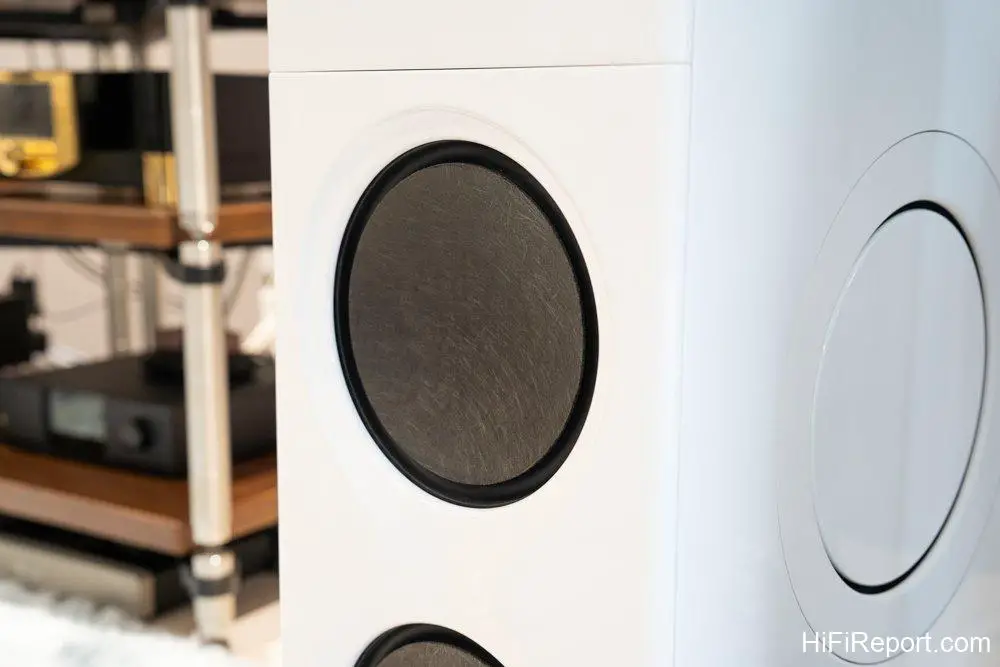
For the bass frequencies, the Aspen FR20 uses two 8-inch long-throw woofers. The diaphragm surface looks dark gray from a distance, but up close, it has fine texture, somewhat resembling a meteor surface.
PS Audio utilizes a non-woven carbon fiber diaphragm with a layer on the front and back, sandwiching a lightweight PMI foam core. This construction provides an ideal balance of rigidity and damping.
The woofer driver features a full-arc, dust cap-less design, a recessed surround, a Nomex spider, a specially designed magnetic gap, dual Faraday rings, and a hefty 12-pound magnet.
Listing all these features individually highlights their complexity, but their singular purpose is the pursuit of more linear operation and lower distortion.
Not only that, PS Audio has also added a 10-inch planar diaphragm driver to each side of the FR20 speaker, operating as a passive radiator to achieve better bass extension.
The Aspen series speakers follow a similar design philosophy. For instance, the flagship Aspen FR30 also features the same 10-inch planar drivers on the sides as the FR20, but double the quantity, with two on each side. The smaller floorstander, the Aspen FR10, has three 6×9-inch oval drivers mounted on the back. Even the smallest Aspen FR5 bookshelf speaker features one 6×9-inch oval driver.
The PS Audio Aspen series speakers employ a fully sealed cabinet design paired with passive radiator bass loading, allowing the speakers to produce surprisingly deep bass frequencies.
Linkwitz-Riley Fourth-Order Crossover with Select Components
Having excellent drivers requires an equally high-quality crossover network. PS Audio utilizes custom-made film capacitors and high-quality air-core inductors in the Aspen FR20’s crossover.

Choosing good components is like selecting premium ingredients for cooking, but knowing how to combine them in the pan is the real skill.
To precisely control the crossover points, PS Audio employs a Linkwitz-Riley fourth-order crossover (LR-4) at 400Hz and 2,500Hz. This filter has a 24dB/octave slope, resulting in minimal overlap between driver frequency ranges and ensuring consistent phase alignment between the two drivers.
On paper, the Aspen FR20 has a sensitivity of 87dB and a nominal impedance of 4 ohms, but the impedance curve is smooth across the entire frequency range, with a minimum of 3.5 ohms.
Smooth impedance variation is even more crucial; this is precisely what PS Audio aimed for. They designed the Aspen FR20 to be an easy load for amplifiers, meaning, simply put, they are easy to drive.
Modern Cabinet Design: MDF Combined with Fiberglass Composite Front Baffle
Regarding the cabinet, PS Audio has designed a modern, even avant-garde, aesthetic for the Aspen speakers.
The main body of the cabinet is constructed from MDF, with carefully designed internal bracing structures to enhance rigidity and minimize resonances.
The cabinet surface features a premium piano-gloss finish, with up to 20 layers of paint applied and meticulously hand-polished through multiple steps, adding significantly to the speaker’s visual appeal.
The front baffle, however, is not wood but a glass fiber composite material, thermo-molded for high density, rigidity, and excellent damping properties.

Integrated wave guides are designed around the openings for the tweeter and midrange drivers to control sound dispersion angles.
The design of the speaker’s base is quite unique. Most speakers have flat bases, which is logical for stability. However, the bottom of the FR10, FR20, and FR30 floorstanding models are all curved, supported by a special aluminum alloy base.
Because the contact surface between the speaker bottom and the base is minimal, the speaker appears to float just above the floor. Four large copper spikes are height-adjustable, allowing users to easily level the speakers. The manufacturer also includes a set of plastic feet that can be swapped depending on the floor surface.
HiFiReport Audio: A Father-Son Business
The listening session took place at Ha Ba’s store, “HiFiReport Audio.” When I arrived, I saw a handsome young man whose face seemed familiar.
“Is Ha Ba in?” I asked. “Yes, please wait a moment,” he replied. Before he finished speaking, Ha Ba emerged from the workshop area behind the store, his face beaming with his characteristic smile.
It turned out that the handsome young man was Ha Ba’s son, A Zheng (Thomas). A Zheng grew up immersed in audio, and with a skilled father guiding him, he handles the store confidently.
“The FR20 you’re listening to this time, he tuned it,” Ha Ba said proudly. “I just made some slight final adjustments.” Ha Ba was clearly proud to have such an insightful son.
A Fresh Combination, Delivering Captivating Sound
Listening to PS Audio speakers, I initially expected them to be paired with PS Audio amplification and source components. After all, PS Audio offers excellent transports, DACs, and a range of preamplifiers and power amplifiers across different price points.

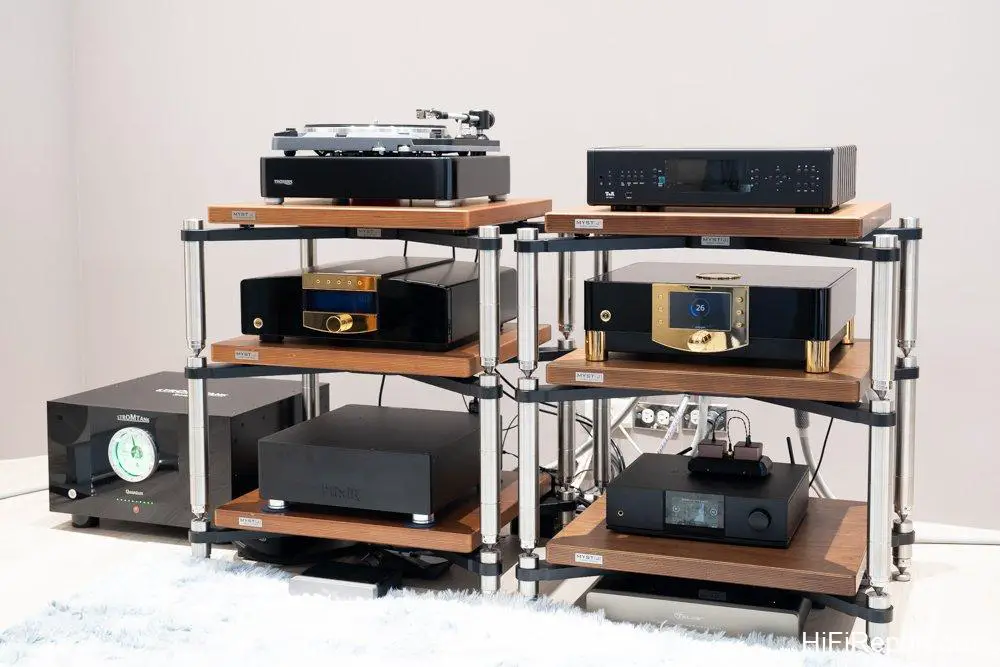
Unexpectedly, Ha Ba had put together a more luxurious combination. For the audition, he brought out the MBL Noble Line integrated amplifier N51 to drive the Aspen FR20. The source was an Auralic Altair G2.2, which combines streaming, DAC, and preamplifier functions.
Surely the power regenerator must be PS Audio’s PowerPlant, right? No, Ha Ba paired them with a Stromtank battery power supply, running entirely on battery power during the session.
This was a combination completely different from what I had anticipated. I sat down and quietly immersed myself in the excellent sound tuned by the HiFiReport father-son duo.
The Aspen FR20’s sound felt grand and composed, with ample energy but no trace of harshness. The sound was open, easily creating a wide soundstage.
The entire frequency range possessed a healthy density, which benefited image formation and detail reproduction. Every sound source felt remarkably tangible.
The midrange and treble had excellent resolution, yet without any brittleness. The bass was clean and extended; the passive radiators did not introduce any booming or muddiness to the Aspen FR20’s low end.
Moreover, as soon as the music started playing, the speakers simply disappeared. This was also incredibly captivating. If I were at home, with a warm lamp lit and a glass of whiskey in hand, listening to music on these speakers would undoubtedly be a pure pleasure.
Clean, Extended Bass, Rich Vocal Detail, and Substantial Images
Listening to Diana Krall’s “All of Nothing at All,” the opening bass plucks were full and round, deep and rich, not at all indistinct, but instead incredibly elastic.
This bass wasn’t just “acceptable”; it was at an exceptional level. I often use this track to evaluate bass texture. Some systems have loose bass, causing the bass guitar to lack definition. Some have excessive bass, making the bass unintelligible. Some have insufficient bass, leaving the listener feeling unsatisfied.
But the bass solo tuned by Ha Ba sounded full, rich, and elastic, with even subtle variations in detail audible. How could I not praise this? Diana Krall’s voice was clear, demonstrating the excellent resolution of the planar driver. Simultaneously, the healthy sonic density imparted a considerable sense of realism.
The Aspen FR20 effortlessly produced an image that was both large and distinct. On some systems, I’ve found the sibilance in this album to be quite pronounced, which can become fatiguing over time. However, I encountered no such issue listening on the Aspen FR20. It is resolving, it does provide ample detail, but its resolution is embedded within a dense, solid texture. Its details seem reinforced, not wispy, vague, or unclear, but rather definite, concrete, and assured.
Besides the vocals, the accompanying piano and guitar were clearly rendered, never getting buried in the mix.
That Drum Sound is Fantastic!
Listening to Dire Straits’ “Money for Nothing,” the distant, ethereal opening call establishes a profound space. As the music develops, a series of drum hits rings out, truly launching the song.
To simply describe the drum sound here as “powerful and forceful” is entirely insufficient. How can I convey just how strong and punchy it is? How forceful it sounds? The drums were not only crisp and lively, but each hit felt like it landed directly on me. Just listening to the drums, paired with the electric guitar and Mark Knopfler’s vocals, sent shivers down my spine.
The Aspen FR20 truly excels at reproducing this kind of rock music. It delivers powerful and impactful drums. When playing electric guitar, it renders the tone with vibrant color while maintaining remarkable stability, avoiding any sense of harshness. The images are large and three-dimensional, making rock songs incredibly engaging to listen to.
“Brothers in Arms” is the title track from the same album. The opening thunder and distorted electric guitar stretch out to form a wide sky. Where are the Aspen FR20s? I could see them, but my ears couldn’t detect their presence at all. They clearly presented a vast soundstage and then simply vanished within that spatial dimension.

The electric guitar’s tone was bright and vividly colored, its delicate and tender lines guiding the listener beyond Mark Knopfler’s monologue, drawing out deeper emotions. Paired with the crisp drum rimshots and keyboard synthesizer effects, the sound conveyed a dreamlike, almost hypnotic atmosphere. This sonic character felt absolutely perfect for reproducing this song!
Like a Perfectly Brewed Espresso Topped with Rich Crema
The sound of the Aspen FR20 is dense and substantial. It possesses high density, but not the kind that’s overly focused or pinpoint. Instead, it’s a density of concentration and texture.
It’s like a shot of espresso: not just strong, but rich with oils, the crema produced during extraction encapsulating abundant aromatic compounds. Even without drinking, the aroma alone is captivating.
If you prefer a more transparent, lighter sound, there are many other brands to choose from. But if you favor a richer presentation, a fuller flavor, then the Aspen FR20 offers precisely that character.
The Dense, Rich, Solid, and Rounded Piano Sound Delivers All the Musical Emotion
Listening to Danilo Rea’s album “Lirico” fully demonstrates what “dense, solid, rich, and full” truly means. The piano notes are full, with substantial body, making the piano sound even more assured.
I’m deliberately avoiding the word “hard” to describe the piano sound, to avoid misleading you into a different interpretation. The piano sound from the Aspen FR20 is certainly solid, but beyond that solidity, there’s a quality of roundness, richness, and fullness.
That “rounded, rich, full” solid piano sound fills the space, making the music exceptionally engaging. Danilo Rea’s pieces on this album are arrangements of operatic arias, each with a story, an emotion, and artistic depth. The Aspen FR20, like a beautiful bel canto voice, artistically conveyed the tenderness and melancholy within this music.
In the second track, “Mon coeur s’ouvre à ta voix” (My heart opens to your voice), the opening features lingering low chords, full of weight and substance. The substantial notes draw the listener deeper into the music. That rich and full flavor must be experienced to be understood.

As for the sequence of low notes in the latter half of the piece, their depth was equally impressive. Furthermore, when Danilo Rea is deeply moved during his performance, he occasionally sighs and makes vocalizations along with the music, and these sounds were also captured in the recording. The FR20 rendered the entire performance not just as music, but as a live event, not confined within a recording, but unfolding right in front of me.
Each Instrument Has Its Own Texture, Real and Prominent
Listening to Yo-Yo Ma, Chris Thile, and Edgar Meyer’s collaboration on the “Bach Trio” album, the dense and substantial notes made the trio sound exceptionally lifelike.
Realism doesn’t always need to be built from countless tiny sonic fragments. A sense of reality and tangibility sometimes requires that very sense of solid density. Listening to the cello, mandolin, and double bass here, each instrument possessed its own distinct texture, feeling real and prominent, allowing the music’s character to unfold naturally.
Through the cello and double bass, we can appreciate the Aspen FR20’s excellent balance in the mid-bass and low frequencies. There was no bloated or overweight bass, yet the layers of the low end were perfectly articulated. The cello and double bass occupy different ranges but also overlap. However, due to different cabinet volumes producing different resonant harmonics, these two instruments should sound distinct even when playing the same note.
You might think this is simple, but some systems lack sufficient differentiation in this regard. Here, however, I could clearly and confidently identify which instrument was emerging in front of me. This is thanks to the tonal expressiveness provided by the entire system.
As for the mandolin, it acts both as a basso continuo and a melodic voice, sometimes merely accompanying, sometimes taking prominence. Regardless, its bright, ringing tone sounded with added substance, making the notes feel more certain.
Excellent Horizontal Dispersion Shines with Large Orchestral Works
The Aspen FR20’s soundstage is broad, and the stage is expansive. Of course, this is also related to room setup, speaker placement, and other tuning techniques, but the Aspen FR20 inherently possesses this characteristic. Its planar magnetic midrange and tweeter, coupled with the integrated waveguide on the front baffle, contribute to excellent horizontal dispersion.
Not only that, but its sense of layering is also outstanding. Playing orchestral music fully brought out these strengths. Listening to the opening piece from “John Williams in Vienna,” the theme from the movie “Hook,” “The Flight to Neverland,” simple themes interweave, creating a constantly shifting sonic kaleidoscope through different instrumentation and harmonies. Percussion provides liveliness and color, the bass drum and timpani deliver a certain impact, brass and woodwinds entwine in a dance – each section flowing and layering into a complex and dazzling soundscape, all rendered clearly on the Aspen FR20.
As for the selection from the movie “Close Encounters of the Third Kind,” John Williams combined four sections of the score into an independent concert piece. The opening segment, “The Arrival of the Mothership,” features extensive dissonance, piercing piccolo lines, and rapid tremolo figures on the strings, escalating the atmosphere of eerie suspense.
When reproducing this passage, the Aspen FR20 meticulously unravelled the musical content, with clear and orderly layers, even revealing the texture of individual instruments. This demonstrated its proficiency in portraying layers and transparency. The transient dynamics showcased during forte passages were also astonishing; the MBL N51 integrated amplifier drove the Aspen FR20 with seemingly effortless composure.
The receding stage depth extended the musical dimension beyond a 2D plane, creating a tangible sense of depth. Based on my listening experience at HiFiReport Audio that day, the Aspen FR20 isn’t afraid of being pushed in volume. As long as your room can handle it, feel free to turn it up. Ha Ba mentioned he typically demos with the N51 volume between 30 and 35; I pushed it past 40. Ah, it got plenty loud, revealing the true capability of the Aspen FR20!
Bringing the Satisfaction and Confidence of Seeing Both the Forest and the Trees
Listening to Myung-Whun Chung conducting the Orchestre de l’Opéra Bastille in Saint-Saëns’ Symphony No. 3, the Aspen FR20 presented the music with a very rich tone, making it sound particularly warm.
The wide and expansive soundstage not only opened up the performance area but also clearly delineated the different sections. Even with Saint-Saëns’ complex harmonies, counterpoint, and ensemble writing, the speaker methodically sorted out the underlying structure. Whether it was the first half of the first movement, the fast-paced second movement’s opening, or the majestic and grand concluding movement, it maintained control.
It even allowed the listener to discern the texture of individual instruments, particularly the tone and texture of the woodwinds. It provided that satisfying confidence of being able to appreciate both the overall structure (“the forest”) and the individual details (“the trees”).
The organ performance is, of course, a highlight of this piece. The Aspen FR20’s bass was deep and clean, portraying the profound depth plumbed by the organ – it was a sense of air, an atmosphere. The organ’s low notes provided a foundation beneath the developing string melody. With clear layering, and the strings sounding warm, smooth, dense, and full, the combination elevated this passage to a heavenly experience, utterly beautiful.
In the latter half of the second movement, the solemn organ enters with immense sonic weight, standing firm like a solid foundation, supporting even the most magnificent musical architecture. As the music progressed, after the stately theme, it moved into the exciting fugue. Layer upon layer of melody built up, with each added layer contributing further beauty. Unravelling these layers and presenting their progression was effortlessly handled by the Aspen FR20.
A Stunning Debut
PS Audio didn’t just dip their toes into loudspeaker design; they aimed for the stars and achieved something remarkable.
With the Aspen FR20, I witnessed PS Audio successfully bringing a sound quality pursued since the last century – smooth, natural, graceful, grand, rich, dense, full, and wide – to a speaker with a strikingly modern design.
The Aspen FR20 doesn’t rigidly adhere to convention or old paths. It uniquely employs planar magnetic drivers for the tweeter and midrange and utilizes new materials and technologies, establishing PS Audio’s distinct sonic aesthetic.
Is it really that good? If you’re in Northern Taiwan, you might consider contacting Ha Ba at HiFiReport Audio for an audition. Listen for yourself, and you’ll know.
Specifications
* Type: 3-way, 4-driver, sealed floorstanding loudspeaker
* Drivers: 1x 2.5″ Teonex planar magnetic tweeter, 1x 10″ Teonex planar magnetic midrange, 2x 8″ Carbon fiber sandwich cone woofers, 2x 10″ Planar passive radiators (one on each side)
* Frequency Response: 23Hz~20kHz (-6dB)
* Crossover Points: 400Hz, 2,500Hz
* Sensitivity: 87dB
* Nominal Impedance: 4 ohms (minimum 3.5 ohms)
* Recommended Amplifier Power: 50~300W
* Dimensions: 50.5” x 16” x 18.75” (HxWxD)
* Weight: 60.3 kg (133 lbs)