
Sennheiser AMBEO Plus Review
I’ve had the pleasure of reviewing the original AMBEO Soundbar myself, and it left a profound impression. Even today, I believe the AMBEO Soundbar’s performance remains among the best, facing few real competitors. For many years, this soundbar served as a centerpiece display at audio shows in Taiwan, so I suspect many enthusiasts have experienced its sonic prowess. However, I’d guess the number of people who could afford it was relatively small, as this soundbar carried a significant price tag.
I recall the price being close to USD 2,650 at the time of my review, a budget most people wouldn’t typically allocate for a soundbar.
Introduction and Context
Addressing this, Sennheiser launched a more affordable model in 2022, the AMBEO Plus. This is Sennheiser’s second soundbar offering. To distinguish it from the new model, the original flagship was subsequently renamed the AMBEO Max. The AMBEO Plus officially arrived in Taiwan in 2023, and we finally had the opportunity to conduct a hands-on review this month.
Design and Driver Configuration
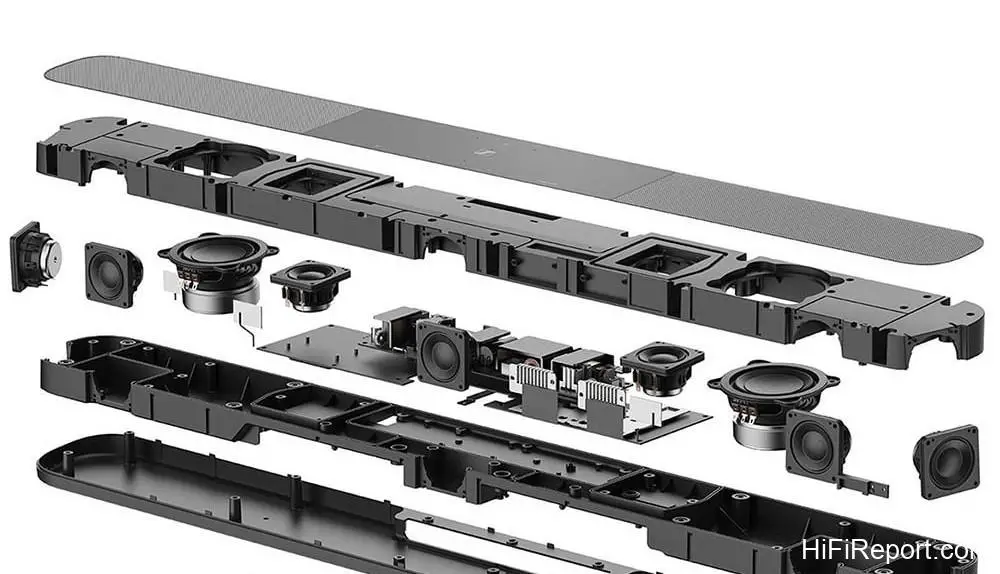
Compared to the flagship AMBEO Max, the AMBEO Plus features a somewhat simplified design. However, when stacked against typical soundbars on the market, it still represents a high-end design. The AMBEO Plus unit itself houses nine drivers: seven 2-inch full-range drivers with aluminum cones, and two 4-inch woofer drivers.
Core Audio Technologies
The original AMBEO Max was remarkable for its combination of virtual sound processing (AMBEO) and sound reflection technology (drivers firing upwards and sideways). The AMBEO Plus continues this design philosophy. Beyond the core AMBEO technology, its nine drivers are strategically placed: two fire sideways, two fire upwards, three fire forwards, and there are two dedicated 4-inch woofers.
Through the collaborative effort of these technologies, the AMBEO Plus claims to deliver a 7.1.4-channel audio experience.
In addition to the AMBEO technology, Sennheiser collaborated with the German research institute Fraunhofer IIS Institute to develop automatic room calibration technology. This system detects the acoustic characteristics of the surrounding space and makes necessary corrections. The first-generation AMBEO Max used a separate external microphone placed at the listening position for measurement.
The AMBEO Plus adopts a more convenient approach, integrating four microphones directly into the soundbar to detect room response and minimize its impact on the sound.
Operating System and Features
Following the launch of the AMBEO Max, Sennheiser continued to refine its operating system and application software. Consequently, although the AMBEO Plus’s hardware design is not as elaborate as the AMBEO Max, its operating system and functionality at launch were actually superior to the AMBEO Max at its original release.
The AMBEO Plus utilizes the newer AMBEO|OS operating system and the updated Smart Control App, allowing it to directly decode multi-channel audio formats such as Dolby Atmos, DTS:X, 360 Reality Audio, and MPEG-H audio. For playback of 2-channel or 5.1-channel audio, the AMBEO technology can perform upmixing for expanded sound.
Connectivity and Streaming
The rear panel of the AMBEO Plus includes two HDMI inputs and one HDMI output. This output supports HDMI eARC functionality, enabling connection to smart TVs for playing back TV audio. The two inputs allow connection of other playback devices, such as a 4K Blu-ray player or a gaming console.
Beyond movie playback, the AMBEO Plus is also a fully featured music streamer. It supports AirPlay 2, Chromecast, Spotify Connect, and Tidal Connect. The inclusion of Tidal Connect is particularly noteworthy; while many audio devices support Tidal, not all support Tidal Connect. Tidal Connect offers a more streamlined playback experience, allowing direct control from the Tidal App, and its presence on a soundbar is quite uncommon.
In addition to Wi-Fi streaming, the AMBEO Plus also supports Bluetooth playback.

The Optional AMBEO Sub
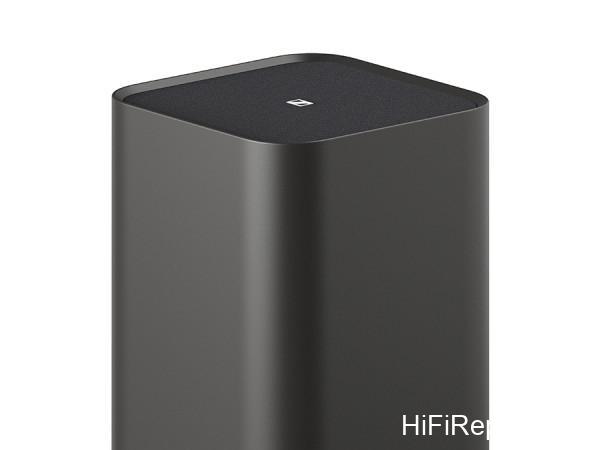
To allow consumers to experience richer low-frequency energy and a fuller bandwidth, Sennheiser also offers the corresponding AMBEO Sub active subwoofer. This subwoofer features an 8-inch driver powered by a 350-watt amplifier, capable of performance comparable to standard, dedicated subwoofers. The AMBEO Sub is optimally paired with the AMBEO series soundbars, and connecting it is easily configured via the app. Notably, you can connect up to four subwoofers.
Multi-subwoofer support for up to four units is a new feature that has only recently started appearing on mid-to-high-end AV receivers in the last couple of years, and the AMBEO Sub follows suit – a truly unique capability in the soundbar world.
Connecting up to four AMBEO Sub subwoofers is also done through the app. Once connected, automatic room calibration can be performed, after which you can manually adjust volume and phase. Since the main adjustments for the AMBEO Sub are handled through automatic room calibration and primarily via the app (the subwoofer itself has no adjustment knobs), it’s theoretically designed for use only with Sennheiser’s own products.
The AMBEO Sub supports wireless signal transmission, so even when using four subs, signal cables are not an issue.
Practical Usage and Performance Impressions
Moving on to practical usage impressions, I initially tested the AMBEO Plus on its own, then compared its performance with the addition of the AMBEO Sub. To put it plainly: adding the subwoofer is highly recommended. The subwoofer’s low-frequency output is quite impressive, providing clear low-end energy that makes the overall sound more dynamic. Thus, this review’s listening tests were primarily conducted with a single AMBEO Sub paired.
The AMBEO Plus comes with both a traditional remote control and an app. The app offers more extensive functionality and is generally the more convenient option.
Within the app, there’s an “AMBEO demo experience” feature featuring three effect demonstrations. Engaging this feature provides a sense of the soundbar’s surround capabilities. However, I found this wasn’t where its strongest effect was demonstrated. To experience the AMBEO technology’s maximum impact, I recommend playing back content with Dolby Atmos audio and then toggling the AMBEO switch (available on both the remote and the app) during playback.
This allows you to instantly perceive the difference the AMBEO processing makes.
With the AMBEO sound processing turned off, the soundstage feels distinctly concentrated in the center of the soundbar. When the AMBEO function is activated, the soundstage expands significantly, creating a wide, enveloping sound field in front of the listening position. At this point, the audio is no longer confined to the center. During my review, I used a 65-inch TV, and I felt the scale of the soundstage extended even wider than the screen itself.
For example, when watching the bus fight scene in “Shang-Chi and the Legend of the Ten Rings” on Disney+, with AMBEO off, the sound was restricted to the center. Turning it on caused the soundstage to broaden dramatically. I could perceive a much more distinct sense of movement in the fight between the protagonist and the villains, and the audio felt more integrated with the on-screen action.
This scene features a very dynamic background score, and here the subwoofer’s strong presence was palpable. Not only were the electronic drum beats in the music more impactful, but they were accompanied by powerful low-frequency energy. The protagonist’s hits on the villains also had a distinct punch, an energy level simply not provided by typical TV speakers.
Another example is the scene from “Avatar: The Way of Water” on Disney+ where the water base sinks and the protagonist’s family escapes. As the base overturns, the distinct low-frequency energy added significant weight to this special effect. The film features many alternating scenes above and below the water, and the soundbar clearly rendered the starkly different acoustics of each environment.
When underwater, the soundbar presented a more muffled, subdued underwater texture, creating audio appropriate to the visuals and plot. Coupled with the wider soundstage, this delivered a more immersive audio experience for the viewer.
Distinctive Strengths and Conclusion
Many brands offer soundbars today, but few develop their own virtual sound technology. This results in many soundbars appearing quite similar, lacking distinctive features. Sennheiser’s soundbar, however, stands apart. It boasts the proprietary AMBEO technology, capable of creating a wider soundstage, along with unique automatic room calibration.
Furthermore, the AMBEO Plus features a different design philosophy that allows connection of up to four wireless subwoofers and direct music playback via Tidal Connect, offering significant flexibility and convenience for both movie audio and music listening. Combined with the powerful and impactful subwoofer, the AMBEO Plus and AMBEO Sub pairing becomes a noteworthy option in the market this year.
Key Features
* Soundbar features 9 drivers
* Claims to deliver 7.1.4 channel audio
* Proprietary AMBEO virtual 3D sound function
* Proprietary automatic room calibration
* Supports various music streaming functions
* Supports Tidal Connect
* Can be paired with the AMBEO Sub subwoofer
* AMBEO Sub supports wireless transmission
* Up to four subwoofers can be connected

AMBEO Soundbar Plus Specifications
* Driver Configuration: 2-inch full-range aluminum cone driver × 7, 4-inch woofer × 2
* Total Amplifier Power: 400 watts (RMS)
* Frequency Response: 38Hz~20kHz
* Inputs/Outputs: HDMI 2 in / 1 out, Optical input, RCA AUX input, USB Type A (for powering accessories), Subwoofer Pre-out
* Wi-Fi Support: IEEE 802.11 a/b/g/n/ac/ax
* Bluetooth Version: Classic 5.0
* Dimensions (with feet): Approx. 105.1 × 7.7 × 12.1 cm
* Weight: Approx.6.3 kg
AMBEO Sub Specifications
* Design: Sealed enclosure
* Driver: 8-inch long-throw woofer
* Power: 350 watts (RMS)
* Frequency Response: 27Hz~80Hz
* Input Terminal: Wireless input, RCA mono input
* Bluetooth Version: 5.2 Low Energy Bluetooth
* Dimensions (with feet): Approx. 27.4 × 36.9 × 27.4 cm
* Weight: 8.2 kg