
Silent Angel Munich M1 Streaming DAC & Headphone Amp Review
Do you stream digital music? How do you stream? Are you using a computer? If you’re a tech-savvy individual, building a computer audio source (CAS) might not be difficult for you, and you might even enjoy it.
However, building a computer for gaming or programming is different from building a CAS. Without dedicated research, the joy of building your own CAS may outweigh its actual effectiveness.
A simpler and potentially more effective approach is to choose an affordable digital streaming device. With the rise of digital streaming, home audio manufacturers are all striving to enter the streaming arena as much as they can.
Ten years ago, you could scoff at digital streaming, insist that physical records were king, and believe your DIY CAS was superior to commercial products. You are still free to hold your views, but the market will not cater to your pride.
The reality is: digital streaming is the present and the future of listening.
Hold on, don’t rush to challenge my point. I have no intention of starting a debate. I’m merely stating the facts based on the current state of the music industry.
This doesn’t prevent you from listening to CDs, vinyl records, cassettes, or reel-to-reel tapes, nor does it stop you from building your own CAS. After all, listening to music is a deeply personal matter. There’s nothing wrong with how you do it, how you play, how you listen, or how you configure your system.
However, if you are still using a PC, Mac Mini, or barebone system to play music, and if you don’t have a streaming device yet but are considering trying it, then please read on.
Streamer Buying Advice for Budget-Conscious Audiophiles
Due to my profession, I have access to many streaming players, including high-priced ones. But I have always believed that the most rational strategy for users with limited budgets is to invest the majority of their source budget in a DAC, and then choose a stable and high-quality streaming transport. This way, the DAC can be used for a long time, and the transport section can be upgraded later.
Digital streaming is different from the familiar vinyl turntables, CD players, and cassette decks of the past, which had constant signal sources. Vinyl, cassettes, and CDs are all immutable physical media.
However, digital file formats can change, and streaming software is updated. Therefore, the process of digital streaming playback will have higher computing demands over time. Smartphones are the best example of this. Does anyone still use an iPhone 4? It’s not that it was bad, but even if the battery is still healthy, its hardware specifications can no longer keep up with the computing demands.
For those with unlimited budgets, upgrading to a new machine every three to five years allows them to always use the highest specification products. For those with limited budgets, choosing a streaming player that suits them allows them to have a smoother and easier streaming journey.
Top 5 Reasons to Recommend Silent Angel Munich M1
There are many choices for streaming players alone. What are the criteria for selection? If you ask ten people this question, you might get ten different answers. Even if you ask me, I have different recommendations for different people.
However, after using the Silent Angel Munich M1, I am very happy to put it on my recommendation list. Moreover, for budget-conscious audiophiles, I strongly suggest placing it high on your priority list.
Reason 1: Transparent Team Information
There are reasons for saying this, of course. First of all, Silent Angel’s team information is very transparent. The core members are veterans who have been in the information and network communication fields for many years, each specializing in their own area.
Such disclosure of team information is rare in the audio industry. Some manufacturers are only proficient in traditional audio manufacturing, and the software and hardware for network streaming are entirely outsourced for design and manufacturing. The original factory is only responsible for assembly and QC.
Team quality and transparent information are my first reasons for recommending Silent Angel.
Reason 2: Affordable and Reasonable Price
Secondly, the price of the Munich M1 is very approachable and reasonable. The Munich M1, equipped with a DAC and providing analog output, is available in 2GB, 4GB, and 8GB memory versions, with prices starting from $1234 USD (originally NTD 39,800). If you opt for the Munich M1T, a pure digital transport version without analog outputs, it is even more affordable. The entry-level 2GB version is only $651 USD (originally NTD 21,000), which is almost equivalent to the cost of buying a NUC or Mac Mini to use as a pure digital transport.
Reason 3: Versatile Applications
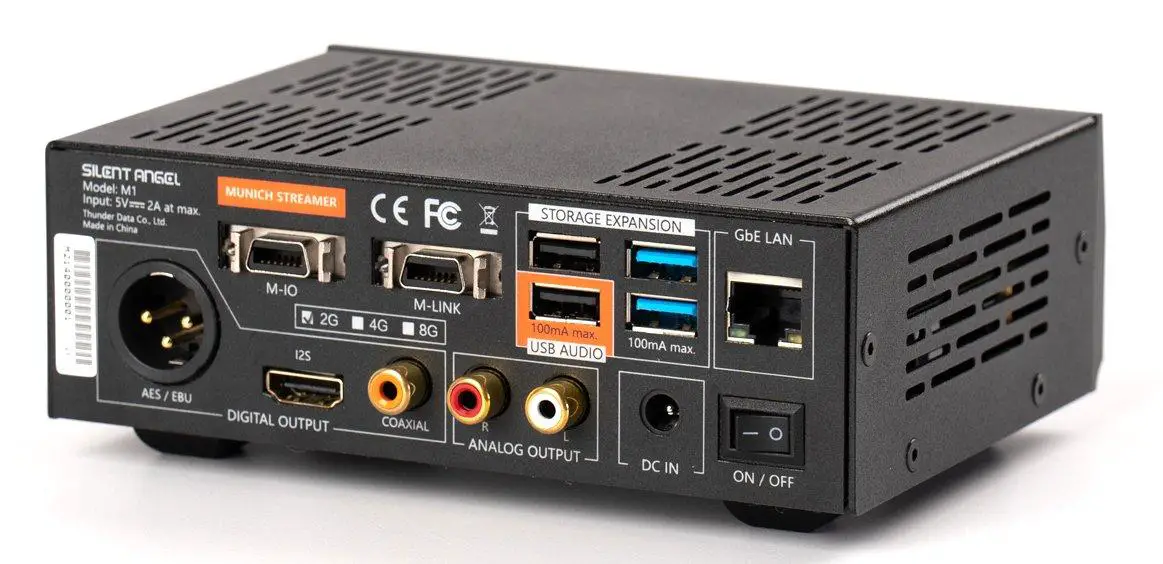
Furthermore, the Munich M1 is versatile and has a wide range of applications. It is itself a network player with a built-in DAC, allowing you to connect directly to an amplifier for use. If you have a better DAC on hand, it has as many as four digital outputs. In addition to USB and RCA coaxial, it also features I2S (HDMI) and AES/EBU, which are rare at this price point; these are all pleasant surprises.
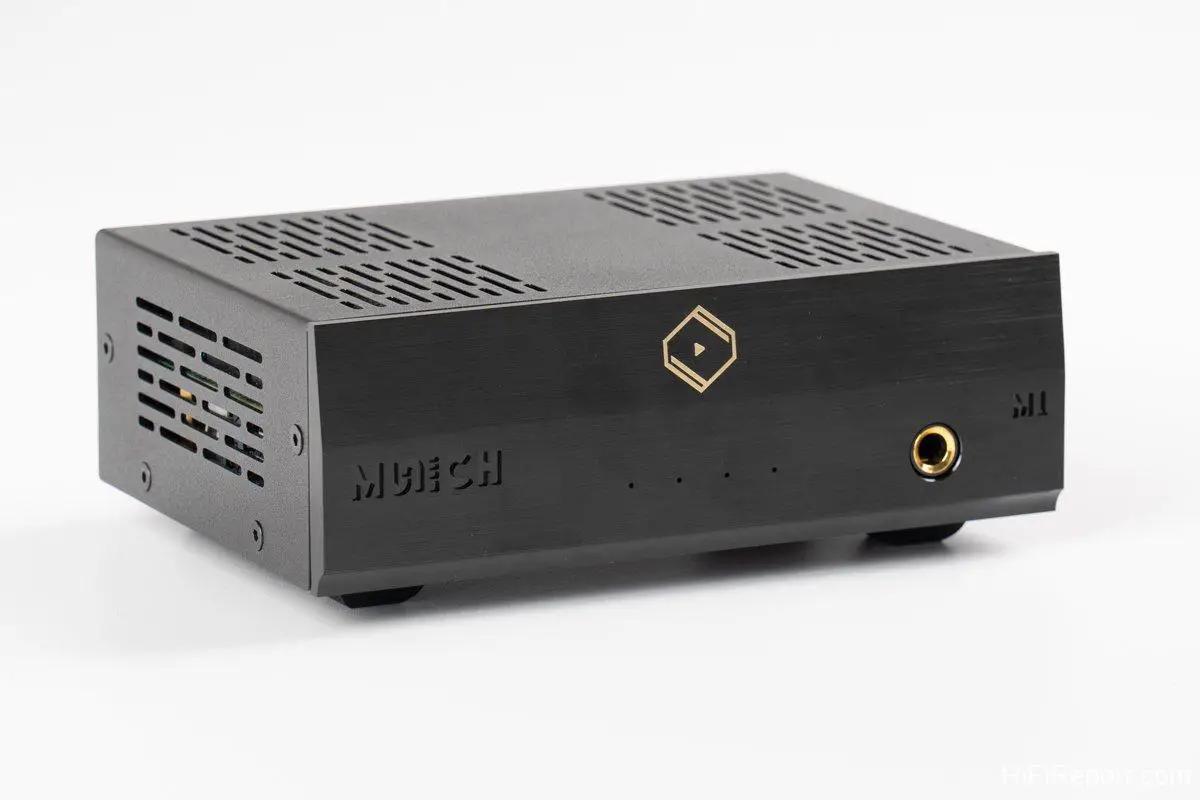
Even if you don’t have a NAS at home or subscribe to online music services, it has three USB Type-A inputs (two USB 3.0, one USB 2.0), which can be used to read files from external hard drives and USB drives. There is also a 6.3mm headphone output on the front panel, so you can listen to music without turning on your main sound system. However, if you buy the Munich M1T, there will be no RCA analog output or headphone output.
Reason 4: Solid Chassis Structure
Again, its build quality is also satisfying. It is small, not much bigger than the palm of your hand, and about the size of two slices of toast stacked together. If you like small audio components, the Munich M1 will definitely suit your taste.
Silent Angel does not deliberately use a fancy design to create a sense of luxury, but practically provides you with a solid and robust chassis. There are strip-shaped heat dissipation holes on the top and both sides of the case to facilitate air circulation. The front panel is cut with a slight upward angle, then changes to vertical at the midline, and then folds in near the lower edge.
The surface of the panel is brushed with hairline, and the Munich model name is etched in the lower left corner. A golden manufacturer’s logo is located in the center, and there are four small holes below with green LED lights to indicate the current working status. The whole unit seems inconspicuous, but it is actually very pleasing to the eye. Coupled with the low-key yet elegant black packaging of the Silent Angel series, I reasonably speculate that a design expert is in charge.
Reason 5: Future Upgradeability
Not finished yet, there’s more. The Munich M1 can be upgraded and expanded. This is impressive, isn’t it? You can buy an M1 player first, and then add a Forester F1 or F2 linear power supply later, and the improvement in sound is significant.
If you haven’t tried an audiophile-grade network switch, Silent Angel’s Bonn N8 can be said to be the most affordable audio-grade switch on the market. In 2021, they launched the N16 LPS with as many as 16 ports. You might not believe in switches until you use one and realize the difference.
The F1 linear power supply has two outputs, and one unit can supply power to both the M1 and N8 simultaneously. This completes a trinity streaming setup. If you want to upgrade the DC power cable, Silent Angel also offers four Bastei series cables to choose from.
Moreover, if you want to upgrade your music storage device to audiophile-grade level, Silent Angel also has the Expanter E1 external hard drive, which has the effect of reducing noise; and the Rhein Z1 music server, which I loved after using it. If you are a Roon user, I strongly recommend you buy it to use as a Roon Core, and you will definitely hear the improvement in sound performance.
Are you still unsure whether to step into the field of streaming playback? The Munich M1 can be an affordable starting point. If you like it after using it, you can upgrade it step by step in the future to build a streaming playback system created for you by an IT engineering team.
RPi-4B at the Core
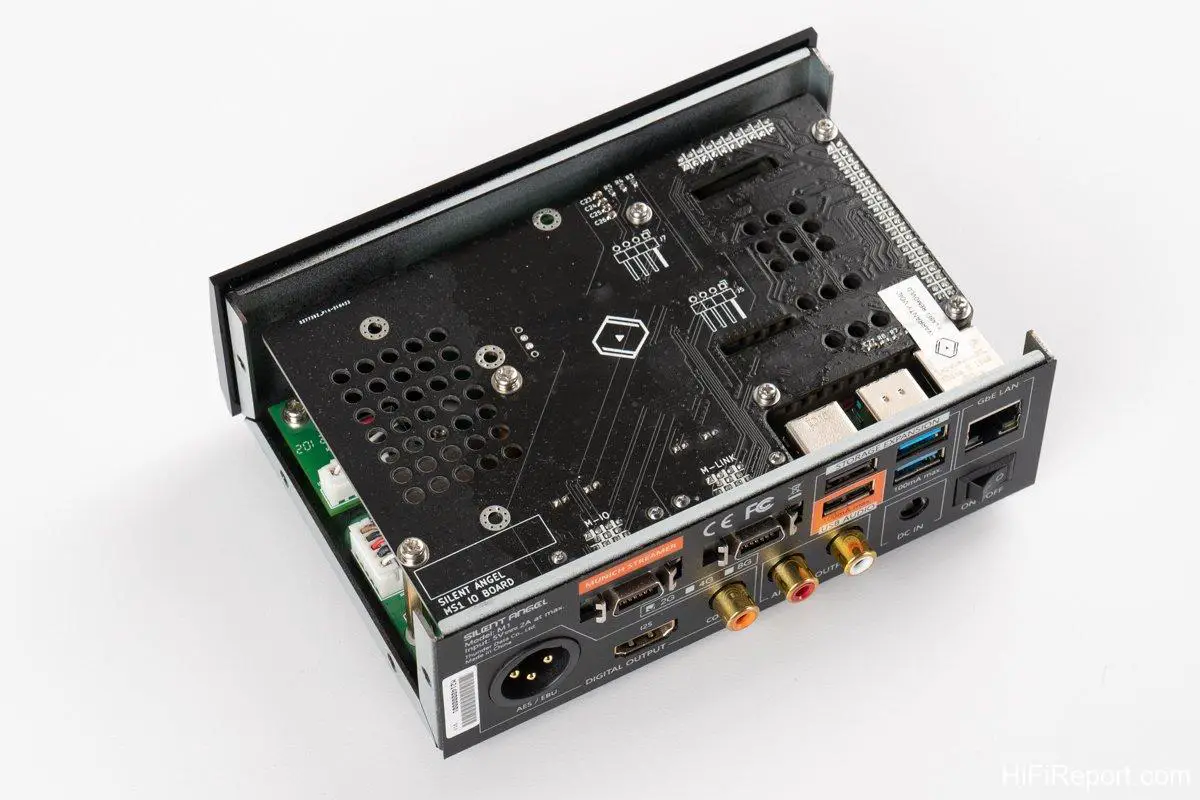
One, two, three, four, five, I have written five major reasons. Is there anything else I haven’t mentioned? Yes, what is its core? As you know, a streaming player, no matter how expensive it is, is essentially a computer.
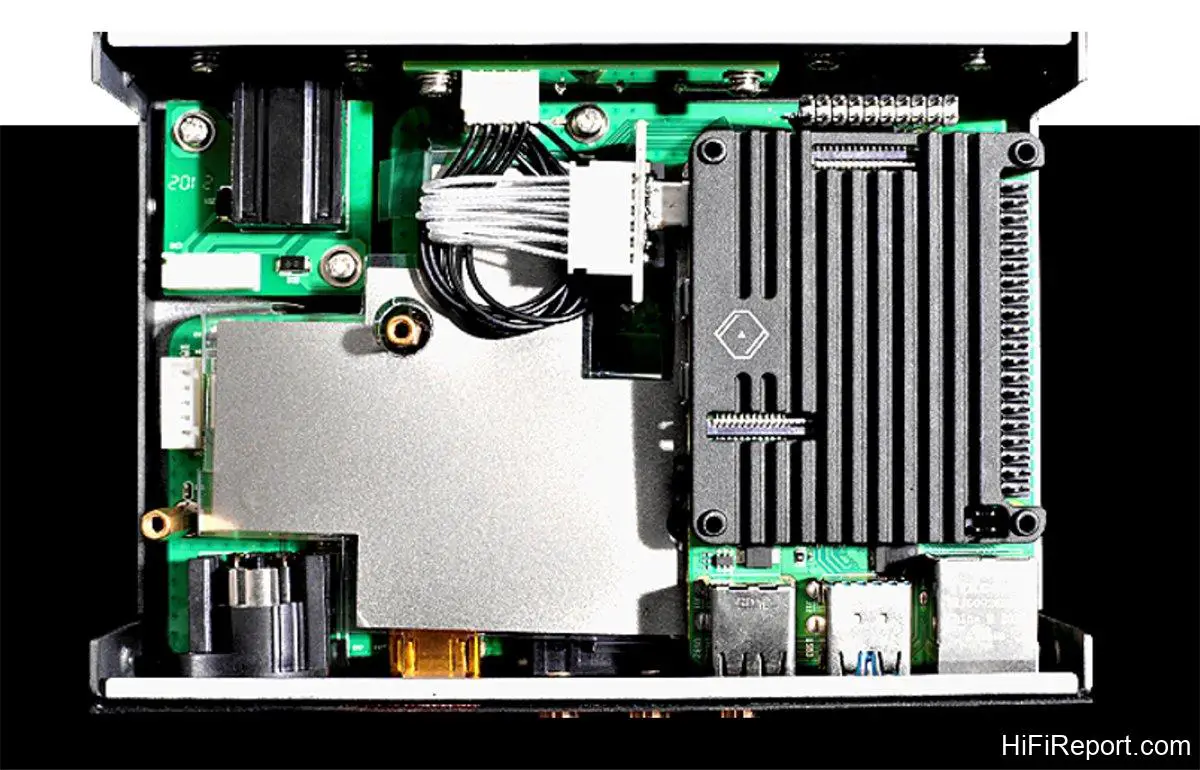
So, what is the core of Silent Angel? Although the manufacturer only provided information such as a 1.5Ghz quad-core ARM Cortex-A72 processor, low-noise DDR4, and 32GB high-speed flash memory, insiders can deduce the answer from the CPU specifications and the manufacturer’s internal product photos.
That’s right, it’s Raspberry Pi. The application of Raspberry Pi is really convenient and widespread, and it is widely used by individuals and audio manufacturers in digital streaming. The Telos EMP player I use at home is based on Raspberry Pi 4 Model B; the 3D Lab Nano Network Player, which I also like very much, is also built on a Raspberry Pi architecture.
Silent Angel’s use of RPi 4B as the core of the Munich M1 is a very wise approach to developing affordable streaming players, because in the field of streaming playback, hardware is not the most critical thing; software is.
This is why when CAS was popular in earlier years, many developers proposed various player software and system optimization programs. Computer operation relies on software, and the rule in the streaming playback field is actually: software rules.
In-house Developed VitOS Operating System and Related Applications
Silent Angel has developed its own VitOS operating system specifically for RPi 4B, as well as related applications. VitOS is based on the Linux operating system, and Silent Angel’s parent company, Thunder Data, wrote a platform that supports Roon Bridge for music servers and streaming players.
The manufacturer even provides VitOS for download, so you can install VitOS on your own RPi 4B. Then, install the VitOS Manager App on your mobile phone or tablet to manage it. The recently launched VitOS Orbiter is a complete playback control software; in this way, you can have a simple and affordable streaming playback system.
So what’s good about VitOS? The manufacturer’s official website provides a clear chart. Compared with ArchLinux and DietPi operating systems, based on the same OS and Roon plug-in version of Silent Angel Rhein Z1 as Roon Core, the speed performance of RPi 4B running VitOS is significantly higher than the other two operating systems.
Smooth App Operation, Complete Functions, and Built-in Player
In actual operation, the VitOS Manager installed on your phone or tablet mainly functions to install Apps and is usually not needed. To play music, you rely on VitOS Orbiter.
The VitOS Orbiter App integrates a variety of streaming services, including Amazon Music HD, TIDAL, Qobuz, High-Res Audio, Spotify Connect, etc. In addition, it also organizes a rich collection of internet radio channels for on-demand listening.
It also supports AirPlay 2, Roon Ready, and DLNA renderer, making its functions in network streaming playback very complete. It also specifically separates a “Local Music” section, allowing you to search for music files on NAS or USB interface storage devices.
In addition, it can also perform various settings, including the specifications of the internal DAC (M1 only) and digital output and USB output. VitOS Orbiter itself also has a built-in player function. The playback interface is similar to general DLNA playback software, with functions such as song selection, track list, file information, album cover, and volume control all included.
The operation of the VitOS Orbiter App can be described as smooth. The Munich M1 I used is the 2GB version. Perhaps the 4GB and 8GB versions will be even faster. Moreover, during my nearly two months of use, it has never crashed, which is commendable. The display language can be set to Traditional Chinese, which is very user-friendly.
Using Z1, F1, and N8 Together
Although the main focus of the review is the Munich M1, I asked HiFiReport to also send the Forester F1 linear power supply, Bonn N8 switch, and Rhein Z1 music server; because this complete set is Silent Angel’s ideal streaming solution.
The entire listening session was conducted at my home, paired with Lavardin IS Reference and Audiomat Adagio amplifiers, and JMR Abscisse Jubile speakers. The reference source was Telos EMP digital transport and Audiobyte Black Dragon DAC.
The Z1 server was used not only as a Roon Core, but also for DLNA streaming using VitOS for comparison with the M1.
Analog Output Sound is Smooth, Natural, Detailed and Clear
The Munich M1, even if it’s not a steal, is definitely worth its price. The sound performance is completely worthy of its price tag. Just using the built-in DAC for direct analog output to the amplifier already delivers a good performance. The details are rich, the soundstage is open, and there is no harshness or piercing quality that can be found in some entry-level digital sources. Instead, it exhibits a smooth and natural quality, with a slightly warm texture.
Listening to Anne-Sophie Mutter’s “Across the Stars” album, her violin lines are clear, and the details of the violin sound are distinct. In slow passages, the friction of the bow hair against the strings is subtle yet clear. The separation performance is also good. Whether it is between the solo violin and the orchestra, or between the various sections of the orchestra, the relative positions and the shapes and locations of individual instruments are all conveyed with complete information, reconstructing a discernible stage.
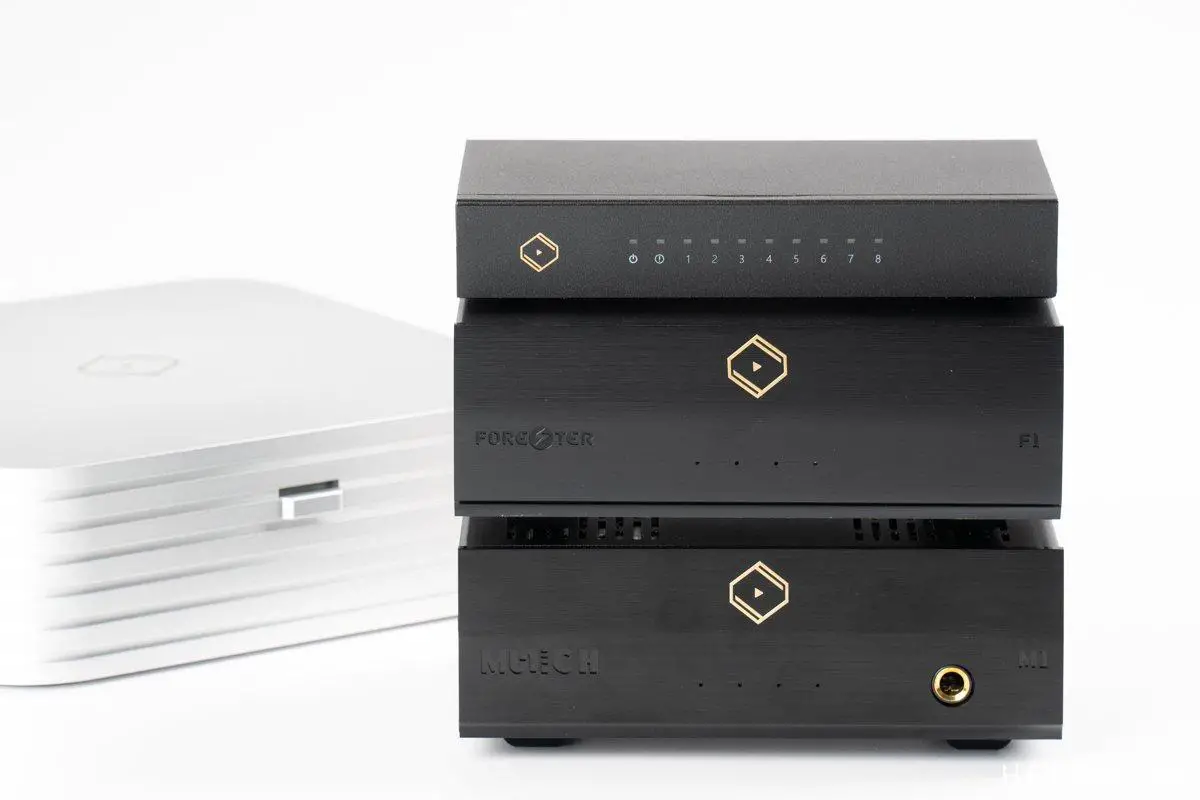
Sound Evolves Further with F1 Linear Power Supply and N8 Switch
If you only use the original switching power adapter for power supply, the sound will be a bit looser, and the low frequencies will be relatively diffused. Switching to the Forester F1 linear power supply, even with just the DC power cable included with the F1, there is a significant improvement in the sound. The most obvious difference is that the sound becomes more solid, the image is better, the sound is more three-dimensional, and the low frequencies are fuller. The sense of texture of drums and bass is more distinct.
Similar changes also occurred when the Bonn N8 switch was added to the streaming path. The circuit of the Bonn N8 has been optimized and EMI electromagnetic wave absorbing material has been added. It is equipped with a TCXO master clock with an accuracy of 25MHz/0.1ppm, which is 50 times more accurate than a general crystal oscillator. This reduces the digital transmission jitter to a level of 369ps, which is about half of the 705ps of a general switch.
After Enhancement, Sound Becomes Thicker, Denser, and Cleaner
The thicker and denser texture, and the cleaner lines, outline a clearer contour and make the music more realistic. It makes the music sound more flavorful. For example, Diana Krall’s “Wallflower” album, where she reinterprets the songs she often listened to in her youth, which are also familiar to us.
After adding the Forester F1 and Bonn N8, Diana Krall’s already rich and deep voice sounds even more charming. Those note transitions and articulations, those throat sounds and breath sounds, those nasal sounds and resonances, all sound more realistic. Some details that were originally uncertain now not only emerge, but also bring a sense of real certainty.
Whether it is in “Desperado” or “Sorry Seems to Be the Hardest Word”, the Munich M1’s reproduction of Diana Krall’s singing, that kind of tangible, emotional expression, is surprisingly charming.
Built-in DAC’s Mid-High Range Performance is Striking
Moreover, I was surprised by the mid-high frequency performance of the built-in DAC in the Munich M1. I did not expect it to have such a rich and detailed midrange, which is a detailed and imaged sound developed on the basis of a certain warmth and thickness.
And after I connected it to the Audiobyte Black Dragon DAC, and after several comparisons, I am even very certain that, perhaps for some people, my “Black Dragon” DAC is not necessarily more pleasing. The Black Dragon’s fully balanced, Class A amplification analog output makes the background blacker, the texture thicker, and the dimensions of the soundstage in width, depth, and height are all expanded.
In comparison, the analog output of the Munich M1 has a shallower soundstage. If the speakers are not far from the back wall, the spatial advantage of the Black Dragon may not be obvious. That’s why I said that the analog output performance of the Munich M1 is indeed surprisingly good.
After connecting an external DAC, the Munich M1 becomes a pure digital transport. At this time, the sound characteristics are mostly dominated by the DAC. If you already have a DAC with sound performance that satisfies you, and you only need to add a player that can take you into the field of streaming playback, then you can choose the Munich M1T.
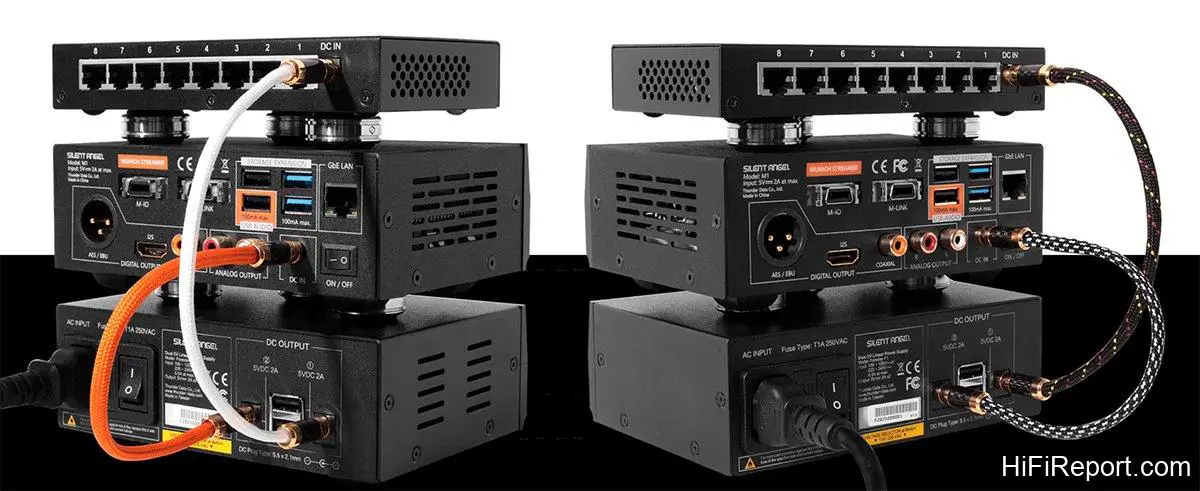
If you usually don’t listen to headphones, that’s fine. Otherwise, the headphone amplifier in the Munich M1 is actually worth trying.
Headphone Amp is Worth a Try and Won’t Disappoint
The Munich M1 itself is small in size and very suitable for desktop use. Paired with headphones, using VitOS to control the volume is actually quite practical. I used Sennheiser HD700 to test the headphone amplifier of the Munich M1, listening to Yo-Yo Ma’s “Bach Trios” album, a collaboration with Chris Thile and Edgar Meyer. The separation of the three instruments is very good, and the details are rich and the information is clear. The plucked texture of the mandolin is outstanding, and the warm and rich tone of the cello, paired with the full and rich double bass, listening to the harmonious sounds of the three of them, adds a gentle and lovely color to these Bach pieces.
Oh dear, more money can be saved. The Munich M1 allows you to not even need to buy a headphone amplifier.
Pity, No MQA Decoding
Of course, the Munich M1 is not without shortcomings. The most regrettable one is that it does not support MQA decoding. If you are a heavy Tidal user, losing this feature will definitely be a deduction. However, if you are also a Roon user, you can use Roon to decode MQA, which can partially compensate for the deficiency.
If you mostly listen to music files you ripped yourself, then not supporting MQA is not a big deal. Because, in addition to this, it can handle almost all other formats.
Let Munich M1 Lead You to the Digital Streaming Realm
If you want me to recommend a streaming player under $1600 USD (originally NTD 50,000), the Silent Angel Munich M1 is definitely on the list. If you buy the 2GB version, and still have budget left over to add a Forester F1 linear power supply, it will be even more powerful.
It has a solid and robust chassis, diverse external applications, practical and stable VitOS App, plus a sound performance with good texture. In this price range, it can almost be crowned king. Do you also want to step into the realm of streaming playback? Munich M1 can lead you there.
Associated Equipment
* **Source:** Telos EMP Server Player
* **DAC:** Audiobyte Black Dragon
* **Amplifier:** Lavardin IS Reference, Audiomat Adagio
* **Speakers:** JMR Abscisse Jubile
* **Cables:** Neotech NEUB-1020 USB Cable, Chubei Lefang Cherry Peacock USB Cable / Divini X-N12 Network Cable, LINNCOM cat 8 Network Cable / Real Cable Cheverny II Signal Cable, Divini S-S12 Signal Cable, Esprit Structura II Signal Cable / Real Cable TDC-600 Speaker Cable / Swisscables Reference Power Cable, Esprit Structura Power Cable, Oyaide Tunami Power Cable, Real Cable PSOCC Power Cable
* **Accessories:** NuPrime Pure AC-4 Power Filter, Telos GNR Active Grounding Machine
Specifications
* **Model:** Silent Angel Munich M1
* **Type:** Music Streaming Player
* **CPU:** 4-core 1.5 GHz ARM Cortex-A72
* **DRAM:** Low Noise 2 GB DDR4
* **ROM:** High-Speed 32 GB Flash
* **Operating System:** Silent Angel ViTOS Orbiter
* **Extended Support Applications:** NAS, USB Storage Devices, Internet Radio, TIDAL
* **Digital Output:** AES/EBU, Coaxial, I2S
* **Analog Output:** RCA
* **Dimensions:** 155 × 50.4 × 110 mm (Width × Depth × Height)
* **Weight:** 950 g