
Sonus Faber Sonetto I Review
After using their initial system for 3 to 5 years, many audiophiles find themselves contemplating an upgrade. Those with sufficient financial means might aim straight for equipment costing tens of thousands of dollars, but many others opt for a more measured approach, considering mid-range components first. However, with technology advancing rapidly, many major manufacturers are trickling down technologies from their flagship and high-end lines to their mid-range and entry-level offerings.
This cautious upgrade path can paradoxically yield better value for money, sometimes even leading to truly exceptional finds, like the Sonus Faber Sonetto I, the star of this review.
This magazine has previously reviewed the Sonetto series home theatre speaker package, bestowing upon it our “Best Recommended” award. Now, bringing the Sonetto I out for a solo review might seem like showing a little bias, and honestly, you wouldn’t be wrong to suspect it. But why review the smallest bookshelf speaker in the series again?
The main reason is my observation that most audiophiles, after entering the hobby and looking to upgrade, tend to heavily consult publications and online reviews specifically about speakers.
It’s precisely for this reason that I felt compelled to reacquaint everyone with the Sonetto series. The Sonetto range was actually displayed at last year’s Munich High End show, yet they seem less discussed in the discourse around affordable and mid-range two-channel systems. When a manufacturer pours so much effort and heart into a product, it would be a real shame if more people didn’t get the chance to hear it.
Aside from that, my personal biases come into play: firstly, I’m captivated by its appearance – this speaker is simply stunning; secondly, the Sonus Faber sound is incredibly alluring. But more on those points later.
Design Philosophy and Aesthetics
First, let’s touch on the Sonetto series’ design philosophy. In Italian, the word “Sonetto” originally meant something simple: “sound” or “melody.” However, it also means “sonnet,” a form popular in ancient Europe, often performed with music, hence its connotations of a “little song” or “tune.” The manufacturer chose Sonetto as their design inspiration, undoubtedly aiming to celebrate and embody the spirit of Italian Renaissance artistry.
In terms of product positioning, the Sonetto series sits below the high-end Olympica series and above the entry-level Venere series. Yet, the pricing remains accessible. The range is comprehensive, including floorstanders, bookshelf speakers, a center channel, and slim surround speakers, catering to both two-channel audiophiles and home theatre enthusiasts. All speakers in the series are available in three finishes: black, white, and wood, allowing you to choose based on your personal taste.
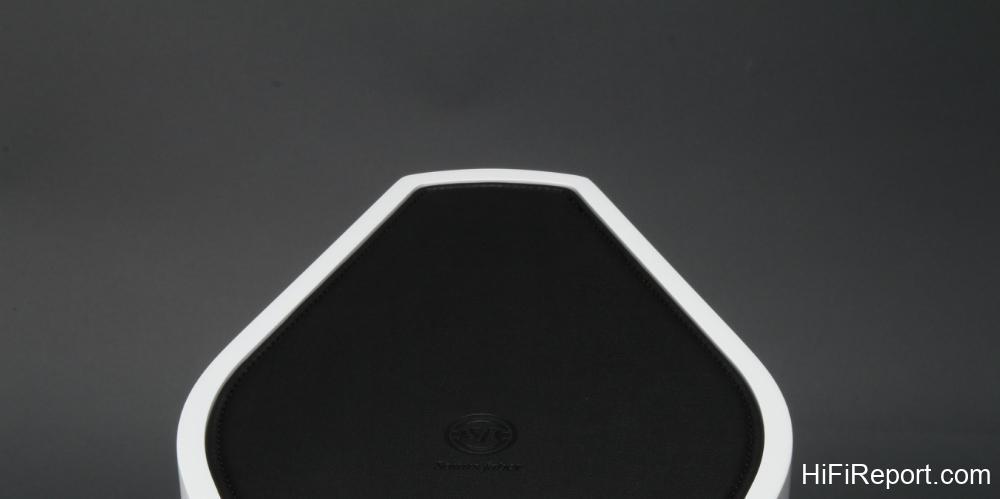
Now, let’s turn our attention back to the Sonetto I. I must tell you upfront, if you, like me, appreciate beautiful design, I can guarantee this speaker will not disappoint! That might sound like hyperbole, but allow me to elaborate. As I carefully unpacked the Sonetto I, lifting the cabinet out of its box, the moment my palm touched the leather top panel embossed with the Sonus Faber logo, I gasped internally. The texture was simply divine – incredibly comfortable and smooth!
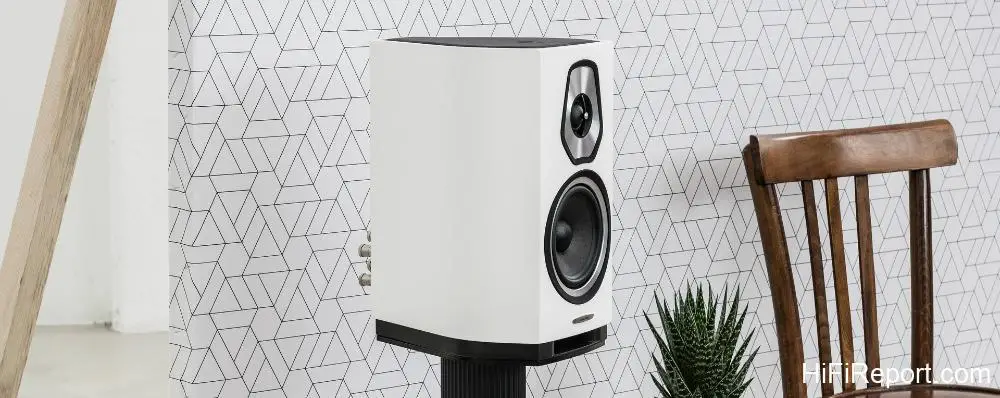
Although the Sonetto I weighs only 5.5 kilograms (not particularly heavy) and its dimensions are modest (approximately 35.9cm high, 21.9cm wide, and 30.5cm deep), holding it for long periods still causes arm fatigue. As delightful as the leather felt, I had to place it on its stand. With both speakers in position, I finally got a clear view of their full glory. The pair sent by the manufacturer was the white finish version.
Initially, it struck me as understated, but after examining it for a while in situ, I realized how much I grew to love the appearance of these bookshelf speakers.
The white finish on the Sonetto I isn’t typical piano lacquer. It uses a matte finish that resists fingerprints and has a touch that’s just as smooth and comfortable as the leather top panel, seamless to the touch. Looking down at the speaker from above, you can see the cabinet adopts the lute shape popular in Europe from the Middle Ages to the Baroque period. Acoustically, this design avoids parallel internal surfaces, reducing internal standing waves and minimizing cabinet coloration.
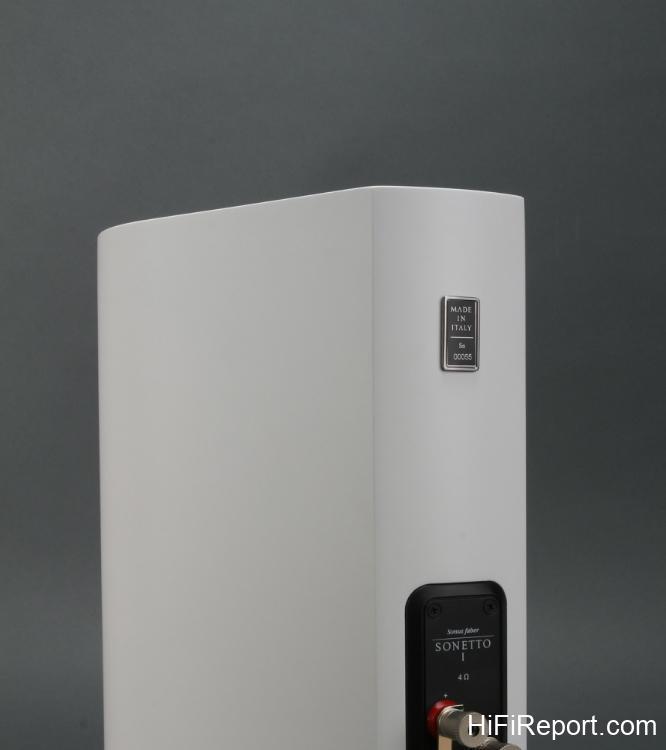
Looking at the details, the rear of the Sonetto I speaker features a nameplate displaying the unique serial number and proudly stating “Made in Italy.” If, like me, you value a speaker’s heritage, this little detail could earn it significant bonus points! The speaker terminals at the rear are configured for bi-wiring and feel equally high-quality. From an aesthetic standpoint, the Sonetto I resembles a graceful woman, possessing both allure and a sense of composed elegance.

It’s not an exaggeration to call it a piece of art. Finding a speaker with such exquisite craftsmanship in the sub-$3,000 USD price range is exceedingly rare. Once you see them in person, you’ll be tempted to place a pair in your living room; I certainly was.
Technical Design and Features
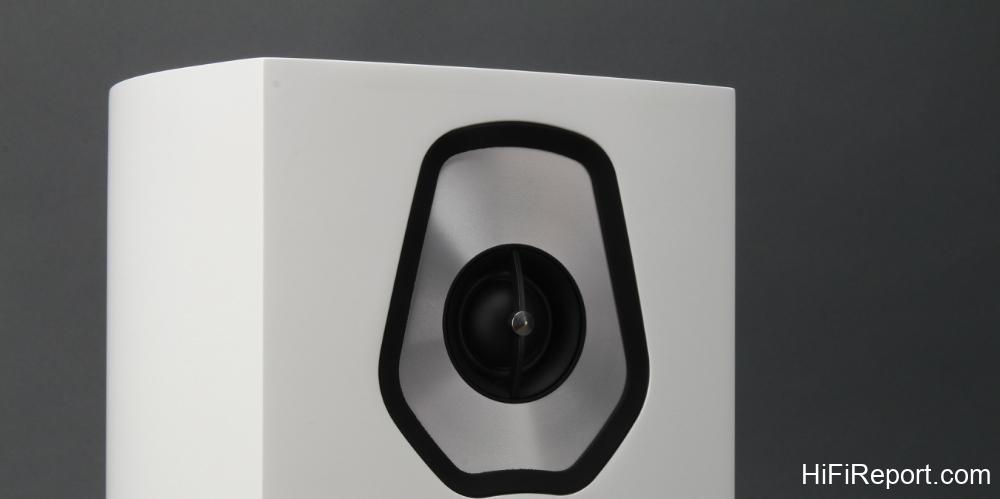
Having praised the aesthetics, let’s move on to the Sonetto I’s design details. The tweeter features Sonus Faber’s exclusive DAD (Damped Apex Dome) design. This translates to a “Damped Apex Soft Dome tweeter.” According to the manufacturer, this technology trickles down from the high-end Olympica series.
The specific implementation involves placing a metal wave guide spike in front of the soft dome diaphragm, with a small piece of damping material positioned behind the spike, slightly touching the apex of the diaphragm.
So, what makes the DAD design unique? When a soft dome diaphragm vibrates, the vibration isn’t uniform; it tends to concentrate more towards the outer edge. As frequency increases, this outward movement becomes more pronounced. In this scenario, the center of the diaphragm can experience unnecessary vibration or deformation, negatively affecting sound quality and potentially introducing unwanted coloration.
The DAD’s design, where the damping material lightly touches the diaphragm’s apex, reduces the likelihood of central deformation. This effectively minimizes coloration and improves sound performance – a truly clever and refined engineering solution.
For the Sonetto I’s mid-woofer, the diaphragm utilizes Sonus Faber’s signature blend of natural fibers and paper pulp, crafted to achieve the “Voice of Sonus Faber” so highly regarded by many audiophiles. If I were to describe it, it would be characterized by warm, soft, and full-bodied mid-to-low frequencies. Furthermore, the Sonetto I’s crossover employs “Paracross Topology.”
The manufacturer uses a semi-balanced crossover design where some passive components like capacitors, inductors, and coils are placed on the negative rail of the circuit. This effectively reduces radio frequency interference, resulting in better resolution from the speaker.
Incidentally, the bass reflex ports on all Sonetto series bookshelf speakers are located at the bottom front of the cabinet. They are designed as carefully calculated, elongated slots that flare out to the sides. The manufacturer states that this approach enhances bass extension, making the overall sound fuller, while simultaneously reducing coloration and improving transient response.
Beyond sonic performance, this design also makes speaker placement considerably easier for audiophiles, eliminating concerns about affecting sound quality by being too close or too far from the rear wall.
Listening Experience
Having waxed lyrical about the design and features, while I deeply admire the Sonetto I’s appearance, sound performance must be judged by ear; it can’t pass the test so easily! Considering its mid-range positioning and aiming to simulate a typical home setup, I paired it with an Audiolab 6000A integrated amplifier, using an in-house Cambridge CD player as the source.
Now, let’s talk about how it actually sounds. Given the manufacturer’s confidence in the Sonetto I’s bass and transient response, I wasn’t going to miss the opportunity to test this. I chose the soundtrack to the film “The Pacific” for the test. As soon as it played, I was genuinely impressed. These small speakers managed to portray such precise localization and layering!
What I appreciated even more was the Sonetto I’s exceptional performance with instruments – their presence and form felt incredibly complete.
To thoroughly evaluate the performance across different types of instruments, I then played Itzhak Perlman’s collection of violin pieces. Once I started, I simply couldn’t stop. The Sonetto I’s rendition of string instruments is outstanding. The violin had a glossy, almost tactile sheen, with a hint of ‘fleshiness’. I could even hear the subtle details of the performer pressing on the strings.
During dynamic shifts and bursts in the music, the Sonetto I remained perfectly composed and articulate. These qualities completely engrossed me; I didn’t realize I had already played five tracks. It’s a shame this was just a review; I could easily listen all day and never get bored!
But why didn’t I mention the bass performance earlier? Because in the music I had played so far, I hadn’t heard earth-shattering, grand-scale bass. I began to wonder internally, while the low-end extends down to 45Hz, it shouldn’t be *this* subtle. Could there be an issue with the Sonetto I’s bass? To verify its low-frequency capability, I selected Michael Jackson’s “Billie Jean” for testing. This time, what I heard was solid, full-bodied, and powerful bass.
It became clear that the bass was indeed there; it just wasn’t artificially exaggerated.
Why the difference? It turns out the Sonetto I’s various design elements are aimed at minimizing coloration across the board. So, when playing different types of music, the performance of all instruments remains faithful to the original recording. Typically, speakers are designed to minimize coloration in the mid, upper-mid, and high-frequency ranges.
However, achieving low coloration in the bass region is much more challenging, as it is significantly influenced by cabinet design, listening room acoustics, and speaker placement. Minimizing bass coloration is a true test of a manufacturer’s expertise.
To confirm my hypothesis, I subsequently played a wide range of music genres, including jazz, pop, electronic music, and band performances. After listening, I arrived at a conclusion: the Sonetto I is like water; it adapts to different musical genres, taking on different forms. Here’s a small anecdote: while I was testing the Sonetto I’s bass with pop music, a colleague, curious, walked into the listening room and exclaimed, “I thought that was floorstander bass!”
Clearly, its low-frequency performance is of a notable standard.
Taking Bill Evans Trio’s album “Portrait In Jazz” as an example, the plucks of the bass strings in the music were solid and distinct, note by note. I could even vividly picture the musician’s fingers hooking the strings and the brief moment of friction. Sometimes orderly, sometimes surging with energy, the bass remained perfectly stable and solid, never fluctuating unexpectedly in volume.
However, given the Sonetto I’s pure Italian heritage of beautiful sound, I had to listen carefully to its vocal performance. For this, I chose Diana Krall’s album “The Look of Love.” The moment she was about to sing, I knew it – this was indeed Italian beauty in sound! The vocals were precisely centered and placed prominently forward. The imaging was concrete, the mouth shape complete, and the phrasing was utterly seamless.
Every breath, every exhalation was clearly audible, with just the right amount of moisture and perfectly natural sibilance. The overall presentation was moving and warm.
After extensive testing, I can confidently say that the Sonetto I performs exceptionally well with all types of instruments, portraying them naturally and brilliantly. Even the electronic effects produced by synthesizers had a nice sense of dimensionality. Across various music genres, it delivered excellent layering and conveyed hall ambiance and natural spatiality beautifully. To put it simply, like its appearance, it is poised and elegant, yet capable of significant dynamic impact.
Conclusion
If your current equipment has seen better days, or if the “upgrade bug” has bitten again, I highly recommend giving the Sonetto I a chance!
Key Features
* High-end DAD tweeter design
* Mid-woofer diaphragm made with a blend of natural fibers and paper pulp
* Elongated bass reflex port located at the bottom front
* Cabinet design inspired by the traditional lute to minimize coloration
* Pure Italian heritage
Specifications
* Design: 2-way, bookshelf, bass reflex
* Drivers: 29mm silk dome tweeter with DAD design x 1, 150mm paper pulp and natural fiber cone mid-woofer x 1
* Crossover Frequency: 2,500Hz
* Frequency Response: 45Hz – 25kHz
* Impedance: 4 ohms
* Recommended Amplifier Power: 30W – 150W
* Sensitivity: 87dB SPL (2.83 V / 1m)
* Dimensions (H.W.D.): 359 (1,090 including stand) x 219 x 305mm
* Weight: 5.5 kg