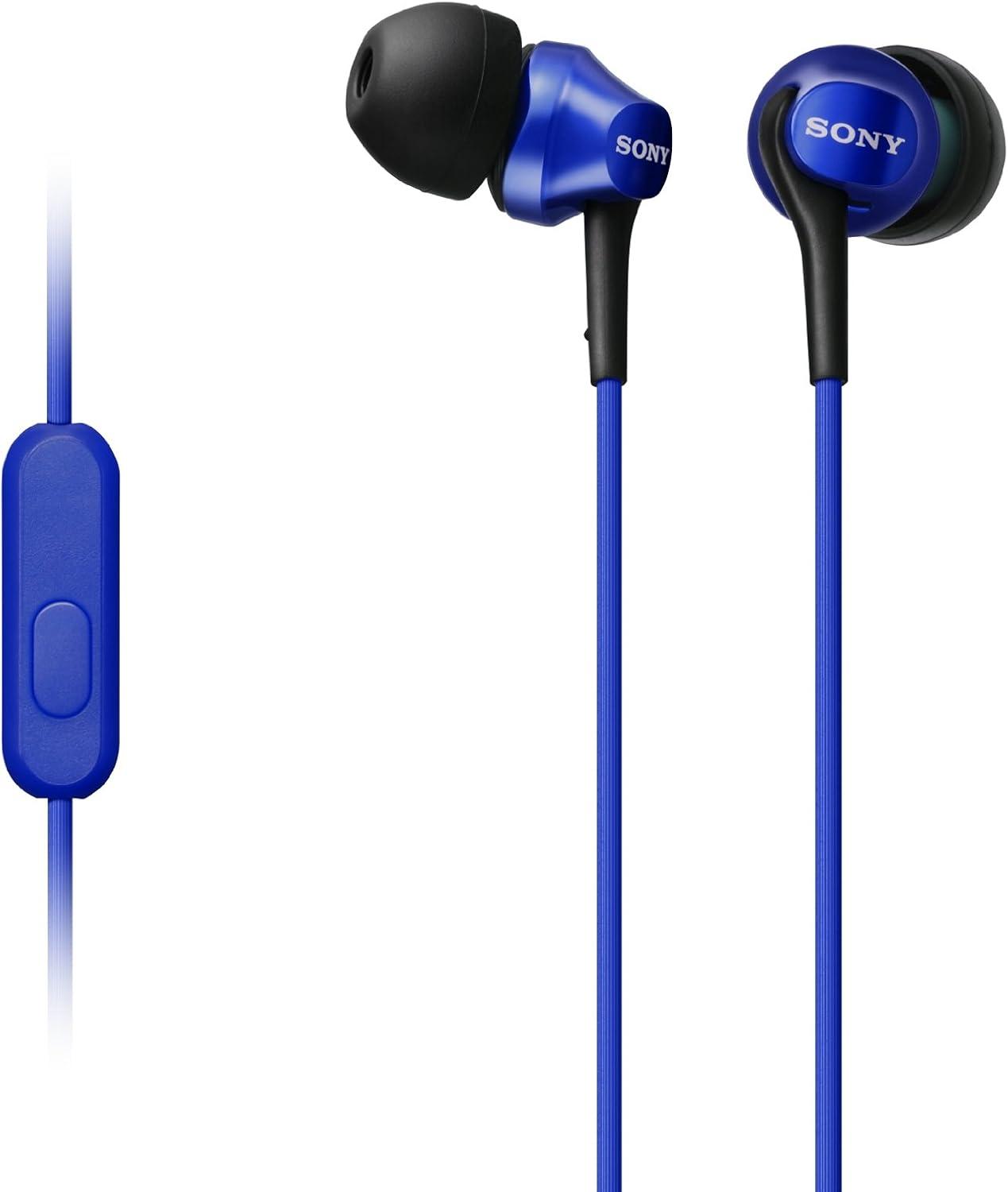
Sony MDR-EX100AP/L In-Ear Headphones Review
The Sony MDR-EX100AP/L pairs a 9mm high-sensitivity driver with an angled earbud structure and a tangle-free serration cord, placing it in the wired, plug-in in-ear tier of Sony’s EX lineup. No battery, no Bluetooth handshake, no charge case: a set of earbuds with an Android-ready inline remote, a hands-free microphone, and a Blue finish built for daily pocket carry. The listening verdict below draws on owner reports spanning several years of real-world abuse and on the limited spec documentation Sony provides for this model.
The Numbers First
- Driver: 9mm high-sensitivity units
- Fit architecture: Angled earbud structure for stable seating
- Cord: Tangle-free serration pattern
- Remote: Inline control for Android phones
- Microphone: Hands-free talking
What’s Inside
Sony’s product listing documents the 9mm high-sensitivity driver, the angled housing that tilts the driver into the ear canal for a more stable seal, and the serration-pattern cord that resists self-tangling. The listing describes the set as “powerful, high quality ear buds offered in a variety of eye-catching colors,” and the Blue finish is one of several available options. The acoustic chamber interior, crossover topology, and diaphragm material are not described in the available sources, so this review does not speculate on them. What the owner reports add is that the set ships with four sizes of silicone ear tips, an L-shaped strain relief where the cord meets each bud body, and an inline remote block. On the Android variant, that remote carries a single pushbutton: one press triggers play or pause, a double press skips or rewinds the track, and the mapping is configurable through the phone. The construction is predominantly plastic, and the tips detach for replacement, a practical detail at this tier.
Tuning and Sound Signature
The MDR-EX100AP/L delivers a presentation that is broadly balanced but leans toward elevated bass and strong treble, with the upper-mid region sitting a shade lower than its neighbors. The most detailed owner account rated each band on a 0-to-10 scale: bass-low and bass-mid land at 7, treble-high at 7 to 8, while mid-high drops to 4 and mid-mid to 5. The result is a sound where pop vocals and lead guitar still cut through clearly, but the overall envelope reads wider and more energetic than a strictly flat response. Sony’s stated design intention is evenly balanced levels across the full frequency range, yet the execution tilts the mids down slightly, producing what one owner called a “loudness” character: elevated bass, elevated highs, and a recessed mid band that keeps the presentation forward without sounding distorted.
Bass Response
Owners consistently describe the low end as punchy and strong rather than sub-bass heavy. One reviewer who had spent a year on high-end over-ear headphones found the EX100AP/L’s bass depth competitive with sets costing far more. A contrasting voice from a semi-professional musician flagged that when the tip seats fully in the canal, the bass takes on a boomy, slightly congested character, like standing next to a large speaker. The same low end reads as engaging to one listener and as smeared to another, and the difference tracks how deeply the silicone tip seats. Among the budget sets one owner had cycled through, the EX100AP/L produced more full bass than Panasonic, JVC, and Skullcandy earbuds in the same tier, edging those competitors on low-end extension while staying below the Sennheiser pair it had been replacing.
Mids and Highs
The midrange carries vocal and pop material well, with one owner noting that mids are “delivered with satisfaction” and that pop and vocals sound very good at normal listening levels. The treble extends further than many owners expected from an entry-level set. A guitarist and long-time listener noted that lyric detail became audible in tracks where pricier buds had masked it, specifically citing the Stone Temple Pilots self-titled album as a test where previously hidden vocal lines came through clearly. A binaural-audio fan reported that 5D-sound clips rendered with a spatial quality that mid-tier headphones did not match. The caveat, echoed by multiple owners, is that the high end runs hot out of the box. One podcast-centric listener found sibilant consonants piercing until they pulled the three upper EQ bands down on the phone, after which the same set sounded, in their words, wonderfully rich for both music and spoken word.
Time With the Music
Daily commuting is where the EX100AP/L earns its keep. One owner rode the metro to school every weekday for a full year and rarely lost a pair to mechanical failure. A runner reported pushing the buds back into their ears a few times during an hour-long run, a minor annoyance rather than a deal-breaker. The serration cord, which owners specifically call out as a tangle-resistance feature, goes into a pocket or bag and comes out in one loop rather than a knot. One owner noted the ridged cord pattern, subtle in the hand, keeps the cable from sticking to itself, reducing tangling noticeably compared with the Apple EarPods they had been using. The L-shaped strain relief at the jack end adds a mechanical margin that the same owner credited with keeping the cord alive after a year of daily pocket carry.
For music, the set handles bass-heavy electronic genres, rock, and podcast narration in a single pass. An owner who listens to trance, house, and techno while working out described the low end as far richer and fuller than a cheaper Panasonic set they had been using, and specifically called out the lows as the deciding factor. The same reviewer flagged that for pure spoken-word audio, the cheaper alternative saved money, but for music of any kind the EX100AP/L pulled ahead. Binaural and spatial-audio content is a niche but enthusiastic use case: one owner played a 5D door-knock clip and described the effect as very trippy, noting that more expensive headphones did not reproduce it as cleanly.
Durability reports skew strongly positive. A set that survived multiple washing-machine cycles, a gravel driveway, and an indeterminate stretch of rain in the sun still played without a change in tone. Another owner has cycled through four pairs since 2012 and lost none to mechanical failure, only to misplacement. The tips are the weak point: one reviewer replaced the medium silicone tips after a year of daily carry, and another had to swap in a larger size because the stock tips compressed in their ears.
Against the Field
Third-party comparison testing for the MDR-EX100AP/L is thin in the available sources. Sony’s consumer-audio web pages spotlight the WH-1000XM4C and the 1000X wireless line, and no independent lab or publication excerpted here benchmarks this model against a fixed competitor set. What the owner base reports is anecdotal but consistent: the EX100AP/L sits just above Apple’s bundled EarPods in clarity and bass extension, undercuts the Panasonic RPTCM125A for music while matching it for calls, and edges out JVC and Skullcandy sets in low-end fullness. One owner who had tried over 30 sub-100-dollar earbuds from various brands placed the EX100AP/L above all of them in balance and distortion, a strong claim that tracks with the 4.1 aggregate across 870 reviews.
The lineage context matters for buyers comparing within Sony’s own catalog. The EX100AP/L is the direct successor to the DREX61IP and MDR-EX38iP, and one long-time Sony owner noted the three share identical components with only cosmetic and model-number changes. A 2015 update from the same owner pointed to the MDR-EX110AP as the US-market replacement, carrying the same acoustic hardware without the iPhone volume remote. Sound quality between the EX100 and the EX110 was described as perceptually identical. An owner who had been running Apple EarPods as a daily baseline and then auditioned an Etymotic MC3 found the EX100AP/L’s tonal balance in the Etymotic neighborhood, a useful anchor for anyone weighing wired in-ear options across brands.
Owner Feedback
The 4.1-out-of-5 rating across 870 reviews lands in the solidly positive zone with a visible complaint tail. The praise clusters around three themes: balanced-to-forward sound that punches above the entry tier, the tangle-free serration cord, and a durability record that surprises owners who expected a cheap plastic set to die within a year. Comfort for extended wear shows up repeatedly, with several owners noting they can wear the buds for hours without switching to something else. One owner simply reported two years of continuous use and called the sound quality “absolutely fantastic” without any modification.
The complaints split into a smaller group. The inline microphone draws the harshest language. One owner called it virtually useless, reporting that callers on two different phones described them as quiet and muffled, and they abandoned the mic for speakerphone. Another owner found it nothing special but workable in quiet environments. Fit retention is the second friction point: multiple owners report the buds working slightly loose over the course of an hour, especially during running, and one noted that even a 1-millimeter shift out of the canal changed the tonal balance noticeably. The high end running hot without an EQ adjustment is the third recurring note, with one owner recommending a custom EQ profile as a precondition for a comfortable listening experience.
Pros and Cons
Pros:
- Balanced-to-forward tuning with strong, punchy bass and extended treble
- Tangle-free serration cord that resists knots in pockets and bags
- Angled earbud structure holds well in most ears for extended sessions
- Owners report sets surviving years of daily abuse, wash cycles, and drops
- Android inline remote with programmable single-press and double-press functions
Cons:
Copyright hifireport.com. Republishing, scraping, or reselling this text is prohibited.
- Inline microphone picks up clothing rustle and ambient noise; callers report muffled audio
- Buds shift slightly out of the canal over time, altering the tonal balance
- High end runs hot out of the box; owners recommend EQ adjustment for comfort
- Stock silicone tips compress and may need replacement within a year of daily use
- No third-party comparison testing is available to confirm relative positioning
Bottom Line
The MDR-EX100AP/L is the set for a daily commuter, a runner who needs a wired option that will not tangle, or a podcast-and-music listener who wants a single pair of buds that handle both without a second device. The tuning leans forward, so someone who craves a flat, reference-style sound will find the upper-mid dip and treble lift grating until they engage an EQ. The mic is a convenience for quiet environments, not a replacement for a noise-canceling headset on a busy street. If the profile fits, the durability track record and the tangle-free cord make this a low-maintenance, replaceable-pair purchase that owners treat as a weekly-carry item.
Copyright hifireport.com. Republishing, scraping, or reselling this text is prohibited.
Specifications
- Model: Sony MDR-EX100AP/L
- Type: Wired in-ear headphones
- Driver: 9mm high-sensitivity
- Fit: Angled earbud structure
- Cord: Tangle-free serration pattern
- Remote: Inline control for Android phones
- Microphone: Hands-free talking
- Color: Blue
- Ear tips: Multiple sizes included
- Aggregate rating: 4.1 out of 5 (870 reviews)
Common Questions
Does the Android remote work with any phone, or only specific models?
The remote uses the standard Android three-button connector, so it works with any Android phone that supports that port. One owner confirmed it also operates a MacBook Pro for volume and play/pause, and a 2012-generation iPod nano for volume. The pushbutton supports single-press for play or pause and double-press for skip or rewind, with the exact function configurable in the phone settings.
Will the ear tips hold during a run, and what if they loosen?
Most owners find the angled structure seats securely for walking and sitting, but several report the buds shifting 1 to 3 millimeters out of the canal after an hour of movement. The fix is to try the smaller tip size, which one owner found gripped better at the cost of some bass isolation. The set ships with four tip sizes, and replacement tips are available from third-party vendors and fit across the Sony MDR-EX and DREX series.
Copyright hifireport.com. Republishing, scraping, or reselling this text is prohibited.
Can I replace the inline remote or cord if it fails?
The sources do not document a user-replaceable cord or remote for this model. The L-shaped strain relief and serration pattern are designed to last, and multi-year owner reports show no widespread cord failures. When a tip wears out, it detaches and is swapped; the remote and cord are integrated into the assembly and are not sold as separate spares. One owner who lost a medium tip sourced a third-party replacement set that fits the MDR-EX connector without modification.
How does the microphone perform on calls in a noisy environment?
In quiet settings the mic is workable, and one owner reports callers rarely ask if they are on speakerphone. In noisy areas, however, the mic picks up clothing rustle and surrounding sound, and one owner described the result as muffled and quiet to the other end. The practical workaround owners use is to switch to the phone’s built-in noise-canceling microphone for important calls and keep the EX100AP/L mic for quiet environments. The mic is a basic condenser element with no active noise cancellation, so it captures the caller’s nearby voice without filtering ambient sound.

- Convenient Remote Control For Android Phones
- Microphone For Hands-Free Talking
- 9mm High-sensitivity Driver Units For Premium Sound Quality