
Sony SRS-RA5000 and SRS-RA3000 Review
In early December 2020, under a non-disclosure agreement, I had my first encounter with the Sony SRS-RA5000 and SRS-RA3000 Bluetooth speakers in a large conference room at Sony’s office. In that vast space, designed to accommodate dozens of people, these miniature SRS-RA5000 and SRS-RA3000 speakers began to play music. To my astonishment, they filled the entire room with beautiful sound, evenly dispersing it into every corner. I was immediately impressed. When the SRS-RA5000 and SRS-RA3000 units arrived at the editorial office, I became absolutely certain that these two smart Bluetooth wireless speakers were not only top of their class but also the best-sounding Bluetooth speakers I had ever heard.
Having stated the conclusion right at the beginning, is there still a need for lengthy explanations? Indeed, if you trust my judgment, you can skip the rest of this article and rush directly to a Sony Store to pick one up, or even simpler, just swipe your finger online, have it delivered to your doorstep, and immediately enjoy the “best-sounding smart Bluetooth speaker currently available.”
(Image/Provided by Sony)
Completely Disrupting Time Phase
Hold on, is it too hasty to make a purchase based solely on the editor-in-chief’s word? Alright, you need more evidence to explain why the SRS-RA5000 and SRS-RA3000 are “currently the best-sounding” Bluetooth speakers.
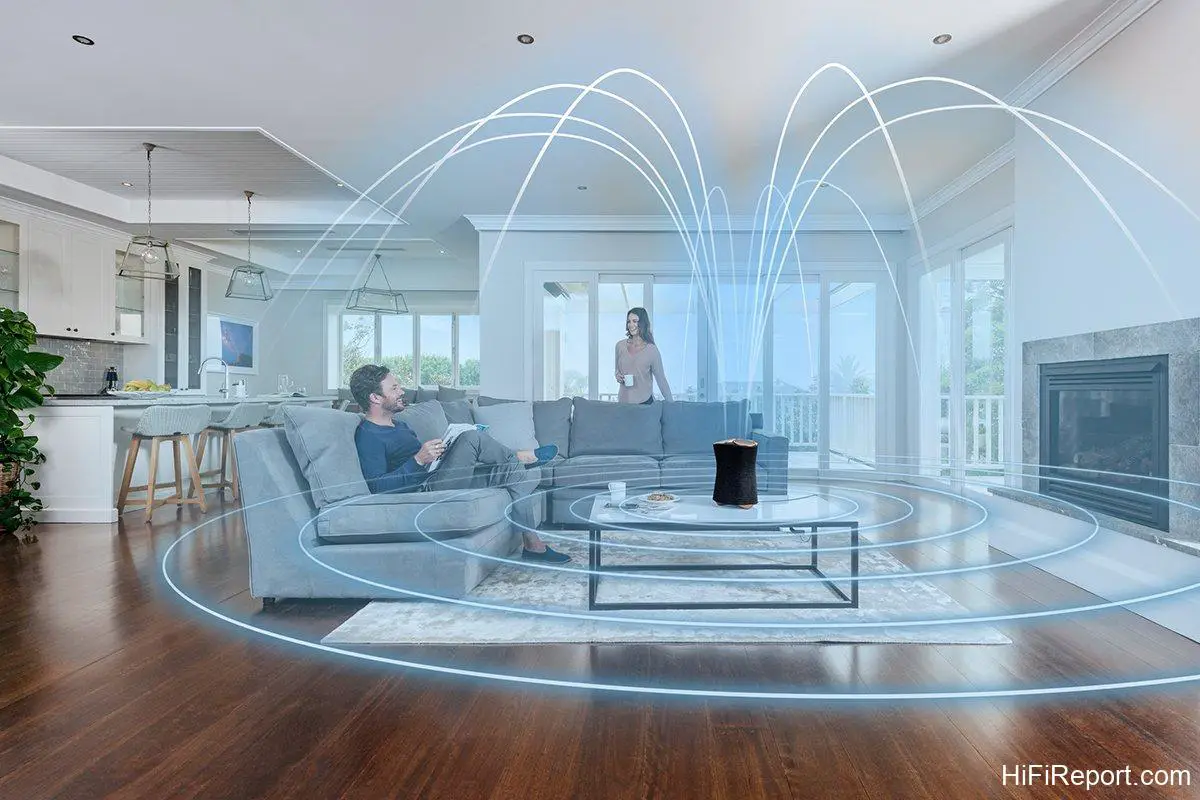
Let me focus on one key aspect: they completely disrupt time phase, creating unprecedented uniform sound wave diffusion, making every spot in the listening space a sweet spot.
At Sony’s private media presentation, the product manager was well-prepared, with over half of the dozens of PPT slides filled with technical information. They even brought up the Haas effect (Precedence effect) and Head-Related Transfer Function (HRTF) to explain the technological breakthroughs in the SRS-RA5000 and SRS-RA3000. If your audio expertise were lacking, you might have been lost in the technical jargon. However, consumers are after a novel listening experience, not necessarily interested in the intricacies of Sony’s technology. So, to put it simply, the DSP technology breakthrough in the SRS-RA5000 and SRS-RA3000 transforms a Boom Box speaker into a multi-channel audio system in a single enclosure, allowing music to naturally spread throughout every corner of the listening space.
(Image/Provided by Sony)
Soundbar-like Virtual Sound Field
What? Still a bit confused? Okay, you’ve used a Soundbar, right? Modern flat-screen TVs are getting thinner, but their sound quality is deteriorating because there’s simply no space for speaker enclosure volume. The sound from these TVs becomes dry, flat, and thin. To improve the audio, a 5.1 or 7.1 multi-channel system, or even adding height channels to enjoy Dolby Atmos and DTS:X, is certainly ideal. However, many find it too complicated. Therefore, installing a Soundbar is the quickest and most cost-effective solution. By utilizing spatial reflections and DSP processing, a single Soundbar can simulate Dolby Atmos and DTS:X. Similarly, the SRS-RA5000 and SRS-RA3000 employ DSP processing to uniformly disperse sound waves throughout the listening space, creating ubiquitous sweet spots.
Is DSP really that magical? Yes, it is. However, it also requires a speaker driver configuration based on acoustic physics. The technology is not that simple. But for home use, the SRS-RA5000 and SRS-RA3000 are incredibly simple to operate! They are Bluetooth speakers; simply pair them with your phone and you can immediately enjoy music. Using the Sony Music App, you can control all function settings and enjoy your subscribed digital streaming music.
(Image/Provided by Sony)
Uniform Sound Dispersion to Every Corner
The basic design of the SRS-RA5000 and SRS-RA3000 resembles a compact Boom Box. The essence of a Boom Box is to create maximum sound pressure within a limited enclosure volume and to squeeze out bass that surpasses the speaker’s size. Speakers designed this way often produce sound with a “boom-chick-boom-chick” booming bass. However, to provide sufficient bass presence in larger spaces with a small speaker, this kind of frequency distribution distortion makes sense. After creating sufficient sound pressure, DSP can be used to adjust and achieve a balanced and even frequency response.
Furthermore, the DSP settings used in the SRS-RA5000 and SRS-RA3000 operate on principles similar to Soundbar DSP virtual surround sound. However, their effect is transformed into two-channel audio. The most remarkable aspect is that stereo imaging can be perceived anywhere in the room. The speakers naturally disappear into the space, leaving only the direction of the sound source discernible, yet stereo sound can be felt everywhere. This is unlike traditional Bluetooth speakers, where the speaker’s location is clearly identifiable, and sound waves cannot uniformly spread to every corner of the listening space.
Simultaneous Horizontal and Vertical Dispersion
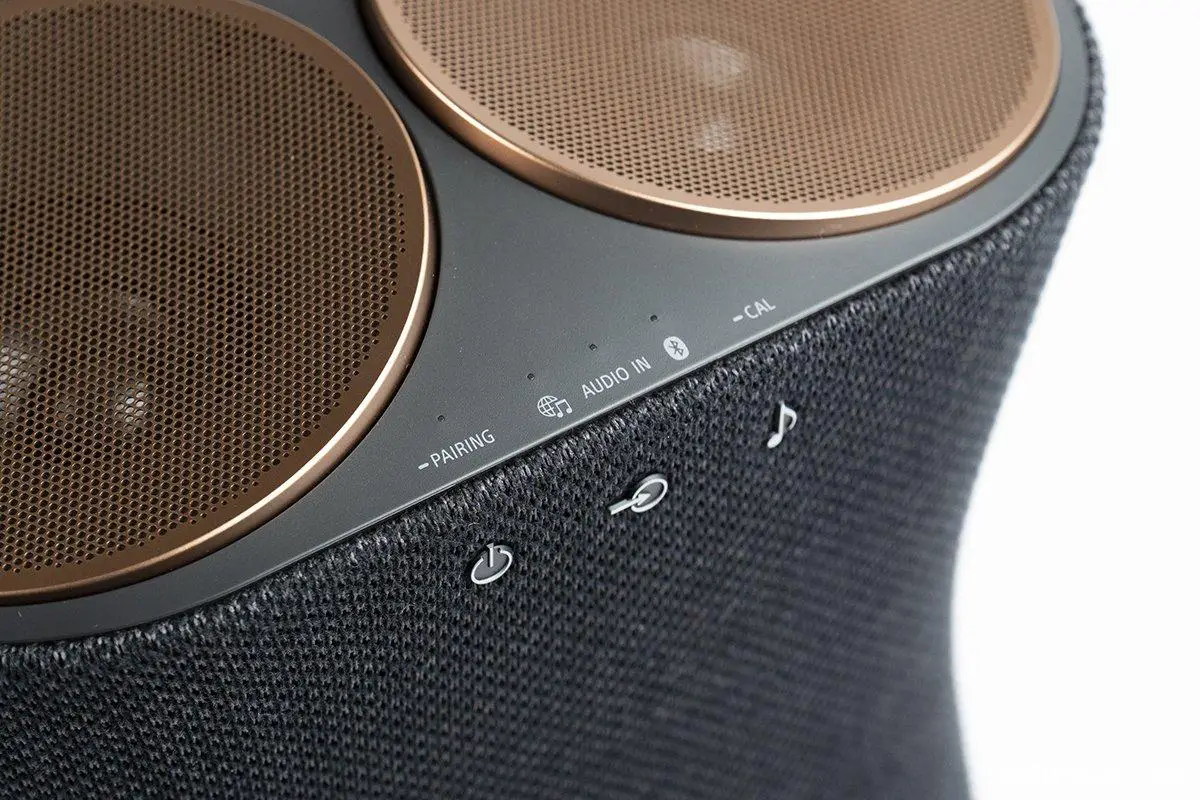
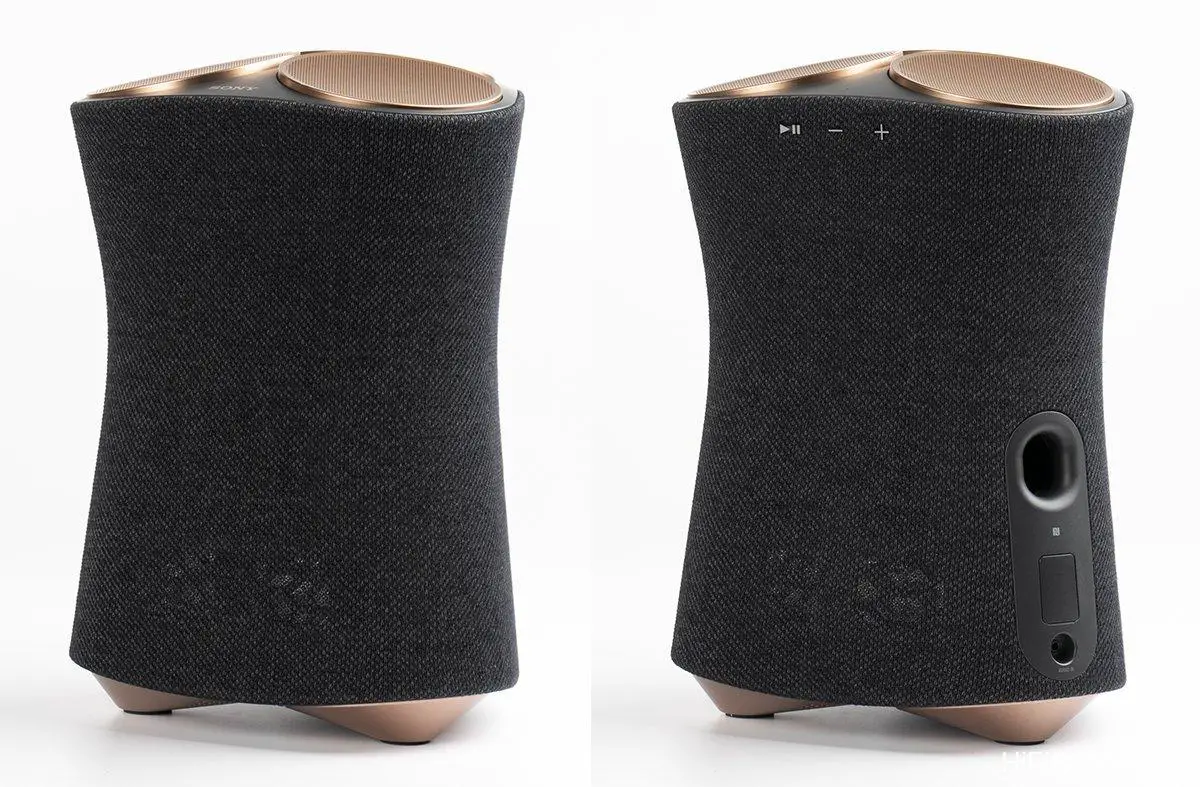
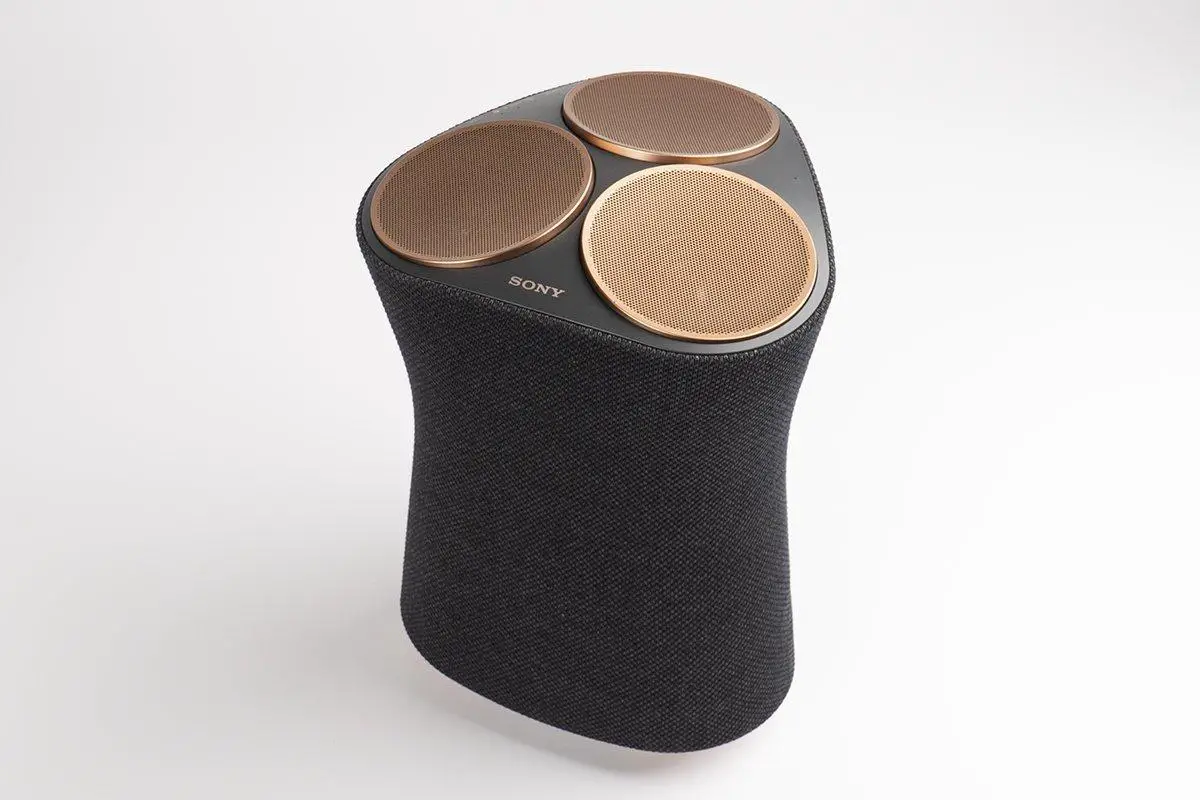
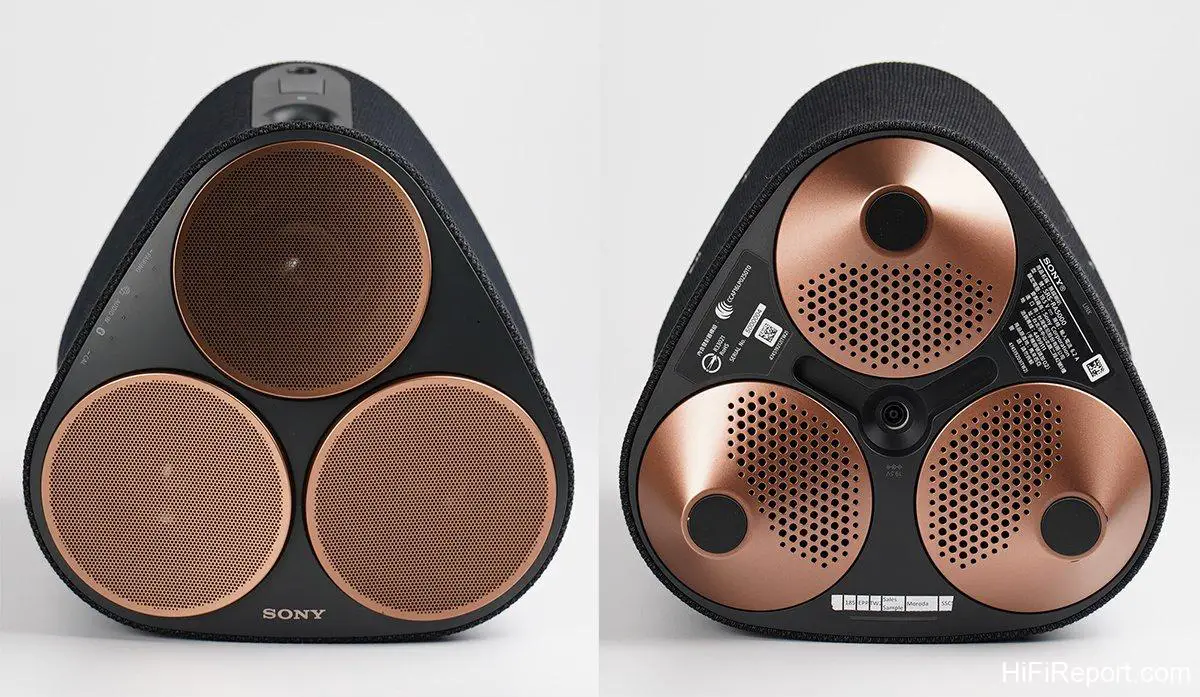
How does the Sony SRS-RA5000 Bluetooth speaker achieve 360-degree uniform sound wave dispersion to every corner of the listening space? Let’s first look at the SRS-RA5000. Its appearance is completely different from traditional speakers. The initial impression is that of an oversized three-headed electric shaver. The three top-firing drivers, combined with the copper-colored speaker grille, contrast with the black cabinet, creating a very unique look that is instantly memorable. However, this design is for sound wave diffusion. On the surface, the SRS-RA5000 seems to have only 3 drivers, but in reality, it’s a 3+3+1 configuration. There are 3 drivers on top, 3 drivers hidden inside the black cabinet, and a subwoofer at the bottom. This multi-driver design creates 360-degree sound from the speaker, considering not only horizontal but also vertical dispersion, thus creating soundstage height.
If you own a Bluetooth speaker and often sit directly in front of it while listening to music, you might have the experience that “it sounds better when sitting.” If you stand up and walk around the room, the soundstage collapses, and vocals lose height, feeling like you’re looking down at the stage. This is because the time phase difference between you and the speaker changes. General Bluetooth speakers have a narrower upward dispersion angle, so a proper soundstage is only achieved directly in front of the speaker. However, the SRS-RA5000 uses 3 drivers to create a 360-degree horizontal sound field, and adds 3 upward-firing drivers, relying on ceiling reflections to create soundstage height. Therefore, the SRS-RA5000 not only has sound reflections from all directions but also reflections from both high and low angles, creating a highly immersive music listening experience.
(Image/Provided by Sony)
Sweet Spots Everywhere at Home
Compared to traditional two-channel speakers, both have direct and reflected sound. However, the point source design theory dictates only one optimal listening position, the sweet spot. Therefore, audiophiles must be meticulous about speaker placement, finding the best location for speakers in the listening space. But Sony, with the creation of SRS-RA5000 and SRS-RA3000, completely breaks the theory of point source design. Acoustically, they use multiple drivers to create spatial envelopment and control it with DSP to refine the sound to be more natural.
How does DSP control sound waves? Basically, it still controls time phase. But Sony’s DSP technology this time is unprecedented, truly achieving “pleasant music everywhere you walk in the room.”
Of course, this pleasant music has a sense of stereo, but it lacks the precise spatial positioning of traditional point-source speakers. However, if you simply want to casually listen to music, rather than meticulously tracking the location of every instrument in the recording, the ubiquitous stereo effect of the SRS-RA5000 and SRS-RA3000 provides an absolutely unprecedented listening experience.
Beauty in Distance
In Sony’s large conference room, I first experienced the DSP spatial sound magic of the SRS-RA5000 and SRS-RA3000. Closing my eyes and walking around the large conference room, comfortable and relaxing music was everywhere. I could only vaguely sense the direction of the SRS-RA5000 and SRS-RA3000 placement and was not entirely sure of the speakers’ locations. When the SRS-RA5000 and SRS-RA3000 were delivered to the editorial office, I didn’t listen to them in the listening room but placed them casually on a coffee table in the office area. Good music was everywhere. Even editors sitting further away from the speakers commented that their position sounded better.
Indeed, the SRS-RA5000 and SRS-RA3000 need some distance to deploy their DSP spatial magic. Listening too close to the speakers, even within arm’s reach, can actually sound worse. This is because the time phase difference controlled by DSP requires reflected sound for calibration. When listening very close to the speakers, the reflected sound doesn’t reach the ears in time, and all you hear is the direct sound from the SRS-RA5000 and SRS-RA3000, resulting in a lack of sound envelopment.
Ideal for Home or Commercial Spaces
The larger SRS-RA5000 is suitable for larger spaces. Sony recommends approximately 660 square feet. The smaller SRS-RA3000 is suitable for smaller spaces, with a recommended optimal area of 396 square feet, which is definitely sufficient for most people. Moreover, multiple SRS-RA5000 and SRS-RA3000 units can be linked together. Even in commercial spaces, wireless linking is easy and requires no additional wiring. Just power them up, and they can create ubiquitous stereo sound in large commercial spaces.
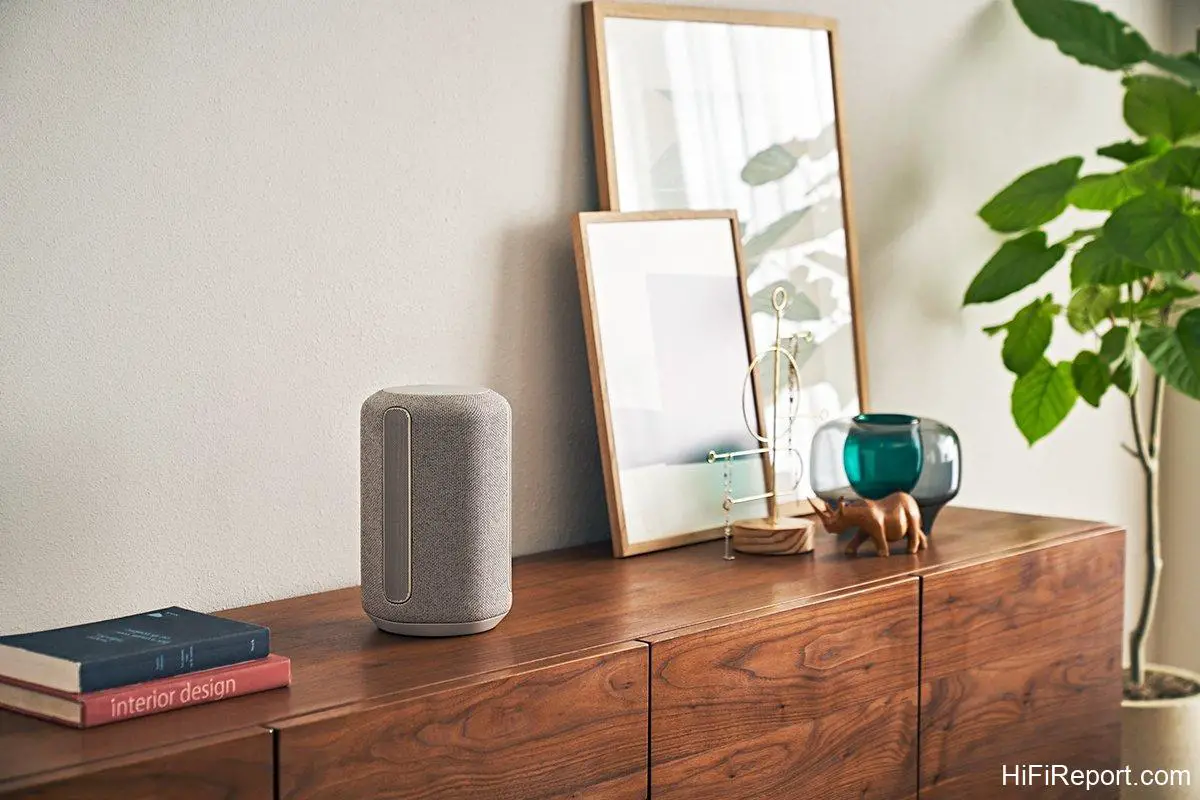
Furthermore, while the two speakers have different appearances, both have appealing designs. Placed in a trendy café, they would certainly fit right in.
The SRS-RA5000 utilizes 7 drivers to create 360-degree sound envelopment. What about the SRS-RA3000? It has a total of 5 drivers: 2 tweeters, 2 passive radiators, and 1 woofer. Only 3 drivers actually produce sound, with the passive radiators merely assisting in adding a bit of mid-bass thickness.
With relatively fewer drivers, how does the SRS-RA3000 create 360-degree sound envelopment? The Sony SRS-RA3000 Bluetooth speaker uses 2 tweeters, 2 passive radiators, and 1 woofer.
(Image/Provided by Sony)

Unique Beam Tweeters
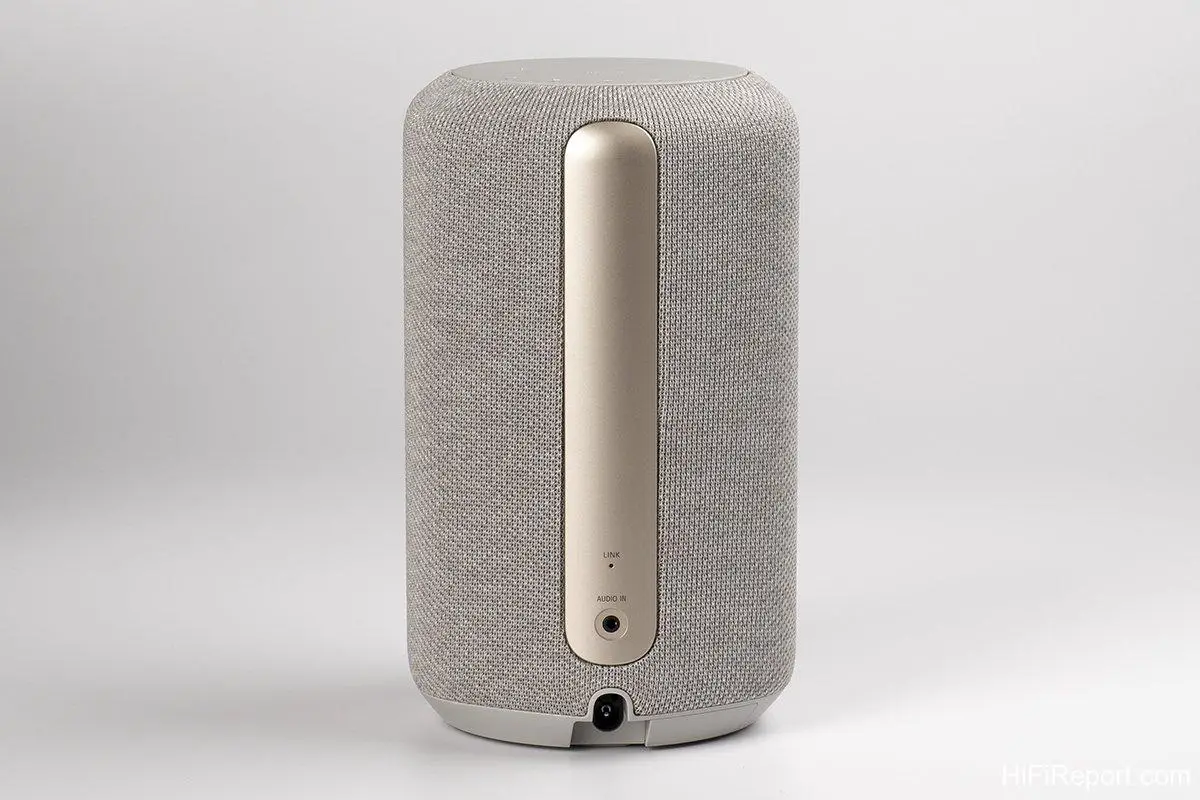
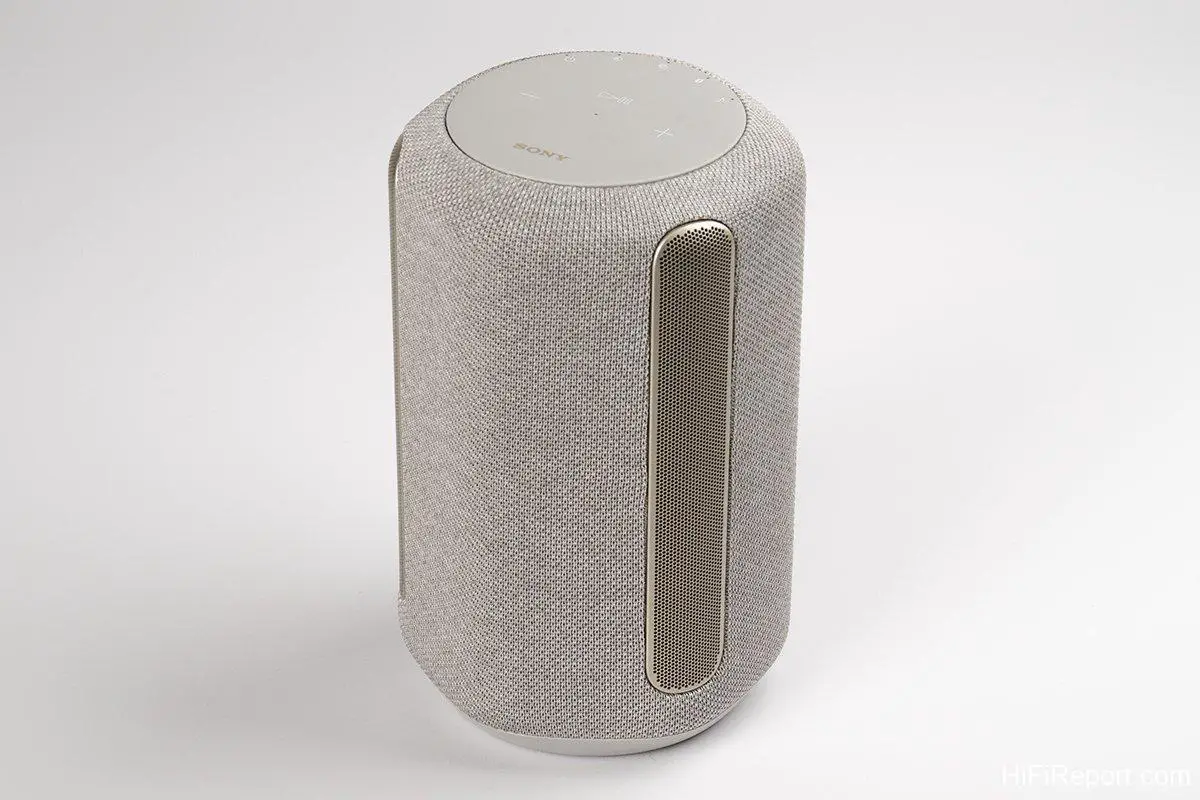
The SRS-RA3000’s cabinet has a hexagonal shape when viewed from above.
Sony employed a rather clever design. The SRS-RA3000’s cabinet is hexagonal when viewed from above. Three of the corners have metal frames, two of which have tiny metal perforations, and one is smooth. The smooth corner has a 3.5mm Line-in input jack at the bottom, and below that is the power socket. This section houses the circuitry. The other two corners are where the tweeters are located, which Sony calls beam tweeters.
One corner of the SRS-RA3000 has a 3.5mm Line-in input jack at the bottom, and below it is the power socket.
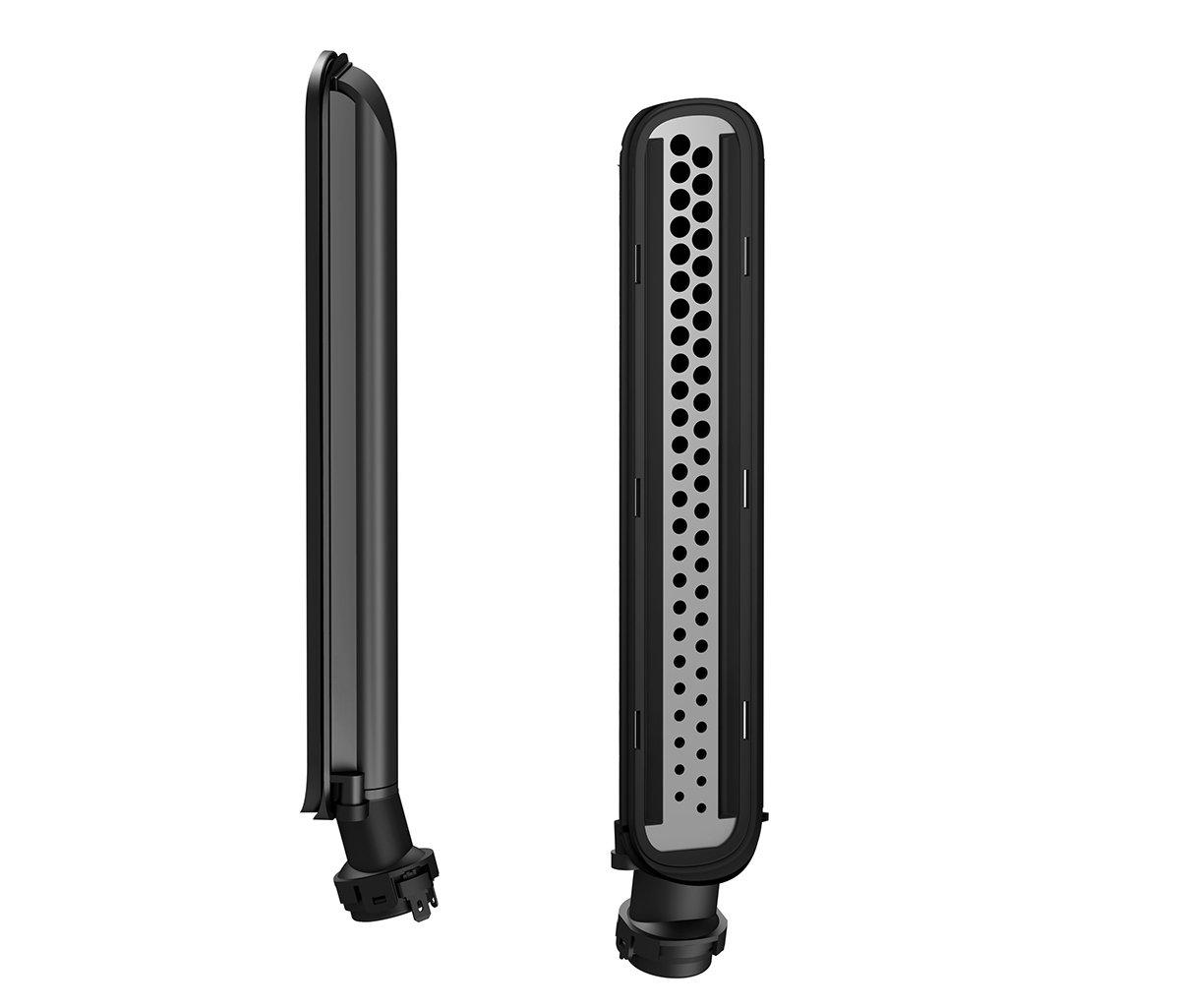
What’s special about beam tweeters? Human ears are sensitive to the directionality of high frequencies. Our ability to discern the direction of sound primarily comes from mid-high frequencies. For lower frequencies, human ears are less capable of perceiving directionality. However, the SRS-RA3000 relies on 2 tweeters, projecting at a 75-degree angle, to disperse the directionality of high frequencies. This is achieved through the beam tweeter’s waveguide. High frequencies are not directly diffused but are diffused outward through the beam waveguide. The tiny perforations disrupt the human ear’s perception of the high-frequency sound source. It seems as if every hole is a tweeter, making it difficult to clearly identify the direction and location of high frequencies.
The beam tweeter used inside the SRS-RA3000.
(Image/Provided by Sony)
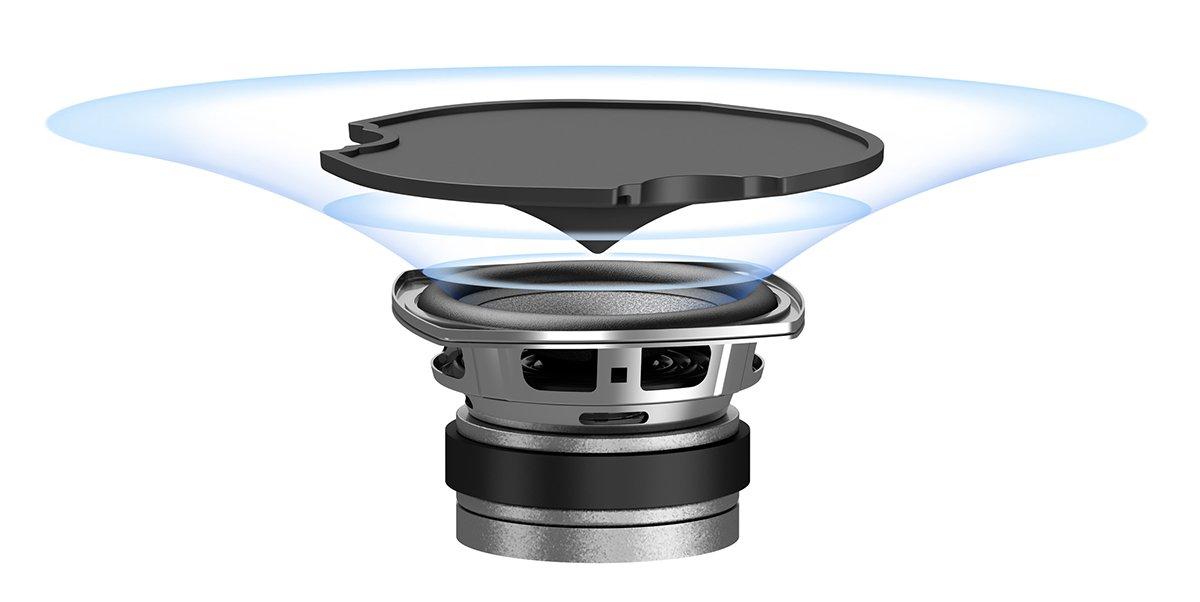
Impressively, by just using beam tweeters, the directionality of high frequencies perceived by the human ear is confused. Then, the built-in full-range driver is used as a woofer, firing upwards, and the driver’s top has a conical diffuser, allowing mid-low frequencies to uniformly disperse 360 degrees. This technology was originally used in SRS-BTV5 / SRS X1 and is now applied to the SRS-RA3000.
The driver’s top has a conical diffuser, allowing mid-low frequencies to uniformly disperse 360 degrees.
(Image/Provided by Sony)
The Only Bluetooth Speaker Addressing Vertical Sound Dispersion
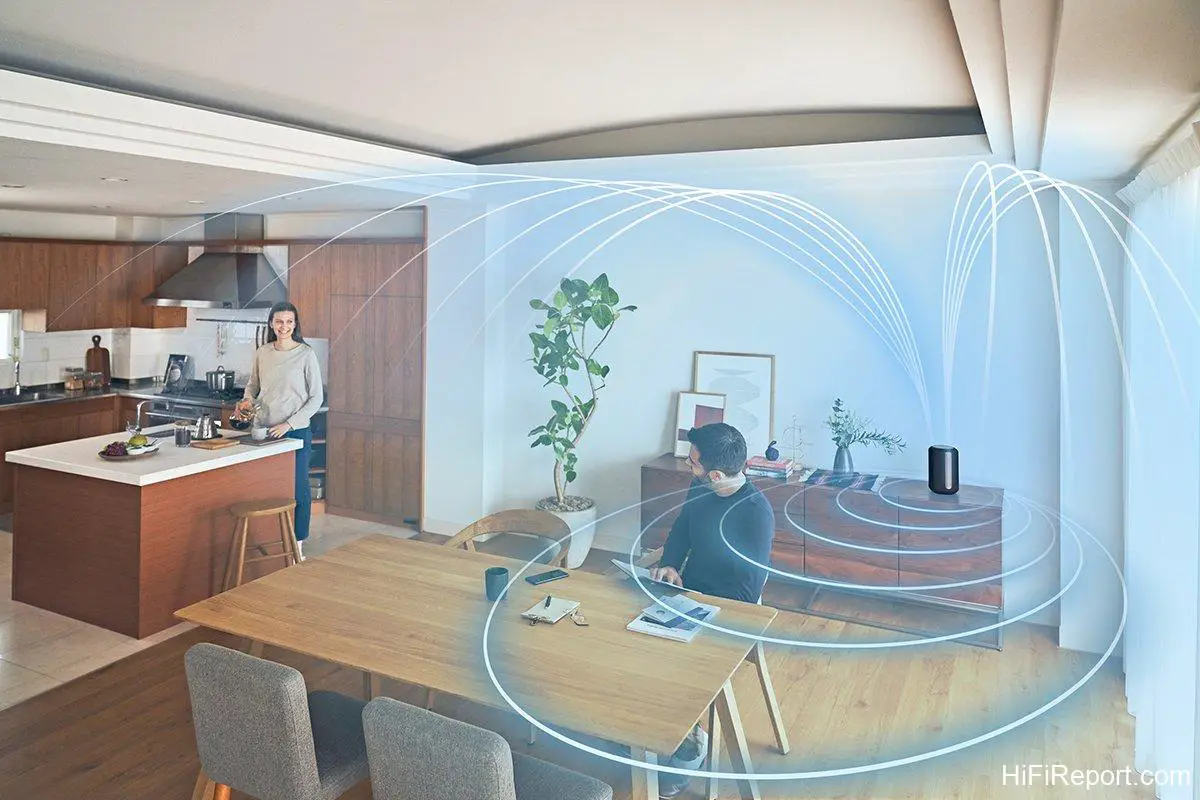
Actually, 360-degree sound-emitting Bluetooth speakers have been available on the market for some time. However, these speakers only consider the horizontal diffusion of sound waves and neglect vertical diffusion. Therefore, they sound good when sitting, but the sound deteriorates when standing up and walking around. But the driver configurations of the SRS-RA5000 and SRS-RA3000 simultaneously address both horizontal and vertical sound wave diffusion. Even when you move around indoors, the sound doesn’t drop to the floor, feeling like you’re looking down to listen to music. It still maintains a comfortable stereo effect.
Listening to the SRS-RA5000 and SRS-RA3000 is a 100% fresh experience. One cannot use traditional two-channel thinking to evaluate these new species introduced by Sony. 360-degree sound-emitting speakers inherently have surround envelopment in terms of physical acoustics. But designs like the SRS-RA5000 and SRS-RA3000, which simultaneously consider horizontal and vertical dispersion angles, redefine 360-degree sound-emitting speakers. Coupled with DSP control, they can uniformly disperse sound waves to any corner of the listening space. I can walk around freely in the listening space and still hear comfortable music, and the volume is roughly the same. The sound doesn’t diminish when moving further away from the speaker. This is the spatial sound magic created by Sony with DSP.
Sufficiently Good Sound Quality and Timbre
Having praised the spatial envelopment of the SRS-RA5000 and SRS-RA3000 so much, what about their sound quality and timbre? I would say they are sufficiently good. Moreover, among Bluetooth speakers in the same price range, the SRS-RA5000 and SRS-RA3000 can be considered to have the best sound quality and timbre.
Do you enjoy listening to Jody Chiang? Try listening to “Holding You Tight.” The ethereal timbre created by the synthesizer in the intro is rendered with clear highs by both speakers. Subsequently, the cello’s bowing has sufficient sonic weight. When Jody Chiang starts singing, her intimate vocals carry a sweet flavor, adorned by acoustic guitar in the background. The best part is that even if you are working while moving around indoors, Jody Chiang’s sweet vocals follow you, sounding good everywhere.
(However, sitting too close to the speaker will make the sound magic disappear.)
Easy Automatic or Manual DSP Adjustment
Is it difficult to unleash the sound magic of the SRS-RA5000 and SRS-RA3000? Not at all. The simplest is the SRS-RA3000, which features fully automatic adjustment. For the first 20 seconds of music playback, the SRS-RA3000 automatically detects ambient sounds, and DSP performs automatic spatial calibration.
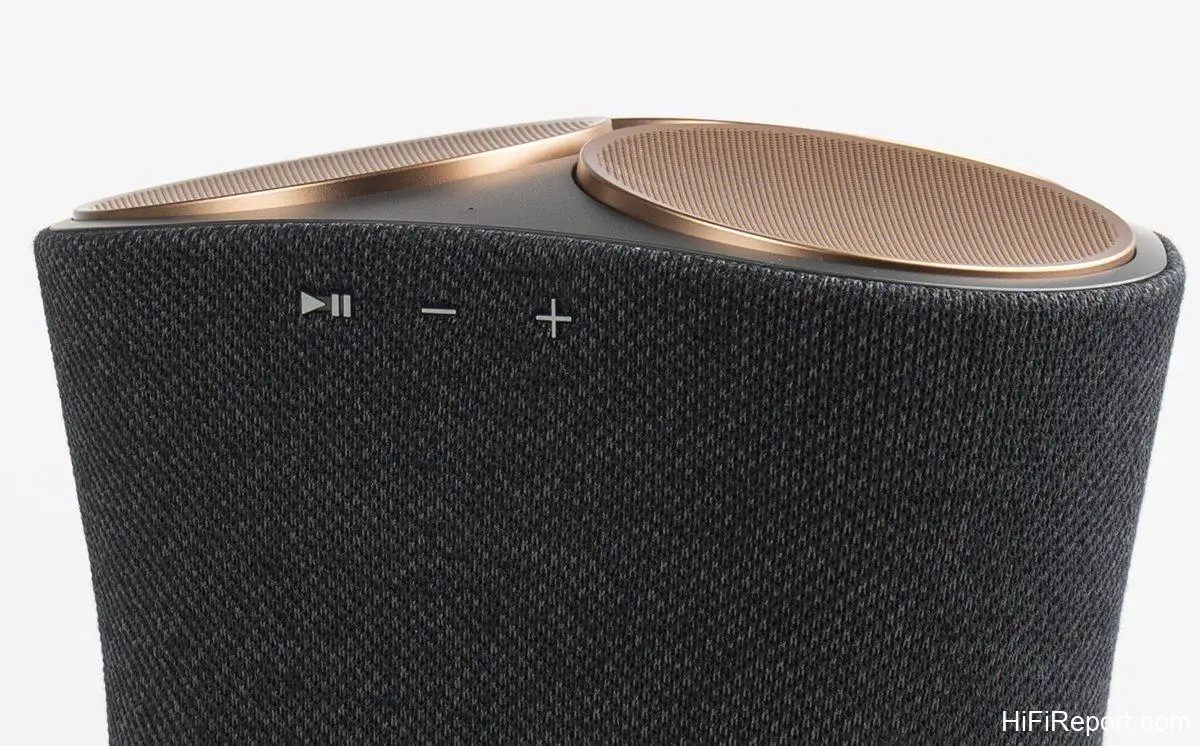
As for the larger SRS-RA5000, due to its larger number of drivers and more complex calculations, it employs manual calibration. Simply long-press the CAL touch button, or use Sony’s Music Connect app for remote control, to activate the spatial calibration function. Voice prompts are activated during startup. The SRS-RA5000 automatically emits test tones and completes the process in a few seconds.
The voice prompt is quite interesting. A female voice says, “Sound Calibration Start. Three, Two, One,” followed by machine-gun-like test tones, creating a countdown launch feeling.
Should spatial calibration be enabled? My answer is always enable DSP spatial calibration. Otherwise, the SRS-RA5000 and SRS-RA3000 will sound like ordinary Boom Boxes, with booming bass, but the 3D imaging will be subpar. Once DSP calibration is activated, Sony’s spatial sound magic is unleashed, and you’ll realize how impressive the SRS-RA5000 and SRS-RA3000 truly are.
Great Sound at Appropriate Volumes
Do you like EggPlantEgg? Listen to “Your Tenderness.” The initial segment features only acoustic guitar and vocals. Both the SRS-RA5000 and SRS-RA3000 can reproduce a comfortable sense of musical envelopment. The larger SRS-RA5000 has better sonic weight and a warmer tonal character, while the smaller SRS-RA3000 has crisper mids and highs, with a brighter sound, which is also good. However, when drums and electric bass join in, the larger SRS-RA5000 appears more composed.
Don’t compare the SRS-RA5000 and SRS-RA3000 with traditional speakers, but rather with other Bluetooth speakers. I don’t usually listen to Bluetooth speakers myself, but my son does, and I often find them noisy, with a grainy feeling in the mids and highs. How about the SRS-RA5000 and SRS-RA3000? As long as the volume isn’t turned up too high, whether it’s Jody Chiang or EggPlantEgg, they sound relaxed and comfortable. And what I mean by “too high” volume is exceeding 80% volume setting. If kept at 50% or below, the SRS-RA5000 and SRS-RA3000 can maintain high-quality performance.
Should you choose the larger SRS-RA5000 or the smaller SRS-RA3000? It depends on your needs. Sony’s answer is room size. For a 660 square feet space, choose the SRS-RA5000; for a 396 square feet space, choose the SRS-RA3000. Also, the upward-projecting sound waves have spatial height limitations. For the SRS-RA5000, the maximum height is 13 feet, and for the SRS-RA3000, it’s 9.8 feet. Exceeding these limits will weaken the effectiveness of Sony’s DSP algorithms. However, most residential spaces typically don’t have ceilings this high.
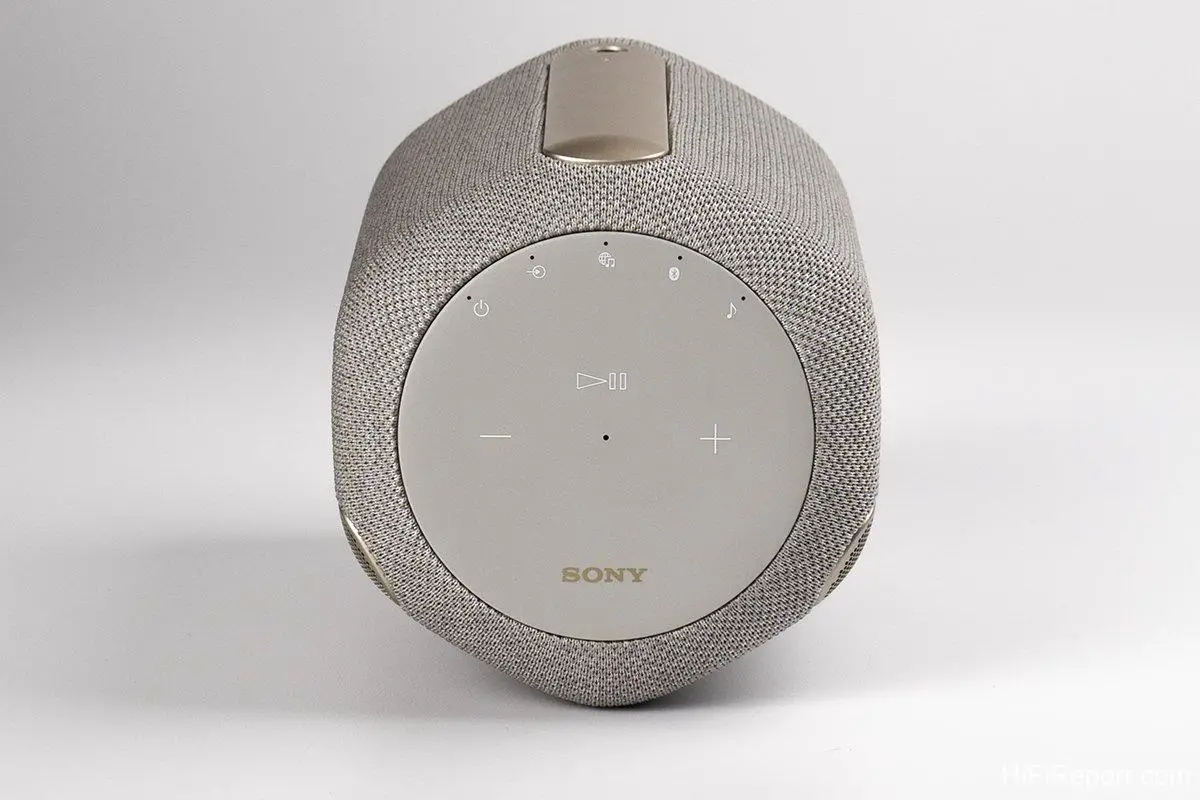
It also depends on personal applications. For example, the SRS-RA3000 has moisture resistance, meaning you can bring the SRS-RA3000 into the bathroom for use, listening to music while taking a bath. If you are lucky enough to live in a hot spring area, soaking in a hot spring and listening to your favorite music played by the SRS-RA3000 during a cold snap would be truly delightful!
(Image/Provided by Sony)
New Benchmark for Bluetooth Speakers in the Same Price Range
Finally, regarding the prices of the SRS-RA5000 and SRS-RA3000, I believe Sony has set a new benchmark for speakers of this type. The innovative horizontal and vertical 360-degree sound wave diffusion, combined with DSP adjustment technology, gives the SRS-RA5000 and SRS-RA3000 a 360-degree immersive listening experience. Moreover, even when moving around at home while listening to music, comfortable sound is uniformly dispersed throughout the space. This entirely new listening experience is a fresh enjoyment I have never felt before.
If you’re interested, immediately rush to a Sony Store to experience them, or simply buy one online and bring it home. This is a music magic box that your wife and children will love. The whole family can easily enjoy wonderful music, and Sony’s DSP has taken care of spatial challenges for you.