
SOtM sPQ-100 Review
While SOtM has built its reputation primarily in the digital audio realm, offering a comprehensive lineup of digital servers, network switches, cables, and DACs, establishing itself firmly as a “digital specialist” among audiophiles, a recent arrival at Audio Art surprised me. The new SOtM sPQ-100 shares the familiar aesthetic of their digital products – compact yet impeccably built – but this time, it’s a pure, unadulterated phono preamplifier!
Why Upgrade Your Phono Stage First?
For newcomers venturing into the world of vinyl, if you’re approaching it with an eye towards future upgrades, the initial components typically targeted for improvement are either the cartridge or the phono stage. More often than not, upgrading the cartridge necessitates upgrading the phono stage to fully realize its potential. As someone who’s been down this path, I’d typically start with the phono stage.
A better phono stage allows you to keep your existing cartridge while experiencing a noticeable sonic evolution, providing a tangible sense of upgrade and granting some breathing room to save up for a cartridge upgrade down the line. Given this perspective, I trust you can appreciate why the phono preamplifier makes perfect sense as a sensible and effective first upgrade for any newly established vinyl system.
SOtM’s Analog Expertise
Many might initially question SOtM’s foray into purely analog territory, given their strong digital background. Can a brand synonymous with digital excellence truly deliver a trustworthy phono stage? Consider this: a well-designed piece of digital audio equipment inherently requires sophisticated analog circuitry alongside the digital components.
SOtM’s ability to create digital products praised by a wide range of audiophiles indicates their high level of competence in designing and implementing high-quality analog circuits and selecting premium components. Think of it this way: their analog expertise has previously been integrated with their digital design prowess to produce highly acclaimed digital gear. The sPQ-100 phono stage represents a pure distillation of SOtM’s design team’s profound understanding of analog circuitry.
There’s no need for surprise or doubt; SOtM already possesses the fundamental capabilities required to build an excellent phono preamplifier.
Multi-EQ Flexibility
When developing the sPQ-100, the SOtM team recognized the crowded nature of the phono stage market. To stand out, they identified a key feature often lacking in competing products: broad support for various equalization curves. While the vast majority of modern vinyl records are produced using the RIAA equalization curve – essentially a form of EQ used to compress the audio signal, allowing it to be etched into the groove within a manageable range – RIAA is just one standard.
To elaborate slightly, the RIAA curve involves reducing low frequencies by 20dB and boosting high frequencies by 25dB during cutting. This prevents excessive groove excursions caused by strong bass signals (which would reduce playing time or make tracking difficult for the stylus) and keeps high frequencies above the noise floor. The phono preamplifier then applies the inverse RIAA curve during playback to restore the original frequency balance.
However, RIAA wasn’t the only game in town historically. Before its standardization in 1954 by The Recording Industry Association of America, different record labels, regions, and cutting engineers employed various equalization methods. Records pressed before 1954 are very likely *not* cut with the RIAA curve. To accurately reproduce these “non-RIAA” records, a phono stage must provide the corresponding inverse equalization curve.
Most standard phono stages don’t mention this because RIAA restoration is typically all that’s needed for post-1954 records. However, for serious vinyl collectors or those obsessed with specific pressings, especially older ones, the ability to select the correct EQ curve is crucial for accurate playback.
Physical Design and Connectivity
The sPQ-100’s standout feature is its support for multiple equalization curves beyond RIAA. Aesthetically, as mentioned, it closely resembles SOtM’s digital components. The rear panel is straightforward, featuring an input for the included external switching power supply (with provision for upgrading to a better supply later), a single set of RCA analog inputs and outputs, and a ground terminal. It’s a simple, entry-level friendly configuration.
Control Switches and Adjustments
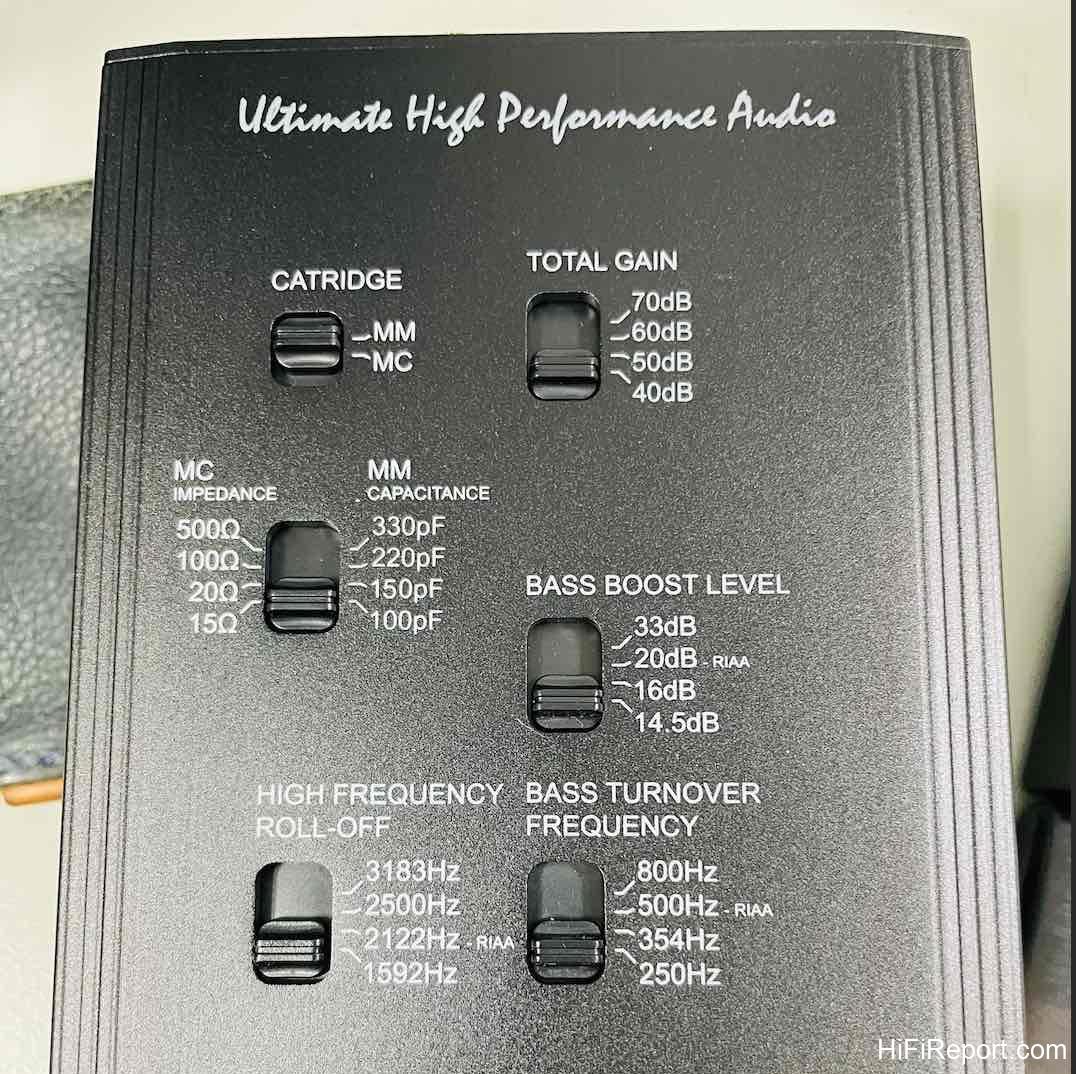
The real magic happens on the sPQ-100’s top panel, which houses numerous toggle switches. Three sets are dedicated to EQ curve settings: “Bass boost level selection,” “Bass turnover frequency,” and “High frequency roll off frequency.” Each set offers four switch positions. Through various combinations of these toggles, the sPQ-100 provides a total of nine different equalization curves.
In addition to RIAA, the eight other curves are: AES, NARTA (NAB), TELDEC, CCIR 78, IEC N78, Columbia LP, RCA Old Orthophonic, and London LP.
This comprehensive selection should certainly satisfy the needs of serious vintage record collectors. Also on the top panel are toggle switches for MM/MC cartridge selection and a four-position gain adjustment. Gain adjustment is helpful for ultra-low output MC cartridges, where a bit more gain can be beneficial. Conversely, if using a higher output MC cartridge, excessive gain might result in a less pleasant sound, allowing you to reduce it.
The 70dB gain setting on the sPQ-100 is quite high and is best reserved for specific, very low-output MC cartridges. For most cartridges, it’s advisable not to start at the 70dB setting.
Adjusting the EQ curves via the top panel toggles is made easy with a helpful detail: the RIAA default settings are discreetly printed next to the relevant switches. The default RIAA settings are 2122Hz for “High frequency roll off frequency,” 500Hz for “Bass turnover frequency,” and 20dB for “Bass boost level selection.” For other equalization curves, refer to the detailed instructions in the user manual. The sPQ-100 also offers adjustable loading options, as expected.
There are four impedance settings for MC cartridges and four capacitance settings for MM cartridges, making for a reasonably comprehensive set of adjustments.
Listening Experience
Having covered the sPQ-100’s comprehensive features, it was time for the listening session. I auditioned the sPQ-100 in my home system, comprising a Pro-Ject RPM 1 Carbon turntable fitted with an Ortofon 2M Red MM cartridge, a NAD C326BEE amplifier, and Totem Mite bookshelf speakers. Upon first listen, the sPQ-100 immediately struck me with its ability to lower the noise floor, creating a notably blacker background, and significantly enhancing the fine detail retrieval.
The sound had a pleasing density and was relatively neutral with minimal coloration, yet highly engaging and easy to listen to for extended periods.
Playing Bill Evans’ “Trio 65′,” the sPQ-100 beautifully rendered the album’s subtle, quiet, and highly precise musical aesthetic. “Trio 65′” is one of Bill Evans’ more relaxed and laid-back albums, containing moments of intricate or virtuosic playing, but which I’ve always perceived as soft and flowing.
Through this system, the first thing that impressed me was the exceptional instrumental separation. On the first track of side A, the jazz drums were pinpoint focused and clearly positioned well beyond the right speaker. The drummer’s solo on this track was also stunningly reproduced, with every hit articulated precisely. The sudden stops, followed by Evans’ rapid piano entrances and repetitions, brought out a hidden liveliness I hadn’t fully appreciated before.
The piano was warm yet delivered with precise timbral accuracy, revealing Evans’ poetic use of the sustain pedal to create atmospheric washes. All sonic shifts were instantaneous and perfectly rendered. It made me realize that even the most beautiful, relaxed jazz can have a foundation of incredible precision delivered by three masters at the peak of their craft.
Next up was a long-time favorite, the soundtrack to the movie “Country.” The piano’s crystalline clarity was the immediate standout. Especially on the opening track, each piano note seemed to float upwards, lingering with a touch of sweetness and infinite harmonic bloom. The liquidity was unlike anything I had experienced before.
Crucially, the background was incredibly black – so much so that it sometimes didn’t feel like I was listening to an LP, yet the signal was so robust and extended, an experience also distinct from listening to a CD.
When the third track’s arrangement grew more complex, the soundstage unfolded with incredible spaciousness and boundary-less breadth. The mid-section guitar solo, which I’ve heard countless times, felt fresh and exciting. Each rapid pluck seemed coated in a layer of sweetness, projecting well beyond the speaker boundaries. It felt like musical sparks were flying towards me – immensely enjoyable without being overly aggressive.
In the low frequencies, listening specifically to the piano’s lower register revealed plenty of depth and fullness, whether it was the misty bass created by the sustain pedal or the resonant string vibration upon key press. The bass was ample without being boomy, maintaining excellent detail and layering – a truly comfortable low-frequency presentation.
Switching to Marit Larsen’s album “The Chase,” a pop recording with country-rock elements, the female vocal image was not just focused but seemed to coalesce into a solid, three-dimensional figure, making it feel incredibly real and positioned firmly center stage. The overall soundstage was quite grand. Despite the busy arrangement featuring electric and acoustic guitars and drums, the resolving power ensured every instrument had a stable, distinct presence in the mix.
In the second track, with the addition of strings, the sPQ-100 demonstrated superb handling of string instrument textures, beautifully rendering their layering, realistic timbre, and the dynamic contrasts between different sections. The main focus, the female vocal, remained solidly anchored and highly three-dimensional in the center.
Her vocal expression and technical nuances were never obscured or lost amidst the other instruments, allowing the rich musical information to unfold freely on the sonic stage. On this country-rock album, I experienced a level of complex layering and chord interplay that rivaled classical music, a truly delightful listening experience.
Conclusion
My audition of the sPQ-100 phono stage has completely convinced me of SOtM’s capabilities in the purely analog domain – though, as I argued earlier, this should have been self-evident. While I didn’t have any vintage records with alternative EQ curves on hand to experiment with, I know there are many vinyl enthusiasts collecting these treasures. After years of building a stellar reputation in digital audio, SOtM has now made a powerful statement in the analog realm.
For serious audiophiles who appreciate both digital and analog, you already know how good SOtM is in the digital world. Now, you can enhance your analog system with an sPQ-100 phono stage, not only achieving better sound quality but also unlocking a new level of appreciation for your vintage record collection. SOtM has solidified its position in digital and is now making other manufacturers take notice in the analog space.
It seems that having a great SOtM product in your system, whether analog or digital, is becoming increasingly essential if you want to keep pace with the best in audio. Step into the world of SOtM’s excellent sound today!
Specifications
* Type: MM/MC Phono Preamplifier
* MM Input Capacitance Adjustment: 100pF, 150pF, 220pF, 330pF
* MC Input Impedance Adjustment: 15Ω, 20Ω, 100Ω, 500Ω
* Bass Boost Level: 14.5dB/16dB/ 20dB@20Hz, 33dB@7Hz
* Bass Turnover Frequency: 250Hz/354Hz/ 500Hz/800Hz
* High Frequency Roll Off Frequency: 1,592Hz/2,122Hz/2,500Hz/ 3,183Hz
* Gain Adjustment: 40dB, 50dB, 60dB, 70dB@1KHz
* MM Input Level: 3mVac-10mVac@1KHz
* MC Input Level: 0.1mVac-1mVac@1KHz
* Output Level: Up to 9.5Vac
* Signal-to-Noise Ratio: 100dB typical@1KHz, max output level
* DC Power Input: 7V-9V
* Dimensions (WHD): 106×48×245mm
* Weight: 1.5 kg