
Stillpoints Aperture 2 Acoustic Panel Review
For audiophiles, the art of acoustic tuning is a constant topic of fascination. However, undertaking renovations or structural changes for the sake of audio is a significant undertaking. This is where acoustic treatment tools come into play. Among them, the Aperture 2 from the American brand Stillpoints stands out with its unique design. Unlike most acoustic panels that are either sound absorbers or diffusers, the Aperture 2 uniquely combines sound absorption, diffusion, and resonance control in a single device. After experiencing it firsthand, I’ve decided to make room in next year’s budget to purchase three units for the HiFiReport listening room.
From Anthropology to Audio
Stillpoints and Bruce Jacobs have been regular visitors to HiFiReport. We had the pleasure of interviewing Bruce back in 2016. For a deeper dive into Bruce’s background and his journey with Stillpoints, I encourage you to read Dai Tiankai’s article (link provided). In brief, Bruce’s academic background is in social anthropology from the University of Wisconsin-Madison, specializing in comparative religion. However, his early exposure to the audio world came through his acquaintance with Bob Fulton, the owner of Fulton cables, and frequent visits to Bill Johnson, the founder of Audio Research. Influenced by these two audio luminaries, Bruce embarked on his path in high-fidelity audio.
What sparked my interest in the Aperture 2? It began at the 2019 TAA Audio Show, where Bruce himself explained the design principles of the Aperture 2 and demonstrated its impact. As his impromptu translator, I found the Aperture 2 intriguing at the time, but didn’t immediately consider a dedicated review. It wasn’t until the latter half of 2020, when HiFiReport’s editorial team initiated video production plans and acquired new filming and recording equipment, that we noticed the room’s reverberation was slightly too long for optimal sound recording. We needed acoustic treatment specifically for the recording microphones. So, we inquired with Sing-Kai Audio, Stillpoints’ distributor, about demo samples. Fortunately, they had them available, and we promptly borrowed three Aperture 2 units.
Unique Design
The Aperture 2 is a square wooden frame, approximately 4 square feet, covered in fabric. It presents a simple and elegant appearance, quite unlike the typical hard-looking diffusers or bulky absorbers we often see.
Traditional acoustic diffusers for audio applications are often based on quadratic residue theory, requiring significant depth and width, and substantial size to be theoretically effective. Similarly, sound absorbers often employ thick, dense acoustic foam, with different densities targeting different frequency ranges, depending on specific needs.

Between absorption and diffusion, I personally lean towards diffusion. In the pursuit of top-tier audio, the goal is to reproduce the rich musical details captured in recordings, creating a lifelike experience. However, if we strive to reveal every nuance in a recording, why would we then want to heavily absorb sound in the listening space? Wouldn’t that diminish the very musical details we’re trying to preserve? Consequently, the HiFiReport editorial room is entirely devoid of absorptive materials. We utilize a few diffusers for flexible acoustic adjustments, and the floor is bare wood-like flooring without carpets, allowing speakers to sit directly on the surface.
Furthermore, several years ago, we incorporated the A.I.S. acoustic tuning system, which involves detailed treatment of the front, rear, left, and right walls. In essence, we aim to optimize room acoustics using tuning tools without altering the room’s structure.
As for my home audio setup, located in the living room, my acoustic treatment consists of a wall filled with CDs and an ever-growing collection of books. These items collectively provide both absorption and diffusion, and surprisingly, the more disorganized they are, the better the acoustic effect seems to be. This is why I’ve never dared to share photos of my home system. While I’m very pleased with the sound, the chaotic appearance is simply not presentable.
Absorption, Diffusion, and Resonance
The Aperture 2’s appearance diverges from conventional absorbers or diffusers. How does it achieve the trifecta of absorption, diffusion, and resonance control? The Aperture 2 employs a different approach to sound management. While it can absorb and diffuse sound, its core design revolves around a “sound trap” mechanism. It doesn’t truly “absorb” sound in the traditional sense, but rather dissipates excess sound energy. This is crucial because it avoids sacrificing the musical detail and dynamics inherent in the recording.
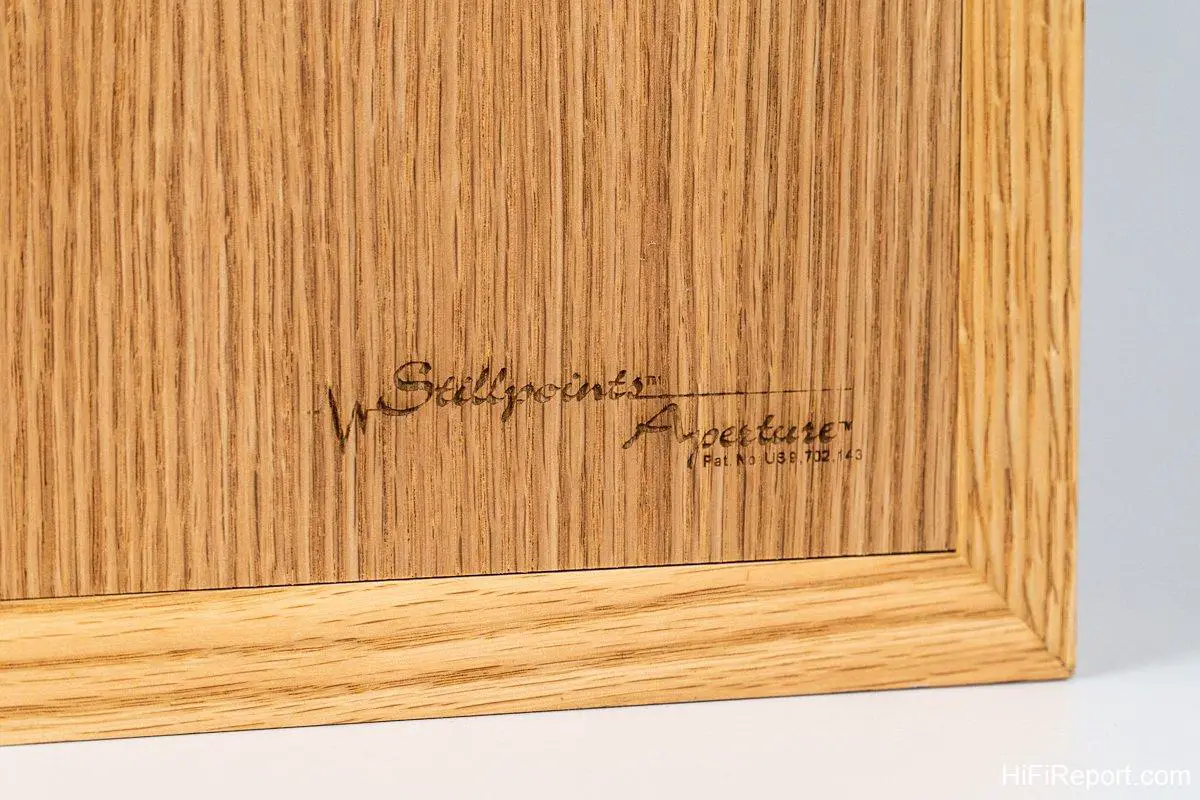
How does the Aperture 2 dissipate excess sound energy? Internally, it utilizes Corning fiberglass. This material is characterized by numerous minute pores, which serve to dissipate unwanted sound energy. The effect is akin to expanding the room’s acoustic volume. This is why it’s named Aperture 2, not Sound-absorbing Panel or Diffuser. “Aperture,” like the lens diaphragm in a camera, signifies an opening or gap. The Aperture 2 relies on the myriad pores within the Corning fiberglass to effectively dissipate surplus sound energy.
Enlarging the Room with Sound Traps
If the concept remains unclear, consider this analogy: through the pores of the Corning fiberglass, the Aperture 2 essentially creates a “hole” within the listening space, effectively making the room acoustically larger. What we refer to as “excess sound energy” often arises from insufficient room volume. When the volume is turned up beyond what the listening space can comfortably handle, it becomes excess energy. This excess accumulates in the room, leading to standing waves and a boomy sound. The simplest solution to eliminate standing waves is to relocate the audio system to a larger room, providing more air volume for sound energy to expand and dissipate. However, in densely populated cities where space is at a premium, expanding listening room dimensions is often impractical. In such situations, incorporating Aperture 2 panels effectively expands the listening space acoustically without physical alteration.
The Aperture 2 boasts a broad tuning range, effectively addressing frequencies from 40 Hz to 40 kHz, encompassing nearly the entire audible spectrum. Furthermore, unlike traditional acoustic treatments, the Aperture 2 dynamically adapts to sound volume. Its effectiveness scales with the intensity of the sound.
Stillpoints explains that conventional absorbers or diffusers are theoretically designed to handle specific sound pressure levels. Because these materials are static, exceeding their designed sound pressure limit necessitates more panels, while operating below that limit might require fewer. They lack dynamic responsiveness to volume fluctuations. In contrast, the Aperture 2 utilizes a composite material, and its internal cavities function as sound traps, dynamically adjusting to volume changes. By strategically positioning Aperture 2 panels within the listening space, they intelligently optimize sound absorption, diffusion, and resonance control.

This overview covers the design and principles of the Aperture 2. While replicating the Aperture 2’s dimensions with woodworking might be relatively straightforward, and Corning fiberglass is commercially available, the true value of Aperture 2 lies in the “know-how.” The crucial questions are: “Which specific type of Corning fiberglass is used?” and “What combination of Corning fiberglass types are employed?” Stillpoints openly discloses the materials used in their sound traps, seemingly unafraid of imitation. This is because the precise material specifications remain proprietary to Stillpoints. Moreover, the Aperture 2 is protected by a US patent, safeguarding their intellectual property.
Solution for Recording
Since HiFiReport began video production, we’ve become acutely aware of the discrepancies between recorded sound and our subjective listening experience. We’ve experimented with various microphones to optimize recording quality. However, the most critical factor in achieving accurate sound capture is microphone placement. Initially, we considered a simple solution: using acoustic foam panels placed above, below, and to the sides of the microphones to absorb excessive reverberation in the microphone’s immediate vicinity. However, we were concerned that this approach might also inadvertently absorb musical detail or compress the dynamic range. This led us to borrow Aperture 2 panels from Sing-Kai Audio for testing.
How to use Aperture 2? It’s as simple as 1, 2, 3.
With a single Aperture 2, position it in front or behind the listening position to manage sound waves reflected from the front or rear walls. This is “1.” With two Aperture 2 panels, place them on the left and right sides of the listening position, approximately at the first reflection points from the speakers to the side walls. This is “2.” If you acquire three Aperture 2 panels, in addition to the left and right placement, add one behind the listening position. This is “3.”

Understanding the “1, 2, 3” approach unlocks the potential of Aperture 2.
Mastering “1, 2, 3”
Since Sing-Kai Audio lent us three Aperture 2 panels, I experimented with all three configurations: 1, 2, and 3. Even with just one panel placed behind the listening position, the effect was immediately noticeable. HiFiReport has an old wooden sofa that serves as our listening seat, making Aperture 2 placement straightforward around the listening area using the 1, 2, 3 method.
I didn’t mount the Aperture 2 panels on the walls. Given the larger size of our listening room and equipment racks along the sides, I utilized metal stands custom-made by Sing-Kai to make the Aperture 2 panels freestanding, positioned to cover roughly head height when seated.
After introducing Aperture 2, the previously noticeable room reverberation, which sounded like natural reverb, diminished significantly. The perceived sense of spaciousness in the music became more focused, but the solidity and definition of sonic images improved. It’s important to note that this primarily impacts the sound captured by the recording microphones. For vocals, we use a separate lavalier microphone, which is layered onto the music track. The objective with Aperture 2 was to tame the listening room’s natural reverb for recording purposes, and the Aperture 2 proved remarkably effective.

Instant Acoustic Improvement
Which configuration of 1, 2, 3 yields the best results? Undoubtedly, it’s “3.” Stillpoints themselves recommend a maximum of three Aperture 2 panels, emphasizing that more isn’t necessarily better. They advise starting with one panel and observing the acoustic changes, then progressively adding a second or third panel based on the room’s acoustic response.
Furthermore, I opted not to place Aperture 2 panels in front of the listening position because our speakers at HiFiReport are positioned more than three meters from the front wall, minimizing front wall reflections. Therefore, placing the Aperture 2 panels behind the listening position, relatively close to the seating, yielded significant improvements.
During my translation for Bruce, he highlighted a crucial concept: “Tune the listening position, not the room.” The Aperture 2 is designed to fine-tune the acoustics specifically at the listening position, rather than aiming to alter the overall room acoustics. In contrast, traditional absorbers or diffusers are often larger because their function is to treat the entire room’s acoustics, requiring panel sizes scaled to the room’s volume. Aperture 2, however, focuses on managing excess reflected energy specifically around the listening area.
While Stillpoints suggests that three Aperture 2 panels are usually sufficient, photos from their 2015 T.H.E. Show display at their website showcase numerous Aperture 2 panels, even stacked and elevated. I believe this was primarily for demonstration purposes, encouraging more extensive use – after all, it was an audio show, and promoting their product is expected.
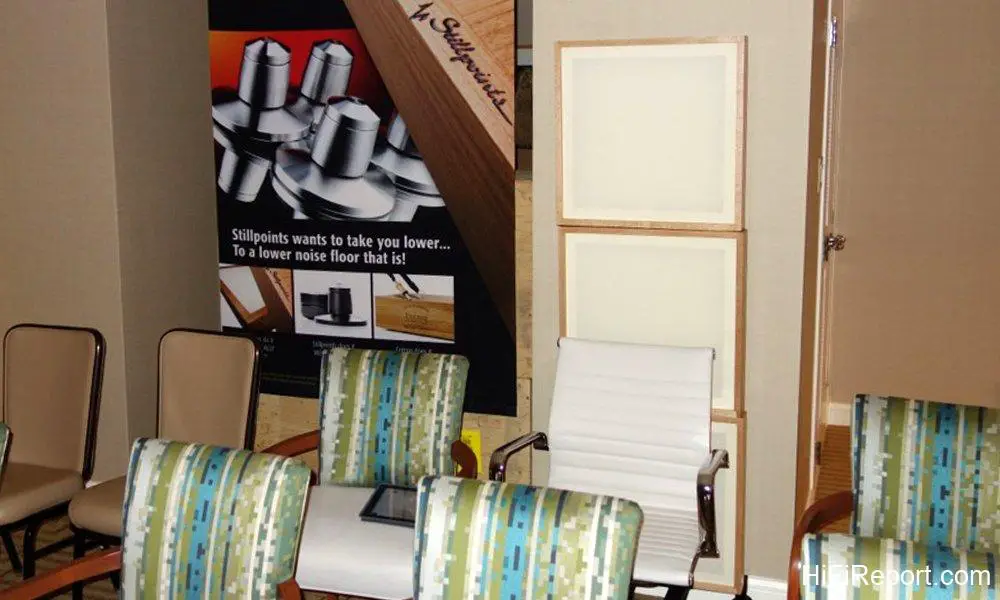
However, Stillpoints’ international sales manager, Bruce, offered a more pragmatic perspective at the TAA Audio Show, advising that three Aperture 2 panels are typically adequate, and excessive use is unnecessary.
(Image source: Stillpoints official website)
Saving Up for Aperture 2
Driven by the need for improved audio recording for our videos, we tested the Aperture 2. The actual results, as captured by microphones, were exceptional. Ultimately, however, we had to return the Aperture 2 panels because their price exceeded the budget allocated for video production equipment. We temporarily resorted to a more budget-friendly solution: purchasing inexpensive studio acoustic foam to manage excessive reverberation around the microphones. While this addressed reverberation to some extent, the overall recording quality paled in comparison to Aperture 2, noticeably diminishing recorded detail.
But rest assured, Sing-Kai’s Mr. Lin, I will be working hard to save up and make room in the budget to acquire Aperture 2 panels. Please have them ready for me. Next year, I’m determined to purchase three Aperture 2 units for HiFiReport. They will not only enhance our listening experience but also elevate the audio quality of our video productions.
Specifications
**Stillpoints Aperture 2**
* Type: Room Acoustic Tuning Panel
* Dimensions: 22 x 22 x 3 1/8 inches (H x W x D)
* Weight: 14-16 lbs (depending on wood density)