
Tien TT5 Turntable Review
Following my previous visit and interview with Tien Chang-Cheng, the innovative mind behind Tien Audio and his globally unique designs, I’ve been intensely interested in his TT5 turntable. In an era where vinyl playback technology is already so mature, his ability to make new discoveries is truly remarkable. Moreover, he hinted at further groundbreaking products in development after the TT5, all employing technologies never before seen. The anticipation is palpable.
But without further ado, let me introduce the TT5, a turntable that might just tempt you to jump into the vinyl deep end!
Resolving Two Key Turntable Challenges
To achieve truly exceptional sound from a vinyl system that meets the rigorous demands of Hi-End audio, four components are essential: the turntable, tonearm, cartridge, and phono stage.
Focusing solely on the turntable, a high-quality design must accomplish two primary objectives. First, it must maintain precise and stable rotation speed for accurate sound reproduction. Second, it must minimize vibration, preventing unwanted resonances from reaching the record, and subsequently traveling through the stylus, cartridge, tonearm, and phono stage, ultimately degrading the audio quality.
Only two issues to solve, you might think turntable design is straightforward? Far from it. Otherwise, why would renowned imported turntables command prices of tens of thousands of US dollars, and even then, not always fully resolve these two fundamental problems?
So, what approach did Tien Chang-Cheng take? He implemented a triple-motor belt-drive system and a low-mass platter, enabling the TT5 to achieve outstanding performance with a relatively simple construction and accessible price point.
Currently, most turntables on the market utilize belt-drive systems to isolate motor vibrations from the platter. The belt effectively prevents motor vibrations from directly transferring to the platter. However, belt-drive systems introduce two inherent challenges.
Firstly, uneven belt tension can prevent the motor’s precise rotation speed from being accurately transmitted to the platter, leading to speed instability. The conventional solution is to employ a heavy platter. The inertia of the heavy platter maintains stable rotation. However, this introduces another issue: heavy platters tend to accumulate resonance, which dissipates slowly. This can create the illusion of a richer sound, which is actually a result of emphasized midrange frequencies and compromised detail and extension at the frequency extremes. Lighter platters, conversely, are less prone to resonance.
Of course, resonance in heavy platters can be addressed by altering the platter’s shape, material, or incorporating damping materials within. However, these solutions increase manufacturing costs and drive up the retail price.
Secondly, single-motor belt-drive turntables, driving the platter from only one side, can induce wobble. Even with the most precisely manufactured bearings and bearing sleeves, there will always be minute clearances (otherwise, the bearing couldn’t fit). When the belt pulls the platter from one side, the bearing essentially rotates and rolls within the sleeve, causing wobble, which is a form of vibration.
If Tien Chang-Cheng chose to design a belt-drive turntable, he inevitably had to confront these two issues. How did he overcome them?
Belt-Driven Platter with Reduced Wobble
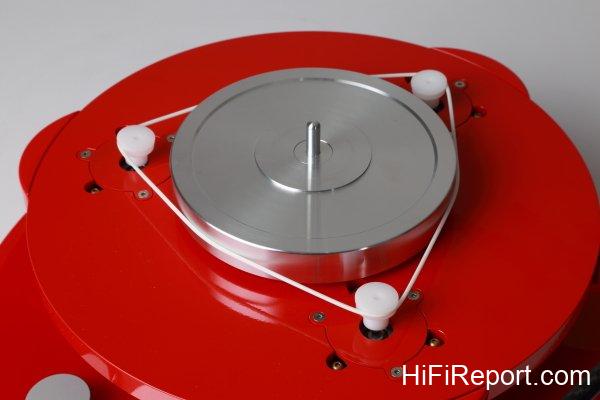
The TT5 employs a triple-motor drive system. A single belt encircles the platter and is driven from three directions, effectively centering the platter’s spindle within the bearing sleeve. This significantly reduces wobble, naturally minimizing vibration.
Furthermore, the TT5 uses only one belt, minimizing the contact area between the belt and the platter. This further reduces belt-borne vibration transmitted to the platter.
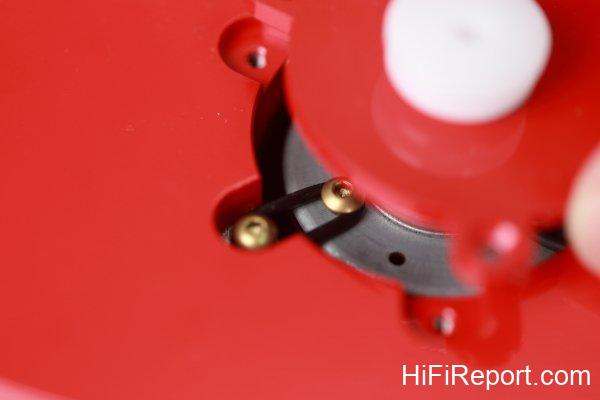
Additionally, these three motors are not rigidly mounted within motor slots. Instead, each motor is individually suspended by three silicone rings, creating a floating mount. This allows each motor to dynamically adjust its driving force in response to variations in belt tension, accommodating uneven tension and contributing to more stable rotation speed. The silicone ring suspension also effectively isolates motor vibrations from the plinth.
With three motors working in concert to drive the platter, the torque load on each motor is reduced, further minimizing vibration.
However, every advantage often comes with a trade-off. Three motors are likely to have slightly different rotation speeds. How is this addressed? And wouldn’t three motors generate more vibration than a single motor? The issue of speed variation is addressed through rigorous motor selection.
Tien Chang-Cheng explained that this selection process isn’t a matter of testing just a few dozen motors. It might take testing 60 motors to find a matched set that meets the required standards. He uses over two thousand motors in his selection process, ensuring not only a higher matching rate but also the selection of motors with the best stability.
Even with matched sets, the three motors won’t have perfectly identical speeds, but the speed difference is minimized to below the threshold of human audibility. The testing and matching methods were uncharted territory. No precedents existed. Tien Chang-Cheng had to develop his own testing methodologies through extensive experimentation.
What happens to the rejected motors? Currently, there are no plans for a single-motor TT5 model, so the discarded motors are simply written off.
The TT5 utilizes three motors driving a single belt, with minimal contact area between the belt and the inner platter. This significantly reduces friction and minimizes vibration transferred to the inner platter. Moreover, the belt’s three-sided grip on the inner platter centers the spindle, further reducing wobble.
Programmed Motor Vibration Control
Tien Chang-Cheng’s solution to the potential issue of increased vibration from three motors is even more ingenious – program-based control! He acknowledges that motor vibration is inherent and difficult to eliminate entirely. However, by controlling the motor vibration to frequencies above the highest frequencies of stylus vibration, its impact on the audible sound can be minimized.
The TT5 employs digitally controlled DC brushless motors. This allows for precise adjustment of motor vibration characteristics through the motor speed control program. Tien Chang-Cheng sets the motor vibration frequency above 10kHz, exceeding the highest frequencies of stylus vibration. This effectively renders motor vibration inaudible. This approach is only feasible with digitally controlled DC brushless motors; AC synchronous motors cannot achieve this level of control.
Digital motor control also contributes to the TT5’s exceptional speed accuracy. Tien Chang-Cheng collaborated with a Ph.D. engineer to design the control circuitry and write the program. This system precisely controls the speed of all three motors. Combined with rigorously matched motors, the speed variation among the three motors is reduced to levels imperceptible to the human ear.
In summary, the TT5 not only achieves more accurate rotation than conventional belt-drive turntables but also minimizes vibration. It excels in addressing the two primary requirements of a high-performance turntable.
The TT5 achieves highly precise motor speed, and the issue of uneven belt tension is resolved through motor suspension and the single-belt design. It eliminates the need for heavy platters to maintain stable rotation, allowing the TT5 to use a low-mass platter, thereby addressing the resonance problems associated with heavy platters.
Furthermore, the TT5’s standard platter is crafted from a specialized Delrin material, an engineering plastic developed by DuPont. Chemically known as POM (polyoxymethylene), it has a similar density to acrylic but superior damping characteristics, making it a more suitable platter material than acrylic.
The advantages of a low-mass platter extend beyond resonance reduction. It also reduces the required motor torque and enables rapid acceleration from a standstill to the correct speed, as well as quick stopping. This enhances user convenience.
Each motor is suspended by three silicone rings, creating a floating mount. This allows each motor to dynamically adjust its driving force in response to variations in belt tension, accommodating uneven tension and contributing to more stable rotation speed.
Magnetic Levitation Bearing: Ideal Partner for Triple Motors
Moving on to the bearing, the TT5 incorporates a state-of-the-art, ultra-precision magnetic levitation bearing. Just how precise? Tien Chang-Cheng states, “It’s as precise as you’ll find in the most expensive turntables.”
The TT5’s bearing is made of sintered ceramic, and the steel bearing sleeve is hand-honed to match the dimensions of each individual bearing. This means each bearing and sleeve pair is uniquely matched and not interchangeable. This meticulous pairing process achieves extremely tight tolerances.
Furthermore, the TT5’s inner platter utilizes a magnetic levitation design. When the inner platter is placed into the bearing sleeve, the bearing doesn’t rest on the bottom of the sleeve. Applying gentle pressure to the platter reveals a slight give, and upon release, the inner platter springs back.
Magnetic levitation bearings are not unique to Tien Chang-Cheng; other manufacturers use them. However, simply using a magnetic levitation bearing doesn’t guarantee superior sound. Tien Chang-Cheng’s rationale for employing a magnetic levitation bearing is that the TT5’s triple-motor drive system centers the platter within the bearing sleeve, minimizing wobble. In contrast, single-motor belt-drive turntables pull the platter to one side. In such cases, a magnetic levitation bearing might actually exacerbate wobble and introduce noise.
In essence, the TT5’s triple-motor drive system allows it to fully realize the low-friction benefits of a magnetic levitation bearing.
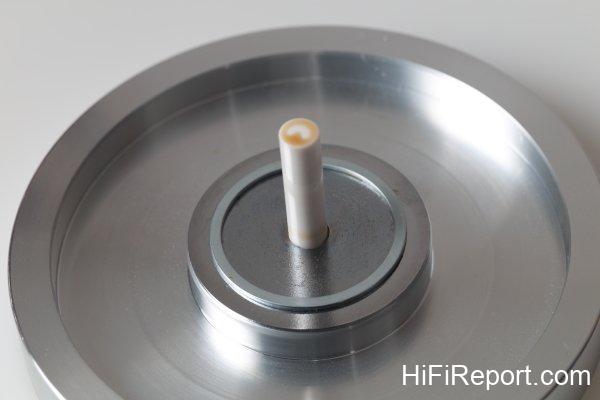
The TT5 employs an ultra-precision magnetic levitation bearing. The white component in the image is the sintered ceramic bearing, surrounded by magnets.
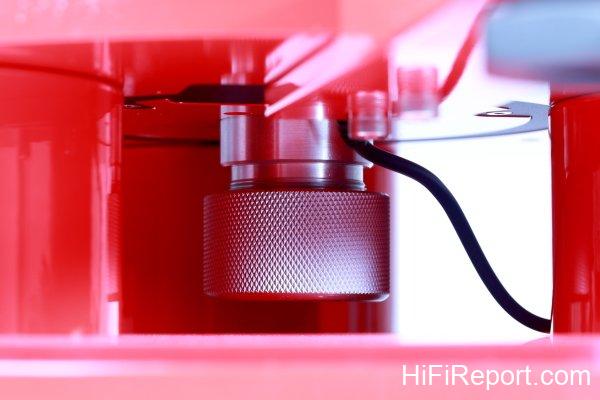
The bearing housing and bearing sleeve. The steel bearing sleeve is hand-honed to match the dimensions of each individual bearing, ensuring extremely tight tolerances through matched pairing.
World-First Torque Adjustment
Let’s now discuss the TT5’s groundbreaking torque adjustment feature, a world first.
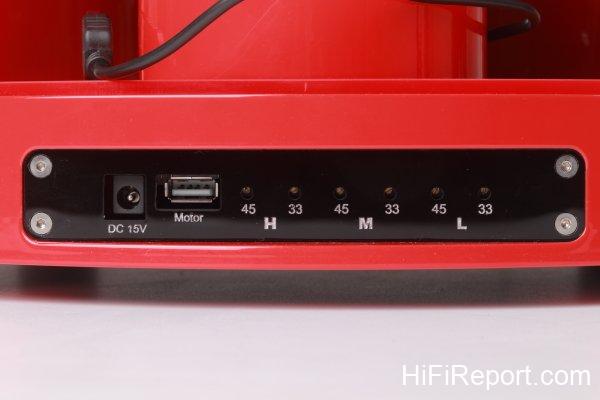
The TT5 offers three torque settings: high, medium, and low. These are designed to be adjusted based on the era and production method of the vinyl record being played, optimizing sound reproduction for each record.
Why did Tien Chang-Cheng think of focusing on motor drive torque? He explained that out of curiosity, he experimented with playing the same record at three different torque settings. He recorded the results as digital files and posted them online for blind listening tests. Surprisingly, votes were cast for all three settings, with no clear consensus on the “best” torque.
While the experiment didn’t yield a definitive answer, it confirmed that torque does indeed influence vinyl playback. This sparked his interest in further investigating torque’s impact.
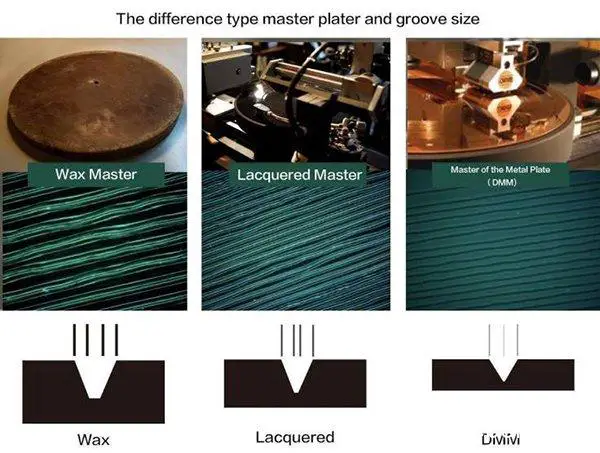
He later discovered that record groove shapes are not always the triangular form we commonly imagine. Some are more trapezoidal. The shape varies depending on the master disc production method. For example, master discs made using early wax masters and lacquered masters resulted in records with more trapezoidal grooves. In contrast, the dominant Direct Metal Mastering (DMM) technique produces records with triangular grooves.
This revelation explained why motor torque affects playback sound. Different groove shapes require different torque levels to “scrape” the groove optimally and extract the maximum amount of information.
Record groove shapes are not uniformly triangular. They vary based on the master disc production method. For example, wax masters (left) and lacquered masters (center) result in more trapezoidal grooves, while the currently prevalent DMM master discs (right) have triangular grooves.
In the past, the ideal torque level was unknown. However, it was known what torque levels record cutting lathes used. Therefore, turntable designers often aimed to match the torque of cutting lathes, assuming this was the appropriate level. However, this torque level is considerably high for record playback.
Through extensive testing and listening, Tien Chang-Cheng discovered that less torque is actually better for playback.
How much less? It’s hard to convey with numbers. To put it in perspective, the TT5’s high torque setting is roughly equivalent to the torque found in typical commercially available belt-drive turntables. The medium torque setting is lower than most belt-drive turntables, and the low torque setting is extremely low, bordering on the point of losing speed.
According to Tien Chang-Cheng’s tests, DMM records, which are the most common type of new vinyl releases, sound best with the low torque setting. This setting achieves the most balanced frequency response and reveals the most complete high-frequency and low-frequency detail, layering, and extension. The TT5’s low torque setting is specifically optimized for DMM records.
When listening to DMM records with high torque, the midrange becomes more prominent, and the sound becomes thicker and richer, delivering the “vinyl warmth” often sought after. However, this can mask the performance at the frequency extremes, compromising musical liveliness and soundstage openness.
So, what are the medium and high torque settings for? Naturally, they are intended for older records. For example, DECCA records benefit from the high torque setting, revealing their solid dynamic power, well-defined image outlines, rich soundstage layering, and accurate spatial ambience.
All-Aluminum Construction
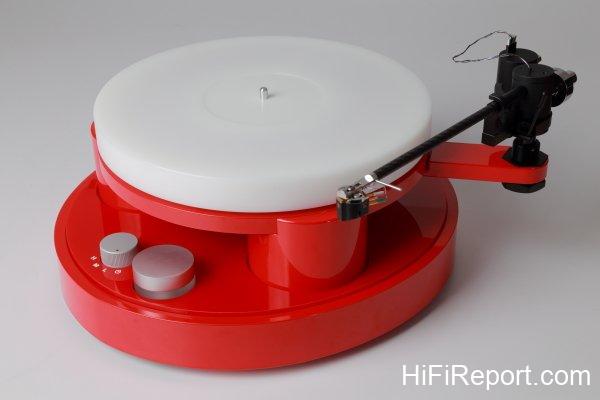
The TT5’s appearance is essentially dictated by its functional requirements. The overall form is composed of several circles.
The largest circular base houses the digital control circuitry, enabling precise control of the three motors’ speed and torque.
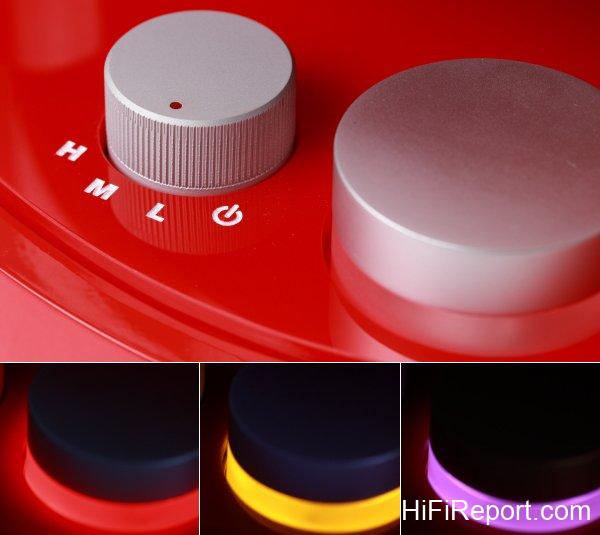
Two smaller circular dials are located at the front. The left dial is the power switch and torque selector. Turning it to the power symbol shuts down the turntable. Turning it left sequentially selects low torque (L), medium torque (M), and high torque (H).
The right, larger dial controls start/stop and speed selection. A gentle press starts playback; another press stops it. Turning it left or right cycles through the speed settings. The TT5 offers 33 RPM, 45 RPM, and 78 RPM.
However, the large dial lacks markings or indicators. How do you know which speed is selected? The lower half of the dial illuminates with different colors. Red indicates 33 RPM, purple 45 RPM, and orange 78 RPM. The colors might be slightly difficult to memorize, but remembering red for 33 RPM is sufficient. From red, one click to the right is 45 RPM, another click is 78 RPM, and another click returns to 33 RPM.
I find the design of these two dials quite ingenious, especially the right dial. A simple press starts or stops playback, which is very convenient for daily use.
The left dial adjusts torque, and the right dial controls speed. Different speeds are indicated by different colors illuminating the lower half of the speed dial: red for 33 RPM, purple for 45 RPM, and orange for 78 RPM.
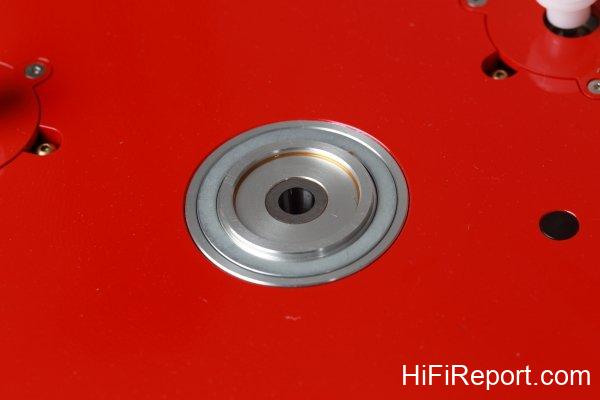
Three large cylindrical pillars rise from the base, each housing a motor.
A circular cover plate sits atop each pillar, securing the bearing housing. The tonearm base can be mounted beneath these cover plates.
The TT5 can accommodate up to three tonearms. The tonearm base structure is simple: a rectangular aluminum plate, easily custom-made if needed.
The TT5’s finish is a painted surface, concealing the underlying material. However, all red-colored parts you see in the photos, as well as the silver inner platter, are made of aluminum alloy. Only the platter itself is made of POM engineering plastic. This results in a substantial overall weight, a very rigid structure, and excellent vibration damping.
Notably, the TT5 utilizes four Stillpoints isolation feet as standard. Each foot costs over ten thousand NTD. Tien Chang-Cheng told me that these feet are exceptionally effective. Once installed, he didn’t want to remove them, so he decided to include them as standard equipment for the TT5, saving himself the trouble of developing his own feet.
Fine speed adjustments are also possible for each torque setting to achieve optimal accuracy.
Master of Nuance and Layering
After detailing the various innovative designs of the TT5, it’s time to discuss its sound.
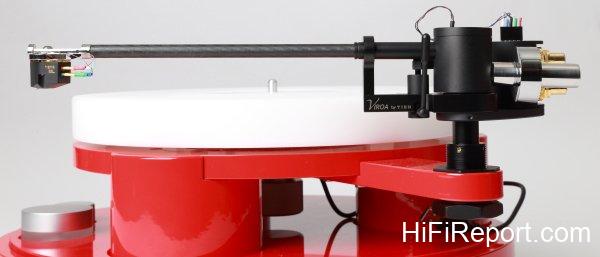
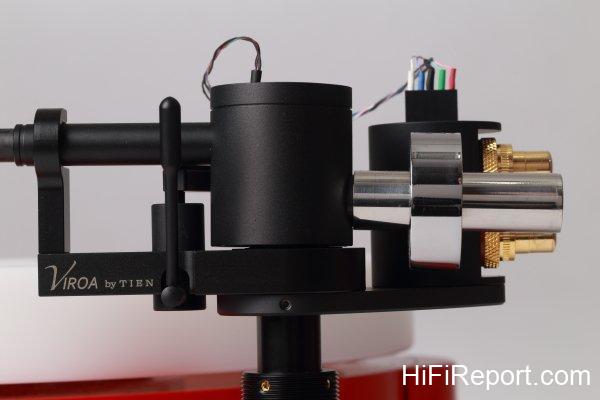
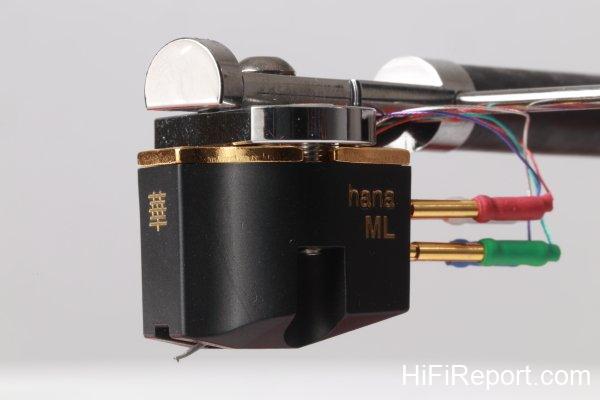
Tien Chang-Cheng also provided his Viroa unipivot tonearm and a Hana ML MC cartridge, which he distributes. The TT5 arrived fully assembled and calibrated, so I simply connected it to a phono stage and started listening.
To properly welcome this distinguished guest, I, a self-proclaimed “CAT” (Computer As Transport user) who primarily listens to digital audio, borrowed a Stein Music Stateline Phono 2 phono stage from Audiomachina. Following Tien Chang-Cheng’s recommendation, I started listening with a 500R impedance setting and then experimented by adjusting it up and down by one step to find the optimal setting.
The entire TT5 system transformed vinyl listening into a simple, relaxing, and delightful experience.
The TT5 requires virtually no waiting during operation. Its low-mass platter has minimal inertia, enabling instantaneous transitions from standstill to correct speed and from rotation to stop, even in the low torque setting. This makes record changing and playback seamless and immediate, without any waiting time.
Furthermore, its smaller footprint compared to typical turntables makes placement easier.
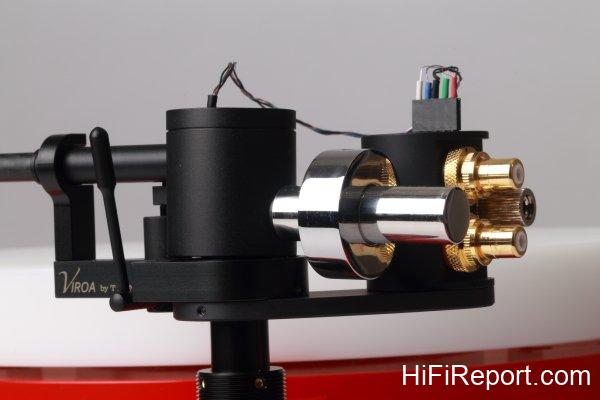
This is the Viroa unipivot tonearm designed by Tien Chang-Cheng. It delivers a very lively sound with open frequency response and vivid detail. The Viroa is a must-have companion for the TT5 to achieve synergistic performance.
My record collection primarily consists of recent releases, so I confidently set the TT5 to the low torque setting for my initial listening sessions.
Using Bach’s 6 Sonatas for Violin and Keyboard (performed by Michèle Auclair and Marie-Claire Alain) as an example, I immediately understood Tien Chang-Cheng’s statement about “low torque better reproducing complete high/low extension and layering.”
My speakers are Aurum Cantus Grand Harmony, equipped with ribbon tweeters and super tweeters, making high-frequency performance their forte. The bass is handled by two 8-inch drivers, providing substantial low-frequency reproduction. Playing this violin and organ sonata vinyl through the TT5, I heard an open and natural sense of space, along with clear and effortless extension at both frequency extremes.
The organ’s low notes were deep and full, but never muddy. Instead, they possessed excellent definition and articulation, providing a solid foundation in the background. The violin, positioned in the foreground, exhibited not only bright clarity and elegance but also clearly rendered the subtle texture of the bow hair scraping the strings, with a slight hint of rosin, resulting in a truthful and sweet tone.
At times, the organ played multiple melodic lines simultaneously, combined with the violin. The sounds across different frequency ranges were both integrated and clearly separated. This demonstrated the TT5’s effortless ability to reproduce sonic layering.
Unveiling Minute Details
Next, I played the 2016 Kaohsiung Hi-End Show demonstration vinyl, featuring a live recording of pianist Yen Hua-Rong’s concert.
The piano sound produced by the TT5 was remarkably pure, completely free of extraneous noise, and imbued with a rich sense of liquidity. It was both clean and refined, smooth and rounded, with a wonderful sense of flow. The tone even had a luminous quality, incredibly captivating.
Furthermore, the exceptional transparency created a sense of immediacy, as if there were no barrier between me and the sound, allowing me to hear not only the beauty but also the truthfulness of the performance.
Through Yen Hua-Rong’s live recording, I discovered another strength of the TT5: outstanding dynamics. Yen Hua-Rong’s playing exhibited clear contrast between soft and loud passages. Her control over dynamics and tempo was evident, especially in sudden dynamic shifts. Powerful key strikes were delivered instantaneously, demonstrating the exceptional responsiveness of the TT5 and Viroa tonearm.
Not only were the loud passages impressive, but the quieter passages were also lively, with distinct dynamic nuances. I believe this is because the TT5’s low vibration and noise floor preserve even the most subtle vibrations within the record grooves, allowing the quietest passages to sound so vibrant.
Let’s switch to more rhythmically intense music. I put on Unlimited Fusion Orchestra’s “Groove Machine” vinyl. The unrestrained dynamism was immediately apparent.
Words like “” ( – shuǎng, meaning exhilarating or fantastic) hardly suffice to describe the sensation. The low torque setting is nothing like its literal description might suggest – a sluggish car with weak acceleration. Instead, I heard powerful and impactful kick drum beats, with lightning-fast transient response. The “thump-thump” sound was concise and clear, with well-defined and direct impact.
Beyond the drums and bass, the soaring saxophone and electric guitar also possessed focused sonic outlines. The saxophone, in particular, had density and substance in its tone, making the playing more forceful and fully revealing the exhilarating and unrestrained nature of fusion jazz.
Vivid Musical Imagery
Next, I played a special record: the 2017 Kaohsiung Hi-End Show demonstration vinyl, treated with nano-coating – the “Skoda Memorial Album.”
This vinyl, shimmering with a metallic sheen, was initially played with the TT5’s low torque setting. The sound still possessed excellent liveliness and a luminous tone, with dense spatial reverberation, indicating rich detail retrieval. However, I also felt the soundstage was somewhat diffuse and lacked focus. The piano’s presence was slightly weak, and the overall sonic weight felt somewhat thin, making it slightly difficult to grasp the musical core.
Why was this happening? Could it be due to the lower surface friction of the nano-coated record? I switched the TT5’s torque to medium. The sound immediately transformed. The piano notes gained solidity and weight, the key strikes became more decisive, and the soundstage became more focused and centered. The image outlines became more defined, and the sense of realism improved. The tone also became fuller and more lush. Crucially, the detail retrieval and musical liveliness remained undiminished; the sound was still full of vitality.
This reminded me of attending the nano-coated record launch event hosted by the Kaohsiung Electrical Appliance Association. The organizers mentioned that nano-coated records have lower friction, and the stylus tracking force should be increased appropriately. It seems the TT5 doesn’t require stylus pressure adjustment. Simply rotating the small front dial to adjust torque can accurately reproduce the intended sound of nano-coated records – truly convenient! This is just a minor demonstration of the TT5’s capabilities. Its greater strength lies in accurately reproducing all records.
I borrowed several older DECCA records from Tien Chang-Cheng, encompassing both classical and popular genres. I played them at different torque settings to observe the sonic differences.
When played at the low torque setting, frankly, I didn’t perceive any significant issues. The sound was quite smooth. However, the image focus and sense of presence were somewhat flat, and the dynamic energy and vitality were also less pronounced, making the overall experience less engaging, though still pleasant.
Switching to the high torque setting brought about a noticeable change. The entire musical picture immediately became more three-dimensional. Images became more focused, textures gained density, dynamics became more impactful, and even the soundstage layering and depth expanded. It was as if a vibrant watercolor painting had transformed into an oil painting, with enhanced three-dimensionality.
What happens when DMM records are played with high torque? The midrange becomes more prominent, adding richness and warmth. However, the extension at the high and low frequencies becomes somewhat limited, and the dynamic nuances are slightly reduced, slightly diminishing the sense of atmosphere and musical vibrancy.
However, there are no rigid rules for using the TT5’s torque settings. You can follow the recommendations in this article or treat it as a tone-shaping tool to explore diverse sonic flavors. Why not?
Imagine, without adjusting stylus pressure, changing cartridges, or tweaking phono stage impedance or capacitance, simply turning a dial can alter the sonic character – incredibly convenient, isn’t it?
Don’t Try This Lightly
Without a doubt, auditioning the TT5 was an unforgettable and delightful experience. It made me seriously consider diving into the vinyl world.
It’s not based on myths or vague, incomprehensible principles. Instead, it employs simple and effective methods, combined with in-house developed software technology and local precision manufacturing capabilities, to effectively reduce the troublesome vibration issues in turntables while maintaining precise speed stability, providing a reliable foundation for vinyl playback.
Moreover, the TT5 features a globally unique and innovative feature – torque adjustment. This allows for the complete revelation of information hidden within record grooves produced by different mastering methods. If you possess a substantial collection of records from various eras, you should definitely consider owning a TT5 to fully appreciate your cherished collection.
Finally, a word of friendly advice: don’t try the TT5 lightly. Be prepared before you audition it. I mean, financially prepared, because after listening, you’ll likely want to own one. Be ready to make a purchase on the spot to avoid subsequent longing and regret.