
Triangle AIO 3 All-in-One Speaker Review
In recent years, all-in-one speakers have become increasingly popular, with major brands launching their own models one after another.
It’s no surprise that tech giants like Sony and Bose are in the game, but even traditional audio brands are actively joining the trend.
HiFiReport has reviewed many products of this type, and they can be considered a powerful force in the current audio market.
Understanding All-in-One Speakers
What exactly is an all-in-one speaker? Typically, a traditional audio system requires at least three separate components: a source, an amplifier, and speakers.
An all-in-one speaker combines these three components into a single unit.
According to the established principles of Hi-End audio, separating audio components as much as possible leads to better sound performance.
This is why CD players separate the transport and DAC, and even the power supply into independent chassis. Amplifiers are divided into pre-amps and power amps, with pre-amps often having separate power supplies, and power amps featuring left and right channel separation. Speakers may use separate wiring for high, mid, and low frequencies, and some systems even employ four-piece speaker setups.
Discrete component design is a guiding principle for Hi-End audio striving for the highest levels of performance.
French speaker manufacturer Triangle has released their first all-in-one speaker, the AIO 3. Staying true to their speaker-making heritage, they avoid using plastic for the enclosure and instead opt for MDF.
However, as the saying goes, “things long divided must unite”.
While discrete Hi-End audio systems still exist, a trend towards integration has emerged in recent years.
Sources are becoming integrated, with CD players serving not only as CD players but also as DACs, and even incorporating streaming capabilities. Amplifiers are not just integrated amplifiers, but also feature built-in DACs and even streaming functions, requiring only a pair of speakers to complete the system.
Furthermore, manufacturers are starting to develop active speakers. These speakers with built-in amplifiers were initially primarily for professional use. Home active speakers were more commonly seen as computer speakers, a product of the personal computer multimedia applications of the 1990s. From a home audio perspective, these were not considered high-fidelity products.
But times have changed. Many manufacturers are now producing active home speakers, many of which boast streaming capabilities and wireless transmission.
Goldmund’s million-dollar multi-driver active speakers are perhaps the most striking example, leading the trend in high-end active speaker design.
Subsequently, more and more speaker manufacturers are boldly venturing into the realm of active speakers, and France’s Triangle has followed suit.
Just over a year ago, I reviewed Triangle’s LN05A floor-standing active speakers, which were a modified version of their Elara series LN05 speakers.
They featured a minimalist and modern design, with a built-in amplifier module offering Bluetooth, decoding, and phono stage functions, providing high user convenience.
Triangle’s interest in audio integration doesn’t stop there. They have further developed the AIO 3 all-in-one speaker. It boasts a compact size, rich features, and impressive sound output, all at a more affordable price, making it even more accessible.
However, its model name is intriguing. Adding a “3” after AIO suggests that there might be other AIO models in the future. If so, that’s fantastic. With the AIO 3 leading the charge, a positive reputation will be established even before future products are released.
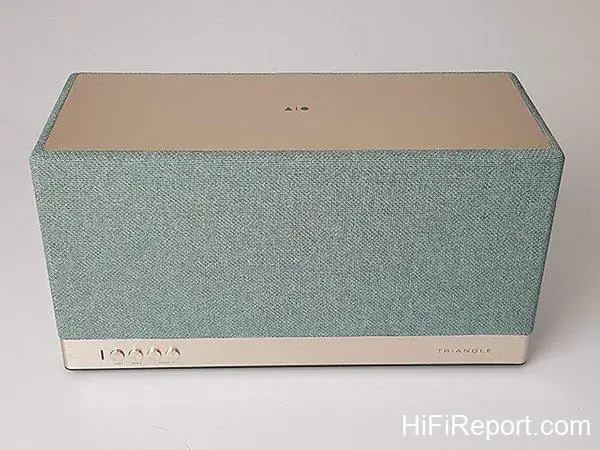
The AIO 3 features a square cabinet, wrapped in a coarse woven fabric, with aluminum alloy top and bottom trim.
Triangle partnered with a Danish fabric manufacturer founded in the mid-19th century. The fabric offers excellent acoustic transparency, as well as tactile and visual appeal.
MDF Enclosure, No Plastic Taste
Many all-in-one speaker enclosures on the market are made of plastic. While formulations and treatments can enhance the material’s damping and rigidity to reduce cabinet resonance,
Triangle adheres to their long-standing tradition of speaker manufacturing, using MDF for the AIO 3 enclosure. This gives the AIO 3 a more solid cabinet structure, making it feel substantial in hand.
Instead of adding various damping materials inside a plastic enclosure to solve the issue of “plastic sound”, the fundamental solution is to use wood for the cabinet.
Once you’ve heard and compared the AIO 3 with other plastic all-in-one speakers, you’ll understand that the AIO 3 is an all-in-one speaker free from the typical “plastic” sonic signature.
The fabric used for the AIO 3 is of excellent quality, making it an understated yet highly textured decorative piece in any home.
The brushed aluminum surfaces, combined with physical buttons and App control, make it very user-friendly.
Nordic Heritage Fabric, Brushed Metal Panel
The square cabinet is wrapped in a coarse woven fabric, with aluminum alloy top and bottom trim.
Triangle collaborated with a Danish fabric manufacturer established in the mid-19th century. The fabric offers excellent acoustic transparency, as well as tactile and visual aesthetics.
Four color options are available: green, black, grey, and blue. My descriptions are simple, but if you look closely at each color, the texture and depth it presents under light gives the AIO 3 an understated yet highly refined presence in your home.
The brushed aluminum surfaces come in silver tones for the black and grey versions, and a light rose gold tone for the blue and green versions.
I believe Triangle’s design for the AIO 3 is even more sophisticated than the Elara series.
Built-in 45W Amplifier per Channel, with EQ Adjustment
The AIO 3 is a complete two-channel system. Each channel features a 1-inch tweeter and a 3.9-inch mid-bass driver, driven by a 45W amplifier per channel.
Interestingly, Triangle has not followed the trend of many digital active speakers on the market by adopting active electronic crossovers. They still use traditional passive crossovers.
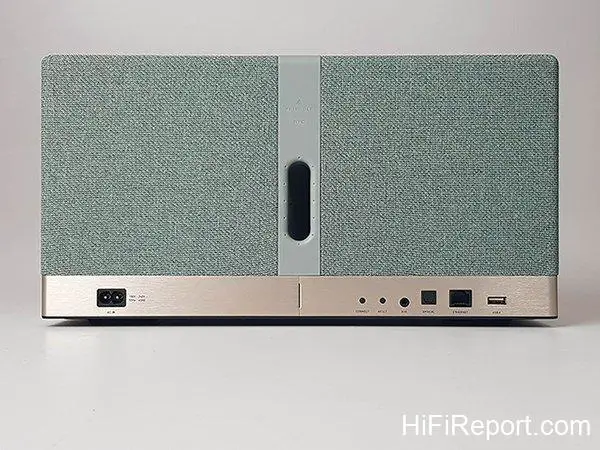
The bass reflex port is located at the rear, featuring a long, L-shaped tunnel design.
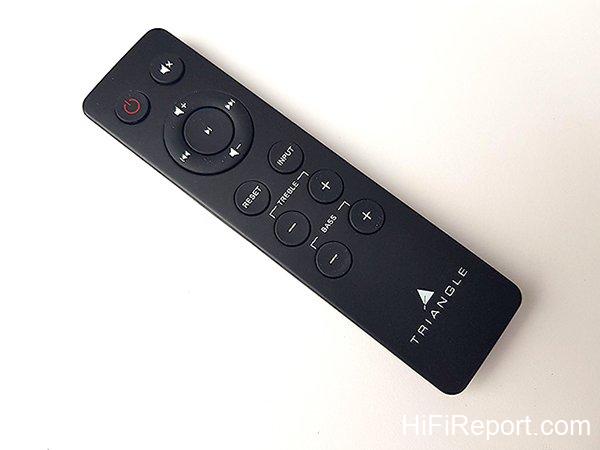
The AIO 3 also includes built-in EQ adjustment. Using the remote control, you can adjust the treble and bass levels, and there’s a one-button reset to cancel all EQ settings.
Counting them one by one, the AIO 3, from amplifier to speakers, continues the design tradition of HiFiReport’s audio systems.
The AIO 3 is a complete two-channel system. Each channel features a 1-inch tweeter and a 3.9-inch mid-bass driver, driven by a 45W amplifier per channel.
The bass reflex port is located at the rear, featuring a long, L-shaped tunnel design.
Wireless Streaming, Hi-Res File Support
Furthermore, it has a built-in DAC supporting up to 24bit/192KHz decoding. Through network streaming input, playing high-resolution files is no problem.
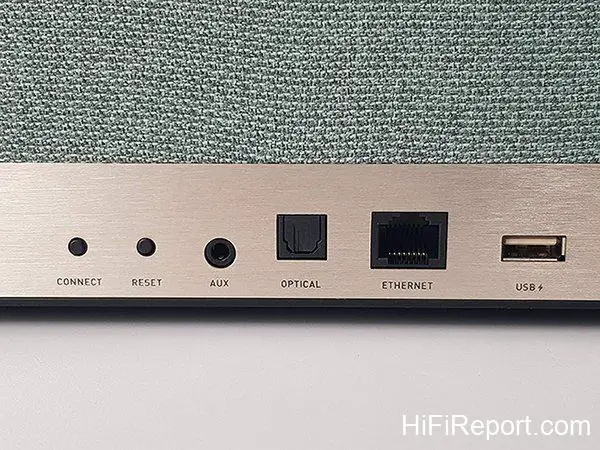
The AIO 3 can be connected via wired Ethernet or wirelessly via WIFI. Wireless setup requires a dedicated App.
Additionally, it has an optical input and a 3.5mm analog input for connecting external sources. You can also plug a USB drive with music files into the USB port on the back of the AIO 3 to play files from it.
For friends who want to share music, the easiest way is Bluetooth transmission. The AIO 3 also supports Bluetooth, and it supports aptX transmission, which can theoretically achieve CD-quality Bluetooth audio and ensure minimal latency.
Among these many features, network streaming music playback is the most important.
If this type of all-in-one speaker still needs to rely on physical connections to external sources, it’s outdated.
Analog input, optical input, and USB input are more like “additional functions”. Their primary function is to play music over the network.
The dedicated App for AIO 3 is well-designed, operating smoothly with quick response times. No crashes occurred during use, indicating good stability.
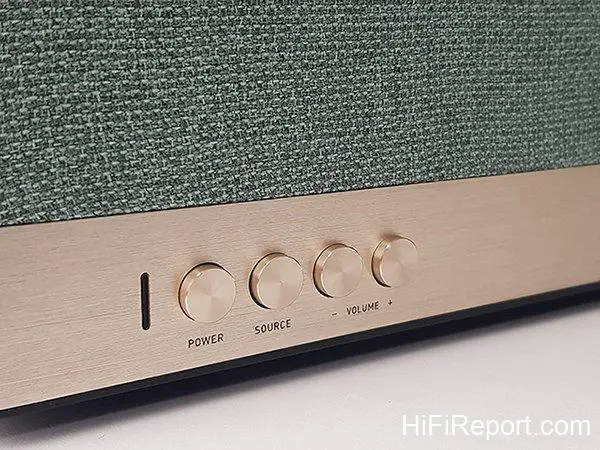
In addition to input switching and volume control via the remote, you can also switch inputs using the physical buttons on the panel, offering both remote and close-up control.
The rich and diverse input options provide users with greater convenience.
You can stream music via Bluetooth, or connect to the network for streaming playback. The USB Type-A port allows connection of external storage devices, and an optical input is available for connecting TVs or set-top boxes. The 3.5mm analog input also provides an option for external sources.
Multi-Room Control, Stereo Pairing
The simplest way to use it is to stream music from your home NAS via DLNA.
If you are a subscriber to Spotify, TIDAL, Qobuz, or Deezer, you can directly play music on the AIO 3. Its App also supports connecting to these service providers, which is very convenient.
If you don’t subscribe to any paid streaming services, it also has built-in TuneIn radio, allowing you to listen to free internet radio broadcasts.
If you are browsing music videos on YouTube or Facebook on your phone, you can pair it with the AIO 3 via Bluetooth and play the audio.
Furthermore, the App also supports multi-room control or dual-speaker pairing.
If you buy two AIO 3s, one for the bedroom and one for the living room, you can see both in the App and control them separately.
If you are having a party and want to play music synchronously in every room, you can group two (or even more) AIO 3s and control them together.
If you ever feel like wanting better sound, you can move the bedroom unit out and pair the two AIO 3s into a true stereo system, with one acting as the left channel and the other as the right channel, instantly elevating the sound quality.
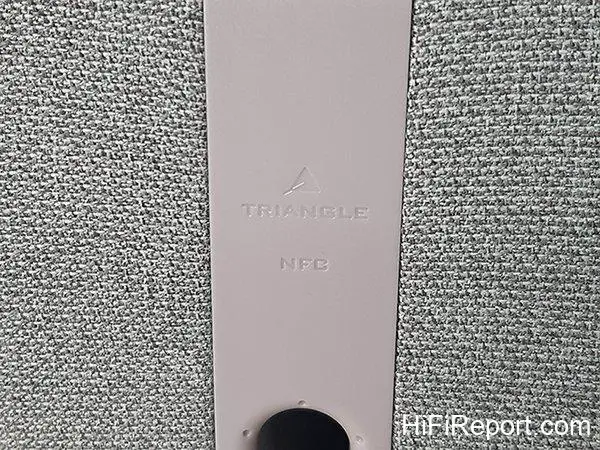
If your mobile device has NFC, pairing becomes even more convenient.
Benefits for Apple Users: Unmentioned AirPlay and .aiff Support
After powering on, wait approximately 20 seconds for the indicator light to illuminate and a voice prompt to announce the completion of startup. Then, select your desired input and you’re ready to play.
In terms of digital streaming experience, the Triangle AIO 3, connected via WiFi, has no problem transmitting 24bit/96KHz high-resolution files. Files stored on a local NAS and Tidal master quality files both play smoothly, and 16bit/44.1KHz files are even easier.
Although the manufacturer’s specifications do not list support for AIFF files, I was able to play .aiff files successfully. Furthermore, even though AirPlay support is not mentioned in the specifications, it does indeed support AirPlay from iPhones and MacBook Airs to the AIO 3. The signal source on the App automatically displays AirPlay.
Therefore, Apple users can use it with confidence.
Wireless network setup for the AIO 3 is simple. First, turn on the AIO 3, then open the App and add a device. A prompt will pop up, directing you to find “TRIANGLE AIO3” in your phone’s WiFi settings.
Next, return to the App, select your local network and enter the password. Press “Continue” and the connection process will begin.
After a short wait, a “Connection Successful” screen will appear, displaying the signal strength.
The left image shows the entry page after setup, listing the Triangle AIO devices that have been set up. If you have multiple AIOs, they will all be displayed here.
Tap “My AIO” to enter the menu on the right, where you can select the playback path and input source.
If you tap the small gear icon in the “My AIO” section, you will enter the settings, where you can change the device name.
Tap the “LR” icon to configure whether this AIO is for two-channel playback, or to be used as a left or right channel. If you have two units, you can pair them into a true two-channel system.
Clear and Uncolored Sound, High Clarity
Triangle lives up to its reputation as a professional speaker manufacturer. The AIO 3’s sound quality is quite impressive.
The sound is clear and not muddy, without any cabinet resonances or booming.
Cabinet resonance and standing wave-induced nasal coloration are quite noticeable in some plastic enclosure all-in-one speakers or active speakers. As the volume increases, the nasal sound emerges.
Throughout my testing, the AIO 3 consistently maintained a considerable level of clarity. Whether it was pop music, rock music, or symphonies, it could maintain a very good musical picture.
Although all-in-one speakers, due to the close proximity of the left and right channels, struggle to reproduce the soundstage of a true two-channel system, the sound has layers, structure, and texture.
That’s good enough.
I was able to use it to appreciate Karajan conducting the Berlin Philharmonic in Wagner’s Tannhäuser Overture. The intertwined counterpoint, the dense and layered instrumental sections, sounded on the AIO 3 almost like listening to music through a pair of small bookshelf speakers.
Satisfying Bass, Full Bass and Drums
When listening to smaller ensemble pieces like chamber music or jazz, the Triangle AIO 3’s warm and slightly rich sonic character gives the music a grounding warmth.
For example, in the jazz duets of Jean-Louis Rassinfosse and Jean-Philippe Collard, with just a piano and a bass, the piano is rounded and crystalline, and the bass has excellent articulation, full and solid.
Although the AIO 3 is small, with a bass driver under 4 inches, the bass extension and depth are surprising.
In fact, I think the AIO 3 is perfectly suited for playing this kind of music at low volumes. Not only is the smooth and warm sound pleasant and comfortable to listen to, but it also maintains the integrity of the music even at low volumes. This is truly something to commend about the Triangle AIO 3! To understand how full its low end is and how its sound energy surpasses its size, just listen to some rock, pop, or blues music.
For example, Dire Straits’ “Money for Nothing”. The drums are solid and elastic, each drum beat is firm and full of impact.
The melodies and harmonies created by the two electric guitars are also clearly presented. As for Mark Knopfler’s vocals, they have excellent depth. Turning up the volume to listen is very satisfying.
Listening to “The Pink Panther” movie soundtrack, you will surely jump out of your seat when you hear the low frequencies, just like I did.
It doesn’t give you a booming, indistinct low end. Instead, it delivers texture when texture is needed, elasticity when elasticity is needed, and softness when softness is called for.
Amidst the rolling bass lines, the saxophone emerges clearly, and the energy of the other brass instruments is powerful.
This is the strength of the AIO 3! This is the playback interface. The DLNA icon in the upper left corner indicates that music data is currently being played from a NAS via DLNA.
If you press the volume icon in the lower right corner, a volume control bar will appear at the bottom, allowing you to control the volume with your phone.
The icon in the upper left corner of the left image is the TuneIn internet radio icon, indicating that a digital radio station is being played.
The right image shows the AirPlay icon. Although the manufacturer does not explicitly list AirPlay support, it does work, which is a boon for Apple users.
Most Engaging at Mid-Low Volume
I also offer some insights regarding the placement of the AIO 3.
First, avoid placing it on surfaces prone to resonance. If it’s heavy solid wood furniture, it should be fine. But if placed on IKEA-style assembled shelving, resonance is more likely at higher volumes, resulting in a muddier sound.
Second, if placed further away from the wall, bass will be reduced. The closer it is to the wall, the more bass you’ll get. If placed in a corner, there will be a sound reinforcement effect, making it sound fuller.
Although the AIO 3 can be quite loud, I believe the AIO 3’s most captivating quality lies in its performance at mid to low volumes. It can clearly present the layers and textures of the music.
Triangle doesn’t treat it as just another consumer electronics product, but rather as a proper audio system. The effort they put into the design is indeed audible.
If you are someone who wants to listen to music but doesn’t want to spend time tinkering with audio systems; if you are someone who is inseparable from their phone and relies on it for everything; if you are someone who is always at the forefront of trends and likes new gadgets; if you are someone who values texture and quality when making purchases,
then you should like the Triangle AIO 3.
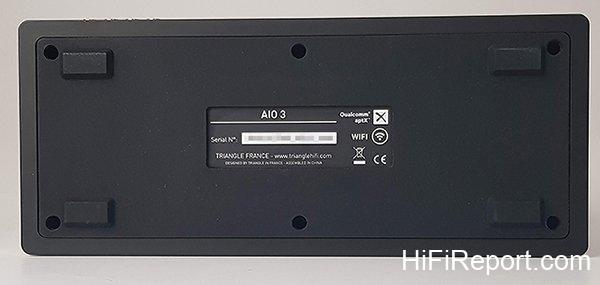
The base and feet are integrated into one piece, with damping properties, making it stable on desktops and cabinets.
It comes with a fully functional remote control, offering excellent ease of use.
Specifications
* Drivers: 1″ Tweeter x2, 3.9″ Mid-bass x2
* Wi-Fi: IEEE 802.11 b/g/n
* Wired Network: RJ-45 10/100M
* Bluetooth: Version 4.2 with aptX support
* Inputs: Aux in x1, Optical x1, USB 2.0 x1
* Music Formats: APE, FLAC, WAV, Apple Lossless (ALAC), AAC, AAC-LC, HE-AAC, HE-AAC v2, MP3, CBR/VBR
* Dimensions: H7.67 x W14.17 x D5.9 inches
* Weight: 11.24 lbs