
Vibrato NetWork HD Bluetooth Receiver Review
I recently had the opportunity to test the Vibrato NetWork Bluetooth receiver, distributed by HiFiReport, specifically the 5th-anniversary edition. Its sonic characteristics were remarkably full-bodied, rounded, smooth, and warm, delivering a performance that truly surpassed my initial expectations.
Initially, I considered Bluetooth playback to be merely functional, just producing sound. As someone accustomed to the nuances of Hi-Res network streaming, I was skeptical about Bluetooth’s ability to deliver a truly audiophile experience. However, the diminutive Vibrato NetWork receiver surprised me by offering a wealth of musical information, faithfully reproducing a significant amount of the layers and intricate details inherent in the recordings.
Furthermore, utilizing the digital output and connecting an external DAC resulted in a noticeable enhancement in audio quality. For individuals eager to access online music streaming but daunted by the complexities of network setup, the Vibrato NetWork presents itself as a truly user-friendly and welcome solution.
Internal Competition?
Vibrato NetWork, it’s a pleasure to encounter you once more. This time, however, it’s the latest iteration – the high-end NetWork HD Bluetooth receiver, unveiled by the manufacturer in late 2021. It boasts a larger footprint, enhanced build quality, and, naturally, a more refined sonic performance, accompanied by a slightly elevated price point.
Let’s address the pricing upfront. The NetWork 5th Anniversary Edition, which I reviewed previously, retailed for around USD 560 (NTD 16,800), with an optional lithium battery pack available for around USD 50 (NTD 1,800). In contrast, the flagship NetWork HD comes bundled with a battery for USD 1140 (NTD 38,000). While the price is doubled, the perceived value and sonic improvements are significantly more than twofold. Unless your budget is so constrained that even a few hundred dollars are a critical factor, the NetWork HD essentially outclasses its predecessor in nearly every aspect, making it a compelling upgrade within the Vibrato lineup.
Battery Included as Standard
The original NetWork boasted a remarkably compact chassis, with a footprint perhaps smaller than that of a smartphone. The NetWork HD, however, is considerably larger. While it doesn’t quite reach the dimensions of full-sized audio components, its length and width are comparable to a 13-inch laptop, and its overall volume is several times greater than its smaller sibling.
Given the substantial increase in chassis size, one might assume that a built-in power supply would be included. However, the answer is no. The NetWork HD, surprisingly, still relies on an external power source.
The manufacturer includes a switching power adapter as standard. However, HiFiReport, the distributor, believes that this stock power supply is insufficient to unlock the NetWork HD’s true sonic capabilities. Consequently, rather than offering optional upgrades, HiFiReport provides the NetWork HD exclusively as a package deal, bundling the main unit with an external lithium battery power supply for a fixed price of USD 1140 (NTD 38,000). This approach simplifies the decision for the consumer and ensures optimal performance right out of the box.
Balanced Outputs: Analog & Digital
The internal circuitry of the NetWork HD is demonstrably more sophisticated than that of the standard NetWork, and the external connectivity options are also significantly upgraded.
It offers both analog and digital output modes, selectable via a toggle switch conveniently located on the rear panel – left for analog, right for digital. The analog output section features a pair of RCA single-ended connectors alongside a set of XLR balanced outputs.
You might not have imagined that Bluetooth playback would ever necessitate balanced connections, right? Vibrato’s inclusion of XLR outputs clearly signals their confidence in the NetWork HD’s audiophile capabilities.
Furthermore, the NetWork HD provides digital output options, encompassing both RCA coaxial and AES/EBU connections. AES/EBU on a Bluetooth receiver? It’s a rare sight. Prior to this, I hadn’t encountered a Bluetooth receiver featuring AES/EBU, or even XLR analog outputs for that matter. This isn’t merely confidence; it speaks to a higher level of ambition and commitment to audio quality.
Linear Power Supply Option
Regarding power, beyond the standard USB Type-C power input, the NetWork HD also includes two connectors resembling speaker terminals, intended for use with an external linear power supply. However, a review of the manufacturer Fuson Audio’s official website reveals no currently listed linear power supply products. It’s likely a product under development, something to anticipate in the future. (In the current streaming-centric audio landscape, the demand for high-quality DC linear power supplies is indeed substantial!)
Bluetooth 5.0 & Range
So, how does the NetWork HD distinguish itself from the standard NetWork model? From a specifications standpoint, the NetWork HD also employs Bluetooth 5.0, supports aptX HD for high-resolution audio streaming, and features an optimized Bluetooth transmission pathway.
The adoption of the Bluetooth 5.0 standard inherently extends the potential transmission range. Laboratory tests indicate a range of up to 100 meters. However, it’s crucial to understand that this is a theoretical maximum achieved under ideal conditions. Don’t expect flawless signal reception throughout your home, especially if it’s not an open-plan studio. Concrete walls, brick, and even drywall partitions will significantly attenuate Bluetooth signals. Laboratory figures are obtained in unobstructed, interference-free open spaces, not typical domestic environments.
Superiority over NetWork: Balanced, Voltage, Clock, Noise Isolation
Bluetooth specifications largely depend on the chipset employed. When devices utilize the same chipset, core specifications tend to be similar. The differentiating factor lies in the implementation and surrounding circuitry. The NetWork HD’s primary advantage lies in its analog stage, featuring XLR balanced outputs – a significant upgrade that immediately places it a step above the standard NetWork.
Moreover, the digital output section of the NetWork HD incorporates audiophile-grade isolation transformers, effectively minimizing digital noise contamination. Furthermore, the NetWork HD operates at a higher 24V internal voltage, surpassing the 9V of the original NetWork and the 12V of the 5th Anniversary Edition. This increased voltage headroom has a substantial positive impact on sonic performance.
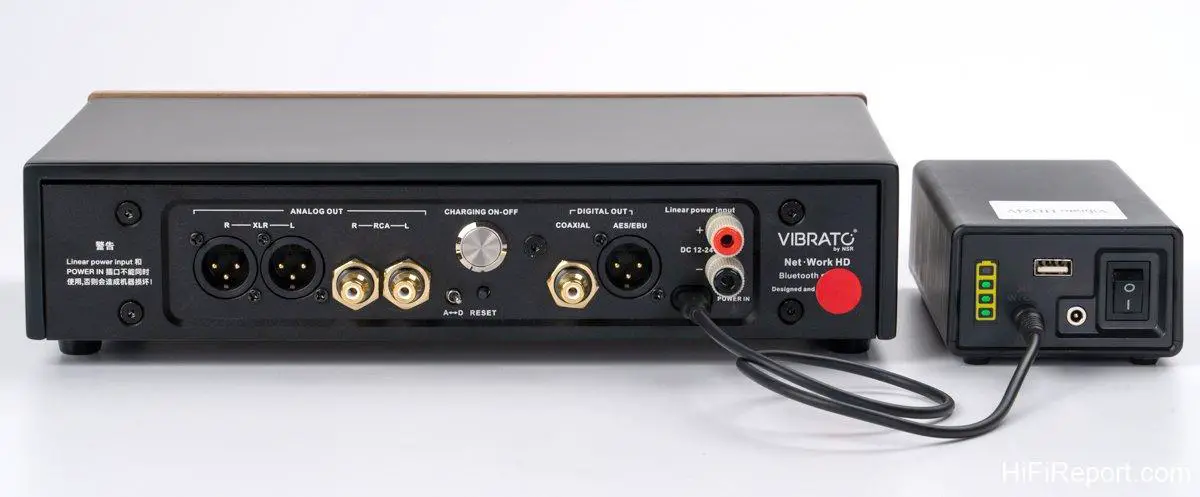
Finally, the clock system. The NetWork HD employs the same high-precision master clock found in Vibrato’s NMT digital streaming player, a product positioned above the NetWork HD in their hierarchy. This shared clock technology further elevates the NetWork HD’s performance towards the high-end audio realm.
Wood Chassis & Solid Wood Faceplate
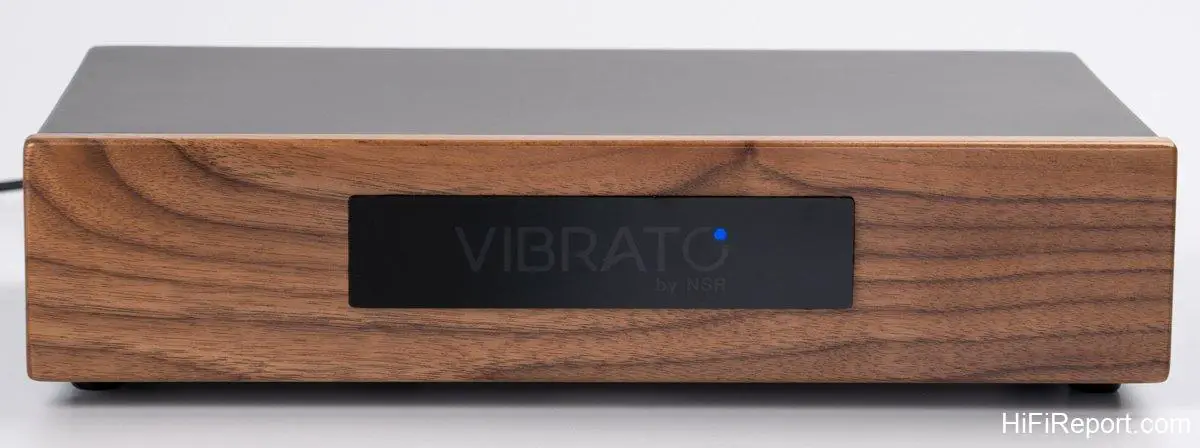
Regarding the chassis, the NetWork HD utilizes a wooden enclosure, finished with a black lacquer. The front panel is crafted from solid wood, featuring an embedded acrylic strip subtly displaying the “Vibrato by NSR” logo. This logo is not illuminated; instead, a small LED indicator provides visual feedback of the unit’s operational status upon power-up.
Due to the natural variations inherent in solid wood, each NetWork HD front panel will exhibit slight unique differences in grain and texture. Therefore, the appearance of your unit may vary slightly from stock photos online. Furthermore, the NetWork HD adopts an internal antenna design, eliminating the external Bluetooth antenna present on the original NetWork. This results in a cleaner rear panel aesthetic and is also a contributing factor to the choice of a non-metallic chassis material.
Capturing Vocal Nuances
The listening evaluation took place in the HiFiReport listening room. Amplification was provided by HiFiReport’s newly released limited-edition Fetron “Xia MK3” pre- and power amplifier set, the OSA-88P-General power amplifier, and the MBL New Noble Line N11 preamplifier and N21 power amplifier. Reference DACs included the Merging NADAC and NuPrime DAC-10H, with JMR Orfeo Jubile loudspeakers serving as the primary monitors.
The NetWork HD was consistently powered by its 24V lithium battery supply throughout the listening sessions. Tidal served as the music source, streamed from an iPhone XR to the NetWork HD. Utilizing the NetWork HD’s direct analog outputs, the sonic presentation was immediately characterized by its clarity and cleanliness. The soundstage and level of detail were demonstrably high, exceeding the performance of the standard NetWork. The sound was noticeably cleaner, the soundstage more expansive, and the instrumental and vocal images more firmly defined and substantial.
Listening to Diana Krall’s rendition of “Desperado,” the piano notes were rendered with a firm, focused quality, yet retained a pleasingly liquid texture and beautiful lingering decay. The accompanying strings were silky and delicate, creating a gentle, ethereal sonic tapestry that was simply beautiful. Diana Krall’s vocals were clearly imaged and richly detailed, allowing for a nuanced portrayal of her vocal style and emotional expression.
Layering, Coloration, Detail
Moving to Jose James’ “Lean on Me” album, the drum sounds were crisp and articulate, possessing a solid and impactful quality. Cymbals shimmered with delicate, colorful high-frequency details. The bass provided a firm rhythmic anchor, while the electric organ added subtle vibrato embellishments. James’ rich and rounded vocals imbued these tracks, regardless of their original genre, with a distinctly bluesy character, a deep and resonant blue hue.
Listening to Anne-Sophie Mutter’s “Across the Stars” album, a collaboration with John Williams, the violin’s melodic lines were clearly defined, and the nuances of bowing and phrasing were readily apparent. When the orchestra swelled, the distinct layers of instrumental sections were clearly delineated, and the powerful low-frequency presence of the lower strings was palpable. The inclusion of a celesta in several tracks introduced vibrant, shimmering tones, like crystalline musical notes, which the NetWork HD rendered with vivid clarity and color.
Overall, the NetWork HD demonstrably represents an advancement over the original NetWork. The higher operating voltage and increased signal swing contribute to expanded dynamics and enhanced detail retrieval. Power supply is a critical factor in audio performance, and Vibrato has clearly focused on this aspect to achieve significant improvements. Given the comprehensive nature of modern Qualcomm Bluetooth chips, which integrate numerous functions, the key to sonic differentiation lies in meticulous attention to power supply design and the implementation of the analog output stage. Careful engineering in these areas inevitably leads to sonic gains.
Digital Output: A Major Step Up
However, Vibrato’s inclusion of digital outputs is not merely an afterthought; it’s a strategic design choice. For users possessing high-quality external DACs, utilizing the digital output can unlock further sonic enhancements. Connecting the NetWork HD to the Merging NADAC via AES/EBU yielded a dramatic improvement in sound quality – a difference discernible within mere seconds.
Taking “Across the Stars” as an example, the soundstage expanded uniformly in width, depth, and height. Instrument separation improved noticeably, the violin’s melodic lines became clearer yet remained free of harshness, the orchestral layers became more distinctly defined, and the richness and weight of the lower strings were enhanced. This was an all-encompassing sonic upgrade. Switching to vocal performances revealed even more benefits. Vocal images became more focused and three-dimensional, with a significant increase in overall detail retrieval.
This was a particularly surprising revelation. It became clear that Bluetooth transmission, even when using a lossy AAC codec from an iPhone, carries a substantial amount of musical information. The limiting factor isn’t necessarily the Bluetooth transmission itself, but rather the quality of the subsequent amplification and processing stages.
Interlude: DAC’s Crucial Role
At this juncture, I’d like to interject a thought. In the realm of digital streaming, I’ve consistently maintained that for budget-conscious audiophiles, the most sensible investment strategy is to acquire an affordable yet well-engineered digital transport and pair it with a DAC that aligns with their sonic preferences. This approach offers both cost-effectiveness and flexibility, while also providing a clear upgrade path in the future.
Ultimately, the quality of digital music playback hinges on the analog conversion stage. Based on my observations, the digital signal streamed from my phone remained consistent, and the digital information received by the NetWork HD was unchanged. However, by simply switching the DAC in the signal path, the resulting sound quality varied dramatically. This underscores the paramount importance of the DAC in digital audio reproduction.
Drawbacks
Returning to the NetWork HD, it’s inherent to Bluetooth streaming that if you’re using your phone as the source, incoming calls will interrupt music playback. Whether this is considered a drawback is subjective and depends on individual usage patterns.
Another consideration is the inherent range limitations of Bluetooth technology. While Bluetooth 5.0 and later specifications boast a theoretical range exceeding 100 meters, this is rarely achievable in typical home environments. Briefly moving from the living room to an adjacent bedroom might not disrupt the signal. However, if you move further away, such as upstairs or to a more isolated location like a bathroom (with a closed door), signal dropouts and stuttering are likely. Therefore, when using Bluetooth playback, it’s advisable to keep your source device relatively close to the NetWork HD.
Why a Dedicated Bluetooth Receiver?
In the current audio market, Bluetooth transmission is commonly found in Bluetooth headphones, Bluetooth speakers, and all-in-one audio systems. Some traditional audio components also incorporate Bluetooth reception, but often as a secondary, convenience feature. Manufacturers like Vibrato, dedicated to developing standalone, high-performance Bluetooth receivers, are relatively scarce, primarily concentrated in regions like China and Hong Kong.
This trend likely stems from regional differences in residential network infrastructure and user habits. Southern China, in particular, boasts a strong concentration of ODM/OEM electronics manufacturers with extensive development capabilities. This environment fosters brand creation (as exemplified by Fuson Audio’s Vibrato), where the necessary resources and expertise are readily available.
For audiophiles prioritizing the highest fidelity in digital streaming, WiFi and Ethernet networks remain the preferred pathways. Network streaming devices, however, often involve a degree of technical complexity and hardware setup. While internet service providers typically handle basic home network installation and configuration, network streaming for audio can still present a barrier for some users. In regions with robust internet infrastructure, like , where network availability is widespread and bandwidth is abundant, dedicated network streaming systems remain the optimal choice for serious audio enthusiasts.
However, the technical hurdles associated with network streaming – including device connectivity, LAN configuration, WiFi setup, and optimization procedures – can be daunting for many users. While dealers may offer some level of assistance, many are hesitant to deal with digital streaming equipment due to the potential for extensive after-sales support related to network configuration issues, even for relatively inexpensive devices.
Therefore, even in regions with excellent network infrastructure, the simplicity and intuitive pairing of Bluetooth transmission offer a compelling alternative for some consumers seeking a straightforward streaming audio experience.
Appealing to Network Averse Users
For those seeking the highest fidelity from streaming audio, I would still recommend investing in a dedicated network streamer, whether a digital transport or a player with an integrated DAC. Network streaming generally offers superior sound quality. However, if you find network configuration daunting or prefer to avoid network-related equipment, or simply want to add Bluetooth streaming functionality to your existing system, Vibrato’s Bluetooth receivers, particularly the flagship NetWork HD, present an excellent solution.
Associated Equipment
* DAC: NuPrime DAC-10H / Merging NADAC
* Preamplifier: MBL N11 / HiFiReport OSA-Fetron-Phantom-Volcano (Xia MK3)
* Power Amplifier: MBL N21 / OSA-88P-General
* Speakers: JMR Orfeo Jubile
* USB Cable: Tromba Cypher-OCC
* Interconnects: Harmonic Technology Magic Link The Final
* Speaker Cables: Tromba Marina OCC-1
* Power Cables: Xsymphony Precision One
* Equipment Racks: Tiglon TMR-2 / MYSTJ Audio CMS
* Acoustic Tuning Devices: ASI
Specifications
* Type: Bluetooth Receiver
* Bluetooth Specification: Bluetooth 5.0
* Signal-to-Noise Ratio: > 96 dB
* Distortion: < 0.002 %
* Crosstalk: < -88 dB
* Analog Output: RCA x1, XLR x1
* Digital Output: S/PDIF RCA × 1, AES/EBU x 1
* Digital Gain: Max 21.5 dB
* Analog Gain: Max 3 dB
* Dimensions: 302 × 187 × 69 mm (W×D×H)
* Weight: 1.7kg