
Vivid Audio Giya G2 Speakers Review
Anyone who sees the Vivid Audio Giya series speakers for the first time will surely be astonished: why are these speakers designed like this? Our typical impression of speakers, unless they are planar magnetic or horn speakers, is mostly a rectangular box. Some might have slight curves, some might have a tilted front baffle, and even with some decorations or variations, they generally don’t stray far from this “predictable” form.
However, Vivid Audio aims to defy expectations from the outset.
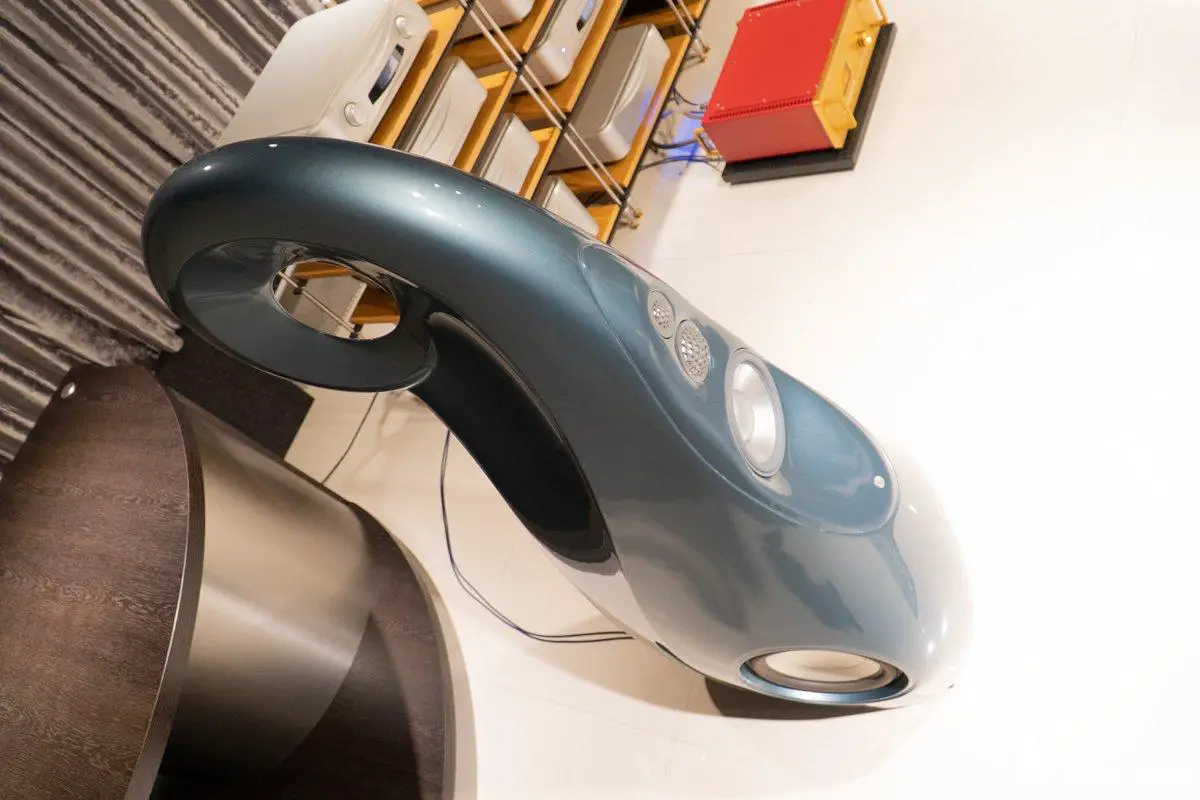
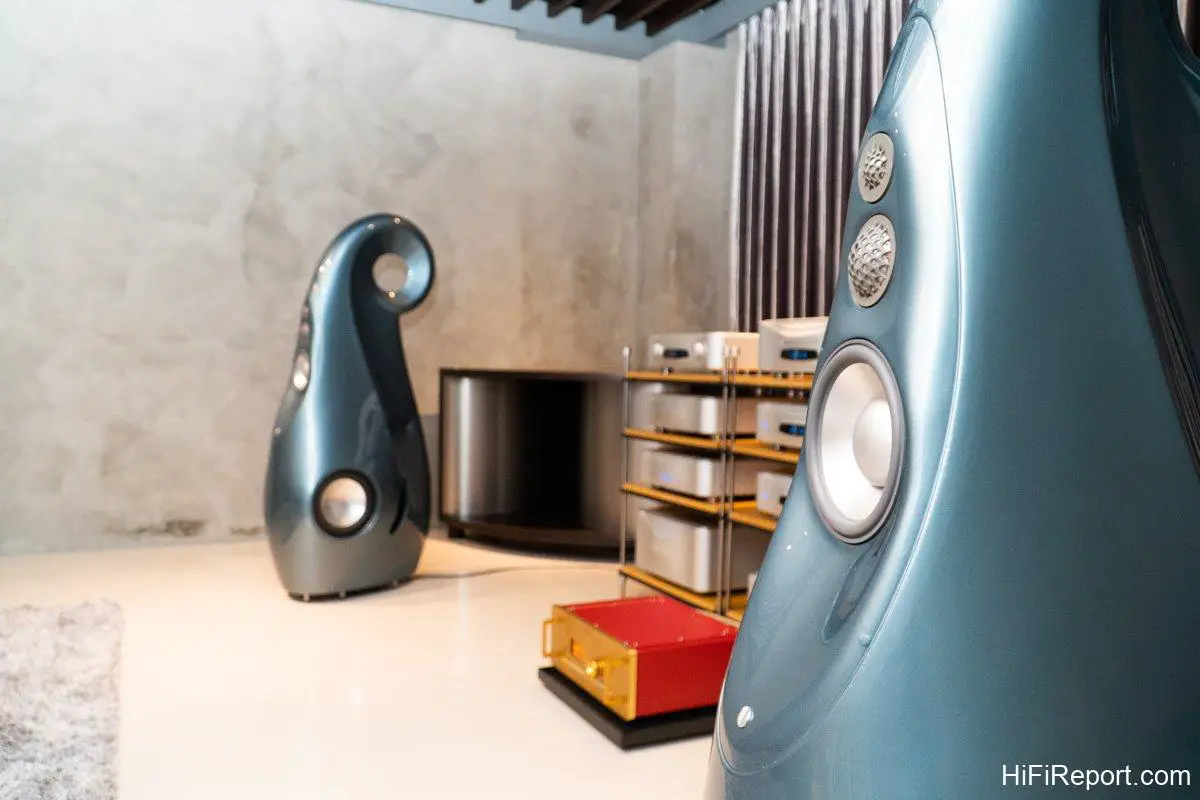
The most representative and high-end series from Vivid Audio, the Giya series, looks like a teardrop from the front. Narrower at the top and wider at the bottom, with a rounded and full mid-lower section, and a loop curving out at the top, resembling a jester wearing a cap. It also bears a resemblance to an alien figure from a science fiction movie. You could even say its appearance has a cartoonish personality, and I wouldn’t argue with you.
Vivid Audio’s Giya series speakers are unforgettable at first sight.
Form Follows Function
However, the Giya series is not shaped this way purely for aesthetics.
Vivid Audio, including the Giya series and their other two series, Kaya and Oval, all have unique and unconventional appearances.
These designs can actually be considered textbook examples of “form follows function.”
Eliminating Diffraction
Vivid Audio believes that traditional rectangular speaker cabinets with multiple flat surfaces and right-angle corners inevitably cause diffraction.
Therefore, the primary design principle for their speakers is to eliminate these parallel surfaces, minimizing diffraction interference and resulting in a more natural and flat frequency response.
This is why none of Vivid Audio’s speakers are rectangular, and in fact, none of their speaker cabinets have any parallel surfaces.
Tapered Tube Load (TTL)
Next, what about that distinctive “hat” on top of the Giya series? That is actually Vivid Audio’s exclusive acoustic technology—Tapered Tube Load (TTL).
When a speaker driver operates, it not only emits sound waves forward, but its piston motion also generates backward sound waves. The forward waves are what we want, while the backward waves are undesirable. If not handled properly, these backward waves can interfere with the driver’s movement, degrading the sound quality.
Therefore, Vivid Audio designed a rearward-tapering tube to absorb and eliminate the back wave from the driver. This way, the driver’s sound emission is not disturbed by back wave interference.
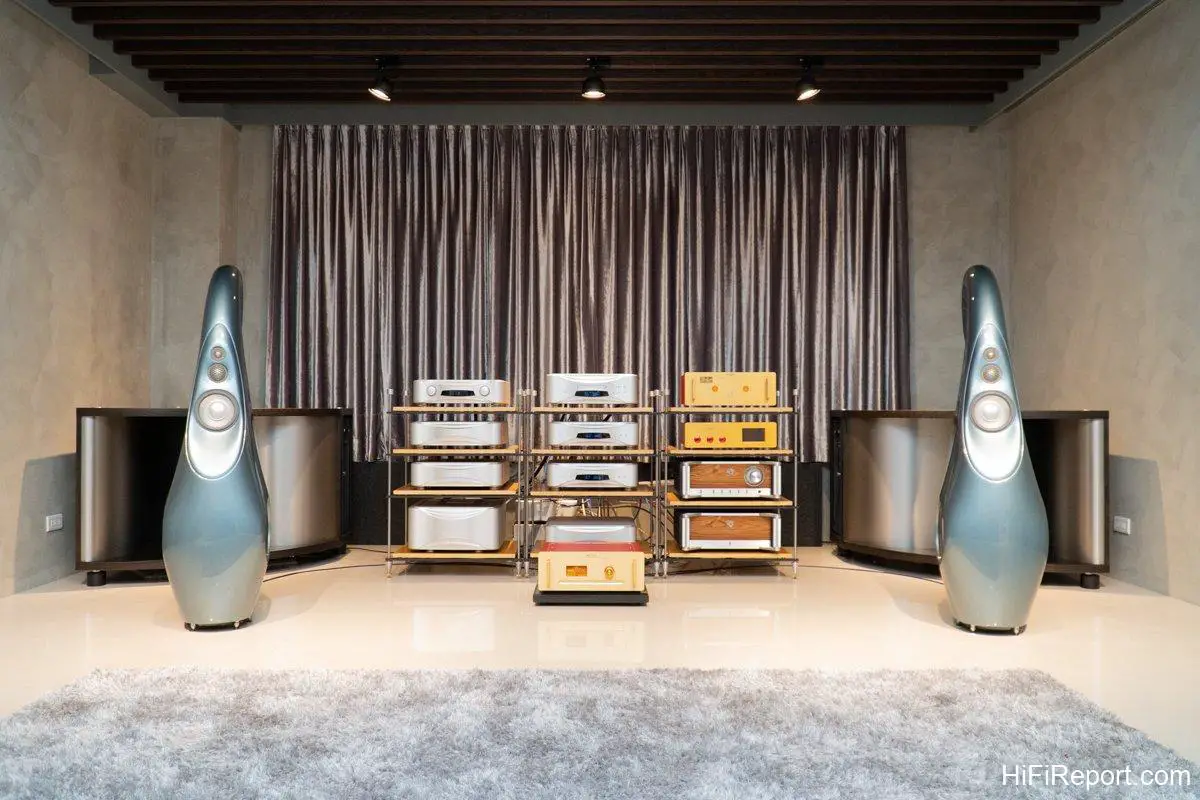
The ring-shaped structure on top of the Giya series is the TTL loading channel for the mid-bass driver.
Laurence Dickie’s Design
Where did such a clever idea come from? This requires mentioning a bit of Vivid Audio’s history.
After the passing of John Bowers, Robert Trunz, who took over leadership at Bowers & Wilkins, collaborated with chief research engineer Laurence Dickie to design the Nautilus loudspeaker—a model that shocked the market at the time and remains a classic even 30 years later.
When Trunz immigrated to South Africa, he met Philip Guttentag, an audio distributor who intended to start a brand. With Trunz’s experience and assistance, Vivid Audio was founded in 2002, and they brought in Laurence Dickie, the designer of the Nautilus, to help.
Trunz and Dickie first co-created Bowers & Wilkins’ Nautilus, and then collaborated again to begin the chapter of Vivid Audio.
Just as the Nautilus influenced every subsequent generation of Bowers & Wilkins speakers, the TTL technology from Dickie became a common gene in every Vivid Audio speaker.
Although Vivid Audio was only established in 2002 and has only 20 years of history, the origins of their products can be traced back to the golden era of Bowers & Wilkins in the 80s and 90s.
(Did you know that the Bowers & Wilkins 800 Matrix series, launched in 1987 and still talked about and loved by many audiophiles, was also designed by Laurence Dickie?)
Composite Material Cabinet
What is this cabinet made of, and how can it be shaped with such curves and no flat surfaces? Vivid Audio believes that the cabinet material should have high rigidity to minimize cabinet resonance.
To achieve this, they chose a composite material used in shipbuilding and aircraft. It is lightweight but extremely rigid, allowing the Giya series speakers to have high cabinet stiffness without excessive weight.
For example, the flagship Giya G1S, standing at 160 cm tall, weighs only 80 kg, while the near-flagship Giya G2, about 120 cm tall, weighs only 36 kg.
CDP for Metal Tweeters
In addition to the TTL technology for back wave elimination, their speaker drivers incorporate other ingenious techniques.

Laurence Dickie prefers to use aluminum alloy diaphragms for their light weight and high rigidity.
However, metal diaphragms can exhibit metallic resonances when breakup occurs, resulting in a perceived “metallic sound.”
The common approach is to add damping material to eliminate metallic resonance, but Dickie considers this a compromise. He proposed a more radical solution: “prevent breakup from happening in the first place.”
How is this done? First, he added a carbon fiber ring to the edge of the tweeter diaphragm to enhance its rigidity.
Second, through finite element analysis (FEA), he found a profile resembling the curve of a freely hanging chain or spider web. This shape raises the frequency at which breakup occurs by an octave, making breakup less likely to happen within the audible range.
The manufacturer calls this technology used for tweeter diaphragms CDP (Catenary Dome Profile). This allows Dickie to boldly use aluminum alloy diaphragms without the traditional “metallic sound” often associated with them.
Super Flux Magnet (SFM)
Their driver’s magnetic system is also meticulously designed.
Because Vivid Audio speaker drivers have TTL tubes behind them, the magnet needs to be donut-shaped to accommodate a sufficiently large central hole for back wave passage. This significantly limits the magnet’s size.
To achieve sufficient magnetic flux within a small volume, Vivid Audio employs Super Flux Magnet (SFM) technology. For example, the D26 tweeter has a peak flux density of 2.5T, twice that of a typical 25mm tweeter.
Highly Vented Former (HVF)
Furthermore, since they aim to increase magnetic flux, the gap between the magnet and the voice coil should be as narrow as possible to maximize effectiveness.
However, when the driver operates, the voice coil moves rapidly within the magnet’s gap, compressing the air and creating a damping force.
The ideal solution is to vent the voice coil former. Vivid Audio drills numerous holes in the voice coil former, with the total area of these holes nearly half of the former’s surface area.
As a result, they successfully raised the resonant frequency of the magnetic system beyond the audible range and reduced the Q value to an immeasurably low level, even eliminating the noise generated by air passing through the holes in the voice coil former.
The manufacturer calls this technology HVF (Highly Vented Former).
Highly Aligned Chassis (HAC)
The frames of the mid-range and bass drivers are also carefully considered.
Vivid Audio points out that the two biggest issues with driver frames are resonance and reflection.
To solve the resonance problem, Vivid uses cast aluminum frames, which are inherently rigid and geometrically designed to provide solid support.
To address reflection, Vivid minimizes the reflective surface area behind the driver frame, making the frame support structure extremely narrow.
For example, their C125 mid-bass driver has a frame thickness of only 3mm. Viewed from above, the frame occupies only 10% of the driver diaphragm area. In other words, 90% of the space behind the driver is open for air to move rearward.
(The energy is then absorbed by the TTL technology and cabinet damping.) This eliminates back wave reflection issues.
The manufacturer calls this technology HAC (Highly Aligned Chassis).
RCCM Bass & RCP Ports
Have we covered everything? Not yet. There’s still the bass section to discuss.
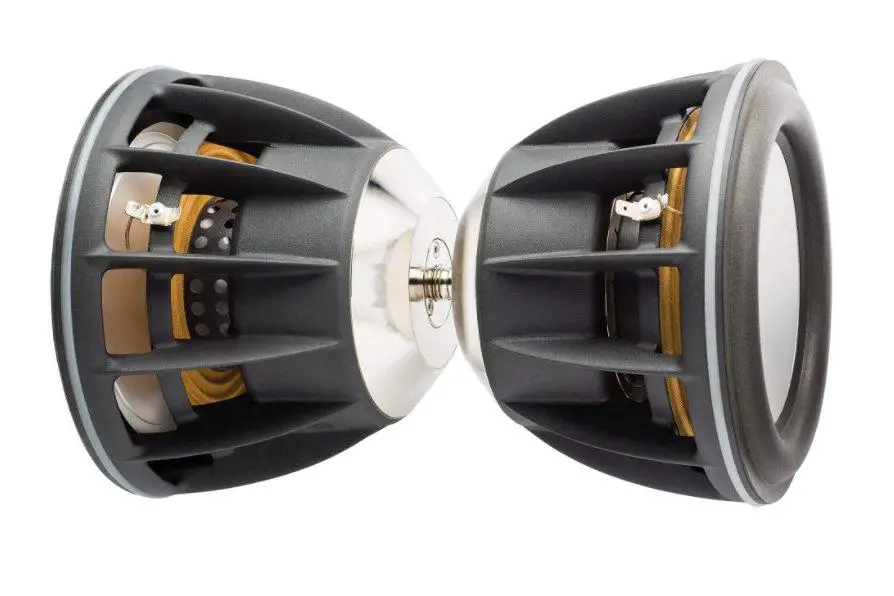
First, their bass drivers in the Giya series (and Kaya series K90 and K45) feature a bass configuration called RCCM (Reaction Cancelling Compliant Mount). Simply put, it involves placing bass drivers back-to-back, so their reactive forces cancel each other out, eliminating vibration problems caused by the bass drivers.
Vivid Audio also employs a bass-reflex design to achieve richer bass.
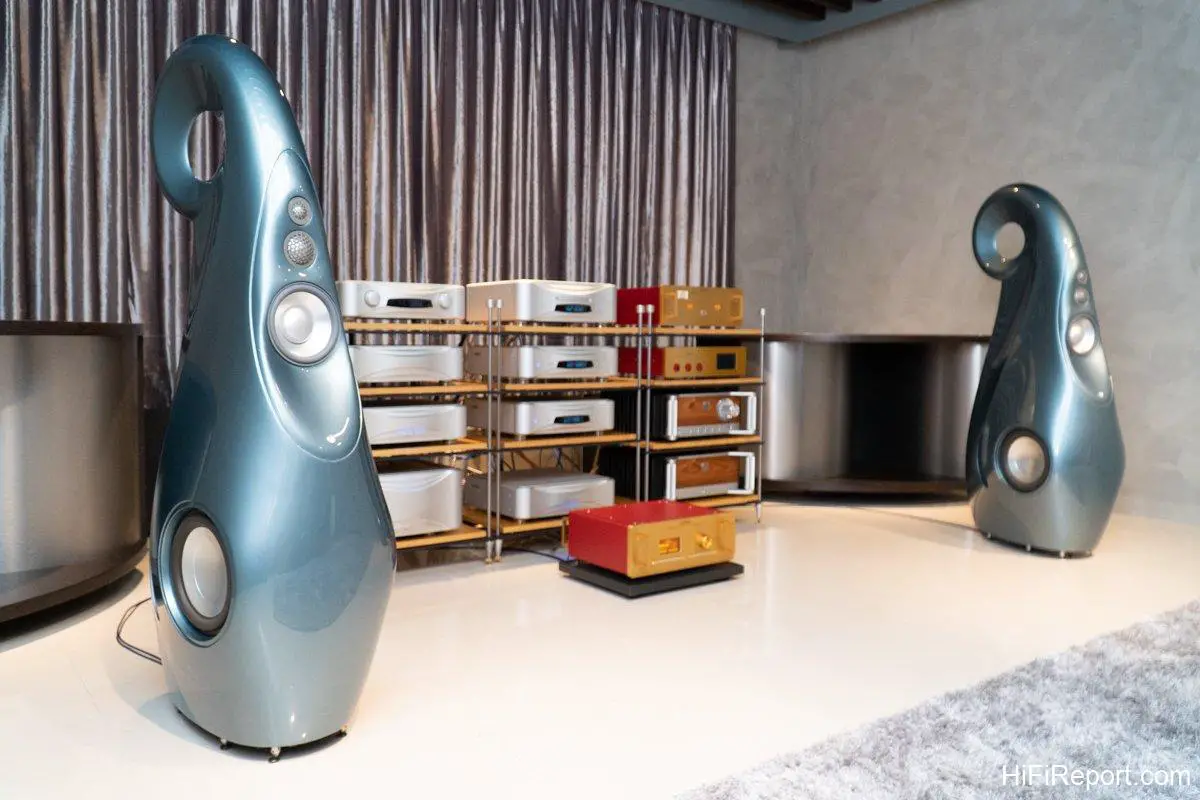
In the Giya series speakers, next to the side-firing bass drivers, they designed a smile-shaped opening called RCP (Reaction Cancelling Ports). Through a symmetrical layout similar to the bass drivers, these ports eliminate the reaction force from air pressure changes caused by airflow in and out of the cabinet.
Technology Across Giya Series
Okay, finally done with the technical explanations.
Vivid Audio’s appearance is distinctive, hardly resembling typical speakers, more like modern sculptures. Coupled with a variety of color options, it’s easy to get the impression that they are all style and no substance, just “empty shells”.
No, that’s not the case.
Vivid Audio brought in Laurence Dickie, the designer of legendary classic speakers. He’s not an artist, he’s an engineer.
He doesn’t design curves for the sake of curves, shapes for the sake of shapes, or spout vague and romantic creative philosophies. He focuses on sound, calculates engineering mathematics, analyzes test results, and speaks with scientific reasoning.
So, it’s not that I’m being long-winded; it’s just that Vivid Audio speakers truly have substantial technical depth.
The Vivid Audio Giya series currently has four models. The largest flagship is, of course, the original masterpiece Giya G1, now evolved into G1 Spirit (G1S), essentially the second generation. Following that are Giya G2, Giya G3, and Giya G4, with the latter three now also evolved to the second-generation Series 2.
The 160 cm tall G1S can still be considered a large floor-standing speaker, but the models below G2 are less imposing. The smallest, Giya G4, is just over 1 meter tall.
The entire series shares the same aesthetic and 5-driver, 4-way, bass-reflex configuration, fully sharing the technology. This makes the entire Giya series flagship-level. Users only need to choose the most suitable Giya speaker based on their room size.
This time at HiFiReport, we auditioned the second-in-line Giya G2 Series 2 (hereinafter referred to as Giya G2).
The tweeter is a 26mm metal dome tweeter (Vivid Audio only lists it as “metal dome” in the specifications, but states it’s an aluminum diaphragm in the technical description), model D26, responsible for frequencies above 3,500Hz. The midrange is a 50mm convex metal dome midrange, model D50, covering the 880Hz to 3,500Hz range.
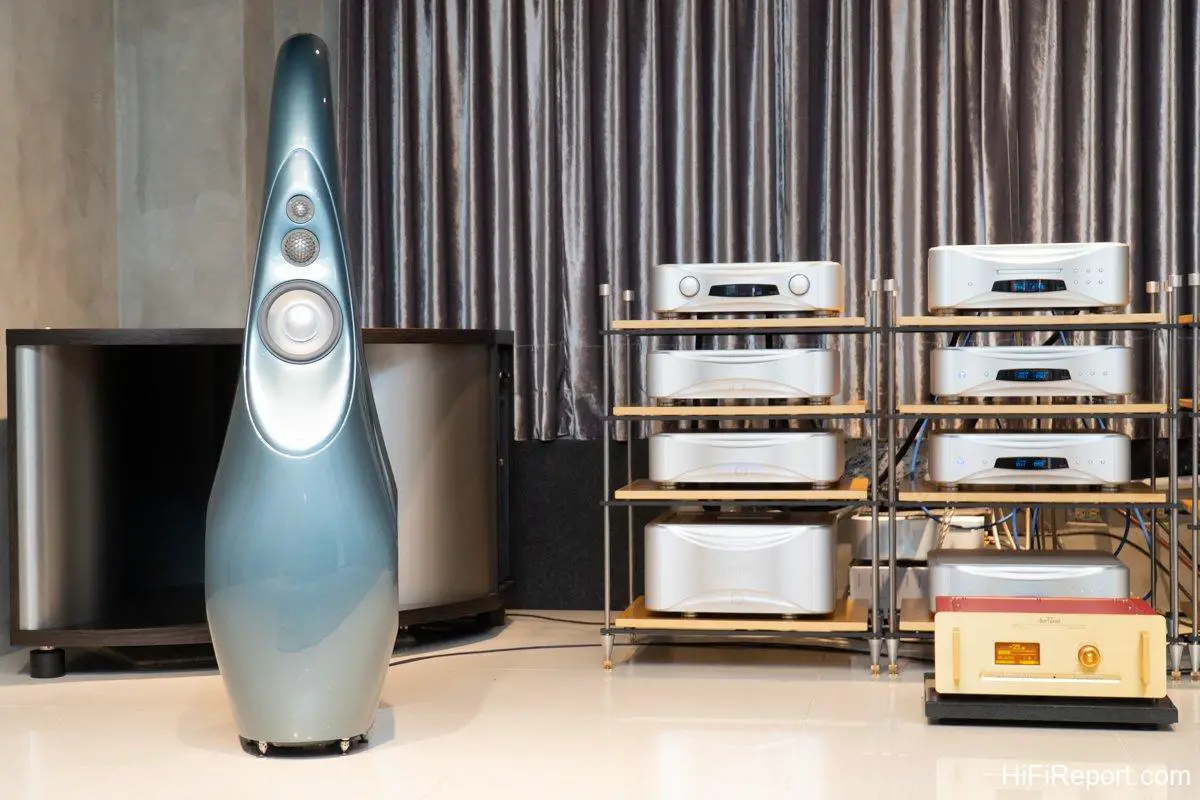
While most midrange drivers are cone drivers, Giya uses a convex dome midrange. Both the midrange and tweeter are protected by gray circular perforated covers, providing optimal driver protection.
Facing forward is also a 125mm alloy diaphragm mid-bass driver, model C125s, handling the mid-bass range from 880Hz down to 220Hz.
The side-firing bass drivers are 175mm metal diaphragm woofers, model C175, responsible for the bass range below 220Hz.
Interestingly, the speaker cable terminals for the Giya series are located at the bottom of the speaker. From the back, the curved surface maintains its seamless integrity.
System Setup
To showcase the capabilities of the Giya G2, HiFiReport set up a luxurious system. The source was the Esoteric Grandioso P1X transport and Grandioso D1X monoblock DAC, considered among the best CD/SACD source combinations available today, along with a flagship Grandioso G1X master clock generator. This combination can rival any top-tier source on the market.
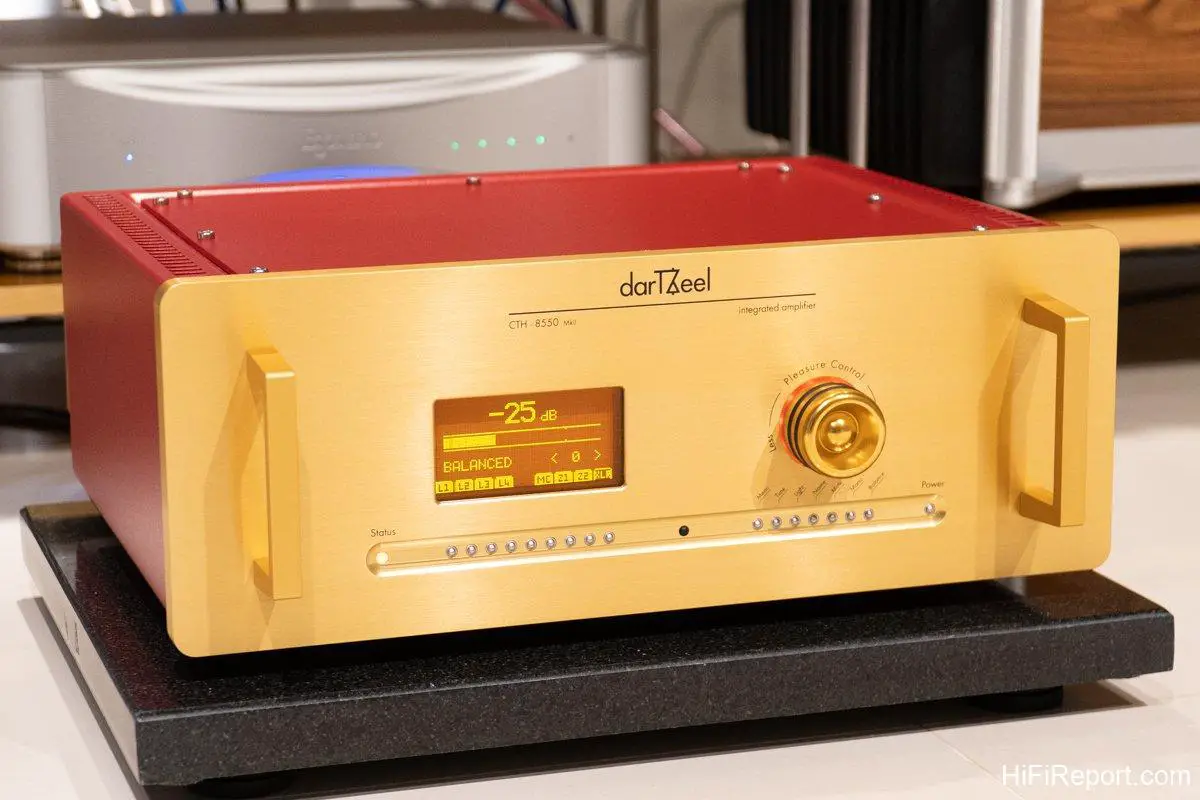
For amplification, they paired it with the newly released darTZeel CTH-8550 MK2 integrated amplifier.
darTZeel CTH-8550 MK2 Upgrades
The CTH-8550 is an integrated amplifier I greatly admire. Its rich, full, clean, crisp, clear, and natural sound, coupled with powerful driving force, has left a lasting impression on me for many years after the audition.
Frankly, the CTH-8550 has always been my reference integrated amplifier, meaning: if it’s a high-end integrated amp, it needs to meet the CTH-8550’s standard; if it’s a pre/power amp combination costing hundreds of thousands, it should perform no less than the CTH-8550.
Now, darTZeel has released the MK2 version.
What has changed? From the outside, it’s hard to tell. The machine looks exactly the same, completely unchanged.
However, the CTH-8550 MK2 has at least three significant improvements compared to its predecessor: First, the chassis is now made of 2.5mm thick aluminum alloy, offering better electromagnetic interference shielding than the previous steel chassis.
Second, the built-in MC phono stage has been given a 6dB headroom increase, making it more adaptable to low-output cartridges.
Third, the power supply has been redesigned to reduce overall noise, resulting in a blacker background and richer detail retrieval.
This audition of the Vivid Giya G2 provided an opportunity to also savor the improvements of the CTH-8550 MK2.
No Metal Sound
With the support of such a luxurious system, and considering the Giya G2’s own premium price of approximately $56,333 USD (1.69 million NTD), its performance could hardly be disappointing. (I’m not judging based on price, but the CTH-8550 MK2 does add a bit of psychological bias—I doubt any speakers paired with a darTZeel CTH-8550 would sound bad?) Overall, the Giya G2’s sound combines both rationality and emotion. It boasts clear and rich detail, a very high level of imaging precision and outline definition, a naturally expansive and unrestrained soundstage, and a natural and slightly warm timbre.
Especially the last point is puzzling: how can speakers using all-metal diaphragms sound so free of harshness, without any metallic taste, and even possess warmth and excellent body? Perhaps the answer to this question is partly related to its bass performance.
The Giya G2’s back-to-back dual bass design makes its bass sound both full and rich. If you prefer a heavier bass, the Giya G2’s performance should be to your liking.
However, while the bass is full, it’s not particularly tight or punchy with sharply defined transients. The side-firing woofers can move a sufficient amount of air, bringing full bass energy, but the approach is gentle, not directly impactful.
The full and rich bass can also influence the mid and high frequencies upwards through octaves of overtones. Perhaps this is the answer to my question.
While the manufacturer boasts technologies like CDP and TTL, I can’t establish a causal relationship between technology and auditory experience through music listening alone. I can only describe what I heard: the Giya G2’s sound is pleasing, easy to appreciate, stress-free, and approachable.
Orchestral Performance
Upon arriving at the HiFiReport listening room, Herbert von Karajan conducting the Berlin Philharmonic performing Richard Strauss’s “An Alpine Symphony” was playing softly, from an Esoteric SACD.
This piece is definitely a test for any audio system, with dramatic dynamic changes. In the opening and closing nightfall sections, the volume is extremely low, while the mountain summit section needs to sound glorious and brilliant, and the storm section becomes intense and violent.
Okay, I’ll give it a listen.
After this test, I’m glad I didn’t miss this piece. The Giya G2 is not large, and its cabinet volume is limited, at most a medium-sized floor-standing speaker. However, it demonstrates exceptional detail retrieval, clarifying the soundstage image. The interplay of different instrumental sections and the complex counterpoint created by Richard Strauss are all resolved clearly.

In the introduction, the bassoons and strings gently play the nightfall motif. As the sun rises and the mountain scenery gradually appears, the mountain motif played by the brass section stirs into action. This entire passage tests how well an audio system handles microdynamics. The Giya G2 is clearly an expert in this area, with excellent resolution at low volumes, rendering those subtle details clearly.
Then comes the sunrise section, the sun motif is brilliant and passionate. From the beginning to this point, only 3-4 minutes have passed, but the dynamic range of the music is astonishing. At this point, the Giya G2 conveys the brass section’s passion very effectively. Is it harsh? Is it strident? Yes, but that’s not the Giya G2’s fault; that’s how the music itself is. You need to wear sunglasses to look at the sunrise, right? Here, the composer and conductor aim to create that dazzling sunlight, brilliant and intense.
Stable Soundstage at High Volume
As the music shifts to the climbing section, the low strings powerfully play the mountain climbing motif. The string sound is dense and full. Mountain climbing is never easy, is it? After continuous development, the brass section plays the cliff motif, with hunting horns sounding in the background. Ah, what a forest scene.
HiFiReport’s listening room is quite spacious and can accommodate considerable sound energy. I turned up the volume, pushing the CTH-8550 MK2 to -9dB. (They told me that during their own testing, they usually turned it up to around -10dB to get clear musical information, which is consistent with my experience.) However, there aren’t many soft sound-absorbing treatments here, just a long-pile carpet on the floor and a leather sofa. But even at this volume, I never encountered harsh noises. Perhaps HiFiReport’s room is good, but I believe Dickie’s efforts in the Giya series speakers truly paid off.
Reaching the mountain summit, the magnificent grandeur is vividly presented. Trombones lead with a solemn and majestic tone, playing the sun motif, while the strings add to the vast scenery under the brilliant sunlight, creating a breathtaking beauty.
The Giya G2 renders the oboe lines in the lament section clearly and with precise localization. The outline and form are truly outstanding. Only strings and woodwinds are heard in alternation, with low strings slowly emerging. The music transitions from sorrowful to ominous. Subsequently, under the sustained high notes of the violins, the woodwinds occasionally play short slurs, representing the calm before the storm. Drum sounds foreshadow distant thunder, followed by the arrival of a violent storm.
Wind machines whir, creating eerie wind sounds. The orchestra powerfully plays wild ensemble passages, with percussion backing up, vividly depicting the scene of a sudden storm.
Rational and Emotional Sound
The Giya G2 delivers a dynamic range and scale for large orchestral works that is greater than you might expect.
Take John Williams in Vienna, for example. In “Flight to the Neverland” from the movie “Hook,” a simple theme, under the maestro’s skillful weaving, emerges wave after wave, layer upon layer, each iteration with variations, captivating the listener. John Williams utilizes the entire orchestra to its fullest extent. The string texture is dense, the violins are delicate, clear, and shimmering, the percussion is lively and varied, and the drums are powerful with full transients, while the woodwinds punctuate with layers of color.
The Giya G2’s clear imaging brings all the musical expressions to life vividly, and with well-defined layers. The timbre is authentic and warm, neither harsh nor strident. This is what I meant earlier when I said the Giya G2 “combines rationality and emotion.”
Extended and Full Treble
In the excerpt from “Close Encounters of the Third Kind,” this concert version, re-arranged, features the theme of alien visitation and the landing of a UFO mothership in the first section. The music is avant-garde and modern. The Vienna Philharmonic’s ensemble ability is superb. The Giya G2, with its clear and transparent image, clarifies every detail of this wonderful piece.
The piercing sound of the opening violins sets a sci-fi atmosphere. The low strings surge, and the music gradually builds from extremely soft to explosive energy. At this point, I must commend the Giya G2’s bass performance. It renders the lines of the tubas and low strings very clearly, with bass that has both depth and definition.
The piccolo’s piercing whistle is sharp but not harsh, preserving the piccolo’s inherent sound and conveying the atmosphere the music aims to create.
Again, I must commend it, this time for its treble. It’s a treble with depth, with ample extension, rich in shimmer and color, but it’s a sound with substance, not grating or unbearable.
Then, a farewell theme is introduced, a romantic and tender string passage. John Williams transforms into a late Romantic master, reminiscent of Richard Strauss and Wagner. The music swells layer by layer, the string texture is incredibly dense, and the brass section plays a five-note motif, bringing the music to a climax.
It’s wonderful, John Williams is amazing, writing such great music. The Vienna Philharmonic is amazing, performing it so perfectly. The Vivid Giya G2 is amazing, reproducing this music so captivatingly.
Rich and Relaxed Bass
As for the theme from “Sabrina,” re-arranged by John Williams, the solo violin takes the lead. In this concert, the soloist is Anne-Sophie Mutter, her second collaboration with the maestro after the “Across the Stars” album.
The solo violin is powerful and expressive, sometimes displaying gypsy flair, sometimes adopting Prokofiev-esque tones. The violin sound is solid, full yet focused, with clear and bright lines. Even when playing in the high registers, it maintains ideal body and thickness, without harshness or stiffness.
When the timpani strikes, it has weight, but the sensation is more relaxed than impactful. The drum sound seems to spread from the front like air, a characteristic well-suited for reproducing timpani in classical music.
Piano Performance
The Vivid Giya G2 also sounds remarkably good with piano music. Take Martha Argerich’s live performance at the 2006 Lugano Festival of Shostakovich’s Piano Concerto No. 1, for example. Although named piano concerto, it’s actually a concerto for piano, trumpet, and string orchestra.
After a brief arpeggiated introduction, the piano directly presents the opening theme, first a humorous descending passage, then a romantic melody. After repetitions by the strings, the piano reappears with a playful attitude, truly capturing the spirit of the first movement.
The piano sound is solid and full, with a hint of warmth and sweetness. It’s truly beautiful piano sound. When low-frequency chords are struck, they have substantial weight. As the piano explores the high registers, it produces solid note transients with brilliant overtones. Don’t assume that because the Giya G2 uses metal diaphragm drivers, it must have a “metallic sound.” The sound it produces is not only free of metallic harshness but even possesses a warm and full texture.
The second movement slows down, with the strings first playing a lyrical and romantic tune. The violins play in the high register, while the low strings provide gentle harmonies. At this point, the violins exhibit a silky and delicate quality, while the low strings sound full-bodied. The Giya G2 clearly delineates the lines of both sections.
Then, the piano enters with an elegant and composed demeanor. As the music reaches a peak, it immediately falls into deep low-frequency chords. The Giya G2 doesn’t pursue bass performance beyond its physical size, but it does its best. These left-hand chords sound weighty and deep enough, and the clearly resolved texture of the vibrating piano strings brings us closer to the piano itself.
As for the strings here, their texture is truly dense and solid. The trumpet’s timbre is warm and brilliant, with a moist quality, displaying different characters with the music.
Having said this, I can’t help but wonder: although Giya G2 owners will certainly pair them with excellent amplifiers, if it weren’t the darTZeel CTH-8550 MK2, could it still be so composed, so rich, so sweet, and so delicate? Perhaps, but it would definitely be a different character.
Vocal Performance
Vocal reproduction is also a major strength of the Giya G2. It has excellent resolution, clearly presenting all the details of vocal performances, but it doesn’t just give you a lot of sibilance and mouth noises. Instead, it uses a lively approach to bring the singing to life before your eyes.
Listening to Diana Krall’s Love Scenes album, the double bass pizzicato is full-bodied and the texture is supple and slightly soft. Diana Krall’s vocals are focused and well-formed, with excellent presence.
The Giya G2’s ability to outline sound lines and shapes is remarkable. In orchestral music, its capability in rendering solo woodwinds is evident. In vocal albums, this ability becomes even more apparent.
Diana Krall’s vocal nuances, when she lets the sound resonate in her throat, focusing the singing on the lips and teeth with less chest resonance, the textural details of that sound are heard very clearly.
Abundant information constructs rich details, resulting in a vivid, three-dimensional, and lifelike singer image. Do you like this kind of vocal performance? You have to listen to Vivid Giya G2.
Emotional Vocals
When playing pop and rock music, the Vivid Giya G2 can deliver a high-energy performance. Strong and full rhythms and unrestrained and colorful electric guitars are elements that get you hyped up.
Take the “A Star Is Born” movie soundtrack as an example. The Vivid Giya G2 conveys the unrestrained spirit of Bradley Cooper’s “Black Eyes.” The drums are powerful and full, the cymbals are clear and bright, and Bradley Cooper’s restrained and slightly gravelly vocals, driven by powerful singing, are filled with intense emotion.
As for Lady Gaga’s rendition of “La Vie en rose,” she sings this chanson with strength and resilience, like a Broadway musical number. When she sings in the high register, the vocal energy is ample. Reproduced by the Giya G2, her solid vocals are truly touching.
In “Out of Time,” the drumstick hits are bright and crisp. I originally expected the metal diaphragm Giya G2 to produce an even crisper sound, but it delivered a more articulate and transient-defined sound. Listening to the wild electric guitar, paired with the thick and heavy drums, the soul of the blues is burning, heating up the surroundings.
Another unexpected surprise is the performance of spoken word segments. This soundtrack album includes dialogue excerpts from the movie, allowing listeners to relive movie scenes while listening to songs. The Giya G2 vividly reproduces these dialogues. The voices have both body and texture, and the imaging is three-dimensional, clear, and not diffuse. This is just a two-channel speaker system, but the imaging of the dialogues is so clear, it’s almost like having a center channel speaker.
If you have a pair of Giya G2s in your living room, even without a home theater system, the Giya G2 can make stories clearer and more immersive when you are watching TV shows or movies.
A Speaker That Makes You Want More
Many people who see Vivid Audio Giya series speakers always focus on their unique appearance. But as I mentioned earlier, Laurence Dickie designed the Giya series based on various acoustic principles.
So, put aside preconceived judgments, don’t judge by appearance, and listen before making any judgments.
Despite having heard the Giya series many times at audio shows, it was only after spending an afternoon in the HiFiReport listening room that I dared to say I had a slight understanding of this Vivid Audio near-flagship model, the Giya G2.
If possible, I would like to hear more, to hear it play Mahler symphonies, to hear it play Widor’s organ symphonies, to hear it play Verdi’s Aida, to hear it play…
Specifications
* Type: 4-way 5-driver bass-reflex floor-standing speaker
* Drivers: 26 mm metal dome tweeter (D26), 50 mm metal dome midrange (D50), 125 mm mid-bass (C125S), 175 mm woofer (C175) x2
* Sensitivity: 89 dB (@ 2.83 V/ 1m)
* Impedance: 6 ohms (minimum 4 ohms)
* Frequency Response: 33 – 33,000Hz (- 2dB)
* Crossover Frequencies: 220, 880, 3500 Hz
* Maximum Power Handling: 800 W
* Dimensions: 1161 x 341 x 578 mm (HxWxD)
* Weight: 36 kg