
Westminster Lab Speaker Cable Review
I understand that this title might seem redundant. If it’s already called “Speaker Cable,” why add “” (speaker cable in Chinese)?
Unfortunately, the manufacturer hasn’t given it a model name, simply calling it “Speaker Cable.” I have to follow suit, but also need to specify the product type in Chinese, hence this somewhat peculiar title.
Which company is so unique? Westminster Lab.
Despite the name “Westminster,” they are not necessarily based in London. Westminster Lab is actually a Hong Kong company, and their products are fascinating in that each product category only has one offering.
They have a preamplifier called Quest and a monoblock power amplifier called Rei.
Their main focus, however, remains on cables, and their product range is quite comprehensive, including power cables, digital cables, analog signal cables, and speaker cables.
Their digital cables are available in BNC, coaxial, AES/EBU, and USB formats, with only one model for each. Similarly, for analog signal cables, there’s one RCA and one XLR option each. Power cables and speaker cables are also essentially undifferentiated. Therefore, each product category has only one model, without additional names or model numbers. It is simply referred to by its type.
The speaker cable we are reviewing here is simply called “Speaker Cable.”
Besides preamps, power amps, and common audio cables, Westminster Lab also offers two interesting products: power cords specifically designed for Lumin and MSB external power supplies.
If you are a user of Lumin X1 or MSB Select DAC or Reference DAC, you might want to consider the upgrade options from Westminster Lab.
Four Cables Per Set, Each One-to-One
Let’s get back to the speaker cable itself.
This cable is quite unique. A set of speaker cables comes in two boxes, one box per channel. Each box contains two cables, and each cable has one connector at each end, a one-to-one configuration. For each channel, you need two cables for positive and negative poles, so each box contains two cables, and a set of speaker cables totals four cables.
The speaker cables are sheathed in white cotton sleeves. The cable itself is thin and somewhat rigid; it can hold its shape when bent slightly.
Have you guessed what it is? Yes, it’s a solid-core cable.
Most common speaker cables are multi-stranded, possibly with different gauges of strands twisted together, or multiple bundles of strands twisted together.
However, Westminster Lab prefers to use solid-core conductors and manufactures them by hand.
(Image from Westminster Lab official website)
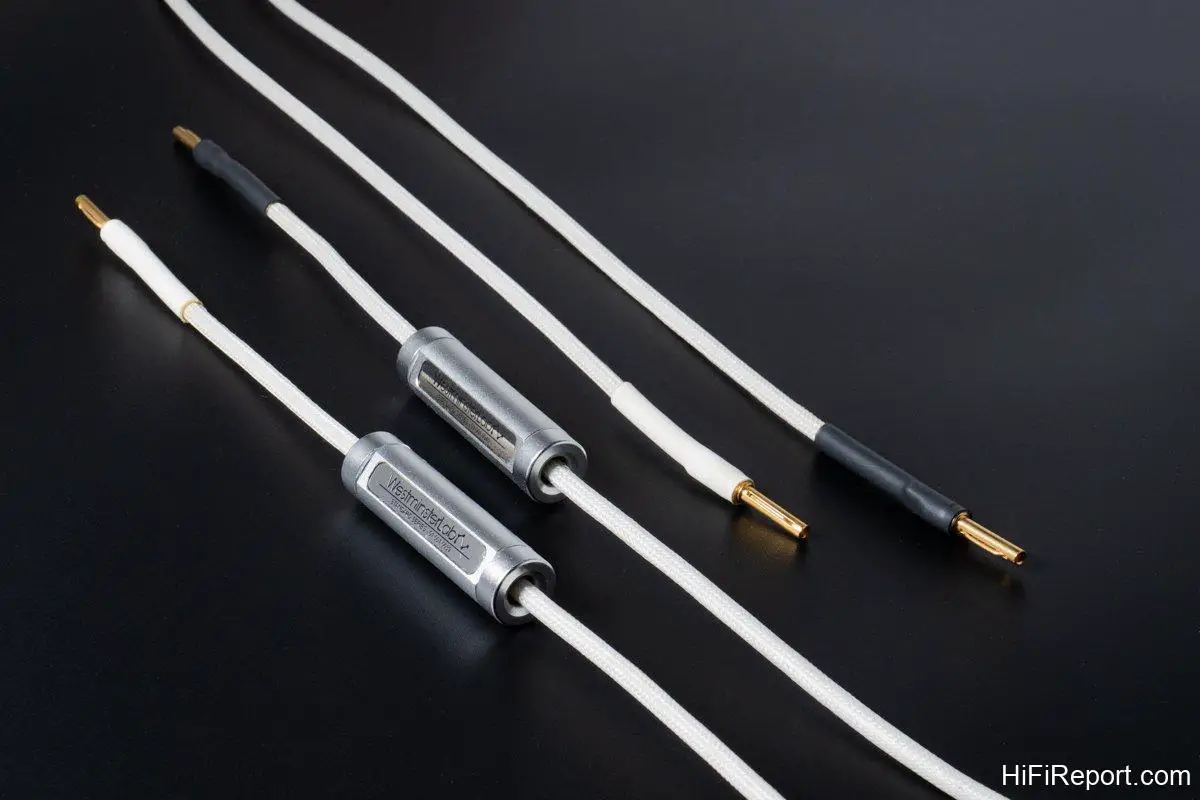
Exclusive Autria Alloy Conductor: Formula? Secret!
The internal conductor is made of an alloy called Autria Alloy.
Is that spelling correct? Is there a typo? At first glance, I also thought I had misread it. But upon closer inspection of the official website, it is indeed “Autria Alloy.”
What does it mean? I’m still in the dark.
However, the manufacturer does offer some explanation.
Typically, audio cable conductors are predominantly made of copper and silver. However, Westminster Lab’s experiments, including high-purity copper, silver, gold, silver-gold alloys, and other precious metals, as well as silver-plated or copper-plated options, yielded unsatisfactory results.
They recognize the merits of single-crystal silver or single-crystal copper. Due to their single-crystal structure, electrons do not need to jump across crystal boundaries, allowing for smoother current flow and signal transmission.
However, Westminster Lab found a common characteristic among these materials: a sound that is heavy and dense.
Perhaps this is what some people are seeking, or what some consider to be good. But for Westminster Lab, this is simply the sound of copper or silver.
They are pursuing something different.
Therefore, Westminster Lab developed its own custom conductor formula, which is Autria Alloy.
Autria Alloy conductors are also essentially produced using a single-crystal process, eliminating crystal boundaries. After drawing the wire, it undergoes both high and low-temperature treatments to achieve better physical and mechanical properties, ensuring that the material cross-section is uniform throughout, thereby achieving optimal transmission performance.
They further enhance the conductor surface by polishing. All conductors are hand-polished and coated with a layer of enamel using their proprietary formula. This further prevents conductor oxidation.
Finally, the conductors are inserted into PTFE tubing (Teflon) to avoid the influence of high dielectric constant on the sound.
Not Silver Sound, Not Copper Sound, But Westminster Sound
Westminster Lab manufactures its own conductor alloy, makes its own cables, uses the simplest insulation, and separates the positive and negative poles into single strands. All of these measures aim to avoid the sonic characteristics of the materials themselves.
They don’t want the sound of copper, nor the sound of silver, nor the influence of insulation capacitance and inductance on the sound. This is the Westminster Lab Speaker Cable.
The speaker cable I have on hand is the banana plug version. The connectors are very simple, without heavy metal shells. They might look somewhat flimsy, but when you understand Westminster Lab’s principles and goals in cable design, you can appreciate why they use such lightweight connectors.
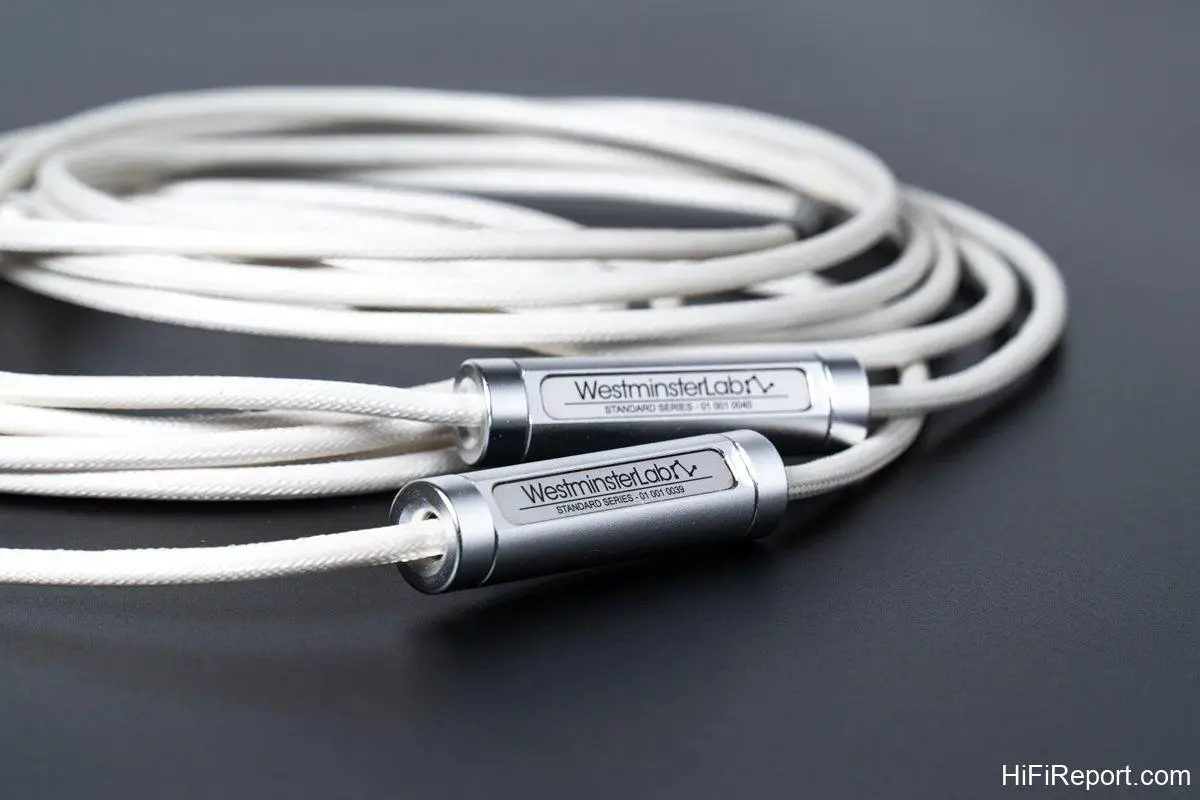
They aim to avoid all possible interference and to achieve the most faithful and complete signal transmission, in order to (huányuán – restore/reproduce) the original sound of the music.
The manufacturer also has two special technologies, one related to winding and one to shielding, but these are technologies used in their signal cables, so I won’t elaborate on them here. If I have the opportunity to review related cables in the future, I will provide more details.
Neutral Sound, Cohesive and Solid, Clean Lines
The Westminster Lab speaker cable sounds tonally neutral and uncolored. It’s really hard to describe what it sounds like, what it resembles, or what sonic characteristics it possesses. In this regard, I believe Westminster Lab has indeed achieved its intended goal.
However, as a solid-core speaker cable, its physical effects are still noticeable. Its sound is cohesive and solid, with clear and defined lines, detailed and precise, fast with short decays, direct and straightforward, without any discernible coloration.
Simply Clearer Than Others
The tonal neutrality allows the system to have more potential for critical listening.
Listening to the young violinist Daniel Lozakovich as soloist, with Valery Gergiev conducting the Munich Philharmonic in Beethoven’s Violin Concerto, the timpani at the beginning of the first movement gently breaks the silence. Even at a low volume, each beat is distinct.
Subsequently, the woodwinds play the first theme, delicate and graceful, rounded and colorful. Listening to the timpani accompanying with a steady rhythm, that drum sound is the rhythmic backbone of the entire movement.
After the second theme is presented, the music turns quiet, bringing out the solo violin, which reintroduces the first theme in an embellished style.
The Westminster Lab speaker cable provides clean and distinct lines. The separation between instrumental sections is clear, without ambiguity or gray areas.
The violin emerges vividly and three-dimensionally, with a strong sense of individuality.
Lozakovich doesn’t offer overly personalized interpretations, maintaining a confident and precise performance. Musical phrases are clear and distinct. Those dynamic variations and bowing techniques are all clearly audible, creating a vivid picture.
Other speaker cables are not incapable of expressing these qualities, but the Westminster Lab speaker cable is simply clearer and more explicit.
In this recording, Gergiev conducts the Munich Philharmonic in a similarly transparent and layered ensemble performance. The Westminster Lab speaker cable also demonstrates its analytical prowess, presenting those layers clearly and completely, seemingly allowing you to hear more and understand more clearly.
Abundant Sonic Details, Excellent Lively Sense
When it comes to jazz, it makes the music sound vibrant and unrestrained.
For example, on Diana Krall’s “All for You” album, Westminster Lab’s cohesive and solid sound, combined with its quick response speed, adds a touch of brilliance to the music and gives the bass more definition.
In “I’m an Errand Girl for Rhythm,” Diana Krall’s vocals are vivid and three-dimensional, with abundant sonic details and an excellent sense of liveliness.
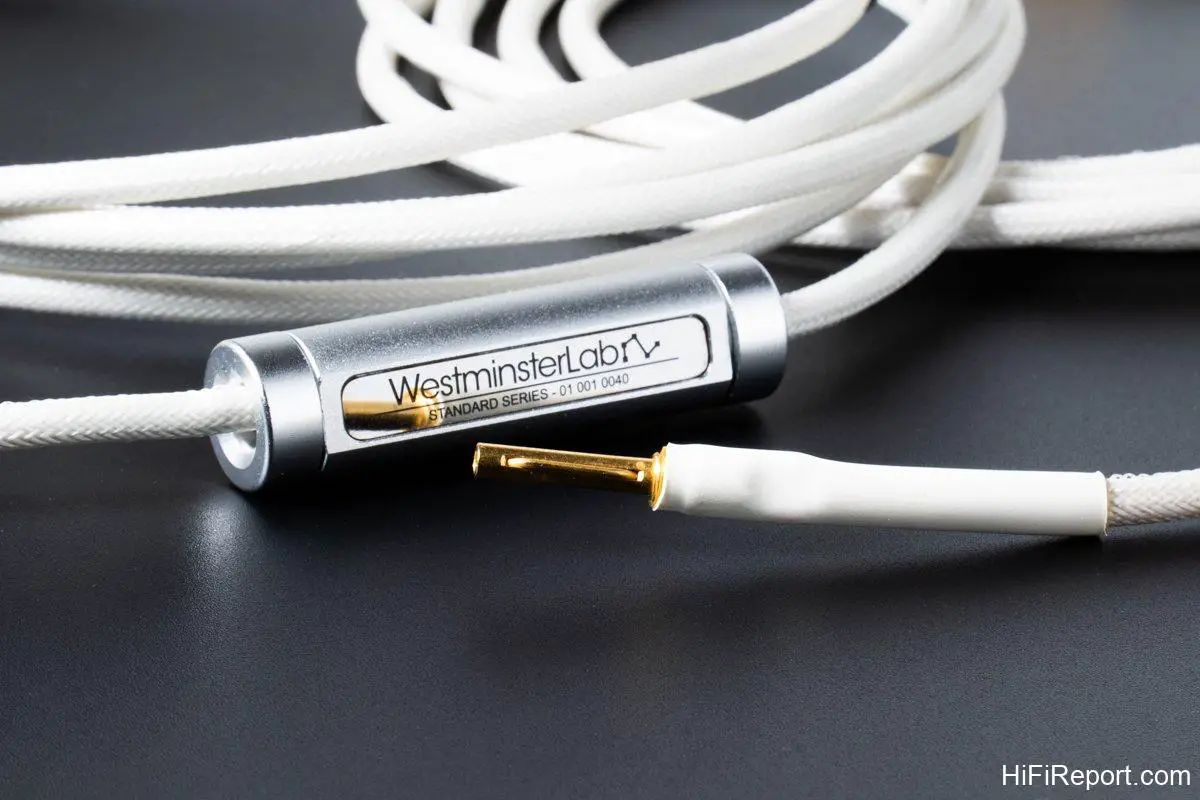
The bass remains full, but it’s tighter, making the sound more agile and bouncy.
The same effect is evident in the guitar playing.
The piano in “Gee Baby, Ain’t I Good to You” sounds clean and crystalline, lacking a bit of warmth and roundness, but gaining in solidity and brightness.
“You Call It Madness (But I Call It Love)” is a slow song. Diana Krall’s vocal details are even clearer and more distinct. Those throat timbres and breathy singing style are truly beautiful.
Crisp and Robust Sound Quality, Clear Instrumental Lines
Listening to the album “The Big 3” by Milt Jackson, Joe Pass, and Ray Brown, Milt Jackson’s vibraphone sounds rounded and crystalline, with rich resonance and beautiful decays.
The vibraphone is played by striking metal keys with mallets, which then trigger sound from metal resonators below the keys. The resonators’ openings can be controlled, allowing players to control the volume of the instrument’s resonance and echo, thereby changing the timbre.
The Westminster Lab speaker cable makes the vibraphone sound clearer and more distinct. It doesn’t have any frequency emphasis that would blur the vibraphone’s timbre, allowing me to better identify its sonic characteristics.
Moreover, through this cable, the vibraphone sounds particularly crisp and robust.
Although it’s a trio arrangement, Milt Jackson’s vibraphone undoubtedly takes center stage.
The guitar and bass mostly play accompanying roles, providing support in melody, harmony, and rhythm.
However, Westminster Lab clarifies the sounds of the guitar and bass even further. When solo opportunities arise, you’ll be amazed by the crisp and clear guitar playing of Joe Pass brought out by the Westminster Lab speaker cable.
He was actually playing all along, but you just didn’t notice it. The Westminster Lab speaker cable can draw your attention to those subtle, peripheral, and non-primary musical elements.
Attempting to Restore the True Color of Sound
This is truly a unique experience.
Perhaps it is precisely because of the distinctive character of solid-core cables that they are less common in the market.
Westminster Lab, however, uniquely chooses to use them to make speaker cables, using their own developed alloy conductor with a unique manufacturing process, hand-applied insulation, and separate positive and negative strands. All of these demonstrate that Westminster Lab is a company with vision.
This speaker cable, in a neutral, uncolored, cohesive, solid, high-density, focused, clear, and robust manner, allows you to hear more musical elements and content.
You can think of it as a tuning tool, to be paired with systems that are overly bass-heavy, slow, or muddy in sound.
However, I believe what Westminster Lab wants to offer you more is the restoration of the true color of music, to present the music in front of you more clearly, openly, and directly, just as I have experienced in these past few weeks.
Specifications
* Type: Speaker Cable
* Conductor: Autria Alloy
* Length: Standard lengths from 1.5M to 6M (in 0.5M increments)