
WestminsterLab Power Cable Review
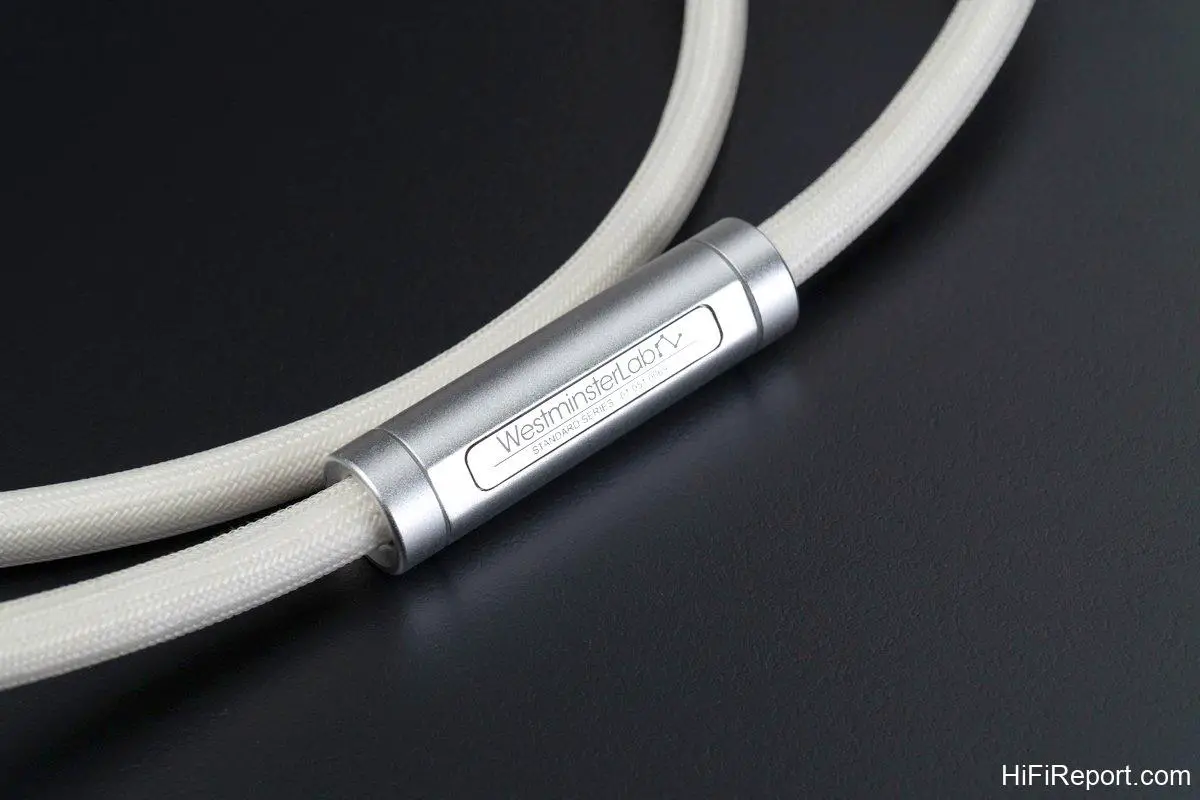
Receiving the WestminsterLab Power power cable, it arrived in an elegant, thick kraft paper box. Inside lay the white Power cable itself, its appearance not aiming for bulk, but rather refined, simple, and unadorned. Hidden within are many of WestminsterLab’s secrets. After auditioning the Power cable, I found this new acquaintance, WestminsterLab, to be very agreeable and pleasing in its musical presentation.
Unique Cables
HiFiReport Audio recently became the distributor for WestminsterLab this year, and subsequently sent over speaker cables and power cables for the editorial team to audition. Mr. Dai Tiankai has already written about the Speaker Cable, and the Power cable was assigned to me for review.
WestminsterLab’s product philosophy is quite intriguing. Almost every product category features only a single model, named simply after its type. Speaker cable is “Speaker Cable,” power cable is “Power,” and other analog cables like RCA and XLR, digital cables like USB, BNC, AES, and SPDIF, all exist as single offerings, named by their function. What’s even more unique is that WestminsterLab also offers two specialized power cables: the Lumin DC Cable and the MSB Hybrid Power Cable, designed specifically for Lumin and MSB equipment.
No Choice Paralysis
Beyond audio cables, WestminsterLab also produces preamplifiers and power amplifiers, each again with just a single model. The preamplifier is called “Quest,” and the monoblock power amplifier is “Rei,” with the Chinese character “” (zero) inscribed on the rear panel of the chassis.
Just like the clean and elegant appearance of the Power cable, WestminsterLab’s preamplifier and power amplifier share a similarly minimalist design. The Quest preamplifier’s front panel even lacks knobs, truly demonstrating ingenuity and distinctiveness.
This product design philosophy, not pursuing quantity but offering only a “single” model for each item, might seem too simple? I believe WestminsterLab is forging a new path. Instead of overwhelming consumers with a dazzling array of product series that cause choice paralysis, they drastically simplify their product line. If you need speaker cables, there’s only the Speaker Cable. If you need a power cable, it’s just the Power. No need to choose, and nothing else to choose from. WestminsterLab offers you a “unique” product. If you appreciate WestminsterLab, you don’t need to waste time making choices. There are no high, medium, or low-end models to select from; every cable is “the only one.”
Unique Technology Philosophy
Although a newcomer to the audio market, WestminsterLab has clearly come prepared, aiming to establish its own unique voice. Their distinctive technical approach is evident in every aspect, from conductor selection and stranding geometry to shielding and insulation, showcasing WestminsterLab’s unique perspective.
Let’s start with the conductor. Traditional conductor materials are typically copper and silver. More demanding designs may employ single-crystal copper or single-crystal silver, utilizing specialized metallurgical processes to elongate the crystal grains, eliminating breakpoints within the conductor and allowing current or audio signals to flow smoothly. However, the inherent sonic characteristics of a single conductor material can be relatively prominent. Many say copper conductors sound warmer and fuller, while silver conductors are brighter and richer in detail, largely due to the conductor’s own sonic signature.
Autria Alloy Conductor
How do you eliminate the inherent sonic signature of a single conductor material? The answer is alloy. Therefore, WestminsterLab developed its own unique alloy conductor, named Autria Alloy. However, WestminsterLab hasn’t detailed the composition of Autria Alloy. Judging from information released by the manufacturer, Autria Alloy appears to also be a single-crystal conductor, with minimal metal crystal boundaries, and it undergoes special heating and cryogenic treatments to further remove the conductor’s inherent sonic coloration, achieving a more neutral sound reproduction.
WestminsterLab not only uses its exclusive Autria Alloy conductor but also favors solid-core conductors. The skin effect tells us that current or signal tends to travel along the surface of a conductor. Hence, WestminsterLab’s Autria solid-core conductor is hand-polished to make the surface smooth, further minimizing impedance to current or signal flow. Furthermore, the conductor is coated with a black enamel layer for protection and then inserted into a PTEF Teflon tube.
Vari-Twist Stranding
Having discussed conductors, let’s talk about WestminsterLab’s stranding technique. Textbooks tell us that conductor stranding can reduce or cancel out EMI and RFI interference. However, the stranding structure can increase the cable length, adding to impedance, capacitance, and inductance. Conversely, without stranding, the cable becomes more susceptible to external noise interference. How to strike a balance and optimize performance? WestminsterLab’s design, called Vari-Twist, uses varying twist angles to achieve the best balance. While the principle sounds simple, the actual implementation is complex. It requires experimenting with various stranding methods to find their proprietary Vari-Twist formula, and it also necessitates the development of suitable manufacturing tooling. There’s a wealth of knowledge involved, and no ready-made tools are available; everything must be developed in-house. This is also WestminsterLab’s secret to success.
Carbon Fiber Shielding
Finally, let’s discuss shielding. Traditionally, cable shielding uses metal braid, such as tin, copper, aluminum, silver-plated copper, or nickel-plated copper, and so on. However, WestminsterLab believes that while metal braid provides shielding, over time, the material itself can absorb these intangible noises and feed them back into the audio system. Therefore, after extensive testing, WestminsterLab discovered that carbon fiber does not absorb these interferences and is unaffected by magnetic fields. Consequently, they comprehensively adopted carbon fiber tubing for shielding.
If you have the chance to handle the Power cable, you’ll notice that the outer tubing isn’t actually in contact with the inner conductors. There’s a gap between the conductors and the carbon fiber shielding tube, somewhat reminiscent of air insulation, though WestminsterLab hasn’t explicitly stated this. Looking at these three technical highlights – Autria Alloy conductor, Vari-Twist, and carbon fiber shielding – it’s clear WestminsterLab possesses unique technical depth. They haven’t built their reputation on empty claims but have honed their skills over years of dedicated effort before entering the market with a truly exceptional product.
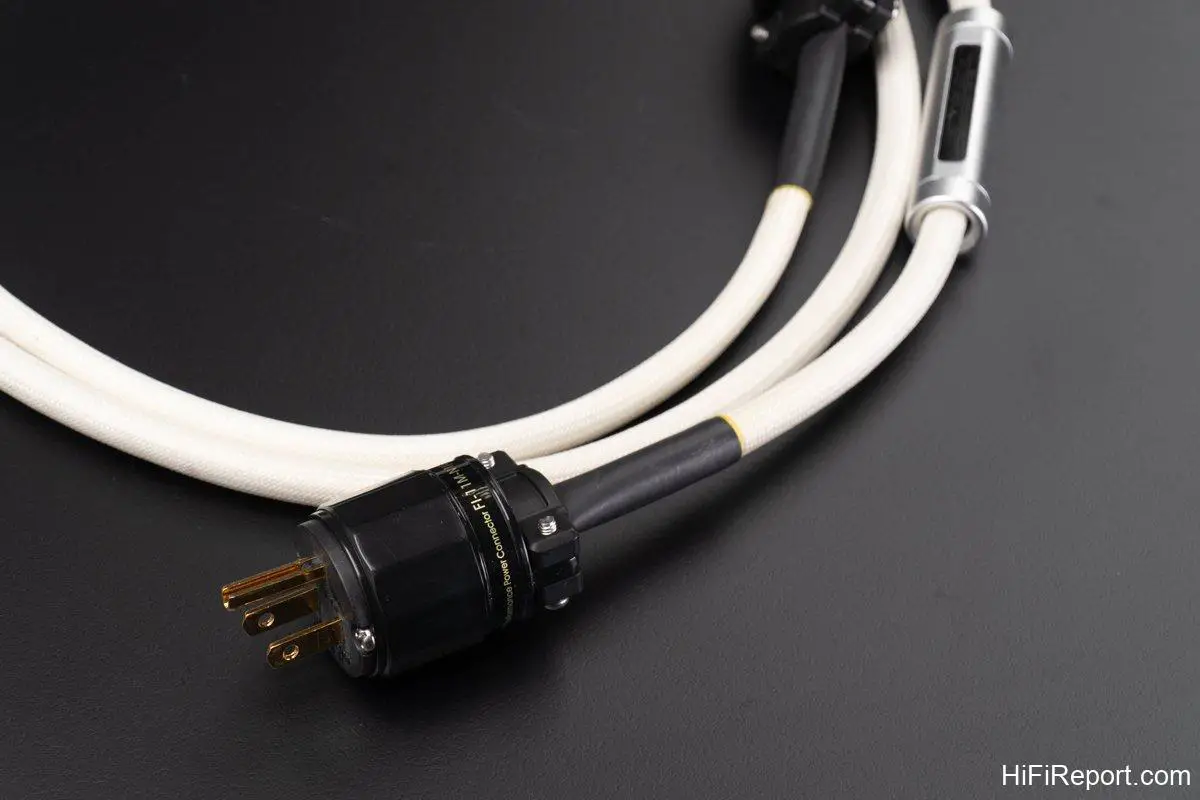
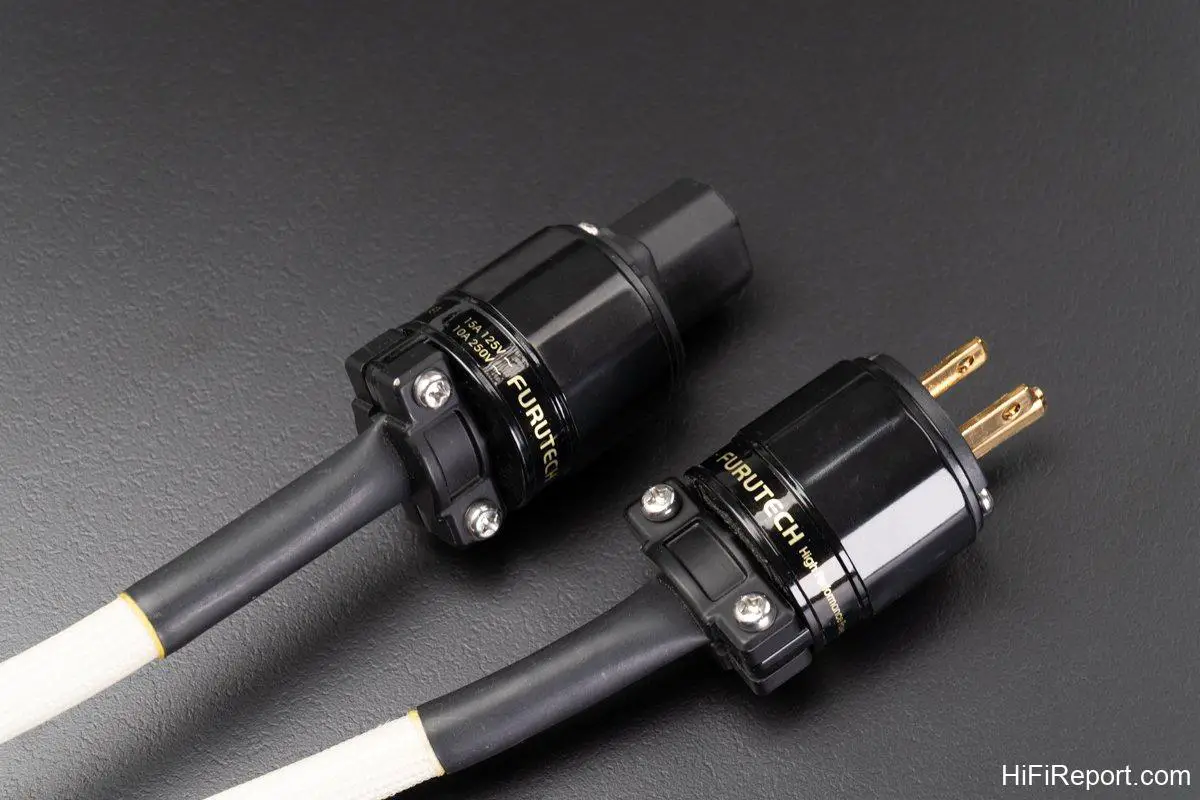
As for the connectors of the Power cable, they use Japanese Furutech FI 11 M-G/G male and female plugs – a safe and reliable choice, opting for high-quality components from a reputable international manufacturer.
The Power cable I received is 2 meters long. The factory offers lengths from 1.5 to 4.5 meters, with length increments fixed at 0.5 meters. This is to optimize electrical characteristics in conjunction with the Vari-Twist design, accommodating specific length adjustments.
Vivid and Focused Imaging
The auditioning of the Power cable took place in the HiFiReport editorial office. I used a full EAR amplifier system, including the 868P preamplifier and 509 MK II power amplifier, driving Wilson Audio Alexia 2 speakers. The source was a YBA CDT4500 paired with a Merging NADAC. The Power cable was primarily used with the 868P preamplifier.
Although this was my first time auditioning WestminsterLab cables, the Power cable resonated with me immediately. Technically, WestminsterLab’s use of alloy conductors aims to eliminate the inherent sonic signature of single conductor materials, suggesting the Power cable should be neutral and transparent, like pure water. However, in actual listening tests, the Power cable presented vivid imaging, with a focused and powerful 3D stereo image. It felt as if the instruments were brought slightly closer, with enhanced tonal vibrancy. Moreover, the musical lines flowed smoothly and naturally, full of life, creating a lively and engaging musical landscape, rather than a bland and diluted sonic experience.
Closer to the Music
I’d like to use “Mozart String Quintets” (Naimcd 085), a collaboration between The Allegri Quartet and violist Prunella Pacey, as an example. With the Power cable in place, the soundstage width and depth didn’t change dramatically, but the instrument imaging became more focused, with clear localization, bringing forth the scene of the string quintet. In the allegro movement, the cello begins on the right, with the violins conversing on the left, and the viola’s rapid, staccato playing in the center. The Power cable meticulously presented the performance of the five string instruments in an organized manner. The mid-high frequency extension was natural, with a tonality that wasn’t particularly bright or dark, but instead presented a smooth, flowing string texture.
Listening to strings, the Power cable’s detailed rendering is impressive. The subtle rasp of bow hair against strings, the dynamic variations, and the contrast between legato and staccato notes all contribute to the presentation of Mozart’s joyful and lively musical expression. It’s difficult to pinpoint exactly what the Power cable enhances. It doesn’t noticeably increase bass quantity, but in terms of sonic density and the fullness of instrument imaging, it feels like you’re brought a bit closer to the string quintet, making the music feel more intimate.
Expressive Piano Dynamics
This sense of closer, more intimate listening experience is also evident when listening to Lupu’s “Mozart Concerto for Two Pianos K.365.” Listening to the joyful and lively third movement, the orchestra opens up a wide soundstage, playing happily in unison, waiting for the dual pianos to enter. Lupu and Previn’s two pianos, left and right, alternately emerge across the soundstage. The Power cable presents vivid music, with piano keystrokes possessing appropriate weight, clear and distinct note articulation, and high density. The wooden sound of the keys being struck carries a warm tonality, even with a slightly rich midrange. When the two pianos play, the left piano has a darker tone, while the right piano is brighter. The Power cable clearly reveals the tonal differences between the two pianos, adding to the listening enjoyment.
Switching to Carol Rosenberger’s “Beethoven Piano Sonata ‘Appassionata’,” the music progresses from soft to loud, from whispers to roars, as if Beethoven spoke softly, but no one listened seriously, so he had to shout to express his passion.
In the soft passages, the pianist carefully controls the volume. High and low notes alternate in a three-part dialogue, leading to a storm of fortissimo playing.
The Power cable beautifully presents the contrast between loud and soft. In quieter passages, the piano has delicate resonance, and the woody sound of the keys is rich. In fortissimo passages, the note articulation becomes full and grand. The rapid runs in the treble range are clear and transparent, contrasting with the massive solidity of the bass notes. As “Appassionata” continuously alternates between loud and soft, that’s Beethoven’s passion, with continuously building notes expanding the piano’s scale, yet responding with soft passages, and then returning to massive chords, constantly switching back and forth between loud and soft. With the Power cable, the contrast between loud and soft is not only distinct, but the levels and gradations of change in between are also clearly contrasted, allowing for a clearer appreciation of the pianist’s intentions.
Reproducing Recording Essence
Listening to classical music, the Power cable presents focused and vibrant imaging, with clear dynamic gradations and a sense of intimate listening. Switching to jazz, the intimacy remains.
Listening to “Tell Me Once Again,” a collaboration between Carol Kidd and Nigel Clark, featuring simple vocals and nylon-string guitar. Listening to “Stormy Weather,” the nylon-string guitar at the beginning bursts forth with vivid imaging. During chord strums, you can even hear the subtle sound of fingertips brushing against the strings. As chords change, the sound of the left hand sliding and moving along the fretboard accompanies the movement of the bass line. Carol Kidd’s voice possesses a bright sheen. The Power cable seems to have turned up the stage lighting a bit, making Carol Kidd’s vocal image feel clearer and closer. The nylon-string guitar’s alternation between chords and single notes is highly detailed. Sometimes the strumming is crisp and percussive, and slowing down the tempo makes the lines softer. These are all the guitarist’s finger techniques, competing with the female singer’s languid vocals.
If the duo jazz of Carol Kidd and Nigel Clark offers a close-up, intimate musical experience, what happens when the recording venue expands? The Power cable faithfully reproduces the original recording, with a sweet and smooth sheen in the mid-high frequencies. For example, listening to Oscar Peterson’s “The Cole Porter Songbook,” the first track “In The Still Of Night” effortlessly evokes a comfortable and relaxed swing atmosphere. And the scene of the jazz big band immediately opens up. The piano and double bass each occupy a corner, and the drum brushes lightly scatter in the air. In contrast to the previous Carol Kidd album’s tight, close-up presentation, Oscar Peterson’s soundstage width is expansive and spacious. In other words, the Power cable faithfully presents the recording characteristics of both jazz albums, while bringing out an appropriate sheen, endowing the music with a more vibrant quality.
Clear Multi-Track Effects
Switching to classic rock, a good cable should sound like what it’s supposed to. Listening to Queen’s “A Night At The Opera,” track eleven, “Bohemian Rhapsody.” The opening harmonies are so distinct you could almost count heads. Queen’s recordings in those days were considered innovative, with harmonies and left-right channel separation effects. The Power cable clearly presents the distinct left-right channel variations. When lead singer Freddie Mercury sings “Bohemian Rhapsody,” he sings with deep emotion.
The multi-track recording of “Bohemian Rhapsody” contains many studio-created effects. Listening with the Power cable is quite fascinating. Brian May’s electric guitar has a rich tone. The overdrive is a standard British tone, and the slightly lush sound seems to have a phaser effect added. The changes in the middle chorus and harmonies, the vocal positions of the four singers, alternate and jump between the center and sides of the left and right channels. These are all multi-track recording tricks. Listening through the Power cable, the layered changes of the interwoven channels are very vivid. Even for old rock recordings, it’s still fascinating to listen to.
A Delightful New Acquaintance
Although this is my first encounter with WestminsterLab cables, my impression is very positive. The Power cable possesses the strength and focus of a solid-core cable, yet it also has excellent resolution and layering, with a remarkable ability to reproduce the essence of the recording. Listening to classical music, you can appreciate the dynamic contrasts of natural acoustic instruments, with clear and natural layers. Listening to jazz or rock, these “plugged-in” recordings, you can experience the diverse and rich variations in the recording. I think, even though this is just my first introduction to WestminsterLab, after hearing the Power cable, if there are other WestminsterLab cables to review in the future, I will be eager to get my hands on them. Because its sonic performance is full of engaging qualities and can bring a fresh perspective to familiar recordings. It can be described as a delightful new acquaintance, worth getting to know better.
Specifications
* Type: Power Cable
* Conductor: Autria Alloy
* Length: Standard length 1.5 ~ 4.5 M (in 0.5M increments)
“`