What Is a Speaker Crossover, and How Does It Work?
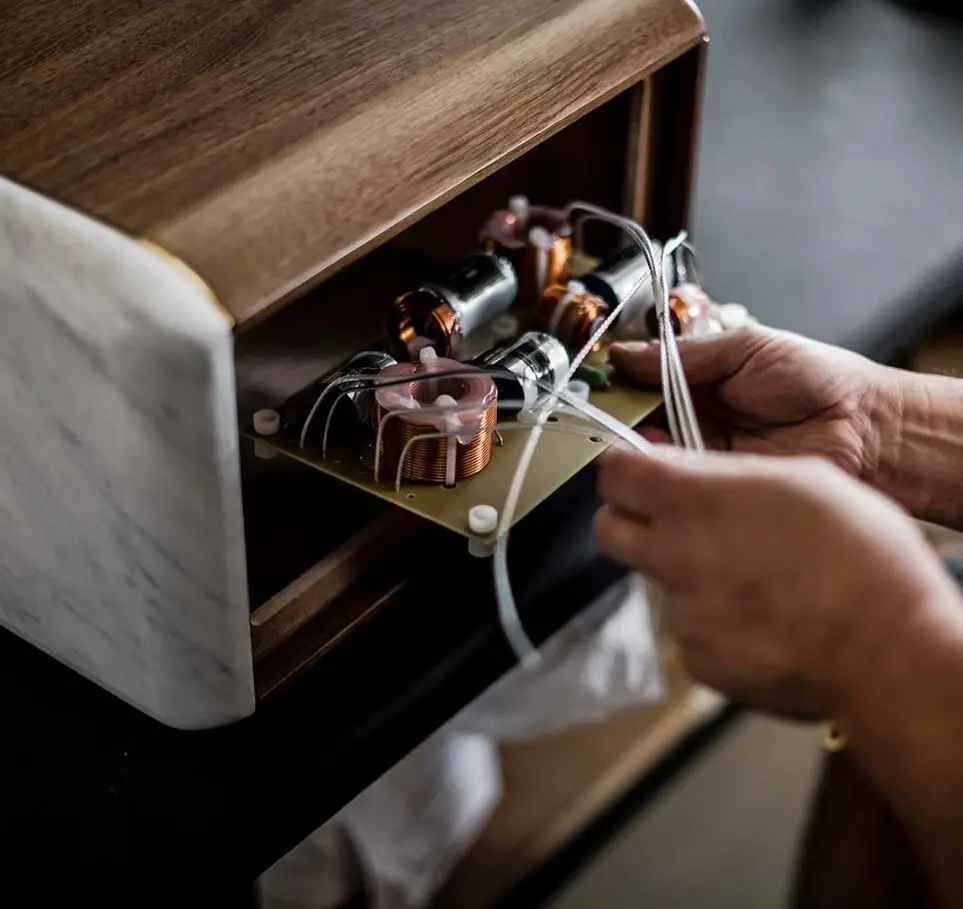
Look inside almost any multi-driver speaker cabinet — the kind with a small dome tweeter up top and a larger woofer below it — and somewhere in there, usually tucked behind the terminals or mounted on a small board, you’ll find a handful of coils, capacitors, and resistors wired together in a deceptively simple little network. That small network has a big job: it decides, moment by moment, exactly which frequencies get sent to the tweeter and which get sent to the woofer. It’s called a crossover, and without it, most multi-driver speakers wouldn’t just sound worse — they’d risk destroying themselves.
Why You Can’t Just Wire Both Drivers Together
It might seem simplest to just connect a tweeter and a woofer to the same amplifier signal and let them both try to reproduce everything. In practice, this creates real problems on both ends. A tweeter, built with a tiny, lightweight diaphragm specifically to move quickly enough for high-frequency detail, generally cannot handle the large amounts of low-frequency energy present in bass notes — sending deep bass straight into a tweeter risks physically damaging or destroying it almost immediately. A woofer, meanwhile, with its larger, heavier cone, simply isn’t built to move quickly enough to accurately reproduce high treble frequencies, and asking it to try tends to produce distorted, poorly controlled sound in that range rather than clean detail (© hifireport.com — content licensed for editorial use).
A crossover exists to solve exactly this mismatch. It’s essentially an electrical filter, or really a pair of filters working together: one that lets low frequencies through to the woofer while blocking high frequencies from reaching it, and another that does the reverse, letting high frequencies through to the tweeter while blocking the bass that could otherwise damage it.
Picture Two Sorting Gates
A helpful way to picture a crossover is as a pair of sorting gates positioned along a single stream of traffic — the audio signal coming from the amplifier. One gate is built to let only the “slow, heavy trucks” of low-frequency sound pass through, sending them down the road toward the woofer, while turning away anything moving too “fast.” The other gate does the opposite, letting only the “fast, light cars” of high-frequency sound through toward the tweeter, and blocking the heavy trucks. Neither gate is perfectly sharp — there’s always some blending right around the point where the two gates meet, called the crossover frequency, which is precisely the frequency range where both the woofer and tweeter are handed at least some of the workload together (© hifireport.com — content licensed for editorial use).
Why “Order” and “Slope” Matter
Not all crossovers filter frequencies with the same sharpness, and this sharpness is described using two closely related terms: filter order and filter slope. A crossover’s slope describes how quickly, in decibels, its filtering effect increases as you move away from the crossover point into the frequency range being blocked, typically measured in decibels per octave — a unit describing how much extra filtering kicks in every time the frequency doubles or halves. A first-order crossover has a relatively gentle slope, around 6 decibels per octave, letting a fair amount of the “wrong” frequencies leak through into each driver even somewhat far from the crossover point. Each added order roughly doubles that slope: second-order crossovers filter at roughly 12 decibels per octave, third-order at roughly 18, and fourth-order at roughly 24, cutting off unwanted frequencies considerably more sharply and abruptly.
There’s a genuine trade-off buried in this choice. A gentler, lower-order crossover generally introduces fewer unwanted side effects to the sound’s timing and phase, and some listeners and designers prize that quality highly. But a gentler crossover also demands that each driver handle a wider range of frequencies beyond its intended specialty, which can be genuinely risky for delicate drivers like tweeters if bass energy isn’t cut off aggressively enough. A steeper, higher-order crossover protects each driver more thoroughly by cutting off unwanted frequencies faster, at some cost to phase behavior around the crossover point, which is part of why crossover design has remained a genuinely debated, nuanced corner of speaker engineering for decades.
The Popular Standard: Linkwitz-Riley
Among the many possible crossover designs engineers could choose, one particular type, called the Linkwitz-Riley alignment, has become something close to a professional industry standard, especially the fourth-order version often abbreviated LR-4. Its defining, carefully engineered trait is that when the woofer’s output and the tweeter’s output are added back together, they sum to a smooth, genuinely flat combined frequency response right through the crossover region, with both drivers deliberately reduced by exactly the same, carefully calculated amount right at the crossover point so that neither an unwanted dip nor an unwanted bump appears where the two drivers hand off to each other. This predictable, flat-summing behavior is a big part of why Linkwitz-Riley crossovers remain such a popular default choice in both professional sound reinforcement and home speaker design.
Passive Versus Active: Where the Filtering Happens
Crossovers come in two broad families, distinguished by where in the signal path the filtering actually happens. A passive crossover sits between a single, already-amplified signal and the speaker drivers themselves, built from coils, capacitors, and resistors that don’t need any external power of their own to do their filtering job — this is the kind tucked inside most ordinary passive home speakers. An active crossover, by contrast, splits the frequencies apart before amplification happens, feeding separate, already-divided frequency bands to separate amplifiers, each dedicated to driving just one driver. Active crossovers, especially modern digital versions, tend to offer more precise, more flexible control over exactly how frequencies are divided, but they require more amplifier channels and more system complexity than a simple passive network tucked inside a single speaker cabinet.
What You Actually Hear
A well-designed crossover is largely invisible in the best sense — when it’s working correctly, a listener shouldn’t be able to pinpoint the exact frequency where one driver hands off to another at all; the sound should simply flow smoothly and continuously across the whole musical range. A poorly designed or poorly matched crossover, on the other hand, can produce audible problems ranging from a subtle dip or bump in tonal balance right around the crossover frequency, to more obvious issues like a “hole” where neither driver is contributing enough energy, or a tweeter buzzing under stress because too much bass energy is leaking through to it.
Everywhere Two or More Drivers Share a Cabinet
Crossovers appear in essentially every multi-driver speaker system on the market: home bookshelf and floor-standing speakers, car audio component sets, professional stage monitors and PA systems, and soundbars combining multiple driver types into a single compact enclosure. Any time a product asks more than one type of speaker driver to share the job of reproducing an entire piece of music, some version of this quiet sorting network is working behind the scenes, deciding, thousands of times per second, exactly which driver gets to sing which note.