
Xiaomi Redmi Buds 6 Play Review
Overview
The Xiaomi Redmi Buds 6 Play sit at the entry level of the Redmi Buds 6 family. Xiaomi positions the “Play” suffix as the most affordable branch of the range, not a variant with extra features. The goal is simple: a competent, very light pair of true wireless earbuds for calls, podcasts, and everyday music listening, without paying for active noise cancellation or high-resolution codecs.
The core specification is deliberately simple. Each earbud carries a single 10 mm dynamic driver, connectivity is Bluetooth 5.4, and the charging case supports up to 36 hours of total battery life. There are touch controls and five preset EQ modes, but no custom parametric EQ and no active noise cancellation. One distinction worth noting up front: the “AI noise reduction” in the name applies to call quality, not to what you hear during music playback.
Despite the budget positioning, the Buds 6 Play have generated strong word of mouth. On Amazon, the Global Version holds a 4.4 out of 5 aggregate rating across more than 23,000 reviews. Third-party testers have been similarly warm, often describing the sound and battery life as better than expected for the class.
© hifireport.com – Original review content by hifireport.com. Reprinting without written permission is not allowed.
Design and Build
Weight is the headline physical characteristic here, and it is genuinely low. Xiaomi says each earbud weighs about 3.6 grams, and describes the goal as reducing pressure in the ear canal. Independent measurements have landed in the same neighborhood, with one reviewer noting 3.8 grams per earbud. Either way, these are among the lighter true wireless designs on the market.
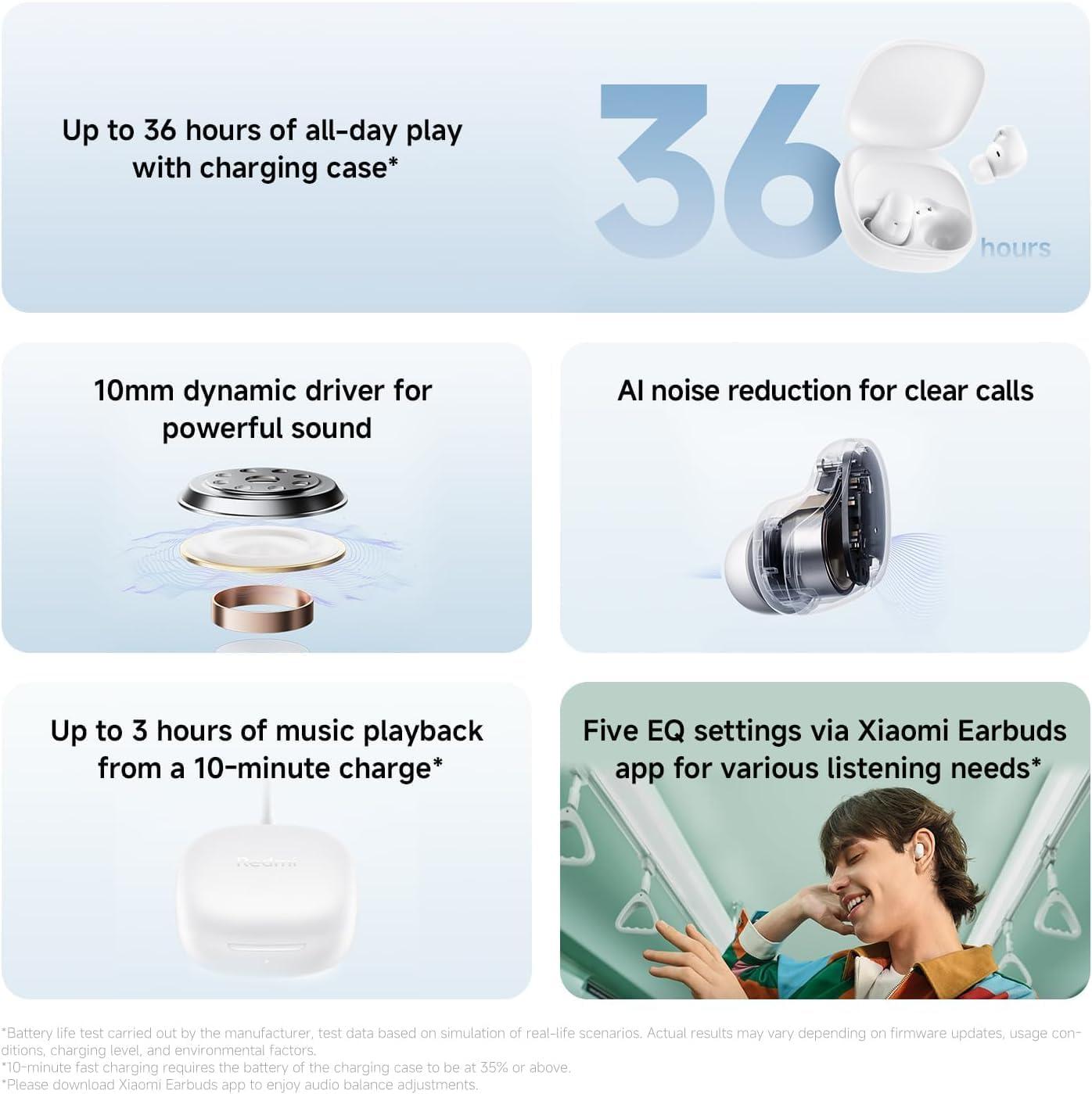
The earpiece has what one reviewer calls a bean-shaped form that sits in the concha rather than inserting deep into the ear canal. That design choice contributes to both comfort and a low-profile look. The buds stay close to the head and do not stick out awkwardly, which makes them feel secure during jogging or casual movement.
The charging case is compact and pocketable, though some reviewers describe it as slightly bulky compared with other small cases. One measured it at roughly 39 grams on its own, with total package weight around 40 to 42 grams depending on the review. A long-term tester who preferred the slight heft said it made the product feel more solid and premium. Finish appears to vary: a glossy finish can show fingerprints easily, while the matte finishes on some colors are more forgiving. Xiaomi offers black, white, pink, and blue, so the look depends on the color chosen.
Packaging is minimal and unremarkable, which is appropriate for the class. There is no charging cable in the box, which is worth knowing before purchase. Inside, buyers can expect the earbuds in their case, extra small and large ear tips, and a user manual. The earbuds are IPX4 certified, meaning they can handle splashes and sweat, which makes them a reasonable pick for gym use or walking in light rain. One long-term reviewer used them repeatedly in the rain without issues, though they did not test heavy gym sweat.

Comfort and Fit
Comfort is one of the Buds 6 Play’s strongest points. The low per-bud weight reduces the downward pull that can cause ear fatigue over several hours, and the silicone ear tips help them seat comfortably. Several reviewers say they wore the buds for hours without discomfort, which is not always the case at this price.
The fit is snug and stable. Testers report the buds stay put while jogging and lounging, without constant adjustment. The included extra ear tips in small and large sizes help users find a better seal, which matters for both sound quality and passive noise blocking. One reviewer noted the buds did not fall out during workouts, a practical detail for gym users.
Comfort comparisons within Xiaomi’s own lineup are telling. One reviewer who previously owned the Redmi Buds 6 Active found those hard to wear for long stretches because they lacked rubber tips. The Buds 6 Play solved that problem, making them suitable for extended commutes, work sessions, and podcasts. The raised comfort ceiling is a meaningful upgrade for anyone considering both models.

Sound Quality
The Buds 6 Play use a 10 mm dynamic driver in each earbud, which Xiaomi says was tuned by its acoustic lab. Ten millimeters is large for a true wireless driver and generally correlates with stronger low-frequency capability. In practice, reviewers describe the bass as smooth and present, with enough volume to partially mask surrounding noise when you turn it up, even though there is no active noise cancellation.
Sound quality is best judged against other budget earbuds, and on that scale the Play performs well. One reviewer said they were shocked after first connecting them, calling the audio surprisingly capable for the money. The bass is full without being overwhelming, and mids and highs are balanced enough for everyday listening. It is not a flagship-level sound, and ambient noise still seeps in on busy streets, but the tuning is well suited to popular music and spoken word.
The Xiaomi Earbuds app adds five preset sound effects: balanced, enhance treble, enhance bass, enhance voice, and boost volume. Reviewers tend to favor the enhance bass mode because it preserves bass, mids, and highs. On phones from Xiaomi, users can also dig into system-level sound settings for additional tweaks. The main limitation is the lack of a custom EQ, so users who want granular control over specific frequency bands will need to accept the presets as they are.

Against Xiaomi’s own more basic buds, the Play sounds noticeably better. A reviewer who compared the Play with the Redmi Buds 6 Active found the Play’s audio clearly improved, with better bass and a more composed overall presentation. That step up makes the Play an easier recommendation even for buyers already inside the Xiaomi ecosystem.
Call Quality and AI Noise Reduction
The “AI noise reduction” feature on the Buds 6 Play is easy to misunderstand. It applies to voice calls, not to playback. Xiaomi uses an algorithm to distinguish human voices from ambient noise, and reviewers who tested the buds in meetings say the results are convincing. Call audio comes through clear in apps like Zoom, and the noise suppression works well enough to make the buds usable in moderately noisy environments.
There is one commonly reported quirk. During calls, wearers may not hear their own voice clearly, which can make it hard to judge whether they are speaking too loudly. The practical workaround reviewers use is to remove one earbud so they can monitor their own volume while staying connected. It is a minor annoyance, not a deal breaker.

Microphone quality is respectable but not perfect. One third-party review lists the microphone as a weak point, while another praises call clarity. In general, the buds are better than many budget rivals for calls thanks to the AI processing, but they will not match a headset with a boom-style mic for recording or broadcast use. The voice-enhanced preset can help prioritize speech when that is the priority.
Battery Life and Charging
Battery life is a highlight. Xiaomi rates the buds for about 7.5 hours on a single charge, with up to 36 hours total when combined with the 600 mAh charging case. Each earbud has a 57 mAh cell, and a full charge takes less than two hours via USB-C.
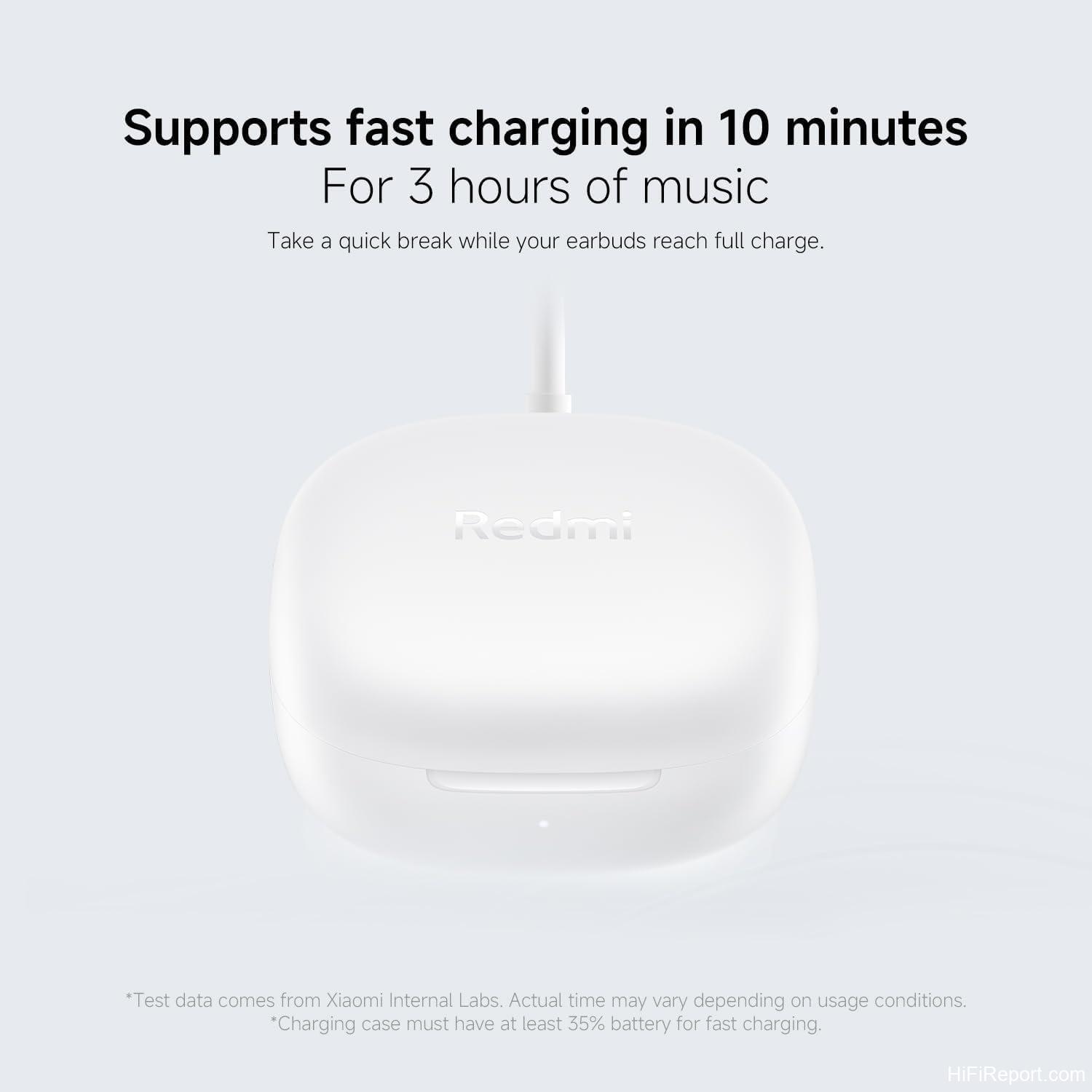
The quick-charge claim also holds up in testing. Xiaomi says a 10-minute charge delivers up to three hours of playback, and at least one reviewer confirmed the claim after plugging the case in for 15 minutes and using the buds through the rest of the day. That is a handy safety net for commuters or anyone who forgets to charge overnight.

Real-world endurance depends heavily on usage habits. A long-term reviewer who wore the buds for about an hour a day and topped them up in the case between sessions went roughly two weeks without charging the case. A heavier user playing music continuously can expect closer to the rated 7.5 hours per earbud charge, with the case providing several additional top-ups. The case itself holds up well over repeated partial top-ups, which is the way most people use true wireless earbuds.
There is no wireless charging, which is common in this price class. Buyers who have standardized on USB-C cables will be fine; the case charges through a standard Type-C port, so any compatible cable works even though one is not included in the box.
This article is the original property of hifireport.com. All rights reserved. Unauthorized reproduction is strictly prohibited.
Connectivity and App Support
Bluetooth 5.4 anchors the wireless connection. Released in 2023, the standard means a more stable and efficient link than older Bluetooth versions, even if the practical benefits are subtler than marketing suggests. The rated range is 10 meters, typical for the category.

Pairing is straightforward. Users can connect directly through their phone’s Bluetooth menu or install the Xiaomi Earbuds app by scanning the QR code on the box. The app pairing process is simple: turn on Bluetooth, open the app, and place the earbuds in, and the connection completes. From there, the app provides battery readouts, touch control settings, and the five preset EQ modes.
One practical improvement over some earlier Redmi buds is laptop compatibility. A reviewer who could not pair the Redmi Buds 6 Active with a Windows laptop found the Buds 6 Play connected without trouble. That makes the Play a more versatile option for work calls and video meetings. Touch controls handle playback, calls, and mode switching, and the app gives users some on-device customization for the control scheme.
What Customers Are Saying
Amazon’s aggregate rating for the Buds 6 Play is 4.4 out of 5 across more than 23,000 ratings. That is a strong signal for a budget pair of earbuds and suggests most buyers are satisfied with what they received. Because Amazon’s review list was not accessible for direct quotes, the score itself is the main indicator here, supported by third-party user scores that skew similarly positive.
The dominant praise across independent reviews centers on value, battery life, comfort, and sound quality for the money. Reviewers repeatedly describe the buds as surprising for their price, with a combination of light weight, secure fit, and smooth bass that is hard to find in this tier. App support and quick charging add to the positive impression, and several testers noted they would recommend the buds to students or first-time wireless earbud buyers.
The main complaints are consistent. Users note the lack of custom EQ, no wireless charging, and microphone limitations. The “AI noise reduction” name also causes some confusion because it does not affect playback. A few long-term reviewers mention occasional connection frustrations, though the Bluetooth 5.4 link is generally stable. None of these drawbacks are unusual for budget earbuds, but they are worth knowing before buying.
Pros and Cons
- Excellent battery life: up to 7.5 hours per charge and about 36 hours with the case, plus a useful quick-charge feature.
- Very light and comfortable: each bud weighs about 3.6 grams and sits comfortably for hours.
- Good sound for the price: the 10 mm driver delivers smooth bass and balanced, lively output.
- Useful app support: five preset EQ modes and straightforward controls through the Xiaomi Earbuds app.
- Solid call performance: AI noise reduction helps voices come through clearly in calls.
- IPX4 splash resistance: can handle sweat and light rain.
- No custom EQ: users are limited to five presets.
- No active noise cancellation: the AI noise reduction applies to calls only.
- No wireless charging, and no charging cable in the box.
- Microphone quality is mixed: clear enough for calls but not outstanding.
- Occasional connection quirks reported by some long-term users.
Verdict
The Xiaomi Redmi Buds 6 Play are a textbook example of a budget product that gets the fundamentals right. They are extremely light, comfortable for long sessions, and powered by a driver that sounds better than expected for the class. Battery life is excellent, the quick-charge feature works, and the app adds useful EQ presets without overcomplicating the experience.
They are not for everyone. Buyers who want active noise cancellation, wireless charging, or a custom EQ should look higher up the Redmi Buds 6 lineup or beyond it. The microphone is fine for calls but not a strength, and the AI noise reduction only helps with voice, not music. A handful of connection quirks have also surfaced in long-term use.
Copyright protected. First published on hifireport.com; any unauthorized copy violates the intellectual property rights of hifireport.com.
For students, first-time true wireless buyers, or anyone replacing an aging pair of budget earbuds, the Buds 6 Play deliver strong day-to-day value. They handle podcasts, meetings, workouts, and playlists with a comfort and stamina that many more expensive buds envy. If you can live without ANC and a few premium extras, they are among

- 3.6g super lightweight: The charging case adopts a clean and sleek design. Each earbud weighs only 3.6g, reducing pressure in the ear canal and delivering lightweight comfort