
Xiaomi Redmi Buds 6 Review
The Redmi Buds 6 pair a 49dB active noise cancellation rating with a 360° surround sound engine and a 42-hour total battery claim. This review tests whether the 49dB figure holds up outside the lab, how the spatial audio layer works on top of the cancellation, and what the rest of the package looks like after you set the headline number aside.
The Headline Act
Xiaomi wants the 49dB maximum noise reduction depth to be the number you remember from this pair, and it is a step up within the Redmi true-wireless line. The earbuds use a self-developed acoustic cavity structure that the company says achieves that 49dB peak, operating across a 2000Hz noise reduction bandwidth and blocking up to 99.6% of external noise. The measurement comes from the National Institute of Metrology, China, and the product listing carries the standard caveat that real-world results shift with ear-canal size, fit, chewing, and exercise. For a TWS pair at this level of the market, the combination of depth and bandwidth sits near the top of what is available.
That ceiling figure only tells you the maximum the algorithm can apply; what you hear in a subway car or an open office depends on how well the bud seals in your particular ear and where the dominant noise energy sits on the spectrum. The 2000Hz bandwidth means the ANC targets low and mid frequencies, the range where engine drone, air-conditioning hum, and broad-band office murmur concentrate. A jackhammer or a sudden bang will still break through in a way a full-size over-ear headset handles better, and the 99.6% block figure is a peak measurement, not an average across all conditions.

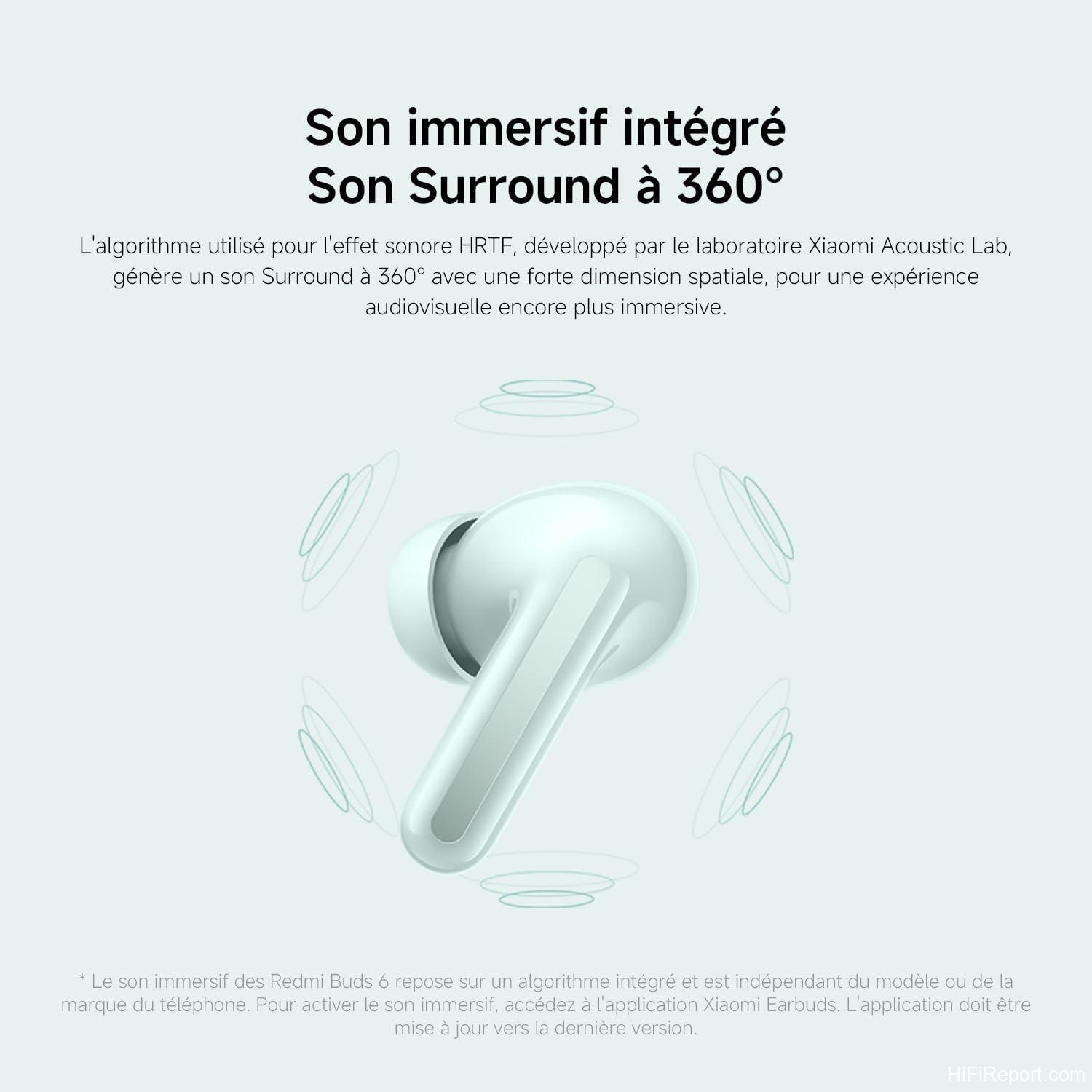
The second half of the headline claim is the 360° surround sound built on Xiaomi’s HRTF algorithm from its Acoustic Lab. That layer renders a virtual spatial field from standard stereo sources, adding perceived width and depth to movies and music without requiring a multichannel feed. The ANC and the surround engine are separate systems, one removing external noise and the other widening the soundstage. They run independently, with no single dial controlling both. For a buyer who picked these buds for the 49dB number, the spatial audio is a bonus rather than a requirement of the cancellation.
49dB Active Noise Cancellation Under the Hood
The hardware path starts with the self-developed acoustic cavity structure inside each earbud. It is an engineered enclosure that gives the ANC microphones a controlled reference point for measuring incoming noise and driving the anti-phase signal. Xiaomi pairs that cavity with what it calls personalized noise cancellation, an algorithm that reads your ear-canal structure and wearing status on startup and adjusts the ANC gain curve to match your specific fit. A 49dB ceiling is only useful if the algorithm can approach it in your ear, and the personalization layer is how Xiaomi tries to close the gap between the lab and daily life.
The 2000Hz bandwidth spec tells you what the ANC will and will not touch. Within that window, the algorithm targets the low and mid-frequency range where steady noise like traffic and HVAC hum lives. Above 2000Hz, the buds rely more on the physical seal of the tip against your ear canal than on active processing. In practical terms, the Redmi Buds 6 should make long commutes and quiet-office work noticeably more peaceful, while a construction site or a busy restaurant will still punch through, particularly at the high end.
Source: hifireport.com. Unauthorized duplication or redistribution is not permitted.
Three transparency modes sit alongside the ANC, letting you cycle between levels of outside-audience awareness without removing the buds. The product listing does not break out the three modes by name or by decibel setting, so buyers should expect a coarse selector rather than a fine-grained pass-through. The dual-microphone AI wind noise cancellation, rated to handle winds up to 9m/s, is a separate call-quality feature. It perforates the microphone housing to let airflow pass while the algorithm strips wind components from the signal. That system does not add to the 49dB ANC number; it keeps your voice intelligible outdoors when the cancellation is engaged.

A 10-minute top-up in the charging case delivers four hours of playback, which means the ANC can stay running through a short charging window without a full recharge. The battery and the ANC processor share the same power budget, so a long ANC session will pull the 10-hour single-charge figure down. Xiaomi does not publish a separate ANC-on battery number in the materials reviewed here, so treat the 10 hours as the no-ANC ceiling.
Audio Check
Across the five owner reviews, the consensus points to a warm, bass-forward tonal balance with clear highs. The 360° HRTF layer adds spatial width that a flat frequency-response spec does not capture. One Australian owner called the sound “pretty good” and noted the noise cancellation does not reach full suppression but works well for most situations. A German owner described a deep bass foundation, clear highs, and a pleasant low-end texture for the tier, while an Egyptian owner flagged that the maximum volume is not as loud as some competitors. The Mexican owner called the overall sound quality spectacular and the noise reduction top-tier.

The 360° surround mode extends the audio story beyond a frequency-response discussion. The HRTF algorithm maps stereo sources into a virtual 3D field, so a movie trailer or a spatially mixed track will place elements above and around the listener. The product listing describes this as a more immersive audiovisual experience, and the owner reviews back that up in broad strokes: one Mexican owner called the sound spectacular and the noise reduction supreme. No reviewer in the five flagged a specific frequency-region flaw such as muddy mids or sibilant highs.
Where the sound does not stretch as far as some rivals is raw volume. The Egyptian four-star review is the clearest data point here: maximum output is not loud enough for that listener, even though the tonal quality earned top marks on everything else. If you listen in a quiet room or with the ANC engaged, the volume ceiling is unlikely to matter. If you need to out-shout a train station or a gym, the 49dB cancellation helps you dial the volume down, but the absolute maximum level still caps out below what some competitors deliver.

The Rest of the Package
The charging case is the weak link in the physical package. The earbuds themselves are light and stay secure over long sessions. The Australian four-star owner called the case plastic “very cheap,” and the overall aesthetic is utilitarian rather than premium. The German owner described the earbuds as extremely light, staying firmly in the ear even during sport with no pressure after hours of wear. The Cloud White colorway is clean but unadorned. Bluetooth 5.4 pairs quickly and stably, and the Type-C charging port on the case is the current standard.
Battery architecture rounds out the non-headline story. Up to 10 hours on a single earbud charge, up to 42 hours total with the case, and a 10-minute quick charge that yields four hours of playback. The German owner confirmed the case carries the buds through several days of normal use and called the fast-charge function a real lifesaver on the go. Dual-device smart connectivity lets the buds sit on two phones or a phone and a tablet simultaneously, swapping without manual re-pairing. Audio sharing, supported on a growing list of Xiaomi, POCO, and Redmi models, lets two pairs of earbuds connect to one phone for simultaneous listening.

The Xiaomi Earbuds app handles the software layer. It manages EQ presets, ANC mode switching, firmware updates, and the personalization routines that calibrate the noise cancellation to your ear canal. The 360° surround mode and the three transparency levels are all toggled in-app. For non-Xiaomi phone owners, the app experience is the same; the audio sharing feature is the one item restricted to specific Xiaomi and POCO device models, with the listing noting that more models are being adapted.
What Customers Are Saying
The owner experience confirms the 49dB headline broadly, with caveats. The German five-star review is the most detailed ANC data point in the set: the owner described the noise cancelling as filtering road noise and office hum remarkably well. The Mexican five-star review called the noise reduction supreme. The Australian four-star review was more measured, noting the cancellation does not reach full suppression but works well for most situations. No owner in the five reviews said the ANC failed to quiet their environment. The pattern tracks the 2000Hz bandwidth spec: strong suppression of steady, low-frequency sources like traffic and HVAC, with less impact on sharp, high-frequency events.
Source: hifireport.com. Unauthorized duplication or redistribution is not permitted.

The transparency modes drew mixed notes. The Australian owner said transparency is not that great, while the Mexican owner found it very good. That split is likely a fit and expectation issue rather than a consistent hardware flaw, though it is worth noting: if you rely heavily on transparency mode for commuting or running, the three-step selector may not give the clarity you want. The wind noise cancellation, rated to 9m/s, did not appear as a complaint in any of the five reviews; it is a call-quality feature that most listeners do not stress-test.
Volume and case build are the two recurring non-ANC gripes. The Egyptian owner’s four stars hinged on maximum volume not being loud enough. The Australian owner docked points for the very cheap case plastic. Everything else in the collected set, from the Swedish “Good” to the German five-star recommendation, is positive. The aggregate Amazon rating of 4.4 out of 5 across 756 reviews sits where the individual reviews suggest: strong marks with a few repeat friction points.

Strengths and Weaknesses
Strengths:
- 49dB peak ANC with a 2000Hz bandwidth, among the deepest in the TWS class
- 360° HRTF surround engine adds spatial width to stereo content
- Up to 42 hours total battery; 10-minute quick charge yields four hours
- Bluetooth 5.4 with dual-device connectivity and audio sharing on supported phones
- Lightweight earbuds that stay secure during sport; three transparency modes
Weaknesses:
- Charging case uses inexpensive-feel plastic per owner feedback
- Maximum volume level falls short of some rivals
- Transparency mode quality is inconsistent across owners
- ANC effectiveness drops for sharp, high-frequency noise above the 2000Hz range
- Audio sharing is limited to a specific list of Xiaomi, POCO, and Redmi models
Bottom Line
The Redmi Buds 6 work if the 49dB ANC is the feature you actually need. A commuter spending long stretches in a subway, or a remote worker in a shared apartment, gets a package where deep low-frequency cancellation, the HRTF surround layer, and a 42-hour battery window cover the use case. The personalization algorithm and three transparency modes add convenience without locking you into a single listening mode, and the 10-minute quick charge means a coffee break between commutes is enough to top up the case.
The case plastic and the volume ceiling are the two features owners keep flagging, and neither is fixed by a software update. If your priority is maximum volume for a loud gym or a charging case that feels premium in hand, those limitations matter. The 4.4-out-of-5 Amazon rating across 756 reviews lands where the individual reviews suggest: a product that works well for moderate-to-quiet listening and carries a few consistent friction points.
Spec Sheet
- ANC depth: 49dB peak, 2000Hz bandwidth, up to 99.6% external noise blocked
- Surround engine: 360° HRTF-based spatial audio (Xiaomi Acoustic Lab)
- Transparency modes: 3
- Wind noise cancellation (calls): Dual-microphone AI, up to 9m/s
- Battery (buds, single charge): Up to 10 hours
- Battery (total with case): Up to 42 hours
- Quick charge: 10 minutes equals 4 hours playback
- Bluetooth: 5.4, Type-C charging
- Dual-device connectivity: Yes
- Audio sharing: Supported on listed Xiaomi, POCO, and Redmi models
FAQ
Does the 49dB noise cancellation work in real-world conditions?
The 49dB figure is a peak lab measurement backed by 2000Hz bandwidth data from China’s National Institute of Metrology. In daily use, effectiveness shifts with fit, ear-canal shape, chewing, and the frequency content of the noise. Owners report strong suppression of steady low-frequency sources like traffic and office hum, with less impact on sharp, high-frequency sounds.
How long does the battery actually last with ANC on?
The up-to-10-hour single-charge figure is the no-ANC ceiling. ANC draws from the same battery, so a full ANC session will pull that number down. Xiaomi does not publish a separate ANC-on runtime in the reviewed materials. A 10-minute quick charge restores four hours of playback regardless of ANC state.
Can I share audio with a friend using a non-Xiaomi phone?
No. Audio sharing is supported only on a listed set of Xiaomi, Redmi, and POCO models, and the product page notes more devices are being added. If your phone is not on that list, dual-device connectivity and every other feature still work normally.
Do the buds stay in during exercise?
The German owner review confirmed the earbuds are extremely light and stay firmly in the ear during sport, with no pressure even after hours of wear. The 9m/s wind noise cancellation keeps call quality usable outdoors, and the personalized ANC algorithm adapts to the wearing status it detects, which includes movement.
Source: hifireport.com. Unauthorized duplication or redistribution is not permitted.

- Built-in immersive sound 360° surround sound Xiaomi Acoustic Lab's self-developed HRTF sound effect algorithm creates a 360° surround sound effect with a strong sense of space, providing an even more immersive audiovisual experience.
- 49dB in-ear deep noise cancellation Restore sound to its purest form Using Xiaomi's self-developed acoustic cavity structure, the earbuds feature a maximum noise reduction depth of 49dB, covering a noise reduction bandwidth of 2000Hz, while also blocking up to 99.6% of external noise. By isolating yourself from outside distractions, you can indulge in a peaceful and immersive auditory experience.
- Noise reduction depth is enabled through active noise cancellation technology, supporting a depth of up to 49dB. It can also reduce background noise by up to 99.6%. Test data is provided by the National Institute of Metrology, China. Actual results may vary depending on the size of a user's ears, buds selected, ear canal structure, how earbuds are worn, whether the user is chewing or exercising, etc.