
zakotu Wireless Earbuds 2026 Review
Overview
The wireless earbud market in 2026 has reached a point where even lesser-known brands can pack an impressive list of features into a compact package. The zakotu Wireless Earbuds 2026 arrive with Bluetooth 5.4, 13mm dual-layer diaphragm drivers, four-microphone ENC call enhancement, IP7 water resistance, and a claimed total playtime that stretches across multiple charges. With over ten thousand ratings on Amazon and a 4.4-star average, these earbuds have clearly found an audience — but how do they hold up against the broader 2026 landscape, where flagship models from Apple, Sony, and Bose continue to push the boundaries of what wireless audio can do?
This review synthesizes the manufacturer’s specifications, the available customer rating data, and the broader expert context from leading tech review publications to give you a clear picture of what these earbuds offer and where they fall short.
Design and Build Quality
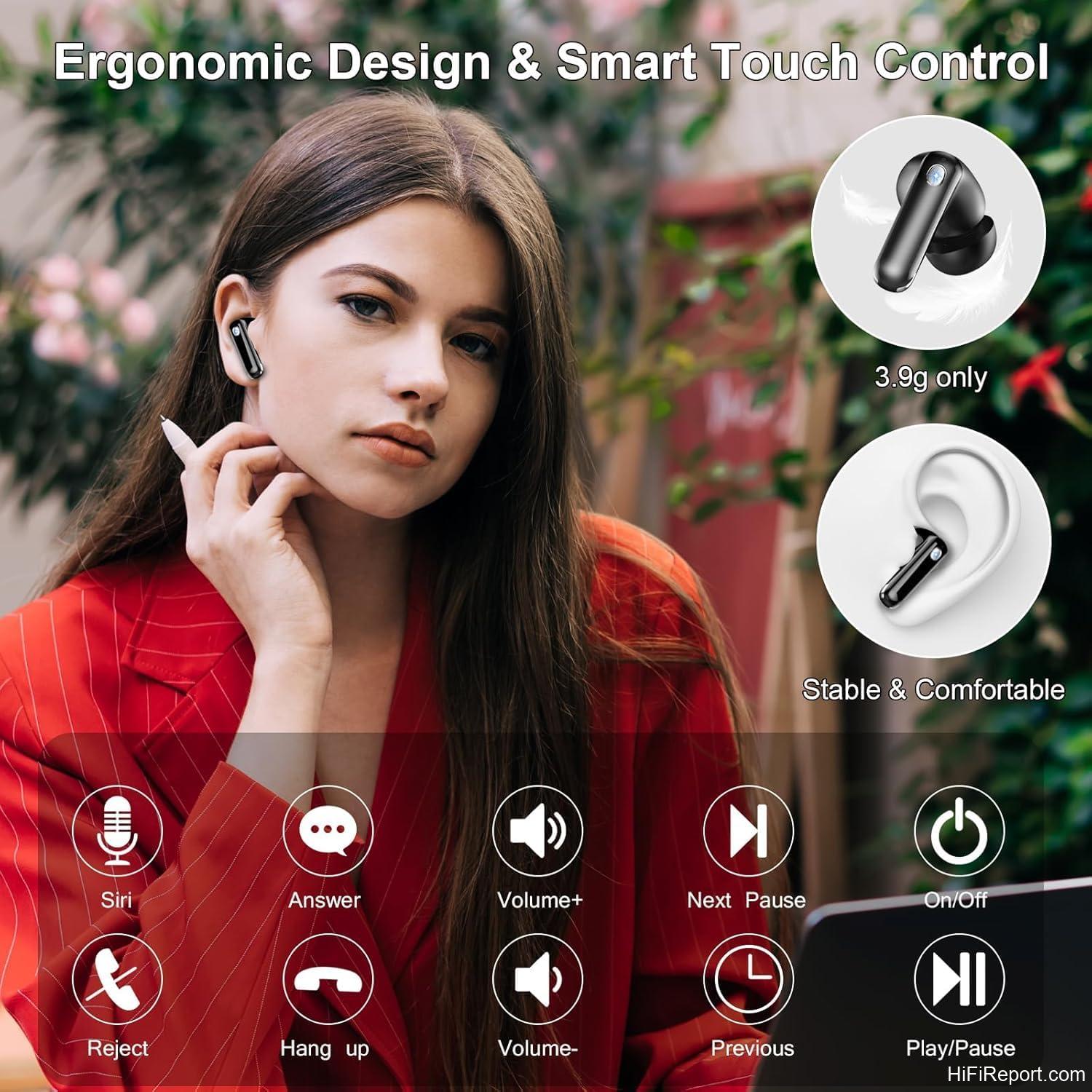
At just 3 grams per earbud, the zakotu Wireless Earbuds 2026 sit among the lighter options on the market. For context, many popular wireless earbuds range from 4 to 6 grams per bud, so this is a meaningful weight reduction that should appeal to users who find heavier earbuds fatiguing during extended listening sessions or workouts. The earbuds ship with three sizes of soft silicone ear tips, allowing users to find a fit that creates a proper seal — something that directly impacts both sound quality and passive noise isolation.
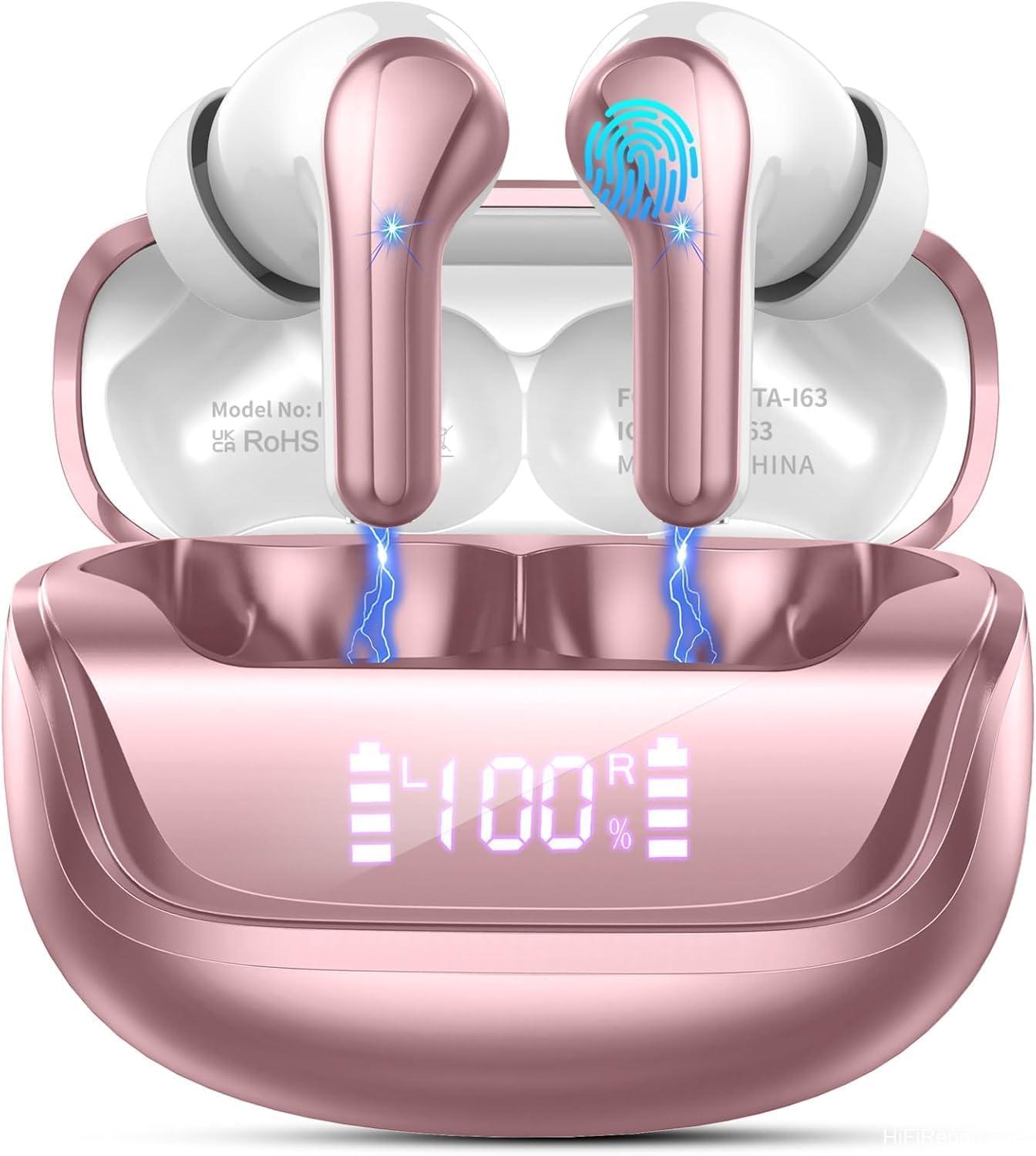
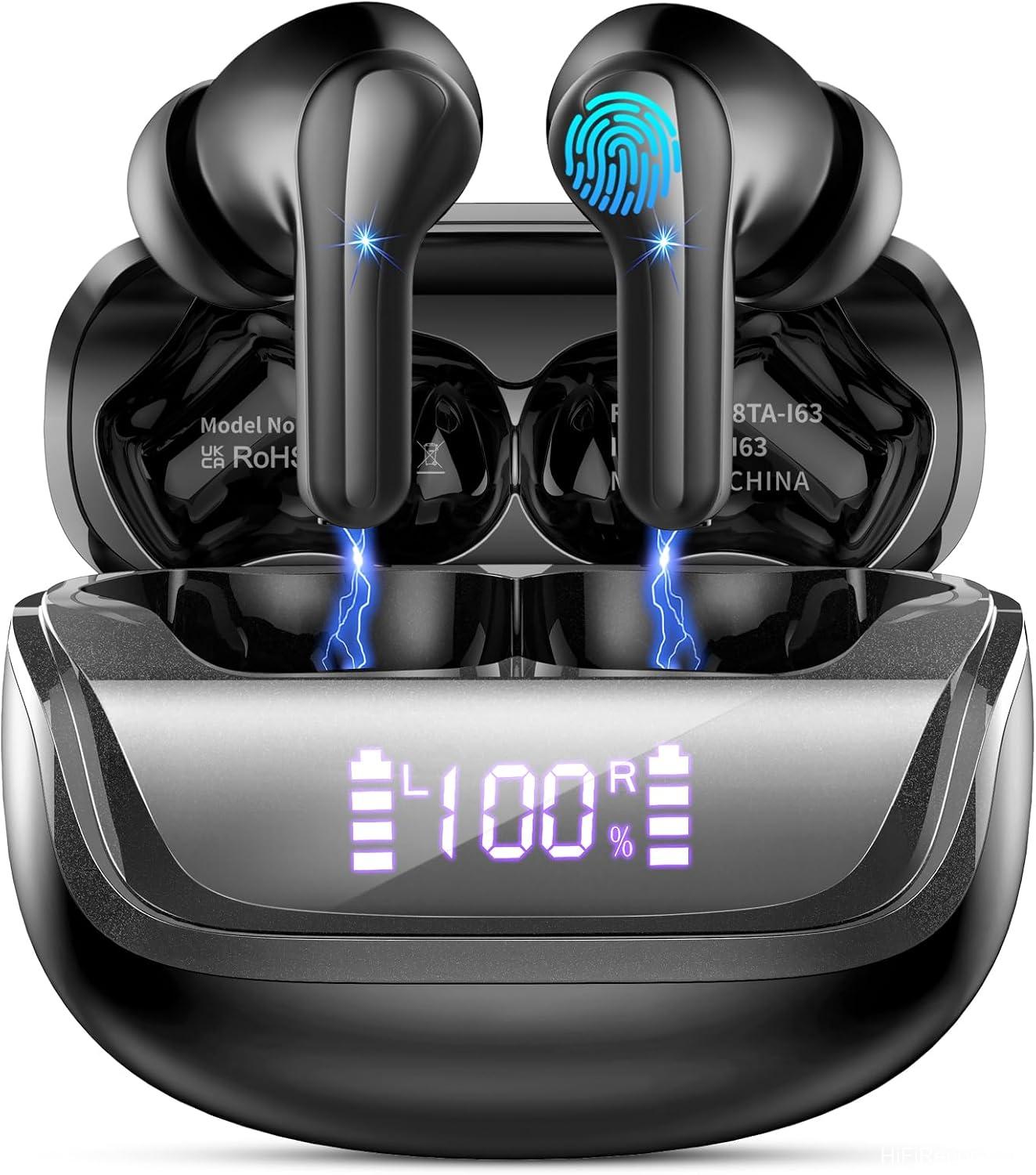
The charging case features a USB-C port for charging, which has become the standard across the industry in 2026. An LED power display on the case shows the battery level of each earbud independently as well as the case itself, a practical touch that eliminates the guesswork of wondering whether you have enough charge for your commute or workout. The case also incorporates OVP (Over Voltage Protection) circuitry, which safeguards the battery during charging and is a welcome safety feature at any tier.
The internal components carry an IP7 nano-coating, which the manufacturer says prevents sweat immersion and protects against rain. This is a higher rating than many earbuds in this class offer, and it signals that these are designed with active use in mind. The ergonomic design is described as providing a firm fit and creating a seal for sound delivery, though as with any earbud, individual ear geometry will ultimately determine how well they stay seated during movement.
Sound Quality and Drivers
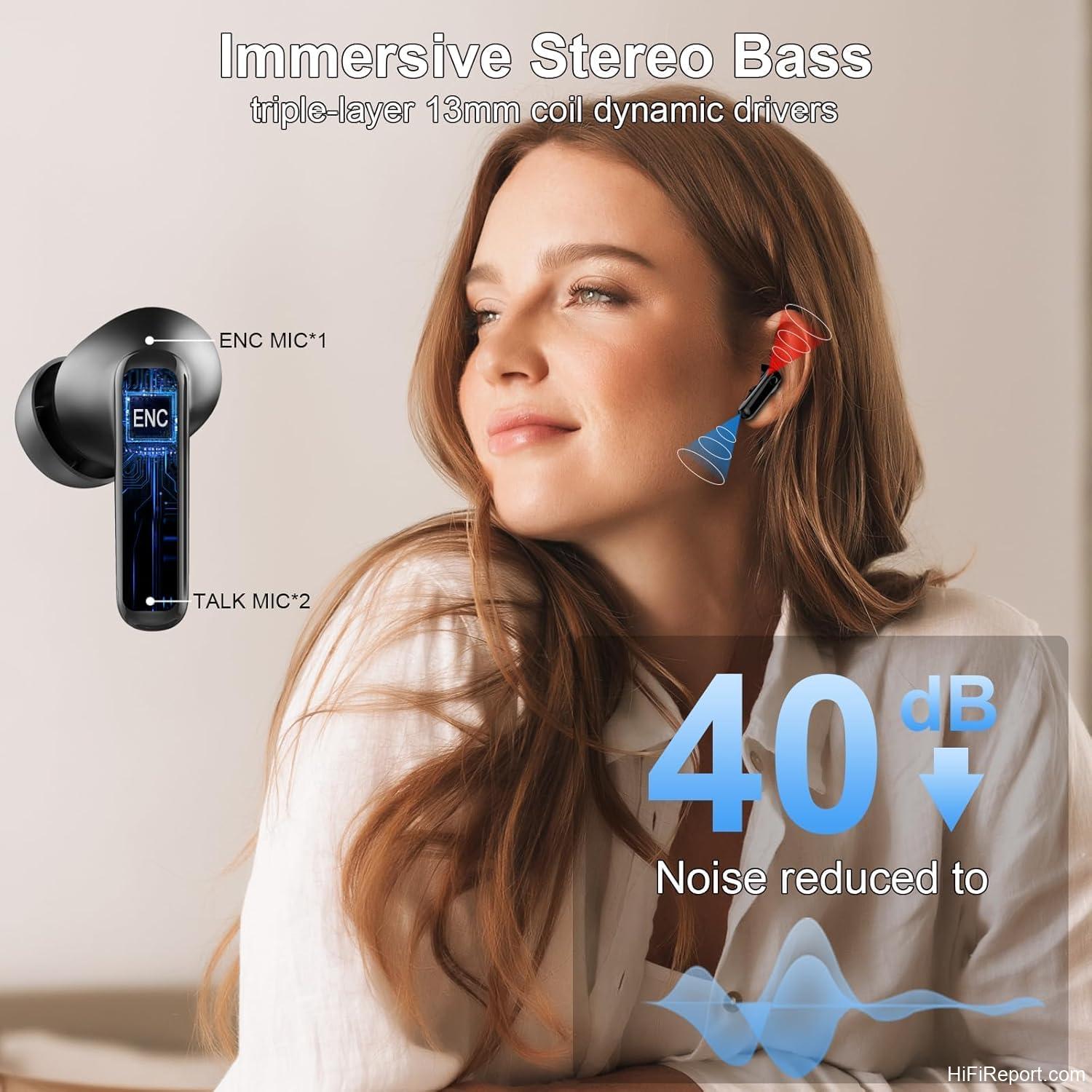
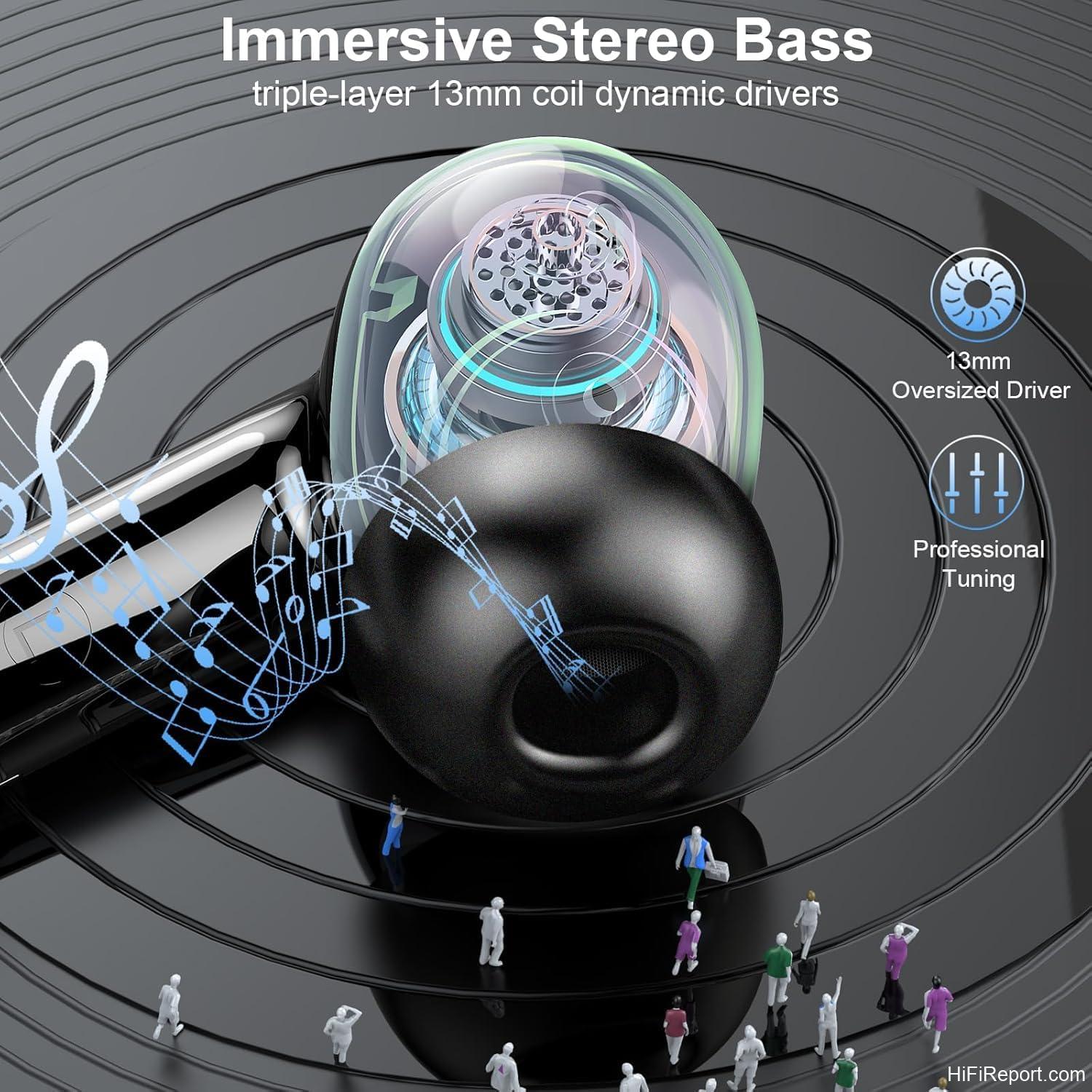
The zakotu Wireless Earbuds 2026 are equipped with 13mm double-layer diaphragm drivers paired with a polymer diaphragm. The manufacturer claims these drivers deliver “sufficiently strong bass” with a natural transition into mid and high frequencies. The larger driver size — 13mm is on the bigger end for in-ear wireless buds — theoretically moves more air and can produce more impactful low-end response, though driver size alone doesn’t determine sound quality.
The product title references “HiFi Stereo,” a term that in this context functions as a marketing label rather than a certified audio standard. In the broader 2026 landscape, expert reviewers at publications like SoundGuys and RTINGS have emphasized that true sound quality depends on factors well beyond driver specifications — including frequency response tuning, codec support, and digital signal processing. The zakotu earbuds support standard Bluetooth audio profiles (A2DP, AVRCP, HFP, HID) but do not appear to support advanced codecs like LDAC or aptX, which are increasingly common even in mid-range options.
According to Tech Searchers’ 2026 overview, the gap between flagship and mid-range earbuds has narrowed significantly, meaning budget-conscious shoppers can now access sound quality that would have required premium investment just a few years ago. However, audiophile-grade options like the Technics EAH-AZ100 and Sennheiser Momentum True Wireless 4, highlighted by GearLab and RTINGS respectively, still occupy a different tier of sound reproduction that budget earbuds with standard codecs and basic driver tuning cannot fully replicate.
This article is the original property of hifireport.com. All rights reserved. Unauthorized reproduction is strictly prohibited.
The manufacturer also claims the earbuds improve vocals by 75% and deliver 50% more bass compared to unspecified baselines. These figures should be treated as marketing claims rather than independently verified measurements, as no third-party lab testing data is available for this product.
ENC Noise Reduction and Call Quality
One of the most important distinctions to understand about the zakotu Wireless Earbuds 2026 is that they feature ENC (Environmental Noise Cancellation), not ANC (Active Noise Cancellation). These are fundamentally different technologies that serve different purposes, and the confusion between them is one of the most common sources of buyer disappointment in the wireless earbud space.
ENC uses the earbuds’ four built-in high-definition microphones to filter out background noise during phone calls, ensuring that the person on the other end of the line hears your voice clearly even in noisy environments. The manufacturer claims this system ensures “high resolution voice recognition and call quality even in noisy environments.” For users whose primary use case involves phone calls, video meetings, or voice assistant interaction, ENC is a meaningful and practical feature.
ANC, by contrast, uses microphones to detect ambient noise around you and generates anti-noise signals to actively reduce what you hear as a listener. This is the technology that makes flagship models like the Bose QuietComfort Ultra Earbuds (Gen 2) — described by GearLab as having “some of the best noise cancellation in the group” and by PCMag as “unmatched in their ability to silence your surroundings” — so effective at blocking out airplane engines, office chatter, and commuter noise.
The zakotu earbuds do not claim to offer ANC for listening. This means that if you are looking for earbuds that will quiet a loud environment for your own listening pleasure, these are not designed for that purpose. The passive noise isolation provided by the silicone ear tips will offer some degree of ambient noise reduction simply by sealing the ear canal, but it will not compare to the active noise cancellation available from products like the Sony WF-1000XM6, Apple AirPods Pro 3, or the EarFun Air Pro 4+ — all of which PCMag and SoundGuys highlight for their strong ANC performance.
This is not necessarily a flaw — many users don’t need or want ANC, particularly those who use earbuds primarily for workouts where situational awareness matters, or who listen in already-quiet environments. But it is a critical distinction that buyers should understand before purchasing.
Battery Life and Charging
Battery life is one area where the zakotu Wireless Earbuds 2026 make competitive claims, though the specifications contain some internal inconsistencies worth noting. The product title advertises “40H Playtime,” the feature heading references “50H Playtime,” and the detailed description states a “total playtime of 45 hours.” Breaking down what the manufacturer actually specifies reveals the source of the confusion.
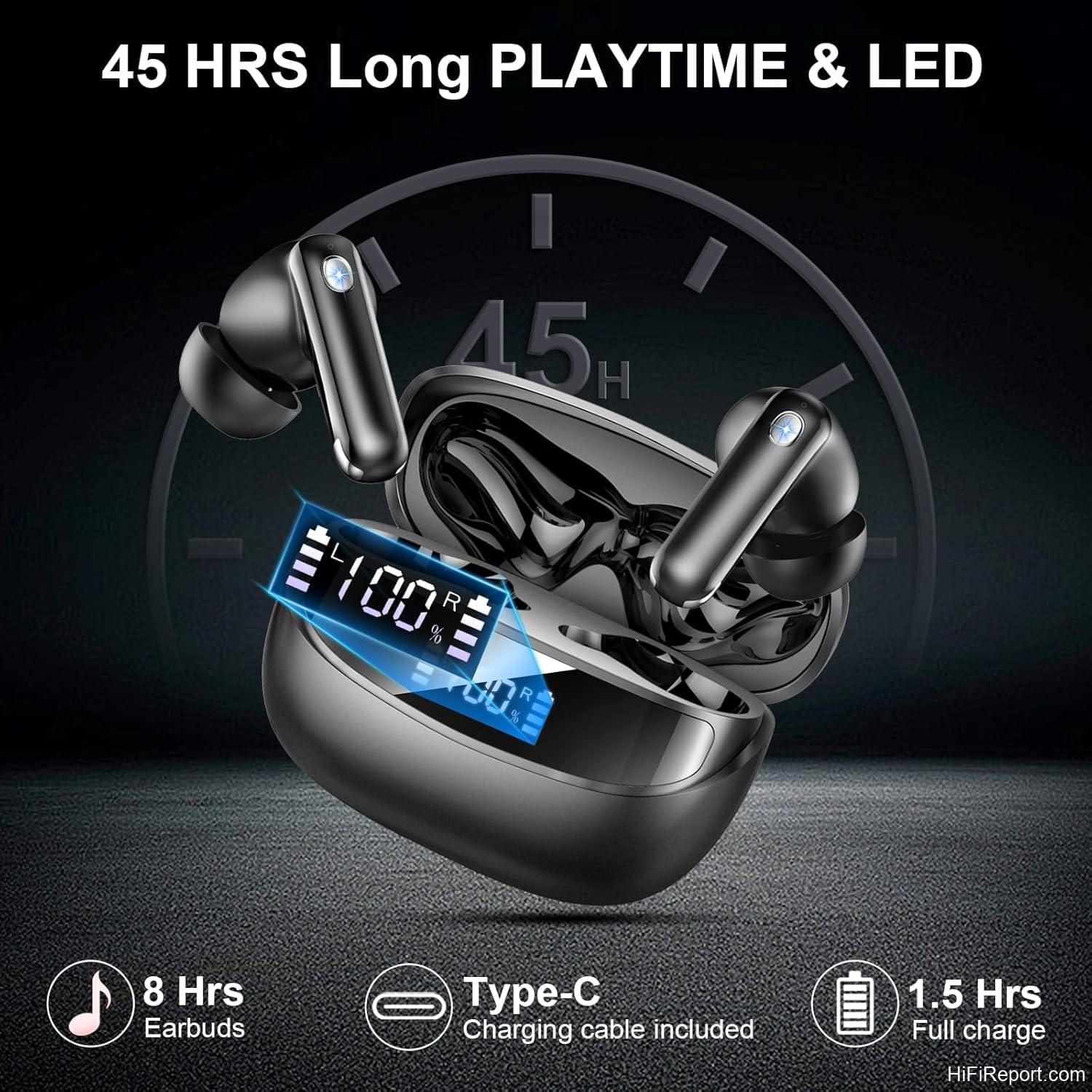
Each earbud delivers up to 8 hours of playback on a full charge, which requires 1.5 hours to achieve. The charging case provides an additional 5 full charges, which mathematically would yield 48 hours total (8 hours times 6 charges), though the manufacturer rounds this to 45 hours. The fast-charging feature is particularly notable: a 10-minute charge delivers 2 hours of playback, which is a genuinely useful capability for users who occasionally forget to charge their earbuds overnight.
In the context of the 2026 market, 8 hours per charge aligns with what Tech Searchers describes as the current benchmark: “most flagship models now comfortably exceed eight hours on a single charge.” Flagship models like the Technics EAH-AZ100 and JBL Tour Pro 3 offer 10 hours per charge, according to The Great Reviewer’s comparison, while the Apple AirPods Pro 3 delivers 8.7 hours and the Sony WF-1000XM6 provides 9.7 hours per SoundGuys’ testing.
The total playtime claim of 45 hours is competitive on paper, though real-world battery life typically falls short of manufacturer claims due to factors like volume level, codec usage, and environmental conditions. SoundGuys and RTINGS both emphasize the importance of independent battery testing under standardized conditions, which has not been performed for this product.
The separate LED battery displays for each earbud and the charging case are a genuinely useful feature. Many earbuds only show a rough case-level battery indicator, leaving users to guess the individual charge level of each bud. The granular display on the zakotu case allows for better planning — you will know exactly when it is time to recharge before heading out.
Connectivity and Bluetooth 5.4
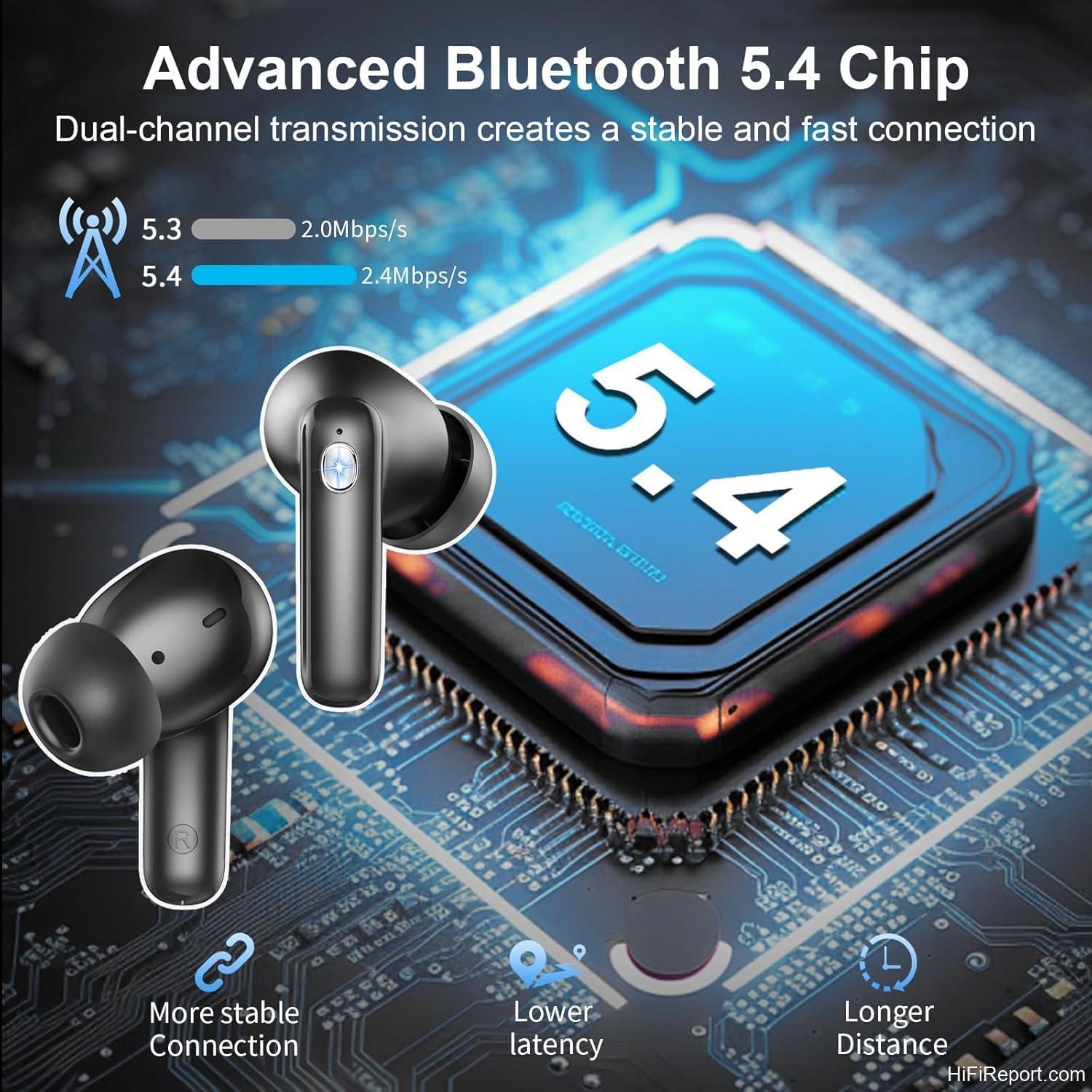
The zakotu Wireless Earbuds 2026 use Bluetooth 5.4, which supports HID, HFP, A2DP, and AVRCP profiles. The manufacturer claims a 15-meter wireless range and a latency of 55ms. The earbuds support both binaural and mono modes, meaning you can use either the left or right earbud independently — a feature that is useful for users who want to keep one ear free for situational awareness while still enjoying audio.
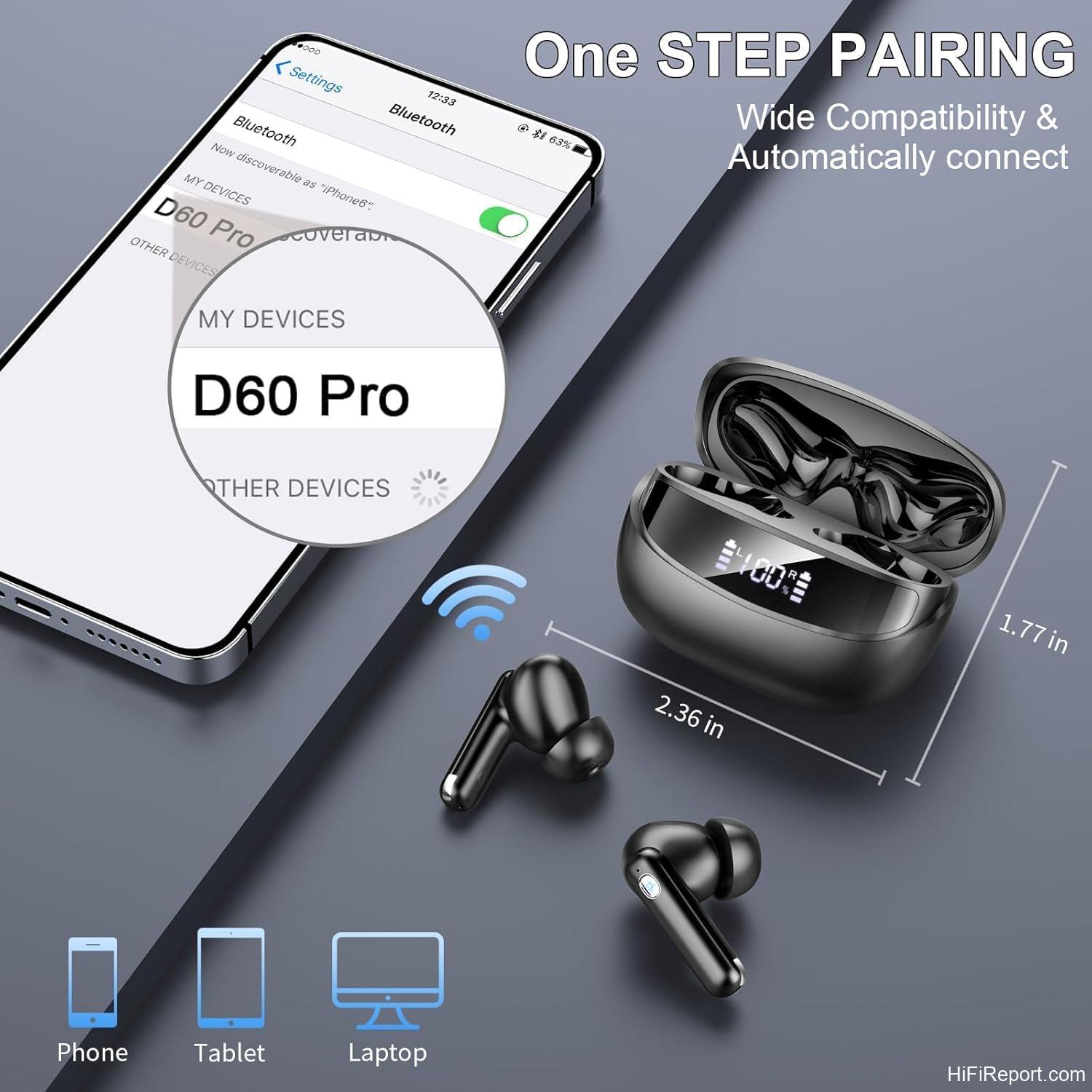
Auto-connection is supported: once initially paired, the earbuds automatically reconnect to the last paired device when the charging case is opened. This is a standard convenience feature in 2026, but its implementation quality varies across brands. The earbuds are compatible with devices running iOS 9.0 and Android 5.0 or later, which covers the vast majority of smartphones currently in use.
However, it is worth contextualizing Bluetooth 5.4 within the 2026 landscape. According to Tech Searchers, “Bluetooth 6.0 is gaining traction across flagship models, bringing lower latency and more stable connections in crowded environments.” The zakotu earbuds’ Bluetooth 5.4 is a solid, proven standard that will serve most users well, but it represents the previous generation of Bluetooth technology. The 55ms latency figure, while decent, may not satisfy competitive gamers who require sub-40ms latency for optimal performance — though it should be perfectly adequate for video streaming, casual gaming, and music listening.
PCMag’s 2026 coverage notes that LE Audio support is becoming more common, even in budget options like the EarFun Air Pro 4+, which the publication highlights as an Editors’ Choice winner. The zakotu earbuds do not appear to support LE Audio, which could limit their future compatibility with next-generation Bluetooth audio devices and features.
Touch Controls and Usability
The zakotu Wireless Earbuds 2026 feature touch-sensitive controls positioned on the upper portion of each earbud’s surface. The controls support play/pause, track navigation (previous/next), volume adjustment, call answer/end, and voice assistant activation. The manufacturer emphasizes that the touch zone is specifically placed on the upper part of the earbud to reduce accidental touches — a common complaint with touch-controlled earbuds across the industry.
Volume adjustment via touch controls is a feature that even some premium earbuds omit. Notably, the Apple AirPods Pro 3 still requires Siri or a connected device for volume adjustment, so the inclusion of direct volume control on the zakotu earbuds is noteworthy. However, PCMag’s review of the similarly positioned EarFun Air Pro 4+ notes that “touch controls can be finicky” even on well-designed earbuds, which suggests that touch control reliability remains an industry-wide challenge rather than a brand-specific issue.
The ability to activate voice assistants directly from the earbuds is a convenient feature for hands-free operation, and the broad compatibility claim means these should pair with virtually any current smartphone without issue.
Water Resistance and Workout Readiness
The IP7 waterproof rating is one of the zakotu Wireless Earbuds’ most compelling specifications for active users. IP7 indicates protection against immersion in water up to 1 meter deep for up to 30 minutes, which exceeds the requirements of most workout scenarios. The manufacturer specifically calls out sweat immersion protection and notes that the earbuds can be worn during exercise or in light rain.
For comparison, the Apple AirPods Pro 3 are described as “waterproof” by PCMag, and many workout-focused earbuds in 2026 carry IPX4 or IPX5 ratings, which protect against splashing water but not full immersion. The IP7 rating on the zakotu earbuds is therefore above average for the category and provides extra peace of mind for users who exercise outdoors in unpredictable weather.
Combined with the lightweight 3-gram design and multiple ear tip sizes, the water resistance makes these earbuds a reasonable choice for runners, gym-goers, and outdoor exercisers. GearLab’s testing methodology emphasizes that their expert panel tests earbuds “during commutes, flights, errands, workouts, and long days at the office,” and RTINGS specifically calls out fit and durability as top priorities for gym use. The zakotu earbuds appear designed with these use cases in mind, even if they lack the open-ear design that some runners prefer for maximum situational awareness.
It is worth noting that the IP7 coating applies to the internal components specifically — the manufacturer states that “the internal components of the wireless ear buds are all coated with IP7 nano-coating.” This is a common implementation approach and should provide adequate protection for typical workout and weather exposure scenarios.
The 2026 Competitive Landscape
The zakotu Wireless Earbuds 2026 exist in a market that expert reviewers describe as more competitive than ever. SoundGuys notes that they have “tested hundreds of wireless earbuds in our lab” and that 2026 offers “an unprecedented range of high-quality options, from industry leaders like Apple, Sony, and Bose to innovative newcomers.” RTINGS reports having “bought and tested over 905 pairs of wireless earbuds and in-ear headphones.”
None of the major expert roundup articles from The Great Reviewer, GearLab, PCMag, RTINGS, SoundGuys, or Tech Searchers include the zakotu Wireless Earbuds in their recommended picks. This does not necessarily indicate poor quality — many capable budget earbuds exist outside the coverage of major review sites — but it does mean that these earbuds lack the independent validation that products like the EarFun Air Pro 4+ (PCMag Editors’ Choice), CMF Buds 2 Plus (GearLab and The Great Reviewer budget pick), or Nothing Ear Wireless (GearLab mid-range pick) have received.
The products that expert reviewers highlight in the budget category offer features that the zakotu earbuds lack — most notably active noise cancellation. The EarFun Air Pro 4+ is praised by PCMag for “excellent sound with powerful bass, strong ANC, broad codec support” and a “feature-rich” design. The CMF Buds 2 Plus is highlighted for “surprisingly sophisticated soundscapes and features” by GearLab. These competitors demonstrate that ANC and advanced features are increasingly available in the budget segment, making the absence of ANC on the zakotu earbuds a more significant gap than it might have been in previous years.
On the other hand, the zakotu earbuds do offer a combination of features that positions them as a straightforward, no-frills option: lightweight design, strong water resistance, long battery life claims, and quad-microphone ENC for call quality. For users who prioritize these specific attributes over active noise cancellation and advanced codec support, the zakotu earbuds may still warrant consideration.
What Customers Are Saying
Detailed customer review content was not available at the time of this review, as Amazon’s login restrictions limited access to the full review list. However, the aggregate rating data provides a meaningful signal about overall customer sentiment.
The zakotu Wireless Earbuds 2026 carry a 4.4-star average rating from over 10,262 ratings on Amazon. This is a solid rating that suggests the majority of buyers are satisfied with their purchase. A 4.4-star average from a sample of over ten thousand ratings indicates consistent positive sentiment rather than a small-sample anomaly — reaching five digits in review count typically requires sustained sales over an extended period.
For context, many of the expert-recommended earbuds in 2026 carry similar or slightly higher aggregate ratings. The volume of over ten thousand ratings suggests these earbuds have achieved meaningful market traction, which generally indicates that the product delivers on its core promises for most users. Products with persistent quality issues tend to see their ratings drop below 4.0 stars as the review count grows, particularly past the ten thousand threshold where negative experiences accumulate visibly.
Without access to individual review content, it is not possible to identify specific recurring complaints or praise points from verified buyers. Based on the rating alone, the earbuds appear to meet expectations for the majority of purchasers at this tier.
Pros and Cons
Pros:
- Extremely lightweight at 3 grams per earbud
- IP7 waterproof rating exceeds typical workout earbud standards
- Quad-microphone ENC for clear call quality in noisy environments
- 8 hours of playback per charge with fast-charging support
- Separate LED battery displays for each earbud and charging case
- Touch controls include volume adjustment, a feature some premium competitors lack
- Binaural and mono mode flexibility
- Strong aggregate customer rating of 4.4 stars from over 10,000 ratings
- USB-C charging with OVP power protection
Cons:
- No ANC (Active Noise Cancellation) for the listener — only ENC for calls
- Bluetooth 5.4 lags behind the Bluetooth 6.0 adoption trend in 2026 flagships
- No support for advanced codecs such as LDAC or aptX
- No LE Audio support mentioned
- Inconsistent battery life claims across product title (40H), feature heading (50H), and detailed spec (45H)
- Not included in any major expert review roundup or independently lab-tested
- No companion app mentioned for EQ customization or firmware updates
- 55ms latency may not satisfy competitive gamers
- No wireless charging option mentioned
Verdict
The zakotu Wireless Earbuds 2026 occupy a specific niche in the wireless earbud market: they are a lightweight, workout-ready, call-focused option that prioritizes practical fundamentals over cutting-edge features. The 3-gram weight, IP7 water resistance, and quad-microphone ENC system make them a reasonable choice for active users who want earbuds they can sweat in, wear comfortably for hours, and use for clear phone calls without fiddling with controls.
However, the absence of ANC is the most significant limitation in the context of the 2026 market. As Tech Searchers notes, ANC has become so effective that flagship models “don’t just muffle sound; they analyze and predict noise patterns before they reach your ears.” More importantly, even budget options like the EarFun Air Pro 4+ and CMF Buds 2 Plus now offer capable active noise cancellation, meaning the feature is no longer exclusive to premium tiers. Buyers who want to silence their environment — whether for focus, travel, or commuting — will find the zakotu earbuds lacking in this regard.
© hifireport.com – Original review content by hifireport.com. Reprinting without written permission is not allowed.
The inconsistent battery life claims across the product listing also raise questions about the precision of the manufacturer’s specifications, though the core numbers — 8 hours per charge with fast-charging support — are reasonable and competitive for the category.
The 4.4-star rating from over 10,000 customers suggests genuine real-world satisfaction, and for users whose priorities align with the zakotu earbuds’ strengths — lightweight comfort, water resistance, call quality, and long battery life — they may well deliver solid value. Buyers seeking a more feature-rich experience with ANC, advanced codecs, app-based EQ customization, or independent expert validation would be better served by alternatives that have received coverage from established review publications.
Pricing varies, and readers should check the product page for current availability and cost.
Specifications
- Brand: zakotu
- Model: Wireless Earbuds 2026
- ASIN: B0H9KGCMHK
- Bluetooth Version: 5.4
- Supported Profiles: HID, HFP, A2DP, AVRCP
- Wireless Range: 15 meters
- Latency: 55ms
- Driver Size: 13mm double-layer diaphragm (polymer)
- Microphones: 4 high-definition (ENC)
- Noise Reduction Type: ENC (Environmental Noise Cancellation)
- Earbud Weight: 3 grams per earbud
- Battery Life Per Charge: Up to 8 hours
- Total Playtime with Case: 45 hours (manufacturer claim; product title states 40H)
- Charging Time: 1.5 hours for full charge
- Fast Charging: 10 minutes yields 2 hours of playback
- Charging Port: USB-C
- Battery Protection: OVP (Over Voltage Protection)
- Battery Display: Separate LED indicators for each earbud and charging case
- Water Resistance: IP7 nano-coating on internal components
- Ear Tips: Three sizes of soft silicone cushions
- Controls: Touch-sensitive (play/pause, track skip, volume, calls, voice assistant)
- Listening Modes: Binaural and mono
- Auto Connection: Yes, reconnects to last paired device on case open
- Compatibility: iOS 9.0+, Android 5.0+
- Amazon Rating: 4.4 out of 5 stars (10,262 ratings)
- Availability: In stock

- Bluetooth 5.4 and Auto Connection: Wireless earbuds adopt Bluetooth 5.4 technology and support HID, HFP, A2DP, and AVRCP profiles, providing a 15-meter wide range and a low 55ms latency. Pairing the earbuds with your device is effortless, and once they are successfully paired, they will automatically reconnect to the last connected device when you open the charging case. The earbuds offer both binaural and mono modes, allowing flexible enjoyment with either the left or right earpiece alone.
- 50H Playtime and LED Power Display: Wireless earphones feature OVP power protection and USB-C fast charging, allowing for up to 8 hours of usage on just a 1.5 hour charge. The included charging case provides an additional 5 charges, giving a total playtime of 45 hours. In addition, equipped fast charging, a quick 10-minute charge will give you 2 hours of playtime. Separate LED in-ear earphones battery display design, you can clearly see the charge level of each ear buds and charging case.
- Hi-Fi Stereo and Crystal Clear Call: Bluetooth 5.4 wireless earphones incorporate 13mm double-layer diaphragm drivers, polymer diaphragm, resulting in sufficiently strong bass and naturally connects to the mid and high frequencies. ENC noise reducing wireless earbuds have built-in 4 high-definition microphones that improve vocals by 75% and 50% more bass. It also ensures high resolution voice recognition and call quality even in noisy environments, providing a crystal clear call experience.