
Zen Blue Bluetooth DAC Review
iFi is a brand I tend to avoid.
I try to ignore news about their products and avoid getting my hands on anything they make.
No, I really don’t want to! Why such a strong reaction? What’s so scary about iFi? And as an audio reviewer, how can I say such things about a manufacturer? Well, you just don’t understand.
Those of us in this line of work get the chance to listen to and use all sorts of equipment.
When a piece of gear arrives, we spend a month or two, or even longer, with it. If it clicks, sparks are bound to fly.
You know what I mean? Love stories in movies and novels often start this way, even affairs often begin with chance encounters, leading to familiarity, understanding, and eventually, affection and love.
iFi is a brand that can easily capture the hearts of audiophiles—especially those like me with limited budgets and shallow pockets—leading to infatuation, emotional investment, and falling head over heels.
Recently, at an audio show, I saw iFi’s iPhono 2 phono stage. I borrowed one from the distributor and was instantly hooked. I bought it after finishing the review.
What’s so great about that phono stage? It offers the most comprehensive features under $5,000, bar none.
Not only are impedance, capacitance, and gain adjustable for cartridges, but it also has multiple RIAA equalization curves, making it compatible with any cartridge and records from any era.
It even boasts a signal-to-noise ratio of 85dB, rare even in models costing twice as much. Adding an external power supply further improves the sound, yet it’s priced affordably for almost everyone. It’s simply unrivaled in its price range.
Of course, I bought it immediately.
Having learned my lesson, I’ve since become particularly wary of iFi gear that arrives at the editorial office. I avoid reviewing them whenever possible to prevent myself from losing control, becoming infatuated, losing my senses, and adding yet another piece of equipment to my home.
This time, I couldn’t escape.
But I am willing to share my experiences with the iFi Zen Blue DAC these past few weeks.
Bluetooth-Only DAC
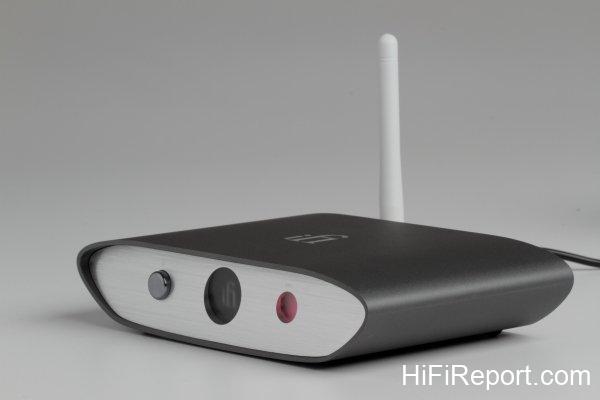
The iFi Zen Blue shares the same aesthetic as other Zen series products. It’s not your typical rectangular box; instead, it features a modern design with wing-like sides and rounded edges.
Why this shape? I have no idea.
Whether it looks good or not is subjective, but I do feel it adds to the production cost.
The Zen Blue and the Zen DAC share the same enclosure. Creating this shaped case is more expensive than a simple square box, similar to their previous xDSD DAC/headphone amp. The wave-like design supposedly increases structural rigidity, but consumers wouldn’t mind if it were absent.
It’s all added cost.
The same goes for the Zen Blue and Zen DAC. Doesn’t iFi understand cost-effectiveness? But they know their core consumer base is younger, hence the stream of unconventional products they release.
The manufacturer positions the Zen Blue as a DAC, but it’s quite different from typical DACs. It lacks the usual coaxial, optical, BNC, and AES/EBU inputs. Even the now-essential USB input is missing, not to mention I2S or network connectivity.
So, what kind of DAC is it? Oh, I missed one input. Did you guess it? Yes, Bluetooth.
Balanced Analog Stage
Zen Blue – the name itself reveals its Bluetooth-centric nature.
It has only one digital input channel: Bluetooth.
It uses the latest Bluetooth 5.0 specification, along with a Qualcomm 5100 chip to process all incoming Bluetooth signals.
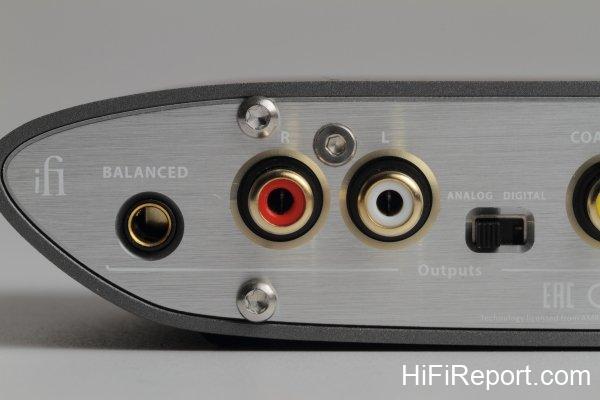
Then, it decodes the signal using an ESS Sabre Hyperstream DAC chip. The analog amplification stage is fully balanced. Consequently, the rear panel analog outputs include not only a set of RCA single-ended outputs but also a 4.4mm balanced output.

The manufacturer recommends using the balanced output whenever possible for the best performance.
Recognizing that some users may be more discerning and already have excellent DACs in their systems, the Zen Blue also offers coaxial and optical digital outputs, allowing you to connect it to your existing DAC.
In essence, the Zen Blue’s role is clear: “I am a DAC, but unlike typical DACs, I’m all about Bluetooth.”
The Zen Blue is versatile enough to be used in any system, from budget setups to high-end rigs. If your system lacks Bluetooth reception, adding the Zen Blue enables you to stream music wirelessly from your phone to your audio system. That’s why I say the Zen Blue is a worthwhile addition to any system, regardless of price.
High-Resolution Codec Support
To fully appreciate the benefits of the iFi Zen Blue, the key isn’t the amplifier or speakers at the end of the chain, but rather your smartphone or mobile device.
We often assume Bluetooth transmission is inferior, primarily because the traditional A2DP profile’s SBC codec is a highly compressed, lossy format with high latency. This perception of poor Bluetooth audio quality is understandable, as Bluetooth was originally designed for short-range data transfer, not high-fidelity music.
However, Bluetooth offers undeniable convenience. Once paired, it instantly transmits signals, which is why Bluetooth headphones and portable speakers are so popular.
Is there a way to improve the sound quality? Apple’s AAC codec is considered superior to SBC.
Qualcomm’s aptX algorithm, a proprietary technology, offers higher coding efficiency than traditional Bluetooth, theoretically capable of transmitting CD-quality audio with low latency.
The newer aptX HD is an extension of aptX, offering even higher transmission efficiency and richer, more complete audio information.
Sony’s LDAC claims to transmit at speeds up to 990kbps, supporting 24bit/96kHz audio signals.
Furthermore, Huawei’s LHDC, also claims to transmit 24bit/96kHz audio at 900kbps.
There are many competing technologies, each with its merits. But the crucial question is: does your phone support them?
Currently, LDAC is primarily found in Sony devices, while LHDC is limited to Huawei and Xiaomi. AptX is widely adopted by Android systems, and aptX HD is gradually gaining traction. If you use an iPhone, you’re limited to AAC.
This is why I emphasize that the extent to which you can enjoy the Zen Blue depends on your mobile device.
Essentially, the iFi Zen Blue is compatible with and understands all these codecs. The limitation lies with your source device. I, for instance, only have an iPhone XR.
This means if you have an Android phone, a Sony phone, or a Huawei/Xiaomi phone, you have the potential to experience even better sound quality than I can.
Status Indicator Lights
The Zen Blue’s front panel features two indicator lights. The iFi logo in the center illuminates to indicate the current transmission format. Yellow for AAC, blue for aptX, magenta for aptX HD, cyan for Sony’s LDAC, and white for Huawei or Xiaomi. If it glows green, you should check if your device is limited to SBC and adjust your settings to achieve better sound quality.
The circular light on the right indicates the current sampling rate. Blue signifies 44.1kHz or 48kHz files, while white indicates 88.2kHz or 96kHz signals.
When using my iPhone, a voice prompt from the speakers confirms successful Bluetooth pairing. Two seconds later, it announces that the current playback format is AAC.
iFi classifies the Zen Blue as a DAC, but I’m more inclined to see it as a Bluetooth receiver with a built-in DAC and analog outputs.
For users without a dedicated DAC, the analog outputs are perfectly adequate. If you own a higher-quality DAC, using the digital outputs is recommended.
Neutral and Smooth Sound
Using the Zen Blue’s RCA outputs directly into an amplifier, iFi’s signature sonic characteristics are evident.
The Zen Blue delivers a very direct sound, without excessive coloration or bias. It leans slightly towards brightness, maintaining musical energy. Remarkably, it manages to impart a sense of smoothness and refinement to Bluetooth playback, even with the AAC codec. There’s no harshness, yet the music doesn’t sound compressed despite AAC’s lossy nature.
This balance between liveliness and sonic quality is impressive, a testament to iFi’s engineering prowess.
Expressive Vocal Performance
For example, playing the Frozen II soundtrack, in “Into the Unknown,” Aurora’s harmonies are smooth and not harsh, with good vocal focus. The piano maintains a solid presence. Idina Menzel, a singer and actress, masterfully navigates the complex arrangements by Kristen Anderson-Lopez and Robert Lopez, blending operatic recitative with lyrical passages while conveying nuanced emotions to match the storyline and visuals.
Pay attention to the drums subtly placed in the background before the chorus. They have palpable form and elasticity. This rendition of “Into the Unknown” completely surpassed my expectations.
In the next track, the playful Olaf’s “When I Am Older” begins with a cheerful rhythm. The rhythmic bass pulses create a sense of musical depth. Josh Gad, who voices and sings as Olaf, delivers a richly expressive vocal performance.
The Zen Blue brings Josh Gad’s voice to life with clarity and vibrancy.
Bluetooth can indeed be Hi-Fi! I can fully enjoy the music!
Enhanced Sound with External DAC
However, connecting the Zen Blue to an external DAC elevates the sound quality further.
The Zen Blue’s rear panel has a switch next to the analog outputs. Switching it to the left selects analog output, and to the right, digital output.
Using the coaxial output to connect to my Aqua La Voce S3 DAC, which I recently reviewed and greatly enjoyed, results in an even smoother, more three-dimensional sound with enhanced spatial information.
Menzel’s vocals become more powerful, with greater nuance in her singing technique.
The drums, rhythm, and bass all show significant improvement. The bass extends deeper, and the drums become more solid.
Even without an external DAC, the Zen Blue’s direct analog output is already impressive. An external DAC allows for another level of sonic refinement.
Thank you, iFi, for including digital outputs, allowing us to enjoy the convenience of Bluetooth streaming while still experiencing high-fidelity music.
More Than Just a Toy
Purely from a digital streaming perspective, Bluetooth playback isn’t inherently superior to network streaming. However, in terms of setup, connection, and ease of use, Bluetooth is the simplest way to listen to music in our smartphone-centric era.
Even my own mother at home uses Bluetooth speakers to play music and listen to the radio.
But beyond headphones and simple Bluetooth speakers, you now have the iFi Zen Blue. It enables your home audio system to play music via Bluetooth.
And its performance proves it’s not just a toy but a serious source component, capable of adding Bluetooth functionality to your existing system.
It also demonstrates that manufacturers and engineers have pushed Bluetooth technology to unprecedented levels, capable of delivering a musically engaging and emotionally resonant experience.
Specifications
* Type: Bluetooth DAC
* Input: Bluetooth 5.0 with AAC, aptX, aptX HD, LDAC, HWA codecs
* Digital Output: Optical x1; Coaxial x1
* Analog Output: RCA x1; 4.4 mm balanced x1
* Frequency Response: 20Hz – 20kHz <+0/-0.5dB (44.1kHz); 1Hz – 44kHz <+0/-3.0dB (>= 88.2kHz)
* Output Voltage @ 0dBFS: 2.05V (+/- 0.05V)
* Dynamic Range: 109dB(A)
* Signal-to-Noise Ratio: 109dB(A) @ 0dBFS
* Total Harmonic Distortion: <0.0015% 10k Load
* Output Impedance: <50Ω
* Power Consumption: <2.5W
* Dimensions: 158 x 100 x 35 mm (W x D x H)
* Weight: 476g