
AIM Network Cable Review
Recently, AIM unveiled two new network cables: the latest flagship NAX, and the NA4, which slots in just above the entry-level NA2. This review will delve into the performance of the NA4.
Conductors: Single-Core Prowess
Prior to the launch of the NAX and NA4, AIM’s network cable lineup consisted of the NA9, NA6, and NA2. With the addition of these new members, the range expands to five distinct models, forming a comprehensive and clearly tiered hierarchy.
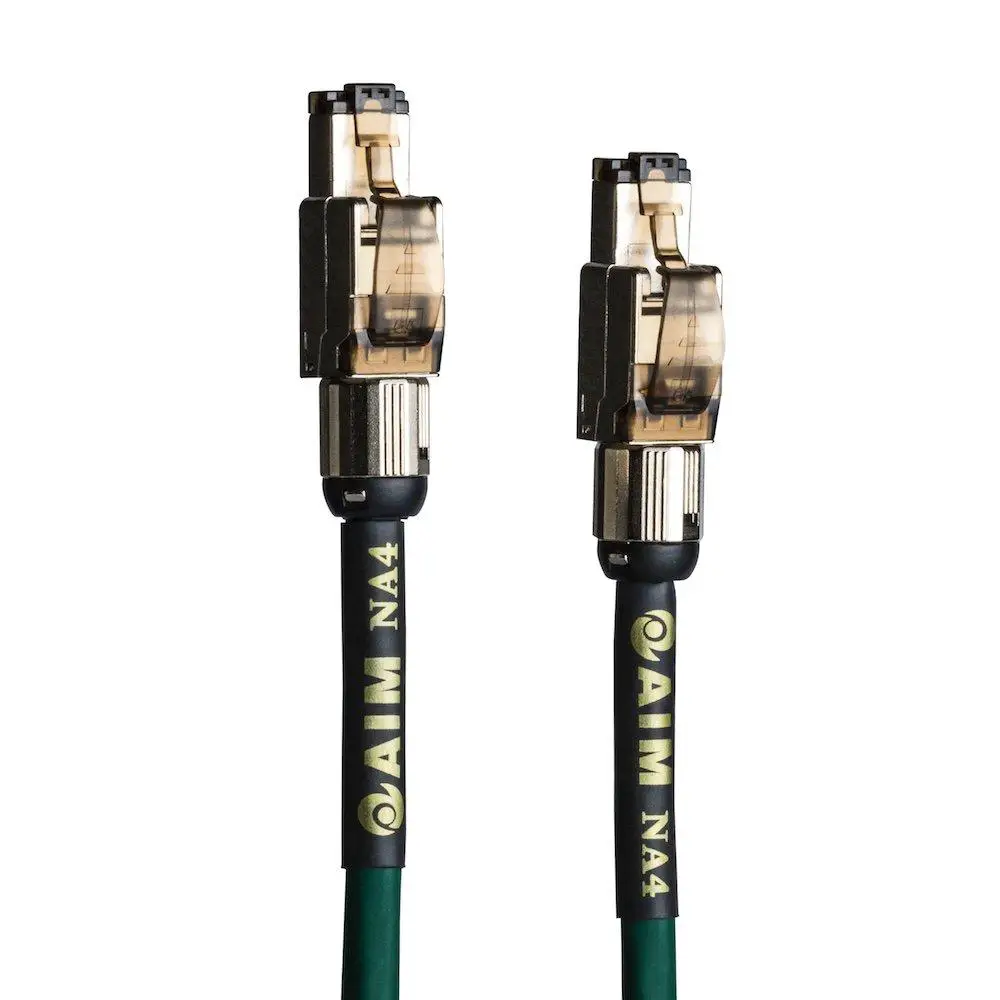
Compared to the entry-level NA2, the most significant visual difference in the NA4 lies in its RJ45 connectors at both ends. The NA2 utilizes a metal-shielded crystal plug, offering a certain degree of noise shielding, combined with an injection-molded plastic boot—a common design for consumer-grade network cables.

The NA4, however, takes a different approach, adopting a fully metal die-cast modular connector. Its structure is akin to the well-regarded Telegartner MFP8, providing more effective resistance against electrical interference and significantly better noise reduction.
Regarding its conductors, the NA4 employs AIM’s signature single-core wire for its core, with a gauge of 24AWG. Across their entire network cable range, from entry-level to flagship, AIM consistently opts for single-core wires, differing only in gauge and material.

What distinguishes single-core network cables from stranded ones? Single-core wires generally boast superior electrical performance over stranded wires, exhibiting lower signal loss and stronger anti-interference capabilities, thereby promoting more efficient signal transmission. However, single-core wires are stiffer, less flexible, and less tolerant of repeated bending. In practice, they are often favored for fixed installations or long-distance runs, whereas stranded network cables are typically used for shorter distances where convenience and ease of installation are paramount.
For serious audiophile network cables, stiffness is a non-issue; superior performance is the sole objective. Hence, AIM’s unwavering commitment to single-core wires contributes significantly to signal fidelity. The NA4 not only utilizes single-core wires but also features AIM’s newly developed high-purity oxygen-free copper for its conductors.

The eight cores are twisted into four pairs. Instead of individual shielding, a cross-shaped backbone separates these four pairs. These are then encased in two layers of high-performance aluminum foil, followed by a high-density copper braided shield, effectively providing triple-layer shielding. AIM cables have always prioritized robust shielding, and the NA4 is no exception.
Enhanced Imaging and Timbre
My listening tests were conducted at home, utilizing a PS Audio AirLens streamer, a Holo Audio Spring 3 DAC, a Serene preamplifier, a NuPrime AMG STA-SE power amplifier, and Alexis Sound Rebecca bookshelf speakers, with Roon serving as the playback software. I connected the AIM NA4 network cable between my network switch and the AirLens, using a Linkomm S/FTP CAT8 network cable as a reference for comparison.

I began my audition with “Apollo,” an album cherished by many audiophiles, featuring a cello accompanied by a single guitar, performing several exquisitely beautiful classical miniatures. Compared to the reference cable, the NA4 rendered the sonic outlines of the instruments with a distinctly more palpable and three-dimensional presence. Both the cello and guitar felt less like mere sounds and more like concrete objects suspended between the two speakers, appearing smaller in form and exhibiting improved separation.
The reference cable, in contrast, presented a somewhat looser and flatter sonic image, with a leaner tonal quality that made it more challenging to precisely pinpoint the location of sounds. Furthermore, the NA4 unveiled a greater wealth of sonic decay and spatial information. This not only imbued the timbre with more richness, sweetness, and silkiness but also recreated a clearer, more realistic soundstage, enhancing the overall sense of three-dimensionality. While this album sounded excellent with the reference cable—due to its inherently superb recording quality—the NA4 elevated the degree of realism and tonal richness, making the listening experience even more captivating.
Structured Soundstage Clarity
Next, I moved on to “Gammal Fabopsalm” from Opus 3 Records’ “DSD Showcase 2” demonstration disc, a piece featuring organ and French horn that serves as an excellent test for a system’s ability to render layering and texture. From the outset, with its complex low-frequency organ chords, the NA4 immediately demonstrated its superior ability to reproduce the body of the bass notes and the expansive foundation of the soundstage. There was a clearer distinction between individual low notes, and with the intertwining melodies of the high notes, the overall structure of the high, mid, and low frequencies was rendered with remarkable coherence.
The reference cable, conversely, presented a somewhat bloated low-frequency image with less defined contours and a muddier timbre. When the French horn entered, the NA4’s contribution was unmistakable, endowing its sonic outline with superb cohesion and clarity. This resulted in improved separation between the horn’s physical presence and the organ. As the music progressed and the organ’s harmonies grew more intricate and the overall volume swelled, the NA4’s advantages became even more pronounced. It presented the soundstage’s high, mid, and low structures with impressive organization, ensuring appropriate separation between different sounds and distinct layers even within overlapping harmonies, preventing any sense of muddiness.

Moreover, because the sound images were more focused and clearer, the overall fullness of the sound and the richness of the timbre were enhanced, giving the music greater power and a more impactful sense of energy.
Dynamic Musicality
The benefits of the NA4 are even more evident when listening to vocal tracks, such as those from Danish singer Jacob Dinesen’s “Let the Hard Times Come.” This album, a compilation of Dinesen’s previously released songs augmented by four new compositions, was curated by Danish speaker manufacturer Dali as an audiophile demonstration disc, and its exceptional recording quality is self-evident.

The album’s tracks blend urban country and pop-rock styles, complemented by Jacob Dinesen’s raw and rugged voice, exuding a strong masculine character. Played through the NA4, the power and infectiousness of his vocals were significantly amplified. The human voice became more prominent, achieving a superior 3D, tangible presence, akin to a physical entity. The sound quality and timbre felt more authentic, creating a sensation of being closer to the performer and intensifying the overall atmosphere.
Furthermore, the music’s dynamic ebb and flow became more vivid. Even in the opening guitar prelude, the plucking felt more forceful, with crisper, more articulate notes, better textural density, and a heightened sense of sonic clarity.
Technical Pedigree, Sonic Validation
From the former flagship NA9 to the entry-level NA2, and now the NA4, I have personally auditioned three of AIM’s network cables. The NA9 delivered a more realistic live ambiance, creating a more direct sound. The NA2 stands as one of the most compelling purchases in its price range. The NA4, meanwhile, provides immediately discernible improvements in imaging, soundstage, sound quality, and detail. These advancements are a direct result of AIM’s years of accumulated technical expertise in communication cabling and their uncompromising commitment to the highest quality, a philosophy that seamlessly translates to their home audio-video products, yielding excellent results.
Stemming from advanced technology and validated through outstanding sonic performance, that is the essence of AIM. It is certainly worth an audition.
Specifications
* **Type:** RJ45 Network Cable
* **Conductor:** Single-core OFC, 24AWG × 8 wires
* **Shielding:** Double-layer aluminum foil, copper braided shield
* **Cable Diameter:** 7.1 mm