
SOtM dCBL-CAT7 Network Cable Review
Is it always true that cheaper cables sound worse? Not necessarily! Take the SOtM dCBL-CAT7 network cable for example. In this audiophile network cable feature, it is among the least expensive, yet its sonic performance is top-tier. This means the dCBL-CAT7 not only offers exceptional value for money but also delivers outstanding sound quality.
Noise Filtering is Key
SOtM products typically enhance audio performance through three primary approaches: employing more precise clocks, providing cleaner power, and filtering out noise from the Ethernet interface. For network cables, which are essentially passive components, the first two methods are not applicable. Therefore, the focus shifts to the third approach: “noise filtering.” Indeed, this is the secret behind the dCBL-CAT7’s excellent sound.
Near one end of the dCBL-CAT7 cable is a translucent acrylic box, which the manufacturer calls the “Filter Block.” Its purpose is to filter out or reduce noise originating from upstream devices such as routers or NAS units. While this noise may not necessarily affect the correctness of data transmission or reception, it can degrade the audio playback quality and diminish the listening experience.
It’s clear that the dCBL-CAT7 improves sound performance simply by filtering out noise. However, the specific filtering method remains undisclosed.
The SOtM website doesn’t detail the filtering method used in the dCBL-CAT7, and the box itself offers no visual clues, leaving us to wonder. It’s worth noting that SOtM also offers a product called iSO-CAT6, which appears to be a standalone version of the filter block found on the dCBL-CAT7. This allows users to connect their existing network cables to the iSO-CAT6 for noise isolation. However, the iSO-CAT6 is a distinct product with isolation as its primary function. It can be used independently or in conjunction with the dCBL-CAT7 for even better results.
Standard Cable Structure
Regarding conductors and structure, does the dCBL-CAT7 possess any unique features? Frankly, not really.
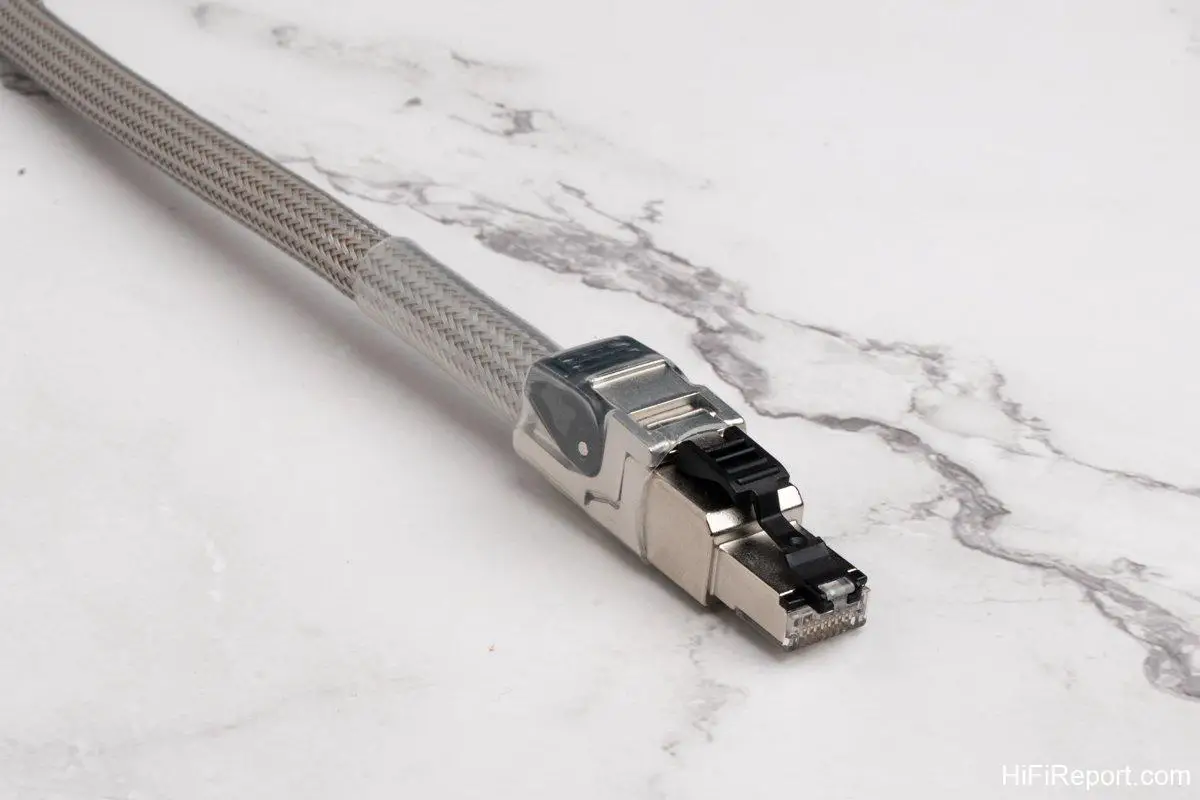
This isn’t to say that the dCBL-CAT7’s conductors or structure are inferior. Rather, it seems SOtM doesn’t believe that conductors and structure are the determining factors in network cable sound performance. The SOtM website doesn’t even specify the material used for the dCBL-CAT7’s conductors. However, given the cable’s rigid feel, it’s highly likely to use solid-core copper wires. In terms of structure, it employs the S/FTP structure common in shielded network cables. This consists of four twisted pairs, each individually wrapped in aluminum foil, and then collectively shielded with a copper braid, effectively blocking external magnetic fields and noise interference.
For the RJ45 connectors, the dCBL-CAT7, like all the network cables in this feature, utilizes Telegärtner MFP8 RJ45 connectors. These connectors offer 360-degree full metal shielding, providing optimal resistance to interference.
Clear, Precise, and Natural
As mentioned earlier, the dCBL-CAT7 stands out as one of the best-sounding cables among those tested. What makes it so good? Simply put, it’s clear and precise, yet natural and smooth. It strikes a perfect balance of clarity, cleanliness, and sharpness with an appropriate degree of smoothness, achieving well-rounded performance.
Take, for instance, Pletnev’s rendition of Shchedrin’s Carmen Suite with the Russian National Orchestra. The recording features a standard string orchestra augmented by various percussion instruments, creating a rich sonic tapestry. Through the dCBL-CAT7, the recording’s diverse timbres are vividly revealed, imbued with a pleasing smoothness that lends the string lines a beautiful and supple texture. The overall sound is harmonious and comfortable.
Furthermore, I noticed the dCBL-CAT7 enhances sonic focus and solidity, tightening image outlines, which in turn improves separation and imaging. The soundstage presentation, depth, and layering are rendered with greater clarity.
While some other network cables can achieve similar improvements, few can do so with the same naturalness as the dCBL-CAT7.
Consider “Mache dich, mein Herze, rein” from Challenge Classics’ “St. Matthew Passion.” The dCBL-CAT7 imbues this 6/8 time signature piece with a fitting rhythmic flow. The dynamics unfold linearly and smoothly, with a balanced and gentle tone, resulting in a softer and more harmonious listening experience.
Similarly, the tenor vocals are rendered with precise and clear imaging, as are each instrumental section in the accompaniment. This clarifies the relationship between the vocals and accompaniment, eliminating any sense of muddiness and achieving excellent cohesion.
In comparison, the reference cable, Linkomm CAT-8, while also harmonious and rich in detail, seems somewhat overly blended, and the sonic images lack focus. The music becomes less engaging.
Performance and Musicality
Moving on to “Up to the Mountain,” track 1 of “The Dali CD Volume 5,” this song features a crisp female vocal accompanied by a steel-string acoustic guitar. Both are inherently high-frequency instruments, and can easily sound harsh if not handled properly. However, the dCBL-CAT7 poses no such issue. Its mid-to-high frequencies and treble possess ample body, coupled with a smooth sonic texture and rich dynamic gradations. Therefore, even when the vocals soar to their highest notes, there’s no sense of sharpness, nor is there any loss of essential brightness and energy. The listening experience is deeply engaging, showcasing a blend of both performance and musicality.
Finally, listening to “Did Trouble Me,” track 2 of “The Dali CD Volume 4,” I not only perceived Tom Jones’ voice as remarkably forward, but also noticed that the size and proportion of each instrument were clearly defined and appropriately scaled. The overall sonic architecture was well-organized, rendering the music with a sense of rationality and control, yet retaining its emotional core. The presentation is mature and sophisticated.
It’s truly surprising that a simple filter block can deliver such significant benefits. SOtM has truly done a remarkable job!
Reference Components
* Reference Network Cable: Linkomm CAT-8 Network Cable
* Storage Device: Synology DS212 NAS
* Network Switch: Ansuz D-TC Supreme Power Switch
* Streamer: MSB The Discrete DAC
* Preamplifier: Norma Audio Revo SC-2 LN
* Power Amplifier: Norma Audio Revo PA-160 MR Mono Power Amplifiers
* Speakers: Wilson Audio Alexia 2
Specifications
* Type: Network Cable
* Impedance: 100Ω (± 15%)
* Supported Standards: 10/100/1000Base-T, 10GBase-T
* Outer Diameter: 10mm
* Filter Dimensions: 120 x 25 x 25 mm