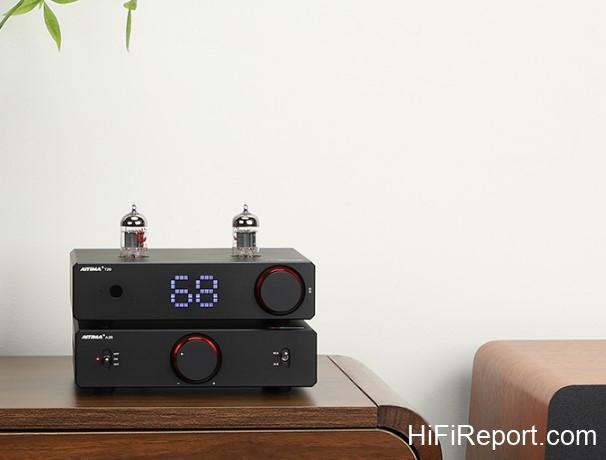
AIYIMA A20 Review
Overview
The AIYIMA A20 is a mid-range 2.1 channel Class D power amplifier that marks a genuine milestone for the brand — their tenth anniversary flagship, and arguably their strongest engineering effort to date. At a mid-range price, it delivers balanced XLR inputs, a fully adjustable high-pass filter, dedicated subwoofer output, 12V trigger automation, and a SINAD measurement of 93–94dB confirmed by third-party testing. That combination of professional-grade features and validated performance is rarely seen from Chinese audio manufacturers at this price point, and it’s what makes the A20 worth paying close attention to.
The 2.1 stereo amplifier segment has grown more competitive every year, with brands like Fosi Audio, SMSL, and Topping all offering TPA3255-based designs. What distinguishes the A20 from the crowd is not simply the TI TPA3255 chip — which has become almost a standard in this category — but the implementation of PFFB (Post-Filter Feedback) technology alongside a full suite of connectivity and control features that most competing designs reserve for more expensive tiers. Where a typical entry-level amp gives you RCA input and a volume knob, the A20 gives you balanced XLR input, subwoofer crossover management, bypass mode, and system automation. It is designed for people who are building systems, not just looking for a box to power two speakers.
Third-party measurements from Audio Science Review confirm the A20 performs at or above its published specifications, achieving a SINAD score that places it ahead of well-known competitors including the Fosi Audio V3 and WiiM Amp in comparative testing. User feedback across multiple regions is consistently positive, with reviewers noting the build quality, the usefulness of real-world features, and a neutral, detailed sound character. With a 4.6 out of 5 rating from over 130 verified buyers on Amazon, the A20 has earned its reputation quickly since launching in mid-2025.
This review covers the A20’s core technology in depth, what makes PFFB significant in practice, the real-world performance of its 2.1 system features, and who will get the most out of it.
Key Features & Tech Specs Explained
TPA3255 + PFFB: The Technology That Changes How Class D Sounds
The TPA3255 is Texas Instruments’ high-performance Class D amplifier chip — widely regarded as one of the best-measuring and most reliable chips in this price tier. Class D amplification works by switching the output transistors on and off at extremely high speed (hundreds of thousands of times per second) rather than continuously conducting current. This is far more efficient than traditional Class AB designs: where Class AB might convert only 50–60% of input power into audio output, Class D converts 85–90%, running cooler and consuming less electricity. For a 185W amplifier like the A20 running at moderate listening levels, this means the unit stays cool to the touch without needing a fan.
What the TPA3255 alone cannot solve — and what PFFB does — is the load dependency problem inherent in Class D designs. Standard Class D amplifiers are sensitive to speaker impedance variation: a speaker that swings between 4 ohms and 16 ohms at different frequencies can cause the amplifier’s frequency response and distortion levels to shift noticeably. PFFB (Post-Filter Feedback) places the feedback loop after the output filter, rather than before it, so the amplifier continuously corrects for any load-related deviations in real time. The practical result is a dramatically flatter frequency response regardless of what speaker you connect — a sound that tracks the source material accurately rather than being colored by impedance interactions. This is why the A20 can be paired with difficult-to-drive speakers, including many high-end models with reactive impedance curves, and still sound clean and linear throughout. (© hifireport.com — content licensed for editorial use)
The measured SINAD of 93–94dB (confirmed independently by Audio Science Review) is a strong result that comfortably exceeds the standard threshold considered “transparent” — meaning the amplifier’s own noise and distortion are below what most human listeners can detect under typical conditions. THD+N of 0.002% and SNR of 116dB are manufacturer-stated figures that are broadly consistent with what third-party testing has confirmed.
Adjustable HPF and Subwoofer Output: Native 2.1 System Management
Most stereo power amplifiers hand subwoofer management responsibility to either an AV receiver or a dedicated outboard processor. The A20 solves this problem internally with a rear-panel HPF (High-Pass Filter) dial adjustable from 60Hz to 200Hz, paired with a dedicated SUB OUT port. Here is how this works in practice: you connect your main speakers to the binding posts, connect your active subwoofer to the SUB OUT, and dial in a crossover frequency. Everything above that frequency goes to your main speakers; everything below it goes to the subwoofer. The HPF toggle on the front panel can switch this function on or off.
This is genuinely useful and not merely a feature checkbox. Bookshelf speakers — even premium ones with 5-inch or 6-inch woofers — typically roll off below 80Hz and can distort or strain when asked to reproduce very low-frequency content at higher volumes. Engaging the HPF relieves the main speakers of this duty, allowing them to focus on midrange and treble where they perform best, while the sub handles the low-end work it is built for. The result is better clarity from the mains, deeper bass extension from the sub, and a cleaner overall sound at all volume levels. It is a feature typically found in amplifiers costing considerably more.
XLR Balanced Input: Professional-Grade Signal Path
The A20 accepts both balanced XLR and unbalanced RCA inputs, selected via a front-panel toggle switch. Balanced XLR inputs use a differential signaling approach — the signal is sent as two inverted copies of itself, and the amplifier combines them at the input stage, cancelling out any noise that was picked up equally on both conductors during transmission. In practice, this means longer cable runs with less interference, and a cleaner signal floor in environments with electrical noise sources nearby (computers, lighting dimmers, other electronics). A front-panel RCA input selector also includes a +3dB gain boost switch for sources with lower output levels, a thoughtful detail that prevents users from maxing their source volume just to reach comfortable listening levels.
For users with a high-quality DAC or preamp with XLR outputs, the A20 allows a fully balanced signal chain from source to speaker — the cleanest possible path, and one that most amplifiers in this category simply do not support.
Bypass Mode and 12V Trigger: System Integration Done Right
The A20 includes two features that transform it from a standalone amplifier into a proper system component. Bypass mode disables the A20’s internal volume control and turns it into a pure power amplifier, letting an external preamplifier (such as the companion AIYIMA T20 tube preamp, or any third-party unit) handle volume and tone shaping. This is how audiophile systems traditionally operate: the preamp manages the signal, the power amp just amplifies it. Without bypass mode, running the A20 with an external preamp would mean two volume controls in the signal path, which creates noise and loses control precision.
The 12V trigger input allows the A20 to be powered on and off automatically by any source component with a 12V trigger output — compatible streamers, AV receivers, and preamplifiers. Connect the included trigger cable once, and the A20 wakes when your source turns on and sleeps when it turns off. No separate power button, no phantom draw during idle hours. AIYIMA includes the trigger cable in the box, a small but genuinely appreciated detail.
Swappable Op-Amps: Built for Tinkerers
The A20 uses socketed, replaceable operational amplifiers — specifically LME49720 and NE5532 chips by default, accessible via bottom-panel screws without voiding the warranty. Op-amps (operational amplifiers) are small signal-processing chips that handle the analog input stage before the main amplification occurs, and different op-amp models can shift the amplifier’s sonic character subtly. Common upgrade options include the OPA2134, OPA2604, and LM4562. Whether op-amp rolling produces audible, measurable differences is a subject of ongoing debate in the audio community, but the physical capability to experiment is there, and many users enjoy the tinkering aspect. For the technically inclined buyer, it adds genuine long-term flexibility.
Build Quality & Design
The A20 is part of AIYIMA’s 10th anniversary product line, and the design aesthetic is a meaningful departure from the utilitarian black rectangles that dominate this category. The chassis is a compact 190mm × 142mm × 46mm slab — roughly the footprint of a hardback book, and just under 2 inches tall — finished in matte aluminum. The front panel features a clean, modern look with a volume control knob with subtle backlighting, an illuminated power indicator that doubles as an HPF mode indicator, and a clean input toggle switch. The build quality is solid: panels are tight, controls move with satisfying precision, and the rear-panel connectors sit firmly without flex. At just over 1.1kg, the A20 is remarkably compact for the power it delivers.
The rear panel hosts an impressive array of connections that would not look out of place on equipment costing considerably more. Gold-plated RCA jacks, XLR inputs, multi-way speaker binding posts (spaced generously and accepting banana plugs, spades, or bare wire), the HPF and bypass control switches, subwoofer RCA output, 12V trigger input, and the power input for the included GaN (Gallium Nitride) 48V 5A power adapter — a modern compact power supply technology that runs more efficiently than conventional transformers. Ventilation slots on both sides of the chassis allow passive convection cooling. The internal board, visible through the bottom panel screws for op-amp access, shows a clean layout with well-spaced premium components including German WIMA film capacitors and Japanese Genicon and Ruby electrolytic capacitors — quality parts that support the unit’s performance measurements.
The package includes the A20 amplifier, the 48V 5A GaN power adapter, a 12V trigger cable, and a user manual. No RCA or XLR cables are included, which is standard at this tier. The overall packaging quality is premium for the price point, with protective foam and a presentation box that reflects the anniversary edition positioning. The matching AIYIMA T20 tube preamp, sold separately, pairs visually and functionally with the A20 as a coherent two-component system.
Sound / Performance
The A20’s sonic character is neutral, detailed, and transparent — it does not impose a sound of its own on the music. Where older Class D amplifiers without PFFB could sound slightly sharp or dull at the frequency extremes when paired with reactive speakers, the A20’s PFFB implementation keeps the frequency response flat and linear across the full audio range. Listeners coming from non-PFFB Class D designs will likely notice a smoother, more consistent treble presentation, particularly with speakers that have significant impedance swings in their upper frequency range. Vocals are clear and accurately reproduced, midrange instruments occupy their natural space in the stereo image, and the overall presentation prioritizes accuracy over any kind of flattering tonal coloration.
Low-frequency performance benefits directly from the HPF and subwoofer integration features. With HPF engaged and a properly matched active subwoofer, the combined 2.1 system delivers full-range sound in a way that neither bookshelf speakers alone nor a subwoofer-only bass boost can achieve. Bass is tight and well-controlled when the crossover is dialed in correctly — not bloated or slow. For music listening, especially genres with prominent bass guitar, double bass, or synthesized low-end content, the combination of main speakers freed from low-frequency strain and a dedicated sub handling the bottom octaves is noticeably cleaner than a traditional 2.0 setup at higher volumes.
Third-party measurement data places the A20’s SINAD at 93–94dB, which comfortably exceeds the standard transparency threshold. In the ASR comparative chart, the A20 measures ahead of popular competitors including the Fosi Audio V3 and WiiM Amp. One area of measured nuance worth noting: the PFFB implementation shows minor non-linearity in the treble frequencies when connected to speakers with extreme impedance swings — a known limitation of current PFFB implementations that is not specific to the A20. In practical listening with the vast majority of real-world speakers, this deviation is unlikely to be audible. The benefit of PFFB’s improved distortion performance and damping factor significantly outweighs this minor measured imperfection. (© hifireport.com — content licensed for editorial use)
Compared to competing products at a similar mid-range price — including the AIYIMA A70 (the amp’s predecessor sibling) and Fosi Audio’s equivalent offerings — the A20 adds the HPF system integration and XLR balanced inputs without sacrificing measured performance. The A70 measures very slightly better in some parameters, but the A20’s practical feature advantages for 2.1 system building are meaningful.
Real-World Use Cases
The A20 is most powerfully deployed as the heart of a 2.1 desktop or living room audio system — two main speakers plus an active subwoofer. The internal HPF crossover management removes the need for an AV receiver or external processor to handle bass routing, which makes the A20 an unusually self-contained and clean solution for this configuration. It is equally capable as a pure 2.0 stereo amplifier with the HPF bypassed, in which case it functions as a highly transparent power stage for any speaker you connect. Users running it in bypass mode connected to a DAC/preamp with volume control have reported excellent results even with demanding speakers in the 4–8 ohm range.
For source pairing, the dual XLR and RCA inputs mean the A20 works with virtually any modern source device — streaming players (WiiM, Bluesound, etc.), DACs with XLR or RCA outputs, CD players, and computers. The 12V trigger integration works seamlessly with streamers and preamps that support trigger outputs, allowing a fully automated system where pressing play on a streaming app starts the A20 without any additional manual steps. For users pairing the A20 with the AIYIMA T20 tube preamp, the trigger connection handles power synchronization automatically, and bypass mode lets the T20’s tube-warmed output flow through the A20 without any impedance or gain interference.
Setup is accessible to anyone comfortable with speaker wire connections and basic cable runs. The input selector and HPF controls are clearly labeled, the manual covers connection scenarios thoroughly, and the auto-trigger functionality removes ongoing operational friction. The compact form factor — fitting easily on a desk shelf, media cabinet, or equipment rack — makes placement straightforward even in space-constrained setups.
What Real Users Are Saying
User reviews across Amazon’s global platforms paint a consistent picture: buyers are impressed, sometimes genuinely surprised, by how much functionality and sound quality the A20 delivers. The most frequently cited positive themes are the clean, distortion-free sound even at higher volumes, the quality of the build relative to price, and the XLR balanced input as a differentiating feature that users specifically sought out. Many buyers note they researched the category thoroughly before settling on the A20, citing the balanced input as the deciding factor over competing options that offer only RCA connectivity.
The features that generated the most enthusiastic user feedback are the ones that make system integration easier: the 12V trigger automation and the adjustable HPF/subwoofer output. Users who run the A20 with a compatible streamer or preamp as a trigger source describe the automated power management as transformative for day-to-day usability — the system simply wakes and sleeps with the source device, removing the last manual step from the listening routine. Users pairing the A20 with the companion T20 tube preamp consistently describe the combination as visually and sonically cohesive, with the hybrid tube/solid-state chain delivering a warmer, more dimensional sound character than the A20 alone.
User experiences across Spain, Germany, the UK, and Canada echo the same core themes: the amplifier exceeds expectations at its mid-range price, the sound is clean and background noise is inaudible, and AIYIMA’s customer service response is notably fast and helpful when contacted. Several reviewers who had previously owned multiple Class D amplifiers identified the A20 as the best they had used, with the XLR inputs and subwoofer management cited as meaningfully improving their existing systems rather than simply adding an alternative amplifier to the chain. The op-amp swapping capability was appreciated by more technically inclined users, even those who acknowledged the audible difference may be subtle.
One reliability note surfaced in third-party analysis: quality control consistency — a common consideration with cost-optimized manufacturers — warrants purchasing from reputable, return-friendly retailers and verifying unit operation during the initial warranty period. The two-year warranty provides reasonable coverage, and the Class D design’s inherently simple construction works in its favor for long-term durability. (© hifireport.com — content licensed for editorial use)
Pros & Cons
Pros:
- Adjustable HPF crossover (60–200Hz) and dedicated subwoofer output bring complete 2.1 system management inside the amplifier — a feature normally requiring an AV receiver or external processor, based on spec analysis and user feedback.
- Balanced XLR input enables a fully balanced, low-noise signal chain from source to speaker, a rare offering at this price point, based on spec analysis.
- SINAD of 93–94dB confirmed by third-party measurement places the A20 ahead of well-known competing designs in objective performance, based on third-party measurements.
- PFFB technology ensures consistent, flat frequency response regardless of speaker impedance variation — solving a known Class D compatibility limitation with reactive or high-end speakers, based on third-party measurements and user feedback.
- Bypass mode and 12V trigger input allow seamless integration as a pure power amplifier within a larger preamp-driven system, based on spec analysis.
- Swappable op-amp design supports customization and long-term upgrade experimentation without voiding the warranty, based on spec analysis.
Cons:
- No built-in DAC, Bluetooth, or streaming inputs — a separate source component is required, which may limit appeal for buyers seeking an all-in-one solution, based on spec analysis.
- PFFB implementation shows minor measured non-linearity in treble frequencies with speakers exhibiting extreme impedance swings, though this is unlikely to be audible in typical listening conditions, based on third-party measurements.
- Quality control consistency warrants purchasing from retailers with strong return policies and checking the unit promptly upon delivery, based on third-party product category analysis.
- The included 48V 5A GaN power supply caps output at 185W per channel into 8 ohms; unlocking the full 250W per channel requires a separately purchased 48V 10A adapter, based on spec analysis.
Who Should Buy This?
The A20 is a natural choice for anyone building a 2.1 stereo system and who wants to avoid the complexity and cost of adding an AV receiver just to manage subwoofer integration. If you have bookshelf speakers and an active subwoofer — or are planning to add one — the A20’s internal HPF crossover removes the need for any additional hardware between your DAC or streamer, your speakers, and your sub. It is also well-suited to buyers who have a high-quality source component with XLR outputs and want to take full advantage of a balanced signal chain without spending significantly more on an amplifier that supports this.
Listeners who enjoy system building and experimentation will appreciate the op-amp rolling support, the bypass mode flexibility, and the 12V trigger ecosystem. Pairing the A20 with the AIYIMA T20 tube preamp creates a visually cohesive system with genuine functional depth — switching between bypass (pure solid-state) and T20-through (tube-warmed) modes gives two distinct listening personalities from one amplifier. This kind of flexibility is rare at this price point and rewards users who like to tune their system’s character for different music or moods.
Buyers who want a simpler all-in-one solution with Bluetooth, a built-in DAC, and remote control may find the AIYIMA A80 or Fosi Audio’s integrated amp offerings more aligned with their needs, since the A20 is a dedicated power amplifier without those conveniences. Users with very small speakers in rooms under 150 square feet may also find that a less feature-rich but even more compact option satisfies their needs without the A20’s full connectivity range. For those who do fit the profile, however, the SMSL SA400 and Fosi Audio ZA3 are worth brief comparison consideration — both offer PFFB and XLR inputs, though without the A20’s native HPF/subwoofer integration.
Verdict
Overall Score: 8.7 / 10 (Sound: 9.0/10 — 50% weight | Build Quality: 8.5/10 — 20% weight | Features: 9.5/10 — 20% weight | Value: 8.0/10 — 10% weight)
The AIYIMA A20 is one of the most feature-complete mid-range power amplifiers available today. It brings together a well-implemented PFFB amplifier core with third-party-validated measurement performance, balanced XLR connectivity, native 2.1 system management, system integration via bypass mode and 12V trigger, and the aesthetic refinement of AIYIMA’s tenth anniversary design language — all in a package smaller than a lunchbox. The fact that independent measurement confirms its performance specs, rather than just taking the manufacturer at their word, is a meaningful indicator of genuine engineering competence behind the product.
The core strengths are hard to overstate for the right buyer: this is an amplifier that can grow with your system, serve as the foundation of a balanced DAC-preamp-power-amp chain, and handle subwoofer integration without requiring any additional hardware. Sound quality is neutral and detailed, with PFFB ensuring consistent performance across the speaker pairings most users will actually make.
Recommendation: Strongly Recommended — for mid-range 2.1 stereo builds, desk and living room systems pairing bookshelf speakers with an active subwoofer, and experienced listeners who specifically value XLR balanced connectivity and subwoofer crossover management. Best paired with a dedicated DAC or streamer with at least one quality output (RCA or XLR), in rooms up to 300–400 square feet.

- 【Reference-Grade Performance】Achieves an exceptional 116dB signal-to-noise ratio (SNR) and an ultra-low 0.002% THD+N, ensuring a perfectly black background and pristine, uncolored sound reproduction. Hear every detail of your music with absolute clarity
- 【Professional 2.1 System Hub】Features an adjustable High-Pass Filter (HPF: 60-200Hz)—a game-changer for system integration. It protects your main speakers from bass distortion, dramatically improves mid-range clarity, and works seamlessly with the Subwoofer Output to create a powerful and articulate 2.1 system
- 【Audiophile-Grade Features & Flexibility】Designed for enthusiasts. Includes BYPASS mode for use with an external preamp, +3dB gain switch for source matching, XLR/RCA input toggle, and LME49720 op-amps,can swappable op-amps design, The 12V trigger ensures seamless integration into automated systems