
American Pass XA160.8 Power Amplifier Review
On this visit, I came to listen to the American Pass XA160.8 monoblock power amplifiers paired with their XP-22 preamplifier, driving American Magico S3 loudspeakers. Little Zhang managed to extract immense scale and energy from this setup, maintaining its imposing presence. Crucially, he unearthed the quintessential “sweet spot” of Pass’s pure Class A amplification.
The “sweet spot” – it’s hard to define. The editor-in-chief often says that sound is not music; sound is merely an element of music. However, the ability to coax truly beautiful music from an audio system, rather than just simple sound, is where true skill lies.

The equipment displayed at HiFiReport commands a considerable price. While not top-tier, the combined cost is comparable to a luxury car from a premium German brand. If the musical performance of the entire system lacked character, Little Zhang wouldn’t be in business.
Before diving into my listening impressions at HiFiReport, let’s first take a look at the stars of today’s show: the Pass XA160.8 monoblock power amplifiers and the XP-22 preamplifier. We’ll start with the XA160.8.

Pass’s Pure Class A Legacy
Founded in 1991, Pass Labs’ founder, Nelson Pass, rose to fame with amplifiers like the Aleph 0 power amplifier. This pure Class A solid-state power amplifier, released in 1992, delivered 70 watts per channel into an 8-ohm load using pure Class A amplification. It utilized MOSFET output transistors, leading audiophiles of the time to affectionately dub it the “teppanyaki” amp due to its high operating temperature. Touching the chassis while it was running could easily burn you, a testament to its genuine Class A operation.
Following this, Pass developed two amplifier lines: the X series, featuring Class AB amplification for higher power output and cooler operation, and the XA series, maintaining pure Class A amplification. Although the XA series offers slightly less power, Pass’s Class A amplifiers continue to hold significant appeal for audiophiles.

Amplifier Class Matters Less Than Execution
Some might ask, which is better, pure Class A or Class AB? The editor-in-chief considers this a false debate. As long as the amplification circuit is well-designed, the class of amplification is not the critical factor. You see that Pass, despite starting with Class A, later ventured into Class AB amplification. This tells you that while many praise Class A for its sonic beauty, its output power simply cannot compete with Class AB. If you want to build kilovatt-level power amplifiers, Class AB is the way to go. Thus, Pass branched into two paths: the X series for high-power Class AB and the XA series for Class A.
Within the XA series, Pass currently offers four models. The entry-level models are the XA60.8 and XA100.8, both stereo power amplifiers. The higher-end models are the XA160.8 and XA200.8, configured as monoblocks. Earlier, I mentioned that achieving high power with Class A is difficult, but the output power of the XA160.8 might surprise you: 160 watts into 8 ohms and 320 watts into 4 ohms. Is this truly a pure Class A amplifier? 160 watts is a significant output, and with impedance halved, it reaches up to 320 watts. By no means can this be considered a low-power amplifier!
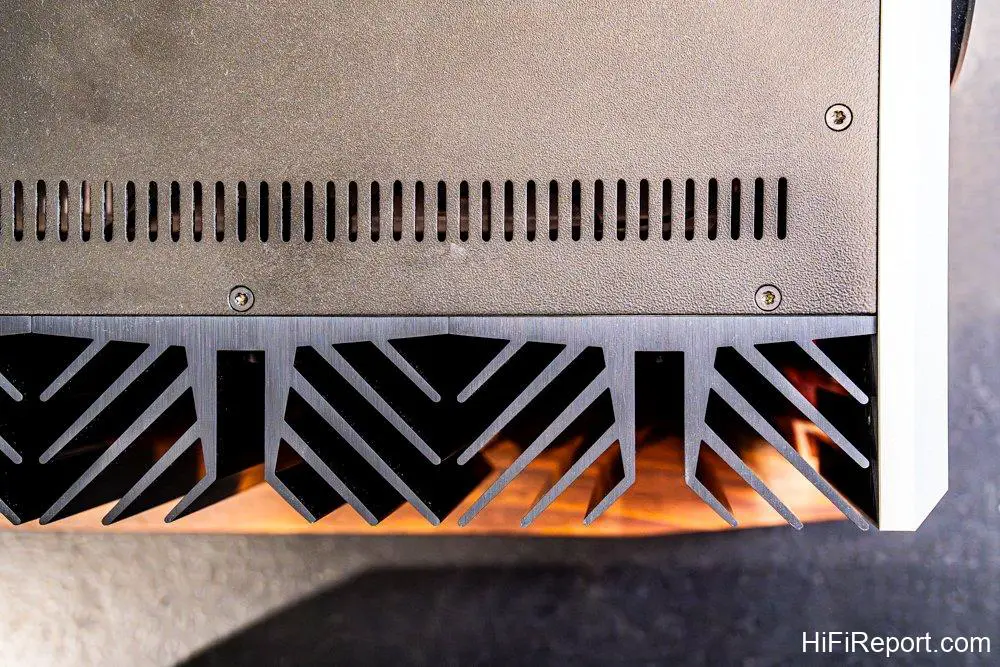
Pure Class A Reaching 320 Watts!
How does one achieve high power in pure Class A? It demands substantial components! A pair of XA160.8 amplifiers utilizes a total of 72 MOSFET output transistors. This not only delivers high power output but also provides high input impedance, making it easier for the preamplifier to drive the power amplifier. Pass also incorporates a generous amount of filter capacitance, increasing power supply headroom and improving the damping factor.
According to the manufacturer’s specifications, the XA160.8 has a damping factor exceeding 200. Generally, a damping factor over 100 is considered excellent. The XA160.8 offers twice that, indicating superior bass control based on its test specifications.

To say the XA160.8 uses heavy-duty components is an understatement. The power supply features a 3000VA Piltron toroidal transformer. Each channel is equipped with six 25,000 uF/75V filter capacitors. Coupled with the metal-encased MOSFETs, which require prior measurement and matching, the XA160.8 boasts a substantial component lineup!
HiFiReport Configures Preamplifier for High Gain
Let’s turn to the XP-22. Its power supply features a two-chassis design, separating the “dirty” power supply unit from the “clean” signal amplification unit – a classic approach. Even more noteworthy is Pass’s use of cherished, now-unavailable Toshiba amplification transistors in the gain stage.

For volume control, the XP-22 employs the same circuitry design as the higher-end XP-30, which the manufacturer highlights for its quieter musical background. The power supply section features a newly designed dual-shielded low-noise toroidal transformer, with a dual-mono power supply configuration.
Regarding the XP-22’s gain, the factory default is 9.3 dB. However, Pass provides an adjustment option, allowing internal circuit switching for either high or low gain. The default setting is low gain. This particular XP-22 at HiFiReport has been configured for high gain, a setting that aligns better with Little Zhang’s preferences.

Technology Less Important, Sound Quality Paramount
Regarding the XA160.8 power amplifier and XP-22 preamplifier, Pass actually provides relatively little technical information. In recent years, high-end audio manufacturers have been less forthcoming with in-depth circuit details. This is because audio equipment ultimately serves music. As long as the gear can reproduce a deeply moving musical experience, that’s enough. Merely talking about technology and components is futile if the sound isn’t pleasing.
Therefore, my visit to HiFiReport Audio to listen to the XA160.8 and XP-22 focused on Little Zhang’s practical experience, aiming to learn from his approach to matching audio components.

Swapping Speakers and Amplifiers
It had been some time since I last listened to equipment at HiFiReport. I recall the main setup on my previous visit featured American YG Acoustics speakers, driven by American Spectral pre and power amplifiers. The digital source was the British dCS Rossini. On this visit, the dCS Rossini remained, but it had been upgraded to the APEX version. However, the speakers were switched to American Magico S3, and the amplification was the Pass XA160.8/XP-22.
I asked Little Zhang why he shifted from Spectral to Pass. He explained that the reason was simple: Spectral wasn’t delivering product anymore, and they weren’t expected to resume. With nothing to sell, he started looking for alternative amplifiers before the last Spectral set sold. After considering various options, Pass seemed to best fit HiFiReport’s needs, so he stocked them.

However, Pass offers the Class AB X series and the Class A XA series. Why did Little Zhang choose the XA? His response was quite amusing: “Just wanted to play around with it!” After running HiFiReport for so many years, Little Zhang’s enthusiasm for audio remains undiminished. I believe that to successfully operate a high-end audio business, the passion for playing with equipment is essential. The owner’s enjoyment translates to the enjoyment of those buying the audio systems.
The Joy of Playing with Audio
And what about the switch to Magico? Naturally, that was also for the sake of “playing”! Little Zhang mentioned that after many years, he felt he hadn’t really spent serious time with Magico, so he decided to pair Pass and Magico. However, when the S3 speakers first arrived, Little Zhang felt the treble was slightly dark. Therefore, the cable pairing wasn’t exclusively MIT; he used a combination of Nordost and MIT to achieve a balanced tone across the entire frequency spectrum.
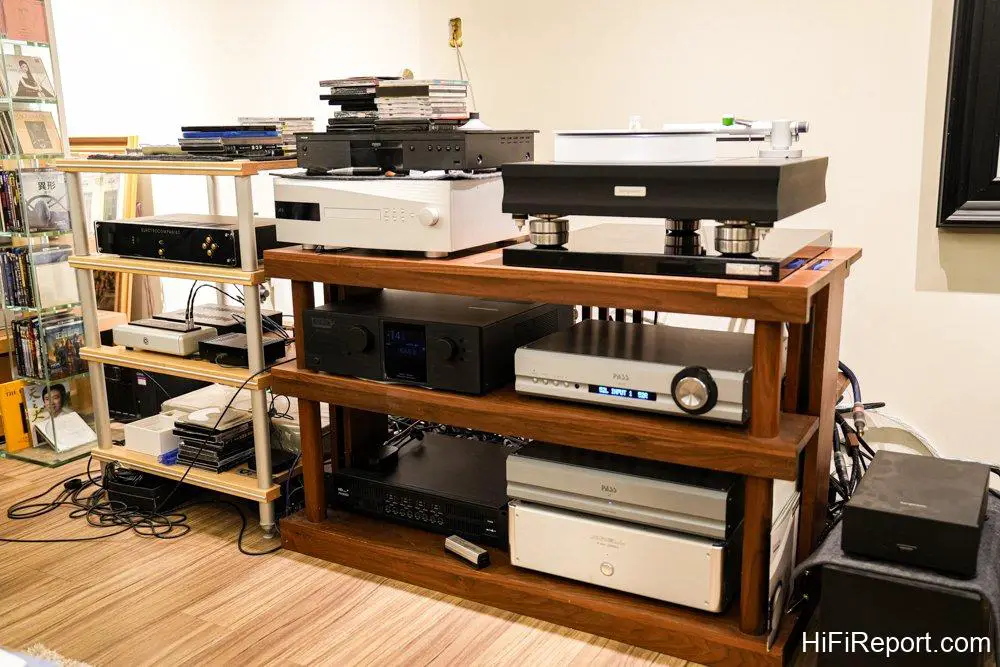
When the conversation turned to audio tuning and speaker placement, Little Zhang’s audio anecdotes were endless. The systems tuned at HiFiReport always possess a massive sense of musical energy. I often refer to this as HiFiReport’s “audio brutal aesthetics” – high-end equipment pushed hard to be explosive, yet without becoming noisy or harsh. That’s the mark of true skill. However, on this visit, while the expansive soundstage remained, the delicacy of the midrange and treble had gained a touch of gentleness. Little Zhang joked that as he’s gotten older, he doesn’t listen as aggressively. I suspect this was just a lighthearted remark; in reality, his audio tuning skills have simply improved, balancing energy with finesse.
“The Four Seasons”: Beautiful Dynamic Contrast
I brought CDs with me to HiFiReport, but they also have a digital streaming system available via Tidal. So, I conveniently chose Anne-Sophie Mutter’s recording of Vivaldi’s “The Four Seasons” with Herbert von Karajan conducting the Berlin Philharmonic. I selected the first movement of “Spring,” the Allegro. The strings introduced the light, airy melodic theme, with alternating loud and soft passages. The XA160.8/XP-22 drove the S3s effortlessly, providing a sense of ease. The expansive soundstage made the speakers disappear into the room, leaving behind the spatial arrangement of the orchestra sections and the interplay with the solo violin.

The fact that the “speakers disappear into the room” alone demonstrates the sophistication of HiFiReport’s system tuning. Now, I could focus my attention on the XA160.8 and XP-22.
Staying with the same album, I switched to the third movement of “Summer,” the Presto. This movement depicts a fierce storm with thunder and lightning. The XA160.8/XP-22 driving the S3s reproduced the strings’ rapid passages with high density and ample weight, creating a sense of overwhelming power from the rushing string sections. Subsequently, the solo instrument took over, the violin’s form becoming focused in the center of the soundstage. As the orchestra rejoined, the XA160.8/XP-22 expanded the soundstage again, drawing a clear contrast between the focused form of the solo instrument and the breadth of the orchestra, as if the concert hall stage was right in front of me.

Excellent Violin Reproduction
Indeed, the warm tonal character of the XA160.8/XP-22’s pure Class A amplification is captivating for listening to string instruments. To further explore this, I put on Gil Shaham’s solo performance of the “Butterfly Lovers Violin Concerto” with the Singapore Symphony Orchestra conducted by Lan Shui. In the opening, the harp emerged from the depth of the soundstage, and the flute introduced the misty, rain-soaked atmosphere of southern China. The XA160.8/XP-22 extended the S3’s wide and deep soundstage. The music moved from soft to loud, distant to near. The gentle melody of the orchestra waited for the violin theme to enter, depicting the first meeting of Liang Shanbo and Zhu Yingtai.
During the first violin solo section, the XA160.8/XP-22 made the S3 sing with deep emotion. The viola responded to the violin. The XA160.8/XP-22 accurately presented the thickness and richness of the viola, creating a significant contrast with the violin. Who is the violin? Zhu Yingtai. Who is the viola? Liang Shanbo. The violin sounded clear and bright, while the viola had a bit more richness. During their dialogue, the cello section provided a foundation below. As the violin soared higher, the orchestra played the theme in unison, the violin delicately decorating the orchestral melody. Listening to the Butterfly Lovers like this was truly beautiful.
Soaring Yet Full-Bodied Coloratura Soprano
The above impressions were based on listening to the XA160.8/XP-22 via Tidal. Next, I switched to the CDs I brought. I put on Kiri Te Kanawa’s “Verdi & Puccini” selection, starting with “E’ strano” from Act I of Verdi’s “La Traviata.” Although the CD only lists one track, it actually continues through to the end of Act I. If it were a full opera recording, it would likely be divided into three tracks.
As I mentioned earlier, the XA160.8/XP-22 made the S3 speakers disappear in the listening space, naturally presenting the stage presence of the opera. “E’ strano” is Violetta’s monologue. The soprano sings of the theme of love, yet feels that a woman like herself is unworthy of love and must instead pursue endless pleasure and absolute freedom. Kiri Te Kanawa’s coloratura soprano became increasingly impassioned. The XA160.8/XP-22 reproduced the variations in the soprano’s coloratura, which were not only high but also had substance. The voice sounded full-bodied, conveying Violetta’s yearning for love.
As Violetta sings with soaring passion, desiring pleasure and absolute freedom, the tenor enters from the depth of the soundstage. The orchestra’s tempo slows by half, singing the theme of love from a distance. The XA160.8/XP-22 created a beautiful sense of soundstage depth, with the male protagonist’s voice coming from deep within. The female protagonist hears his call and sings the melody of pursuing freedom again. The tempo quickens, and she sings higher and higher with increasing passion. The XA160.8/XP-22 beautifully rendered the soprano’s coloratura lines. As the coloratura reached its peak, the orchestra played in unison to conclude, ending Act I of “La Traviata.”
Audiophile Recordings Offer Fuller Energy
If using the XA160.8/XP-22 to drive the S3s for classical music, whether opera or concertos, showcased expansive soundstage and accurate positioning, then switching to audiophile recordings highlighted the robust low-midrange power, combined with clear contrast and high-density note articulation.
For example, on the Stockfisch Records compilation “Closer To The Music Vol.6,” I listened to “Joker’s Hand,” a collaboration between Allen Taylor and Jacob Dinesen. Two guitars, two men. The opening acoustic guitar was presented by the XA160.8/XP-22 with a clear left-right separation in the soundstage, the arpeggiated chords of the acoustic guitar sounding crisp.
When the singing began, Allen Taylor’s voice was slightly right of center, while Jacob Dinesen’s was left. Between the S3 speakers, it felt as if two people were in front of me, playing guitars and singing. I knew this was carefully positioned in the recording studio, but the XA160.8/XP-22 reproduced the clear recording layout with excellent channel separation. The sonic weight of the XA160.8/XP-22 provided a solid foundation of rich male voices beneath the crisp guitar plucking. During the harmony, the two voices were separated left and right, the one on the right higher pitched, the one on the left lower. Though the instrumentation was simple – just guitars and voices – it was full of character.
Celeste’s Airiness Contrasts with Solo Violin
While listening, Little Zhang at HiFiReport mentioned that when the S3 speakers first arrived, he felt the treble was a bit dark, which is why he adjusted the cable pairing. However, I didn’t perceive that issue at all! So, I took out one last CD, “Across The Stars,” a crossover recording of film themes featuring Anne-Sophie Mutter and John Williams. I chose the “Hedwig’s Theme” from the movie “Harry Potter.”
Why “Hedwig’s Theme”? Because the music opens with a celeste, creating a shimmering, ethereal sound from the depth of the soundstage, lightly tinkling out the melody. Then the violin enters, one after the other, presenting a strong contrast in the soundstage. The XA160.8/XP-22 driving the S3 sounded beautiful in the treble! Furthermore, the subsequent repetition of the theme by the brass section had substantial weight. The contrast and layering of the orchestral sections were beautifully built. The pizzicato of the double basses provided a taut energy to the low frequency, heightening the tension in the violin section before leading into the solo violin. The violin’s tone had density, with rich details conveying the subtle changes in the bowing.
Priceless Musical Engagement
HiFiReport has tuned the pairing of the XA160.8/XP-22 and S3 so well. It delivers both powerful musical energy and exquisite delicacy, allowing the strong and weak contrasts in the music to create outstanding musical engagement. This kind of musical engagement is truly priceless.
As my listening session drew to a close, Little Zhang at HiFiReport politely asked, “Do you have any questions? If anything isn’t tuned well, please be sure to let me know!” Little Zhang, you’ve made the XA160.8/XP-22 paired with the S3 so captivating, you’ve made the editor-in-chief afraid to turn on his own system for three days after going home! And you ask me to pick apart and find fault?
Experience Speakers Disappearing
I want to say that HiFiReport is skilled at extracting the energy from audio systems; this is the Little Zhang I already knew. However, this particular XA160.8/XP-22 pairing with the S3 adds an extra layer of refinement and delicacy. The dense and rich details create captivating musical engagement – that is where Little Zhang’s true skill lies. Come to HiFiReport to savor the essence of Pass and experience the magic of speakers disappearing into the space.
Specifications
* **Pass XP-22**
* Type: Solid-state preamplifier
* Inputs: XLR x 2; RCA x 3
* Outputs: XLR x 1; RCA x 2
* Input Impedance: 22 k Ohms
* Gain: 9.3 dB (Balanced)
* Dimensions: 17” x 12” x 4” (W x D x H)
* Weight: 40 lbs
* **Pass XA160.8**
* Type: Class A solid-state monoblock power amplifier
* Output Power: 160 Watts/8Ω, 320 Watts/4Ω
* Gain: 26 dB
* Input Impedance: 50 kΩ Single-ended, 100 kΩ Balanced
* Frequency Response: 1.5Hz – 100kHz
* Total Harmonic Distortion: 1% @1 kHz, full power
* Damping Factor: 200
* Dimensions: 19×11×21.5 inch (W×H×D)
* Weight: 123 lbs