
Ansuz Power Switch X-TC Network Switch Review
I have emphasized more than once that we are living in the age of streaming.
In a market where physical record sales have drastically shrunk, CDs are fading but not truly gone, and vinyl records continue to fill the demand gap left by CDs.
Cassettes, reel-to-reel tapes, and other nostalgic analog formats cater to the tastes of a minority of enthusiasts.
However, none of these alone can support the music industry’s growth.
The music industry reached its revenue peak around 2000, but subsequently declined year by year, especially after 2005, with a rapid rate of decline. Between 2010 and 2015, annual revenue was halved or even less compared to 10 years prior.
Just when things seemed hopeless, starting in 2016, the music industry began to climb year after year, with an astonishing rate of growth. In just four short years, it has returned to 80% of its peak level, and the outlook remains positive.
What caused this upward momentum against the trend? It’s none other than streaming.
More precisely, it’s online streaming services, and even more specifically, paid online streaming services.
Today, if you want to listen to music, you don’t necessarily need to own physical records. By paying a small monthly fee, you can enjoy millions of songs in online libraries.
Listening to music at home is incredibly convenient. Whether it’s online streaming or locally stored files, you can find the music you want to hear on your tablet, phone, or computer and play it on demand.
The Case for Streaming
Yet, many people still believe that streaming sound quality is not good enough, inferior to CDs and vinyl.
I want to start here and make a fair case for streaming.
First of all, different music playback methods will naturally produce different sounds.
This is purely a physical phenomenon, and the resulting sound is a matter of personal listening preference.
It’s really hard to judge which is superior.
Our focus should be on the music itself.
If I don’t have a vinyl or CD of a particular album, but I can find it in an online library, then it becomes my only option for listening.
Since it’s the only choice, why should I care about sound quality comparisons? Whether you revere vinyl, believe in reel-to-reel, or champion CDs, supporters of any physical format are limited to their own collections; and their collection is what sounds best to them.
Furthermore, since different playback methods inherently produce different sonic characteristics due to physical properties, our task is not to compare the sounds of different methods, but to pursue better sound quality within the existing playback method.
In the realms of vinyl and reel-to-reel, enthusiasts have many avenues for improvement. While CD playback offers fewer options, serious audiophiles can still find ways to enhance the experience.
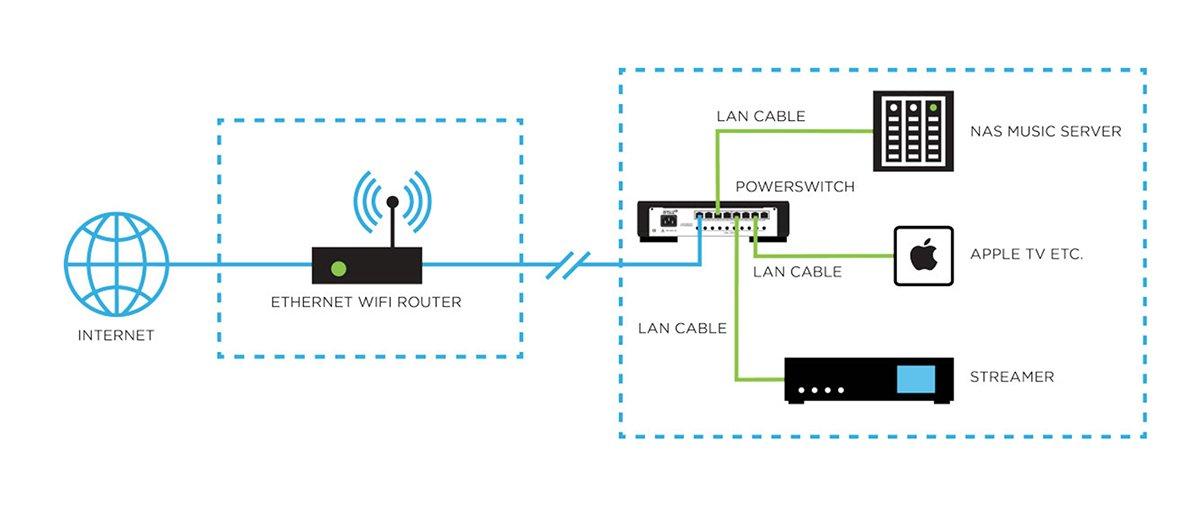
What about streaming? If you use a computer as a digital transport (CAT), there’s a lot to explore in terms of computer hardware and software optimization.
However, this requires specialized knowledge. Most people unfamiliar with computers tend to opt for streaming devices from audio manufacturers, such as dedicated streaming players or DACs and amplifiers with built-in streaming capabilities, which simplifies streaming music playback.
Upgrade Network Cable
Although it’s simple, there’s still room for improvement.
I recommend that all friends who use streaming playback at home try to establish two fundamental upgrades. First, replace your network cable with at least an audiophile-grade one.
If you care about signal cables for analog equipment, if you care about digital cables between your CD transport and DAC, how can you not care about the network cable at the front end of your streaming setup? In the past couple of years, audio cable manufacturers have been launching Ethernet cables. While their claims vary, network cables adhere to industrial standards, and their internal structure cannot be arbitrarily altered. Manufacturers are focusing on conductors, insulation, structure, shielding, and connectors within the existing standard framework, each showcasing their unique skills.
Generally speaking, although each brand’s story is different, their appeals and goals are largely similar.
Audiophile-grade network cables place greater emphasis on impedance consistency and anti-interference capabilities, aiming for more stable transmission and reduced noise.
If you are only buying one network cable, you can connect it before your streaming player, which is the last segment of the streaming path.
According to HiFiReport’s network cable experiments, audiophile-grade network cables, as long as they excel in these two aspects, provide noticeable improvements as soon as they are connected, and the benefit is greatest when connected at the last segment.
Add Audiophile Switch
The second fundamental upgrade is to get an audiophile-grade network switch.
Many people, including myself initially, struggle to understand this.
However, audio is like traditional Chinese medicine – it’s not always about understanding. How acupuncture works effectively is difficult to explain through medical theory, and similarly, the effect of audiophile network switches on streaming music is also perplexing.
In setting up a local area network, switches are usually used for LAN port expansion and network management purposes.
However, in the realm of streaming playback, audiophile-grade switches are not concerned with data throughput, but rather emphasize reducing noise and providing more stable power.
If you use a network switch from a networking brand, its benefit to audio performance is less than that of an audio brand switch.
Why? I don’t know.
I can only say that the demands in audio are different from network management, and the thinking of audio manufacturers differs from networking brands.
Don’t say I’m unprofessional; even professionals don’t understand.
Editor-in-Chief Guo has interviewed R&D executives from IT companies (https://feature.u-audio.com.tw/featuredetail.asp?featureid=1173) and even business owners who have worked at networking giants like D-Link (https://feature.u-audio.com.tw/featuredetail.asp?featureid=1179). Before trying Ansuz PowerSwitch, they didn’t believe that a mere switch could bring about much change. However, once they used it, there was no turning back.
As for why it works, they also don’t understand.
Tesla Coil Noise Cancellation
So, what does the manufacturer say? Ansuz states on their official website that their PowerSwitch primarily focuses on noise cancellation.
They explain that our current network streaming environment is subject to multiple interferences. Computers, routers, and switches in the streaming path actually contain a lot of electrical noise. However, Ethernet is a floating network without its own ground, preventing this noise from being effectively discharged, and thus the noise floor cannot be lowered.
Ansuz’s approach is unique. They utilize a grounding technology called Tesla Coil to eliminate noise.
This is a coil with double-wired counter-wound windings connected to a power conductor. When the coil encounters voltage spikes, the reverse windings generate opposing waves to cancel them out.
Ansuz claims this method is effective, but it cannot completely eliminate noise 100%.
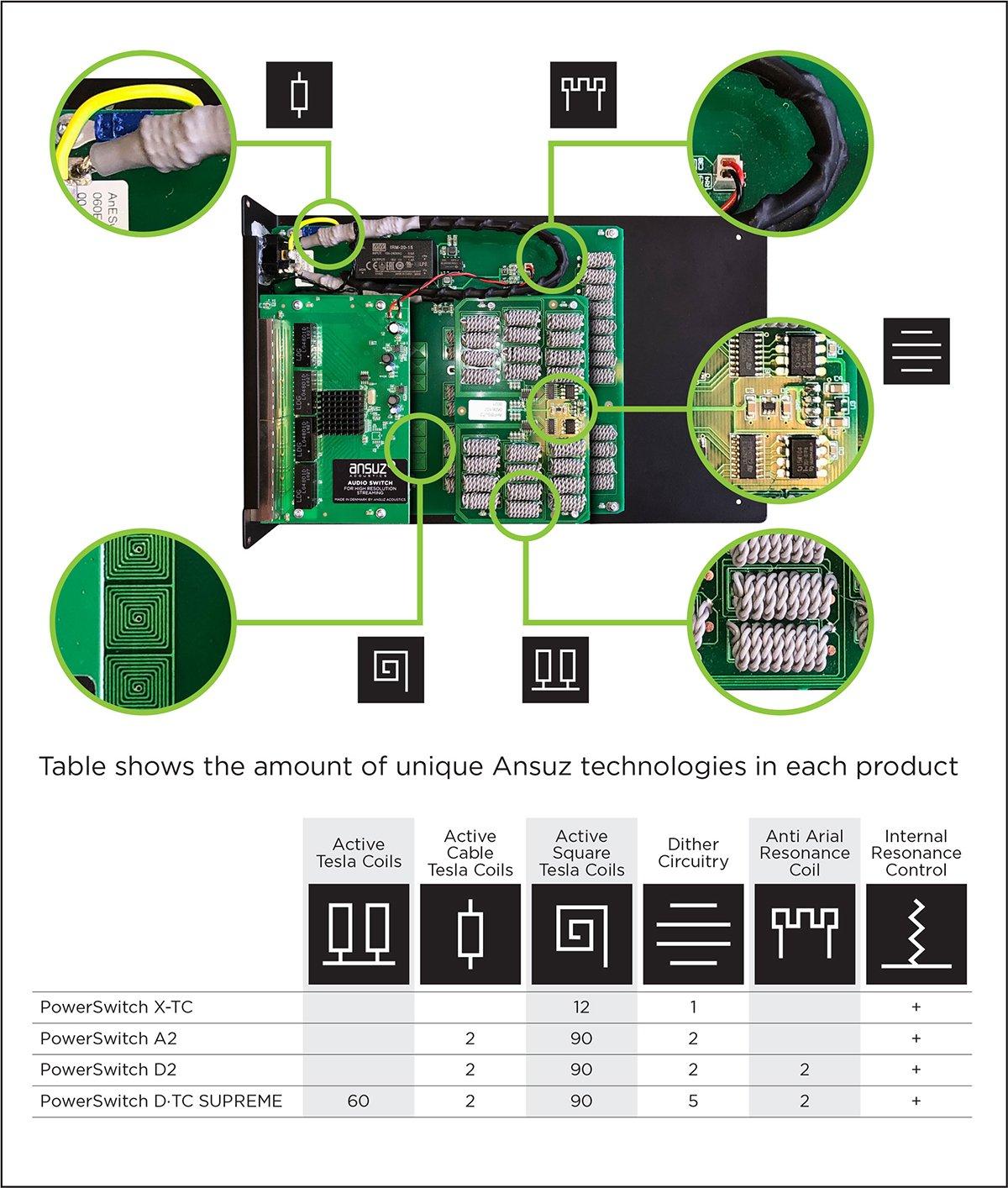
To enhance the noise reduction effect, more sets of Tesla coils can be connected in parallel. Ansuz’s PowerSwitch series is developed based on this technology.
Four Models, Five Technologies
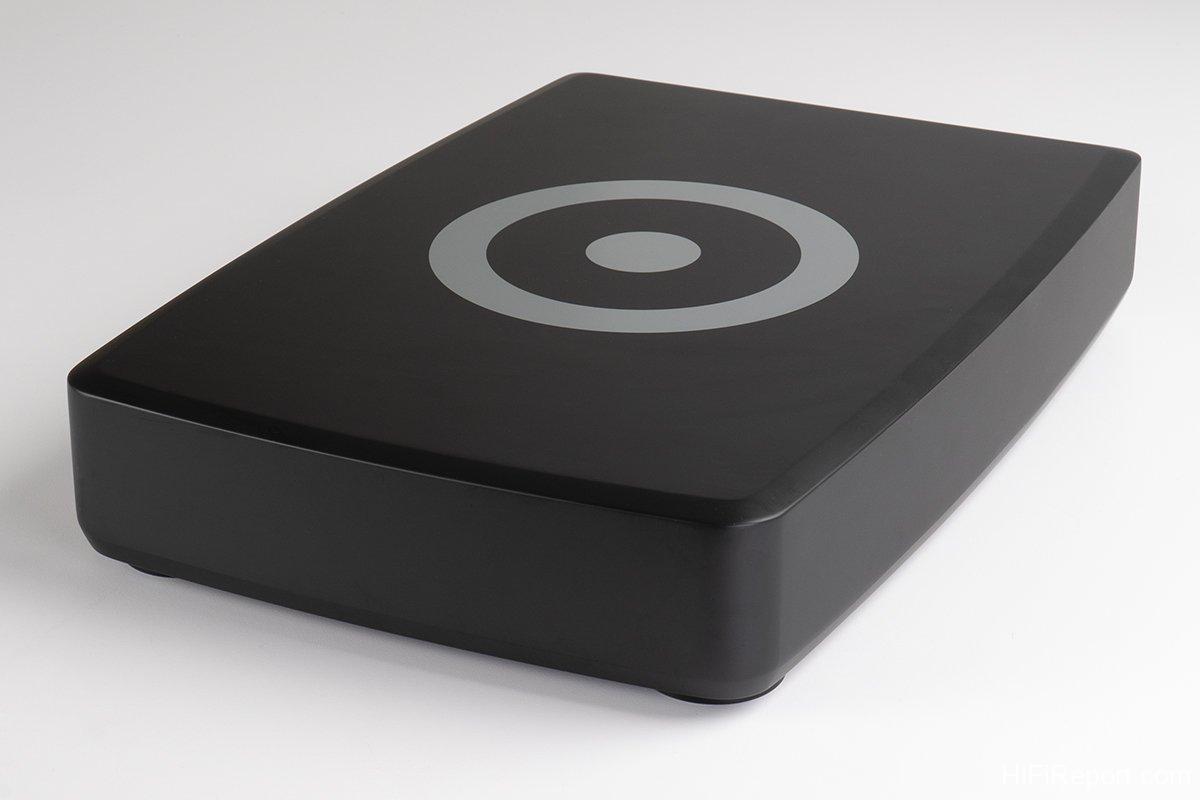
They currently offer four models. The entry-level model is PowerSwitch X-TC, followed by PowerSwitch A2, then PowerSwitch D2, and the flagship is PowerSwitch D-TC Supreme.
All four switches share the same chassis size, but their internal components differ. Higher-end models incorporate more of Ansuz Noise Suppression technology.
Regarding Tesla coils alone, they have Active Square Tesla Coil technology (AS-TC), which is their basic design and present in every PowerSwitch model. Then there’s Active Cable Tesla Coil technology (AC-TC), installed at the rear of the power input socket, available in PowerSwitch A2 and above. The third type is Active Tesla Coil technology (A-TC), a spectacular array of coils, exclusive to the flagship PowerSwitch D-TC Supreme.
Furthermore, PowerSwitch D2 and above feature a technology called Anti Arial Resonance Coil Technology (AARC), while the Analog Dither Technology (AD) and star grounding, present in the entire series, work in conjunction to enhance the switch’s performance.
Ansuz also emphasizes the power supply of their switches.
Most commercially available switches adopt adapter-style external power supplies, but the quality of these power supplies is not good enough. PowerSwitch has a built-in power supply, which allows users to utilize better power cords and pair them with their Mainz8 power distributor for even better power quality.
On the back of the entire PowerSwitch series, below the 10 RJ45 ports, there is a corresponding low-voltage output port, which is used when pairing with Ansuz’s own active network cables.
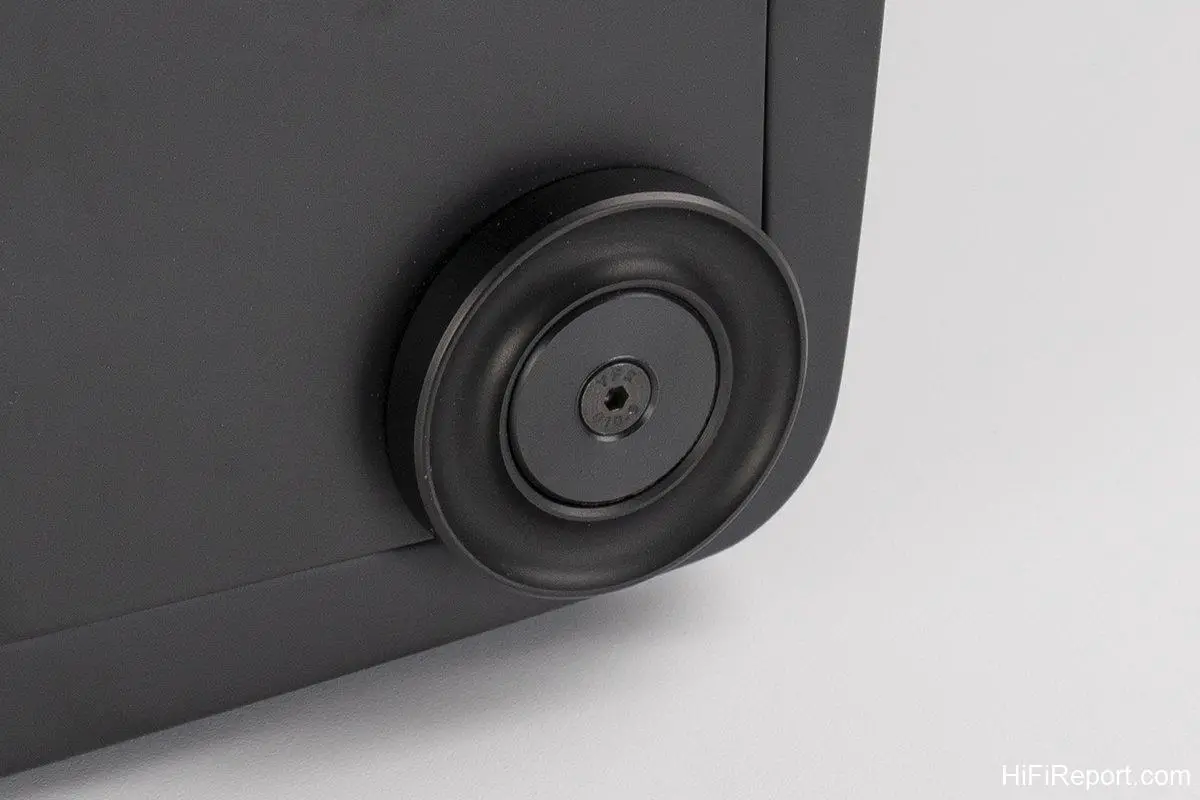
Two other special features of PowerSwitch are worth mentioning. Their chassis is made of MDF with a matte black finish, which is related to Ansuz’s vibration control philosophy. Its feet are also unique. The foot has a groove at the bottom. This foot is called Darkz feet, and it can be paired with Ansuz Darkz resonance control devices, which use titanium or ceramic balls to dissipate vibration, a resonance control technology they are proud of.
Entry-Level Pricey
The PowerSwitch X-TC I have is Ansuz’s entry-level switch, priced at $2,400 USD, with a retail price of $2,400 USD in Taiwan.
Just hearing this price, anyone would consider it expensive.
In our minds, even the most high-end home switches are only a few hundred dollars, and some even support SFP fiber optic network cables. How can a switch be so expensive? Even among audiophile-grade switches, this entry-level model is pricier than other brands.
Expensive, expensive, expensive.
This is the first reaction people have to Ansuz PowerSwitch, and I was no exception.
However, after using it, day after day, listening to more and more music, and spending more time with it, I became increasingly inseparable from it, even though it’s just the entry-level PowerSwitch X-TC.
Finding Streaming Vitality
What’s the difference? In a word: vitality.
Ansuz PowerSwitch X-TC imbues music with excellent vitality, making it more engaging.
I have owned two switches before. First, a Unifi 8-port switch from a networking brand, recommended by Mr. Zhang from HiFiReport.
Because of my familiarity with Mr. Zhang, I trusted his word and brought one home immediately. Connected to the back end of the modem, the sound indeed changed. The contrast between loud and soft became more apparent, the dynamics improved, and the sound became fuller and more powerful. The extent of the change was as significant as changing a power cord for an amplifier.
Later, as the editorial department successively received audiophile-grade switches for review, I tried them one by one.
As a result, each one was better than the Unifi. The biggest difference was that the sound became cleaner, with fewer rough edges, clearer outlines, more solid imaging, and improved soundstage depth.
I had only had the Unifi for a few months, but after trying these audiophile switches, I felt restless.
Finally, considering the price, I chose the cheapest NuPrime SW-8.
It has passive noise-absorbing materials and enhanced master clock, making the square wave of data packets more perfect. After that, the streaming performance at home took another leap forward.
Without comparison, there would be no distinction, but with comparison, the Ansuz PowerSwitch X-TC made me restless again.
I find it hard to pinpoint exactly what it enhances, but it’s obvious that PowerSwitch X-TC makes streaming playback at home more natural, smoother, more vivid, more lively, more colorful, more three-dimensional, and more distinct.
It doesn’t bring about any fundamental changes in the sound itself, but it makes the music feel agile and ingenious.
Agile, Lively, Airy Sound
I used Roon to play Mozart piano quartets performed by Irish pianist Finghin Collins and others from Qobuz. These are 24bit/96kHz Flac files, with vivid and smooth sound quality.
Without the switch, the music was already very pleasant. After adding the PowerSwitch X-TC, the music became even more agile and lively.
The piano notes became more focused, more textured, and even had a bouncy quality.
The positioning of string instruments became more precise, the sound sources became more tangible, and vibrato and tremolo became clearer.
The feeling is like watching a 4K movie – details, atmosphere, and outlines become even clearer.
The most captivating aspect is when playing vocals.
I used Anne Sofie von Otter’s compilation album released by Naive as an example. It includes Otter’s recordings for Naive across multiple albums, ranging from French chansons to art songs, a wonderful crossover compilation.
French has various guttural sounds and palatal sounds that are absent in Taiwanese and Mandarin, but they more easily highlight the vitality of the audio.
In Barbara’s famous song “Dis, quand reviendras-tu”, Otter’s vocal timbre is relatively thick, and her French accent carries a hint of Germanic weight, yet it gives the song a temperament rarely found in French female vocals.
PowerSwitch X-TC makes the recording sound airier, the sound becomes relaxed and flowing.
I haven’t heard this on other switches.
Ansuz’s approach is different from everyone else.
Hooked, No Turning Back
I’m hooked.
The direction of sound improvement brought by Ansuz PowerSwitch X-TC is exactly what I love.
Am I going to buy it again? Wait, PowerSwitch X-TC is the entry-level model. Maybe I should try PowerSwitch A2.
For an extra $1,200 USD, it adds AC-TC technology, and the special analog dither circuit is twice that of PowerSwitch X-TC. The number of AS-TC square Tesla coils is even comparable to the flagship model. Its effect must be even better.
I should borrow a PowerSwitch A2 from Mr. Hu at HiFiReport to try and see if this extra $1,200 USD is worth it.
Don’t think this is a privilege for us media. You can do it too. You are welcome to borrow it for audition. However, you have to be mentally prepared that this is mostly a “no turning back” situation – once you’ve used it, you won’t want to return it.
Specifications
* Type: Network Switch
* Functionality: QoS, Half-duplex mode, Full-duplex mode, Energy-saving features
* Dimensions: 69 × 261 × 377 mm (Height × Width × Depth)