
Aqua La Voce S3 DAC Review
Before truly experiencing its sound, I hesitated to review this DAC; but after listening, I am incredibly grateful for the opportunity to encounter it.
This DAC is the Aqua La Voce S3.
Understated Traditional Design
Let me begin by explaining my initial reluctance to review this DAC.
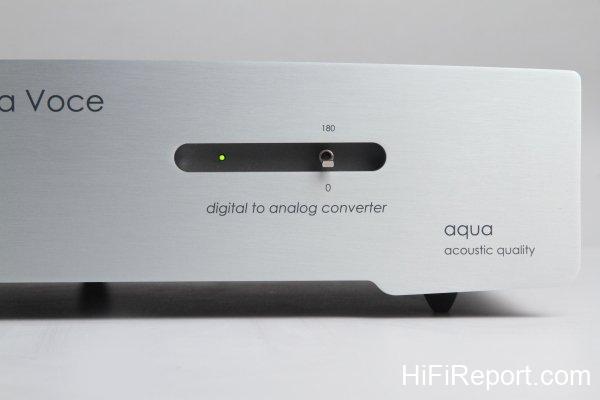
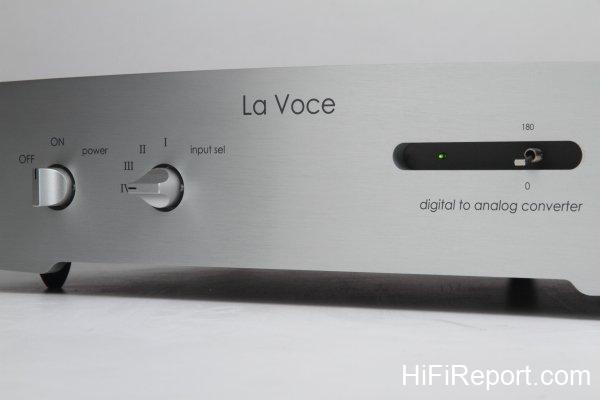
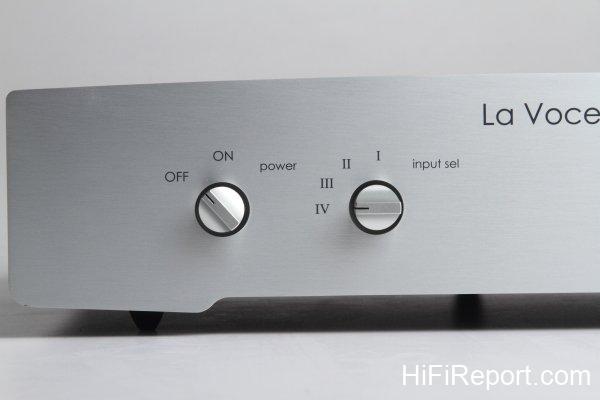
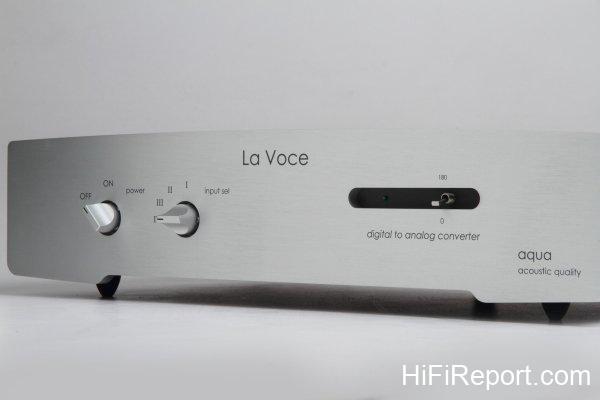
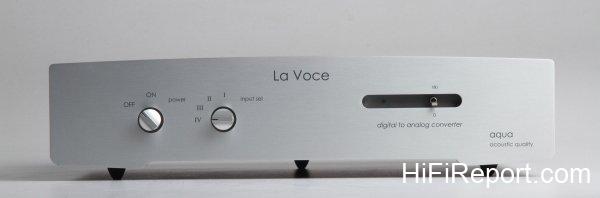
The La Voce S3 simply doesn’t look impressive. The front panel features only a power switch, digital input selection, a toggle-style phase switch, and a single green LED power indicator. There isn’t even a screen.
How could a DAC released in mid-2018 be so basic? Its appearance is reminiscent of products from 20 years ago. My first impression immediately brought to mind the Theta DS Pro G3.
However, after listening, the surprise was no less than when I first heard the DS Pro G3. In fact, the La Voce S3 sounds even better.
Despite its unassuming exterior, the La Voce S3 is meticulously crafted inside. The “S3” suffix indicates that this is the third generation of the La Voce model, representing continuous refinement of the same architecture to keep pace with mainstream digital standards.
The La Voce S3 is the latest entry-level DAC from the Italian brand Aqua.
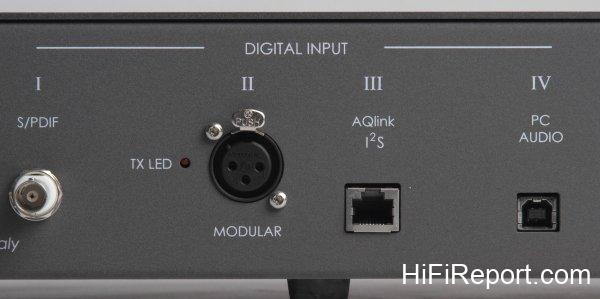
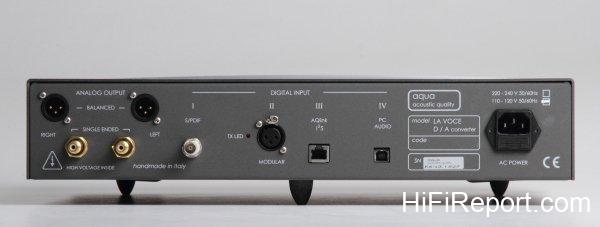
It offers only four digital inputs. While the balanced AES/EBU and USB Type-B inputs are straightforward, the others are more distinctive.
For S/PDIF, instead of the common RCA coaxial, it uses BNC. And the adjacent RJ45 network port isn’t for network streaming but is specifically for I2S connection to Aqua’s own La Diva CD transport.
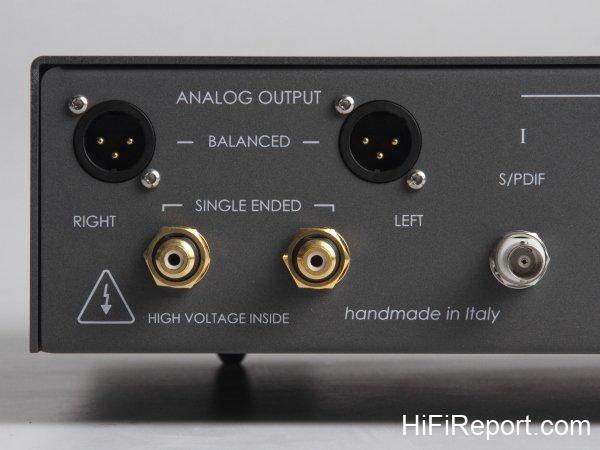
For analog outputs, both RCA single-ended and XLR balanced options are available. There is no headphone output and no network streaming capabilities.
Functionally, the La Voce S3 is a very “traditional” and “pure” DAC.
As I mentioned, its appearance is understated, and its features are not extensive. The essence of the La Voce S3 lies entirely within its internal design.
The power switch is on the left, and the input selector on the right.
The La Voce S3 eschews flashy designs like LCD screens and touch buttons, exuding a sense of unadorned, retro charm.
R2R Ladder DAC Excellence
Most modern DACs utilize off-the-shelf decoder chips from manufacturers like Burr-Brown, AKM, and ESS.
However, Aqua takes a different approach, opting to design their own R2R Ladder DAC.
All three DAC models currently in Aqua’s lineup, from the flagship Formula xHD to the La Scala MK2, and now the La Voce S3, employ R2R Ladder DACs.
Is this inherently better? It’s not a matter of better or worse, but rather a reflection of the designer’s philosophy and dedication.
Some audio manufacturers consider the DAC just one component in the signal chain, focusing their aesthetic expression elsewhere, and using readily available chips doesn’t detract from their achievements. Others believe that only by designing their own discrete DACs can they achieve uniqueness and showcase their sonic aesthetic.
This is akin to a noodle shop deciding whether to buy pre-made noodles or make them in-house, or a dumpling restaurant choosing between supplier-bought or hand-rolled dumpling wrappers. Making noodles or rolling wrappers by hand doesn’t necessarily guarantee superior noodles or dumplings, but it signifies a commitment: “I have the skill for handmade production, and I insist on it.”
Aqua has brought their acclaimed R2R Ladder DAC down to the La Voce S3. Notably, the previous S2 version did not feature a discrete DAC.
This is what an R2R Ladder DAC is all about.
It uses a series of precision resistors arranged in a ladder configuration to convert digital signals into analog.
The entire decoding path is remarkably simple, without any digital filtering. This means that the incoming digital signal is converted to analog without any digital processing.
Aqua selects ultra-high-precision resistors in the array, controlled by an FPGA chip. This entire circuit is referred to as the Decoding Board.
Moreover, they have thoughtfully adopted a modular design, allowing users to upgrade to newer DAC versions in the future for a fee, ensuring their DAC can evolve to the latest specifications.
This R2R Ladder DAC supports PCM up to 24bit/384kHz and DSD128.
While Ladder DACs may struggle to match the specifications of IC-based DACs, these specifications are more than sufficient for most users, considering that Red Book CD format remains the most commonly used.
Chasing high specifications in digital equipment, without upsampling, is often more about perception than practical benefit.
For La Voce S3 owners, even though I keep emphasizing its “traditional” functionality and appearance, its DNA of software-driven evolution is genuinely appealing.
In my experience, every FPGA-based DAC experiences significant sonic improvements with each software update.
Therefore, forget about specifications, features, and appearance. Listen to the present, and think about the future. The La Voce S3 can grow alongside your system, perhaps until the day you can afford a Formula HDx.
The bottom adopts a three-point contact design with three rubber-encased soft feet, two at the front and one at the rear.
Four digital inputs, and both single-ended and balanced analog outputs are provided.
Discrete Design, Quality Parts
Not only is the DAC circuitry discrete, but so is the analog amplification stage.
Aqua has eschewed common op-amp amplification in favor of a discrete analog amplification circuit.
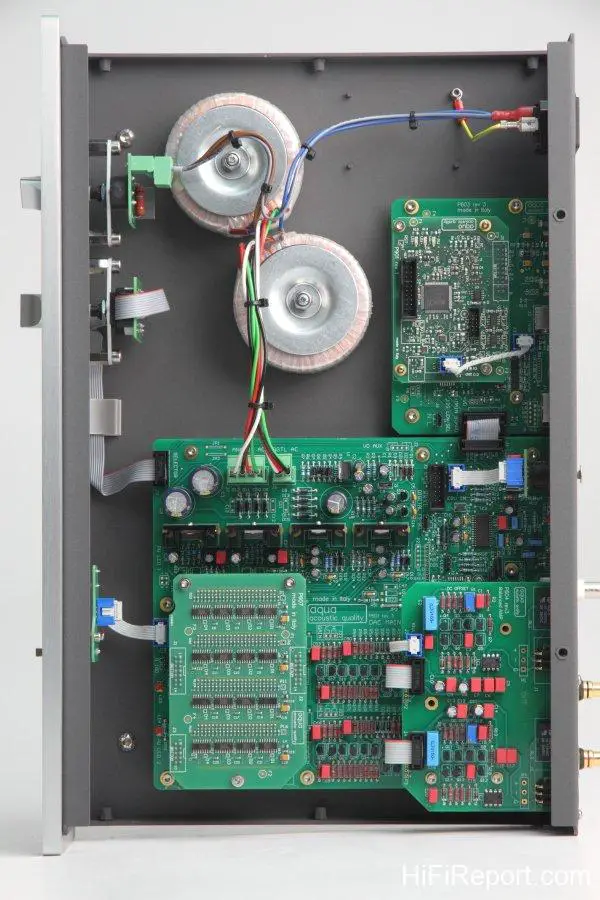
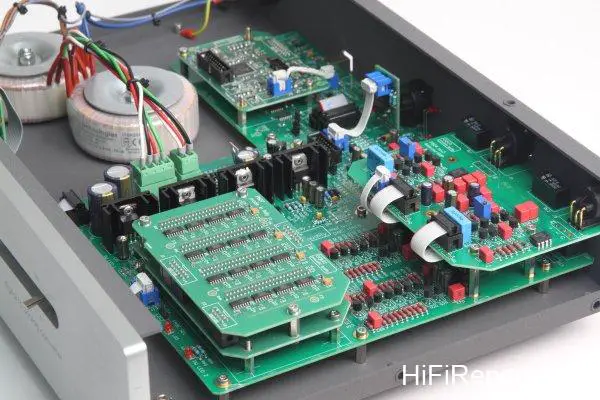
In terms of power supply, the La Voce S3 uses two transformers for separate power delivery, isolating the analog and digital sections.
The voltage regulation circuits in both power supplies are also designed with discrete transistors.
In essence, from the power supply onwards, from digital to analog, from input to output, the La Voce S3 is entirely Aqua’s own design.
It incorporates two toroidal transformers internally, dedicated to the analog and digital circuits respectively.
Circuit boards are kept as separate as possible. This modular design preserves the possibility of future upgrades.
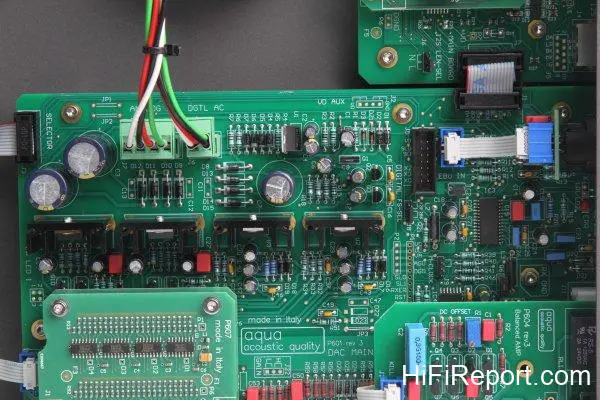
Here is the voltage regulation and rectification circuitry, located on the main circuit board near the transformers.
Aqua avoids using off-the-shelf integrated circuits whenever possible, opting for their own discrete circuit designs. This makes component selection particularly crucial.
They choose highly durable capacitors, low-noise metal film ultra-precision resistors, metal film pulse capacitors, and ultra-fast rectifier diodes, among other premium components.
This is analogous to cooking: circuit design is the technique, and components are the ingredients. Good technique combined with quality ingredients yields excellent cuisine! For digital inputs, Aqua particularly emphasizes that the S/PDIF input features PLL clock locking, effectively addressing jitter issues.
However, the manufacturer most highly recommends connecting to their own La Diva transport using the AQLink I2S interface. This I2S input is designed to completely eliminate jitter.
Aqua’s I2S utilizes RJ45 network connectors, and the manufacturer recommends using CAT6 network cables for connection.
The USB input, supporting the highest decoding specifications, employs the latest firmware USB receiver circuitry, featuring asynchronous reception and future upgradeability.
Although the La Voce S3 lacks network streaming input, users can add a separate streaming player or use a computer as a digital source, outputting via USB to the La Voce S3 for decoding.
This is precisely how I conducted my listening tests.
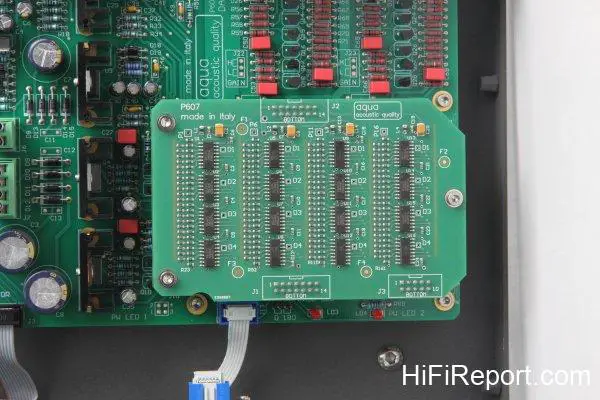
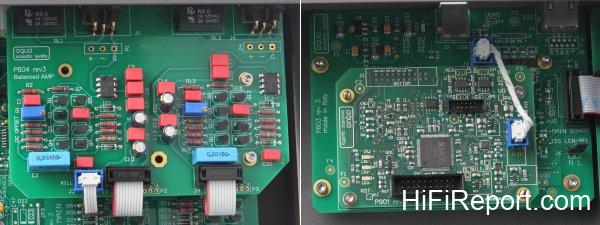
The left image shows the analog output section. The La Voce S3 is not internally balanced, but it offers balanced analog outputs. The image shows the balanced analog output circuitry.
The right image shows the digital input section. The small circuit board mounted above is specifically dedicated to USB reception.
This clearly demonstrates Aqua’s expertise in modular design.
Aqua’s modular design adopts a layered architecture within the chassis, keeping each circuit section independent. This facilitates future upgrades and reduces interferences.
Astonishing Musicality
I brought the La Voce S3 home and paired it with an Auralic Aries Mini, using Roon to play music files from my NAS and Tidal.
Despite the La Voce S3 being a seemingly “traditional” DAC, its application is entirely up to the user.
I didn’t have AES/EBU or BNC output transports, nor did I have Aqua’s own La Diva CD transport with AQlink. USB was my only connection option for testing.
Listening this way, it sounded truly excellent.
The rich musicality of the La Voce S3 genuinely astonished me.
In what ways is it good? Let me borrow an advertising slogan I saw outside a liquor store to explain.
This year, Diageo Taiwan launched a Singleton Chinese New Year gift set featuring three popular single malt whiskies, each with a character to celebrate the New Year and represent the whisky’s characteristic: “” (Fēng – Abundant), “” (Fù – Rich), and “” (Shùn – Smooth).
Singleton uses their 12-year-old core expression to represent the smooth texture created by slow fermentation and distillation—hence, “” (Smooth).
They also utilize another 12-year-old, but finished in sherry casks, bringing a rich aroma and complex flavors—hence, “” (Rich).
And they use the aroma-rich 15-year-old as the “big brother” of the series gift set—hence, “” (Abundant).
The more I listened to the Aqua La Voce S3, the more I felt that Singleton had inadvertently described the merits of Aqua’s equipment.
The sound of the Aqua La Voce S3 isn’t the type that immediately impresses with sharp clarity, extreme density, massive dynamics, profound weight, or expansive soundstage.
Yet, it doesn’t lack dynamics, bandwidth, or bass. Its sonic texture is smooth, without any harshness or roughness. It’s also full-bodied, juicy, and well-hydrated, with no dryness in the sound. Its tonal expression is rich, with abundant information and clear details that are not aggressive.
It perfectly embodies the three characters: “” (Abundant), “” (Rich), and “” (Smooth).
Analog outputs include both RCA single-ended and XLR balanced.
Digital inputs total four. Interestingly, for S/PDIF, they use BNC instead of the more common coaxial RCA.
Additionally, there are AES/EBU inputs and AQlink-I2S input via RJ45 network cable, specifically for use with their own La Diva transport.
The fourth input, USB Type-B, enables streaming playback for the La Voce S3.
Abundant, Fragrant, and Elegant Sound (“”)
Let’s start with “” (Abundant), represented by the 15-year-old Singleton.
Singleton notes the characteristics of this whisky on the label: Rich, Fruity, Elegant.
I felt the same way listening to Andrew Rangell’s performance of Chopin’s Mazurkas.
Rangell’s Mazurka rendition is the most rational, structured, and uniquely personal version I’ve ever heard.
As an artist renowned for his interpretations of Bach and Beethoven, Andrew Rangell seems to infuse the spirit of Bach and Beethoven into Chopin. Under his fingers, the Mazurkas exhibit a rational and resolute quality, while still emanating a melancholic and detached air.
Listening to this album on the Aqua La Voce S3 is truly captivating. It imbues the piano tone with warmth and roundness. Rangell’s interpretation remains rational, but with enhanced tonal richness, the depth and dimension of the musical image become comparable to the difference between lenses—like switching to a Zeiss or Leica lens, presenting a richer, denser, and more grounded image. At the same time, you can sense the piano tone becoming more three-dimensional, particularly evident in Rangell’s highly independent fingerwork in triplets and ornamentation, revealing a Bach-like character.
Hearing his clear and distinct structure, along with powerful chords, that’s Beethoven.
The rich and full-bodied piano tone is “Rich”; the lingering, pervasive resonance is “Fruity”; the unhurried, composed, and confident pacing, coupled with his structured and meticulous phrasing, is “Elegant.”
Rich, Lively, and Engaging (“”)
Next is the 12-year-old “Sherry Cask” expression.
This whisky’s label also lists Rich and Fruity, but adds “Vibrant.”
“Vibrant” is a difficult word to translate directly in audio terms. We might think of “vibration,” but that’s not quite right here. The word also means “lively, bright, exciting, animated, spirited.”
Frankly, it’s hard for me to imagine a whisky finished in sherry casks twice being particularly lively or bright.
I’m not concerned with the actual taste of this whisky; I’m borrowing the adjective.
The La Voce S3 not only corresponds to the gift set title “” (Rich), but also embodies the “Vibrant” quality—liveliness, animation, brightness, and excitement.
For example, listening to Jean Geoffroy playing Bach’s unaccompanied sonatas on the marimba, the La Voce S3 excels at conveying the richness of the sound. The lush and mellow marimba tone is like a tapestry woven from wooden keys and metal resonators.
In the Presto of BWV 1001, the music flows smoothly like water, with notes sparkling and agile. The La Voce S3’s sonic outlines are not sharp, and its density isn’t rigid; its sound has a touch of elasticity, a hint of resilience.
In the Fugue of BWV 1005, the alternating voices build up a rich sonic texture. Because it’s a percussion instrument, the clarity of the notes is even more pronounced than with a violin.
Indeed, the harmonious resonance built up by the resonators—isn’t that like the aroma of honey and ripe fruit, the taste of nuts and chocolate? The La Voce S3 and sherry cask whisky are truly similar! The front panel right side has a phase inversion toggle switch. If you feel the sound focus is unusual, try adjusting the phase.
Smoothness, Softness, and Roundness (“”)
As for the basic 12-year-old Singleton, its label, in addition to Rich and Fruity, highlights the “Rounded” characteristic.
Singleton’s popularity is not without reason. It’s precisely because they employ slower fermentation and distillation, creating a more refined spirit.
Furthermore, Master Blender Maureen Robinson emphasizes balance, resulting in a smooth and easy-drinking texture.
This 12-year-old core expression is labeled “” (Smooth), and it lives up to its name.
People drinking whisky often emphasize smoothness; the same applies to listening to audio.
The sound of the La Voce S3 can also be described as “” (Smooth), fully illustrating what “Rounded” means.
How do we judge its smoothness? How about Debussy’s String Quartet? Listening to the Quatuor Ébène’s version, the first movement’s tempo marking by Debussy is “Animé et très décidé” (Lively and very determined). The young Ébène Quartet imbues this piece with an elegant and delicate quality, unlike the more austere Alban Berg Quartet, revealing a graceful demeanor.
In those seemingly dissonant chords, a warm and elegant glimmer shines through.
The second movement is marked “Assez vif et bien rythmé” (Quite lively and rhythmic). The soundscape constructed by the four string instruments is exuberant, structurally clear, and layered.
Listening to the broken chord patterns and the ostinato bass accompaniment, the instruments converse with each other in pizzicato. In just one movement, there’s a wealth of interest.
And the La Voce S3 makes these musical phrases sound lively and expressive.
The third movement slows down the tempo. The texture of the strings is truly beautiful—the lines are soft yet substantial in texture, concentrated but not heavy, solid but not thick. The harmonic fabric is dense yet clear and defined. The music floats in an atmosphere of quietude and slight dreaminess.
The La Voce S3 renders the strings smooth and gentle, even with a sweet fragrance. The music is lively but without any harshness, making Debussy’s dissonances sound utterly harmonious.
The piano rendered by the Aqua La Voce S3 has a rich and lush palette of colors. The marimba it presents is mellow and full-bodied. When playing strings, it reveals just the right amount of body and smoothness.
This DAC is “” (Abundant), “” (Rich), and “” (Smooth).
Majestic and Refined Sound
Large-scale orchestral music can illustrate how these three characteristics combine to showcase the La Voce S3’s musical delivery.
Take Alice Sara Ott’s performance of Tchaikovsky’s Piano Concerto No. 1 as an example. The La Voce S3 renders the sudden dynamic surges and the weighty bass harmonies with an elegant confidence.
The first movement opens with the French horns leading, playing descending quarter notes, accompanied by the orchestra’s unison notes, creating a sense of march-like progression.
Then, the piano resolutely plays triplets, and the orchestra presents the first theme, followed by the piano restating the theme.
The movement’s opening is majestic and full of spirit. The La Voce S3’s sonic character is inherently spirited, colorful, radiant, and well-hydrated, with a solid, resilient texture and clear, flowing lines.
As a result, the music sounds both grand and maintains a refined elegance. This balance is often found in more expensive equipment. The La Voce S3 conveys and expresses more than equipment in its price range.
The more I listened, wrote, and pondered, the more I felt the similarity in temperament between Singleton and the La Voce S3.
Presenting Music in its Full Richness
For another example, I chose a recording of viola player Benedicte Royer and organist Bettina Leiter.
This album features many premiere recordings, and I wasn’t familiar with most of the composers, but I was captivated the first time I heard it.
The viola’s range and timbre are between the violin and cello. Due to its lower range, its expressiveness is less prominent than the violin, and it has fewer solo pieces, often used only as accompaniment.
Here, a viola and organ duet is surprisingly beautiful.
The viola’s warm and rich tone, singing like a mezzo-soprano, paired with the organ’s wide range, is truly exquisite.
For any audio system, the organ is challenging to reproduce.
For a long time, audio media has misled readers, limiting the organ’s portrayal to low-frequency performance, as if besides deep bass, the organ is unremarkable.
This is completely wrong.
Appreciating a Talisker whisky isn’t just about peat smoke and pepper. Talisker selects a broad heart of the spirit to create the richest aromas and flavors possible. This is why every expression of Johnny Walker in the same group includes Talisker, yet each whisky is different, showcasing different facets of Talisker.
The organ’s rich facets are evident when appreciating this album. And the La Voce S3 renders the rich timbres, the stable soundstage, the deep bass, and the complex harmonies—that’s the flavor Talisker should have, oh, no, that’s the essence of the organ.
Inspiring a Deep Musical Craving
During my time with the Aqua La Voce S3, I was truly happy every day.
Before this, I was listening to the Metronome AQWO at home, a highly musical CD player and DAC. After returning it, I brought back the La Voce S3, and it continued to bring me listening pleasure and satisfaction.
Looking at the Aqua La Voce S3, I thought: it is truly born to serve music.
Even as their most entry-level model, the La Voce S3’s “” (Abundant), “” (Rich), and “” (Smooth) musicality completely made me forget its unadorned appearance, deeply arousing my craving for music, and making it irresistible to stop listening.
Specifications
* Type: Digital-to-Analog Converter
* Digital Inputs:
* RJ45 AQlink (I2S) – PCM 24 bit / 384kHz – DSD64, DSD128 via DoP
* BNC coax (S/PDIF) 75 ohm – PCM 24 bit / 192kHz – DSD64 via DoP
* USB port – PCM 24 bit / 384kHz – DSD64, DSD128 via DoP
* AES/EBU balanced 110 ohm – PCM 24 bit / 192kHz – DSD64 via DoP
* Analog Outputs: RCA x1; XLR x1
* Output Impedance: 100 ohm RCA – 200 ohm XLR
* Frequency Response: 20Hz to 50kHz +0.5dB/-0.5dB
* Total Harmonic Distortion: 0.1%
* Dimensions: 450 x 310 x 100 mm (W x D x H)
* Weight: 9KG