
Asrok PPB-2400 Battery Power Conditioner Review
Last December, a few days before the audio show, I received a message from my old friend Su Yanzhang. He mentioned that his newly developed battery power supply would be showcased in HiFiReport’s exhibition room and invited me to listen and provide feedback.
This was quite significant. To my knowledge, there was only one company in the market specializing in battery power supplies for audio equipment – the German brand Stromtank. This meant Su Yanzhang was entering a very exclusive club! Naturally, I had to go and listen.
I did visit, and the sound was indeed impressive. However, I only experienced the system powered by the battery, with no opportunity to compare it to the sound using the hotel’s mains power. Without this comparison, it was impossible to definitively attribute the excellent sound solely to his battery. Consequently, after the show, I borrowed a unit directly from him to thoroughly test the effects of battery power in my home setup.
The results? Remarkably good. So good, in fact, that I believe battery power might be the ultimate solution for audio power conditioning, capable of resolving all sorts of power-related issues. It could very well become a standard component for all serious audiophiles in the future. After all, if you have your own personal power plant, do you still need to worry about power quality? Or even power conditioning at all?
Pure Sound Foundation
My acquaintance with Su Yanzhang dates back over a decade. At that time, he had already returned from a prestigious French culinary school and was working as an executive chef in a well-known hotel. Yes, he is a chef, but that’s not his only expertise.
He studied science and engineering in university, then pursued film studies in graduate school. After graduation, he opened a coffee shop before heading to France to study culinary arts. Upon returning to Taiwan, he focused on the food and beverage industry, even publishing coffee and cooking books, and hosting television cooking shows. Furthermore, leveraging his expertise and passion in the coffee field, he developed a unique slow-grind electric coffee grinder, creating his own brand which he continues to manage.
Strangely, none of these professions are related to audio. So how did Su Yanzhang develop the Asrok PPB-2400 battery power conditioner? It turns out that among his many interests and skills, there’s one that has remained constant and enduring: audio. For many years, he has not only been an avid audiophile and music lover but also designed and built his own audio equipment, deeply immersed in the world of sound.
Su Yanzhang created the brand Asrok for his battery power conditioner, derived from “as rock,” signifying a solid foundation.
Everything in audio is built upon the foundation of power. Good power leads to good sound. Asrok, like a source of pure water, provides audiophiles with a solid base for their systems.
Lithium Iron Phosphate Battery Technology
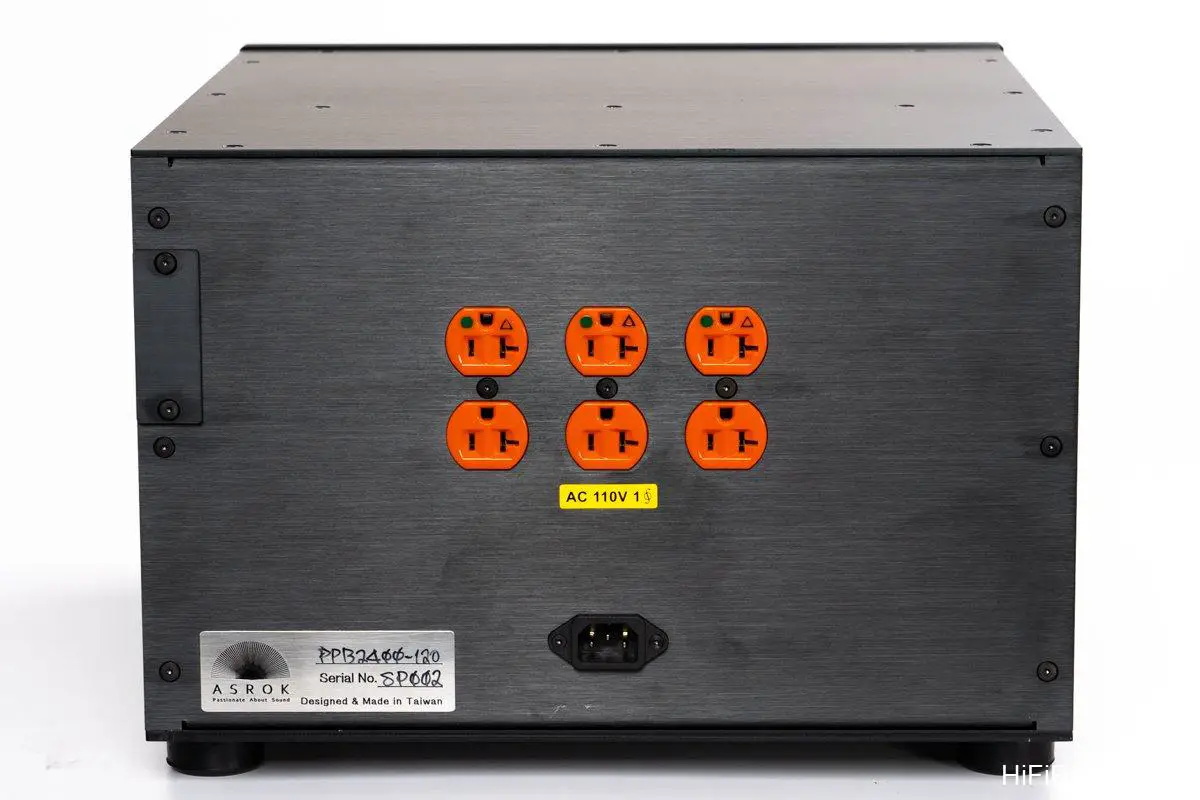
The PPB-2400 is a dedicated battery power supply unit that delivers AC power. This means your audio equipment doesn’t need to be connected to your household mains; it can operate solely on the PPB-2400. The rear panel provides 6 outlets, allowing up to 6 devices to be powered simultaneously.
It’s a common belief that battery power is the cleanest form of electricity. By extension, the PPB-2400 provides your equipment with the purest power possible! The entire PPB-2400 unit comprises three essential components: batteries, an inverter, and a battery management system.
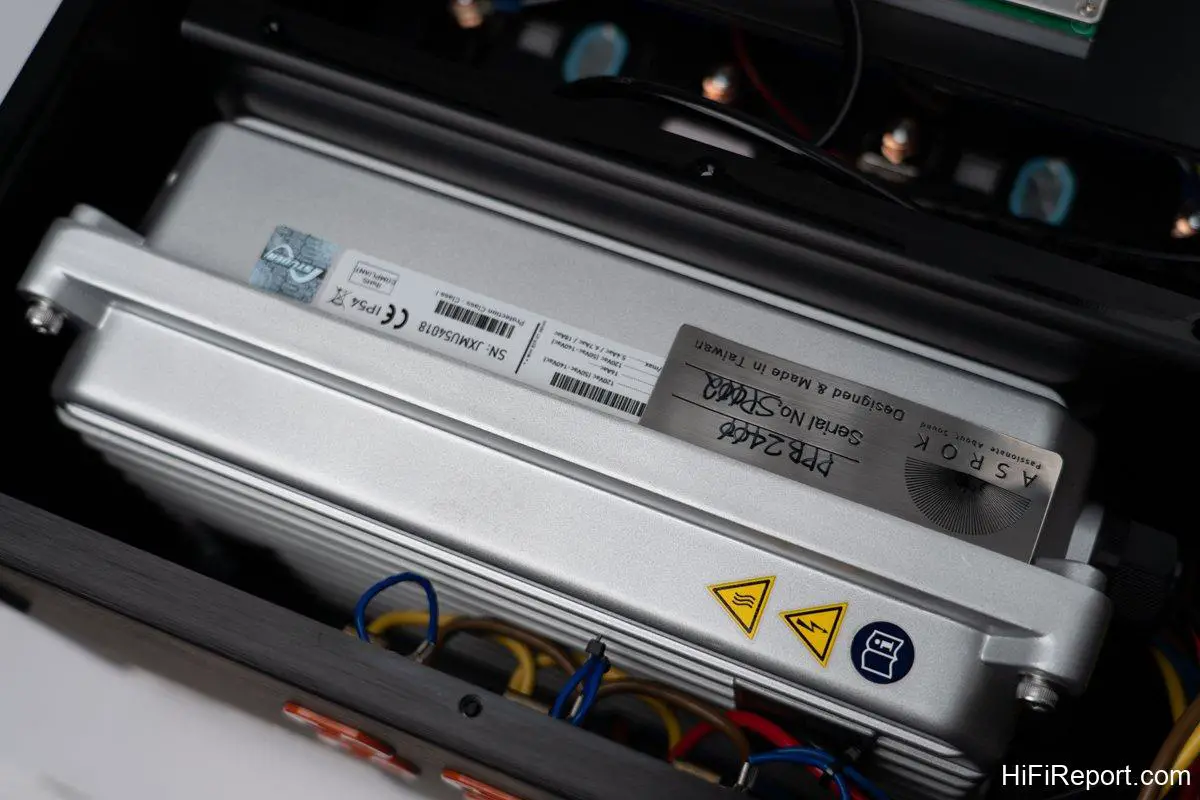
There are numerous global suppliers for these components, ranging in scale, but none are specifically targeted at the audio industry. Instead, they cater to industrial sectors like energy, transportation, and uninterruptible power supplies (UPS). Su Yanzhang experimented with many brands to find the most stable and sonically superior combination for the PPB-2400.
For the battery, the PPB-2400 utilizes lithium iron phosphate batteries, the same type used in mainstream electric vehicles. These batteries are known for their long lifespan, stability, and safety.
Longevity is undoubtedly a primary concern for users. How long do they last? According to Su Yanzhang, the lithium iron phosphate batteries in the PPB-2400 are rated for at least 3,000 to 4,000 charge cycles, meaning repeated charging and discharging. Even after 4,000 cycles, they retain 75% of their charging capacity. Assuming daily charging after listening sessions, they should last for at least 8 to 9 years, making them quite durable.
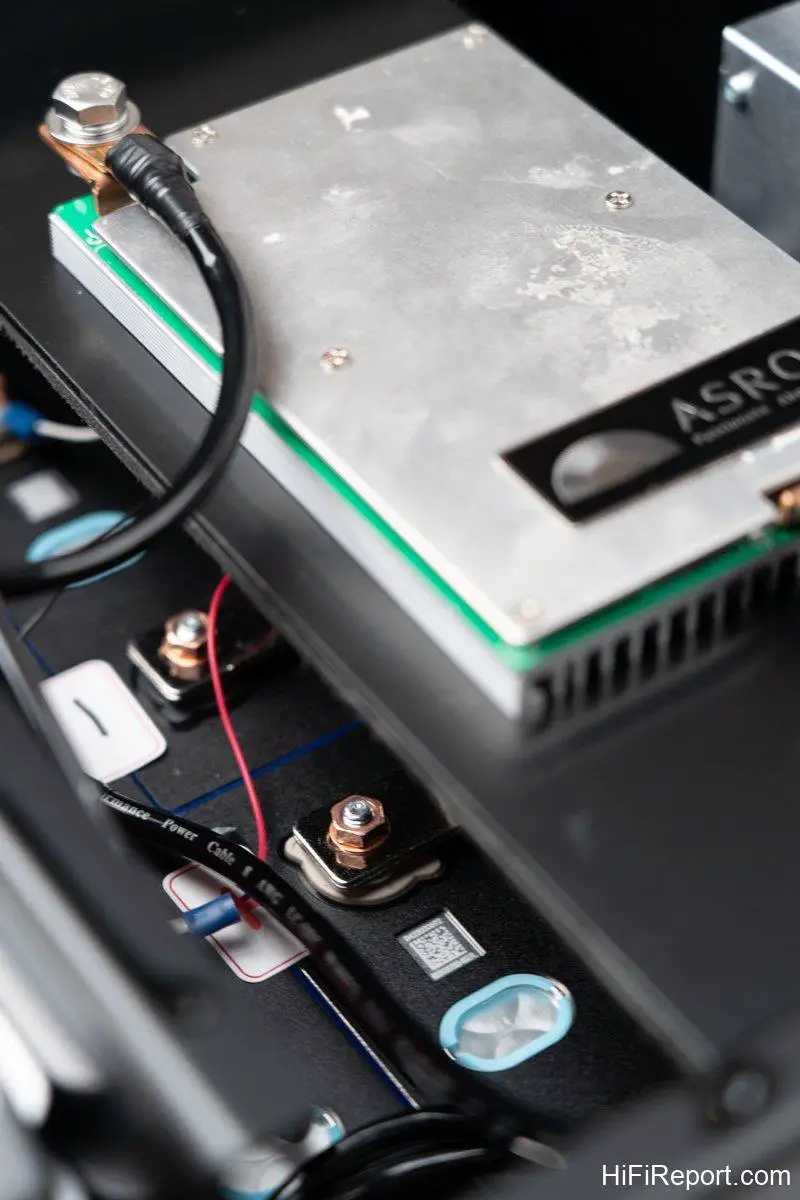
In terms of capacity, the PPB-2400 houses 8 cells of 3.3V / 105Ah batteries, connected in series to form a 24V / 105Ah pack, resulting in a total capacity of 2,400Wh. It offers a continuous output power of 650W. Is this sufficient? For my system, it’s enough for an entire evening of listening, and even a full day on weekends. I simply recharge it when not in use and have never experienced power depletion. Therefore, I believe 2,400Wh is ample for most systems, unless you’re running power-hungry Class A amplifiers operating at full power continuously or very large systems demanding high instantaneous current, in which case you might consider using two units.
Swiss-Made Inverter
Next, let’s discuss the inverter.
The inverter’s role is to convert the battery’s DC power into AC power output. The quality of the AC output is critically dependent on the inverter.
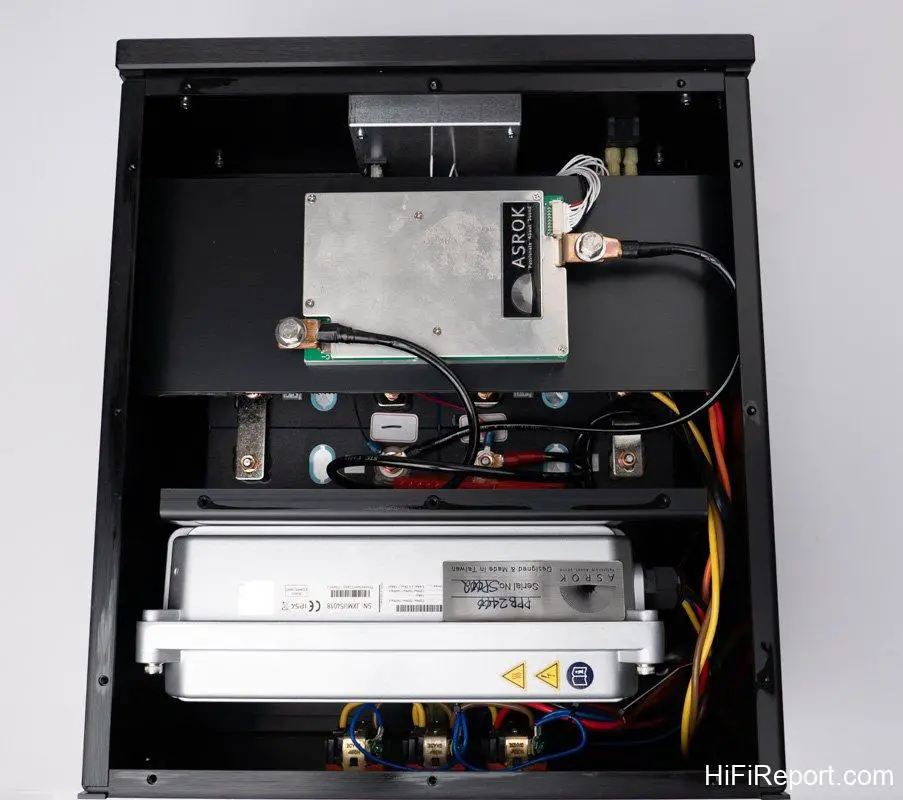
Su Yanzhang also tested various brands and ultimately chose a Swiss-made Studer inverter, regardless of cost, because it offered the best sonic performance, echoing Stromtank’s similar choice.
The battery management system is a control circuit board responsible for managing battery charging and discharging.
The PPB-2400’s battery pack consists of 8 smaller cells. The battery management system monitors the real-time status of each cell, ensuring that each is evenly drawn upon during discharge and equally charged during charging. Once fully charged, charging ceases, preventing overcharging. This prevents any single cell from aging prematurely and affecting overall efficiency and lifespan.
Each PPB-2400 battery pack also requires cell matching. Eight cells with closely matched characteristics are selected and assembled in the same unit. This ensures more consistent charging and discharging behavior, further extending the overall lifespan.
Furthermore, the battery management system includes parameters that need to be manually configured to suit home audio usage conditions.
In fact, both the battery management system and the inverter in the PPB-2400 have built-in protection mechanisms, providing dual safeguards for user safety and optimal battery life.
Simple Functionality, Easy Operation
The PPB-2400, being a large battery power supply, operates at low voltage and high current. Therefore, the internal wiring between battery cells and between the batteries and the inverter is crucial.
Su Yanzhang uses thick metal plates to connect each battery cell and heavy-gauge pure copper wires to link them to the inverter, ensuring unhindered power transmission.
The rear panel features three medical-grade American standard outlets, providing a total of 6 power outputs.
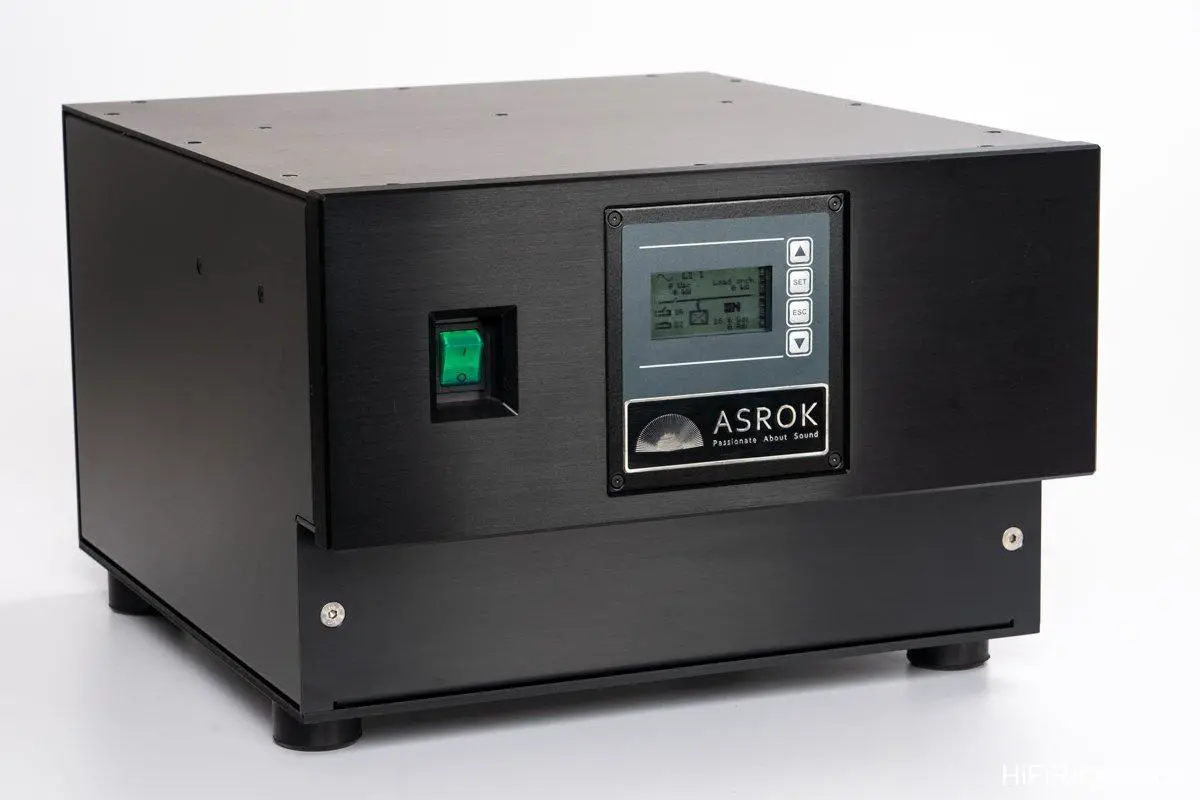
The front panel has a small monochrome screen in the center, displaying information such as input/output voltage, wattage, current, etc.
On the left side of the front panel, there’s a large green switch that allows users to manually control battery charging.
For instance, after an evening of listening, when your audio system is turned off, you can flip the green switch to initiate charging the PPB-2400. You don’t need to worry about the charging duration because once the battery is fully charged, the internal charging process automatically stops, even though the green light remains illuminated, preventing overcharging. When you want to listen to music the next day, simply turn off the green switch. This completely disconnects the external power supply, ensuring power is solely drawn from the battery. At this point, your audio system will be entirely isolated from any mains power pollution.
Can you listen while charging? Yes, you can. With the green switch on, charging and music playback are possible. However, in this mode, the power is entirely derived from the mains, not partially from the mains and partially from the battery.
Su Yanzhang designed the PPB-2400 for operational simplicity. Turning the switch on initiates charging and mains power passthrough, while turning it off engages pure battery operation. Therefore, generally, you can leave the switch on, indicated by the green light, to keep the battery charged. It won’t overcharge. When listening to music, turn it off, and the light goes out, switching to pure battery power.
What if you forget to charge? No problem. When the battery level drops below 20%, the PPB-2400’s protection mechanism activates. The screen will display a red light and power output will cease to prevent excessive battery discharge and damage. So, there’s no need to worry about forgetting to charge.
Additionally, you can monitor the current battery level via the screen to decide when to recharge. A full charge is indicated by 28V on the screen, and it automatically shuts down at 22V. So, when the voltage approaches 22V, it’s time to recharge.
Immediate and Noticeable Improvement
The listening tests were conducted at my home, using the following equipment: Auralic Aries G1 wireless streaming transport, Holo Audio Spring 3 DAC, Holo Audio Serene preamplifier, NuPrime EVO One power amplifier, and Aurum Cantus Grand Harmony speakers.
The PPB-2400’s power capacity is sufficient to handle all of the above devices simultaneously. However, initially, for easier and quicker A/B comparisons, I only connected the preamplifier and power amplifier. Power amplifiers typically switch on and off quickly, reducing the waiting time after unplugging power cords and keeping sonic memory fresh for A/B testing.
However, my concerns were unnecessary because the difference was substantial. Based on my familiarity with my system’s sound, I immediately recognized the improvements. There was no need for repeated A/B comparisons. I quickly connected the streaming transport and DAC to the PPB-2400 and began my listening sessions.
The sonic improvement brought by the PPB-2400 was holistic, comprehensive, and even transformative. It delivered qualities that I previously thought were mutually exclusive!
Enhanced Texture and Timbre
Firstly, the PPB-2400, as expected from battery power, undeniably made the sound cleaner. However, this cleanliness was different from what I had experienced with other types of power conditioners, devices, or cables. How was it different? Its background and sonic foundation were very clean, but not in a completely black, suffocating way. Its timbre was transparent, but not extremely so. Instead, it revealed a wealth of texture and timbre, making the sonic palette remarkably rich, with a wonderful, natural sense of smoothness, making the listening experience comfortable and delightful.
Listening to naturally produced acoustic instruments like piano, strings, or wind instruments, and of course vocals, through the PPB-2400, I heard timbres that I had never experienced in my system before.
For example, string instruments and piano seemed slightly darker, but in fact, they weren’t. It was more like a more realistic woodiness, the resonance of the instrument body, making the timbre sweeter.
Upon hearing such rich timbres, I was instantly captivated! My Grand Harmony speakers, with their ribbon tweeters and aluminum ribbon super tweeters, are incredibly detailed and excel at conveying timbre and atmosphere. The PPB-2400 allowed these strengths to be realized even more fully.
Improved Imaging, Soundstage, and Dynamics
Beyond timbre, the PPB-2400 also significantly enhanced aspects like imaging, soundstage, and dynamics.
The PPB-2400 noticeably made the sound more solid and focused, greatly improving the clarity of sonic images and outlines. The size and scale of different instruments were very clearly defined, with precise relative proportions and a highly accurate soundstage. This allowed me to better discern recording differences and the choices made by recording and mixing engineers, making listening incredibly engaging.
Crucially, the solidity provided by the PPB-2400 was lively, agile, and dynamic, never ponderous. The sound possessed both substantial weight and agility, making the music more vibrant.
The bass performance was an even bigger surprise. The PPB-2400 effortlessly brought out clearer, more composed, and more layered low frequencies. I couldn’t help but feel that my years of effort in improving bass performance had been largely in vain.
The PPB-2400 gave my system’s bass not only excellent depth and ample quantity but also clarity, well-defined lines, and rich layers, with a very natural and nuanced extension.
I’m not sure if it’s because battery power provides a smoother output, better control, or because it minimizes power noise and interference, resulting in better bass. In any case, the bass performance was significantly improved.
Furthermore, the entire soundstage exhibited a very natural sense of composure, lending the music exceptional stability (possibly also related to the quiet background), but without sounding lifeless.
The harshness, edginess, and aggressiveness I had previously encountered in some recordings were gone.
The inherent timbre of instruments was expressed more completely and fully, enriching the sound and making the music more flavorful.
It was truly astonishing!
Rediscovering My Music Collection
Here, I want to use a cliché often employed by audio reviewers: with the PPB-2400 in place, every recording sounded like the first time I was hearing it.
Despite being a cliché, it’s undeniably true.
For instance, Quatuor Ebene’s rendition of The Beatles’ famous “Come Together” from their album “Fiction” has excellent resolution, transparency, and definition, making it an audiophile-quality recording, but it can sometimes sound overly sharp and fatiguing.
With the PPB-2400, the previously somewhat rigid and edgy texture gained a richer midrange and less aggressive, non-fatiguing highs. The elasticity of the sonic lines improved, and the timbre acquired a honey-like sheen, enhancing sweetness and opulence.
The inherent tightness of the arrangement remained perfectly intact, and pizzicato notes became noticeably snappier, more articulate, and weightier, rendering the dry texture of pizzicato more clearly. The sense of each instrument’s physicality also improved.
Similarly, in track 6, “Intro Calling You,” the unique sounds created by drummer Richard Hery using special instruments, in collaboration with the quartet, gained a more prolonged sense of sustain thanks to the PPB-2400’s deep, black background. Brightness, sonic completeness, and atmosphere were all significantly enhanced, drawing me deeper into the music.
Another example is Yuri Temirkanov conducting the St. Petersburg Philharmonic Orchestra in “Scheherazade.” The scale of the symphony orchestra was not diminished by battery power. It remained expansive, stable, and grand. Furthermore, the lower soundstage became more focused and cohesive, low-frequency clarity and layering improved significantly, and localization and separation were enhanced. The structure of the high, mid, and low frequencies became more organized.
In short, the musical picture became clearer.
Music with Emotion and Expression
Next, I wanted to conduct another comparison. I unplugged the preamplifier, power amplifier, and DAC from the PPB-2400 and reconnected them to my original power strip.
Listening to “Scheherazade” again, the first string unison sounded heavy and indistinct, the soundstage was bloated, and the timbre was less transparent. The soundstage depth noticeably shrank. The lowest frequencies were unclear and muddy. The outlines, lines, and localization of the solo violin were less defined.
Switching back to Quatuor Ebene’s “Come Together,” strangely, the sound became ordinary, the system became commonplace. The overall timbre became muddy, the density of texture deteriorated, tightness was significantly reduced, and transparency plummeted. During more energetic passages, the texture became harder and unpleasant, prompting me to lower the volume.
Alas… this is the brutal reality of A/B comparisons.
I quickly reconnected the preamplifier, power amplifier, and DAC to the PPB-2400. Listening to “Come Together” again, the sound instantly returned to being clear, concrete, precise, and realistic. The music was full of emotion and expression, and the timbre was radiant, beautiful, and opulent – precisely what one expects from fine string instruments.
And “Scheherazade”? The soundstage was both expansive and focused, no longer a top-heavy pyramid shape, but rather a well-ordered columnar structure, vertically and horizontally, with a rigorous structure, accurate localization of each section, excellent separation, and a relaxed, spacious ease.
Subsequently, the solo violin emerged, its form crystal clear and its texture brilliant and luminous, a night-and-day difference.
A Straight Path to Sonic Bliss
What level of sonic achievement can be attained when home power is optimized to perfection? I don’t know, and perhaps no one can answer that question definitively. However, the PPB-2400 provides a glimpse into that possibility, offering an initial outline of perfect power. After all, it provides pure, unadulterated 60Hz sine wave power from the source, which is far simpler and more effective than dealing with power issues downstream, and without any questionable side effects.
Finally, returning to the price, the PPB-2400 might still be considered somewhat expensive, but I believe it is within the reach of many audiophiles. The key point is that whether you are an audiophile or a HiFiReport reviewer, you should not regard it as a luxury item or an optional tuning accessory, but rather as an indispensable standard component. Investing in it will reveal that the path to audio nirvana is indeed a straight and rewarding one.
Specifications
* Type: Battery Power Conditioner
* Battery Capacity: 2,400 Wh
* Continuous Output Power: 650 Watts
* Peak Output Power: 1,000 Watts continuous (30 mins), 2,500 Watts transient (5 secs)
* Output Voltage: 100 – 130 VAC / Pure Sine Wave
* Output Sockets: Medical-grade Outlets × 6
* Dimensions: 385 × 260 × 350 mm (W × H × D)
* Weight: 38 kg