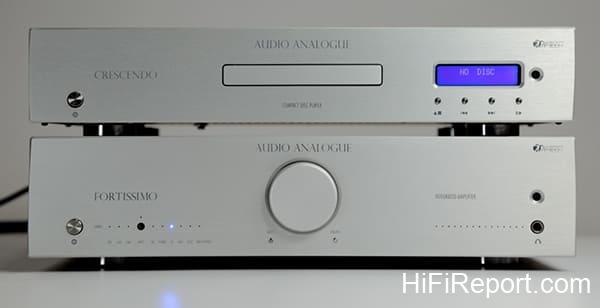
Audio Analogue Crescendo CD Player and Fortissimo Integrated Amplifier Review
The Audio Analogue Crescendo CD player and Fortissimo integrated amplifier from Italy immediately catch the eye with their thick aluminum front panels and metal chassis. Without excessive decorative elements or styling lines, they make a statement through their clean, elegant design. However, a closer inspection reveals that these seemingly minimalist components harbor numerous thoughtful details.
For instance, the aluminum front panel’s edges aren’t simply sharp right angles. Instead, they feature symmetrically beveled curves that span the entire edge, transitioning from wide to narrow and back to wide—a subtle detail only noticeable upon close examination. The ventilation design is equally clever. Taking the Fortissimo amplifier as an example, the metal top cover features large ventilation areas composed of numerous short rectangular holes.

However, the bottom plate required a different approach. Too many ventilation holes would compromise its rigidity and potentially affect the entire unit’s structural stability. The manufacturer’s solution was to align the ventilation holes with the internal heatsink positions, ensuring efficient air circulation without compromising chassis integrity. Isn’t this attention to detail impressive?
The Crescendo CD Player: Thoughtful Design
The name “Crescendo” comes from the musical term meaning “gradually getting louder”—an apt choice by Audio Analogue. The control interface is refreshingly straightforward: power switch on the left, monochrome display on the right, and four control buttons below the display handling eject, stop, track skip, and play/pause functions. For added convenience, a remote control is included. The CD tray is centrally positioned on the front panel. The rear panel maintains this simplicity with just one set of RCA outputs and a coaxial digital output.

Opening the top cover reveals the CD mechanism enclosed in a metal housing. According to manufacturer specifications, the Crescendo originally used the TEAC CD-5010A mechanism, though current production models use the CD-AA1 (powered by AirTech). The firmware and circuit design are handled in-house by Audio Analogue’s engineers. The unit employs a BurrBrown 24bit/192kHz DAC chip for digital-to-analog conversion. Notably, the power supply circuitry is isolated on a separate circuit board to minimize high-frequency interference and noise.
The Fortissimo Integrated Amplifier: Power Meets Precision
The Fortissimo—named after the musical term for “very loud”—may be compact, but it delivers at least 100 watts of power. The front panel features just two controls: a power switch on the left and a large central aluminum knob that both rotates for volume control and can be pressed to switch inputs. The right side of the front panel features multiple blue LED indicators—the more that are lit, the higher the volume.
While initially attractive, these LEDs can become quite bright in dark environments. Consider positioning the unit away from direct line of sight or using a small decorative element to partially shield the LEDs if they prove too intense.

The connectivity options are comprehensive. The rear panel offers multiple RCA inputs, including an MM/MC phono stage, balanced XLR inputs, optical and coaxial digital inputs, and a USB port. The USB input supports digital audio up to 16bit/48kHz—sufficient for standard resolution playback. Output options include RCA Pre/Rec outputs, a coaxial digital output, and a 6.3mm headphone jack on the front panel.
Internal Engineering
Opening the Fortissimo reveals a massive toroidal transformer occupying nearly half the chassis depth, separated from the main circuit board by substantial heatsinks to prevent interference. The amplifier employs a dual power supply design: one for the preamp and small signal circuits, and another for power amplification.

The left and right channels are completely separated, each with independent power supplies and six power transistors per channel. This configuration delivers 100 watts into 8 ohms and 180 watts into 4 ohms—plenty of power for most home speakers. The manufacturer emphasizes the use of 4-layer circuit boards to minimize signal paths and reduce interference.

Sound Quality: Warmth and Authority
During testing, we paired these Audio Analogue components with our reference CC ADmonitor Preference bookshelf speakers and Sub monitor MK3 subwoofer. Initially using the Crescendo as a transport feeding digital signal to the Fortissimo’s DAC produced a clean, analytical sound with excellent resolution. However, extended listening revealed that the Crescendo’s analog output offered a warmer, more substantial presentation with greater musical scale.

Sarah Chang’s recording of the Bruch and Brahms violin concertos demonstrated the system’s capabilities beautifully. The violin strings carried an appropriate warmth, with the instrument positioned slightly behind the speakers’ plane at a natural distance. The image was precisely focused, creating a deep soundstage. Chang’s double-stop technique revealed fine tonal distinctions, with airy highs that maintained attack without becoming harsh. The relationship between soloist and orchestra was clearly defined, with the violin forward and the orchestra expanding behind it during full orchestral passages.
Piano Performance
Nobuyuki Tsujii’s “Mozart Collection” piano album revealed smooth key touches that let you imagine his fingertips dancing on the keys. Every keystroke and note decay showed subtle dynamic variations and timing nuances. The system portrayed the grand piano with appropriate scale, enhanced by a quiet background that emphasized the instrument’s presence. The piano was positioned slightly behind the speakers, though not as deep as the orchestral recording, creating a more direct presentation.

Bass Response and Vocal Reproduction
Rickie Lee Jones’ “Pop Pop” album, particularly the opening track “My One and Only Love,” showcased the system’s excellent bass capabilities. The double bass had substantial weight and clear definition, demonstrating good speed and resolution without muddiness. The bass positioned left and guitar right created a clean, bouncy presentation without drag. Jones’ vocals emerged from the center with immediate presence, warm yet fresh-sounding, with high density but without congestion.

The Verdict
The Audio Analogue Crescendo and Fortissimo combination offers clean, austere styling paired with a warm, substantial sound that bridges the gap between tube-like warmth and solid-state resolution and power. Whether reproducing solo instruments, vocals, or full orchestras, the sound remains rich in detail without artificiality, capable of both delicacy and authority as needed. The Fortissimo is particularly impressive as a multi-function device, combining a 100-watt amplifier, USB DAC, headphone amplifier, phono stage, and preamp outputs in one versatile package.
Technical Specifications
Audio Analogue Crescendo CD Player
- Type: CD Player
- Total Harmonic Distortion: <0.003% (1kHz @0dBFs), <0.005% (1kHz @-10dBFs)
- Dynamic Range: 97dB
- Outputs: 1x RCA, 1x Coaxial Digital
- Dimensions: 3.2 x 17.5 x 13.7 inches (H x W x D)
- Weight: 15 lbs

Audio Analogue Fortissimo Integrated Amplifier
- Type: Integrated Amplifier
- Power Output: 100W (8Ω), 180W (4Ω)
- Inputs: 4x RCA, 1x XLR, 1x 3.5mm, 1x Phono (MC/MM), 1x Optical, 1x Coaxial Digital, 1x USB
- Outputs: 1x RCA (REC/PRE), 1x 6.3mm Headphone, 1x Coaxial Digital
- Input Impedance: 60kΩ (unbalanced), 20kΩ (balanced)
- Signal-to-Noise Ratio: >100dB
- Dimensions: 4.6 x 17.5 x 15.4 inches (H x W x D)
- Weight: 27.6 lbs