
Audiomica Laboratory Anort Consequence Network Cable Review
Audiomica is a Polish cable brand founded in 2007 by Lukasz Mika. Despite its relatively short history, Audiomica has demonstrated strong research and development capabilities and rapid growth. The company currently boasts six distinct series of products, offering a comprehensive range of cables to meet diverse consumer needs.
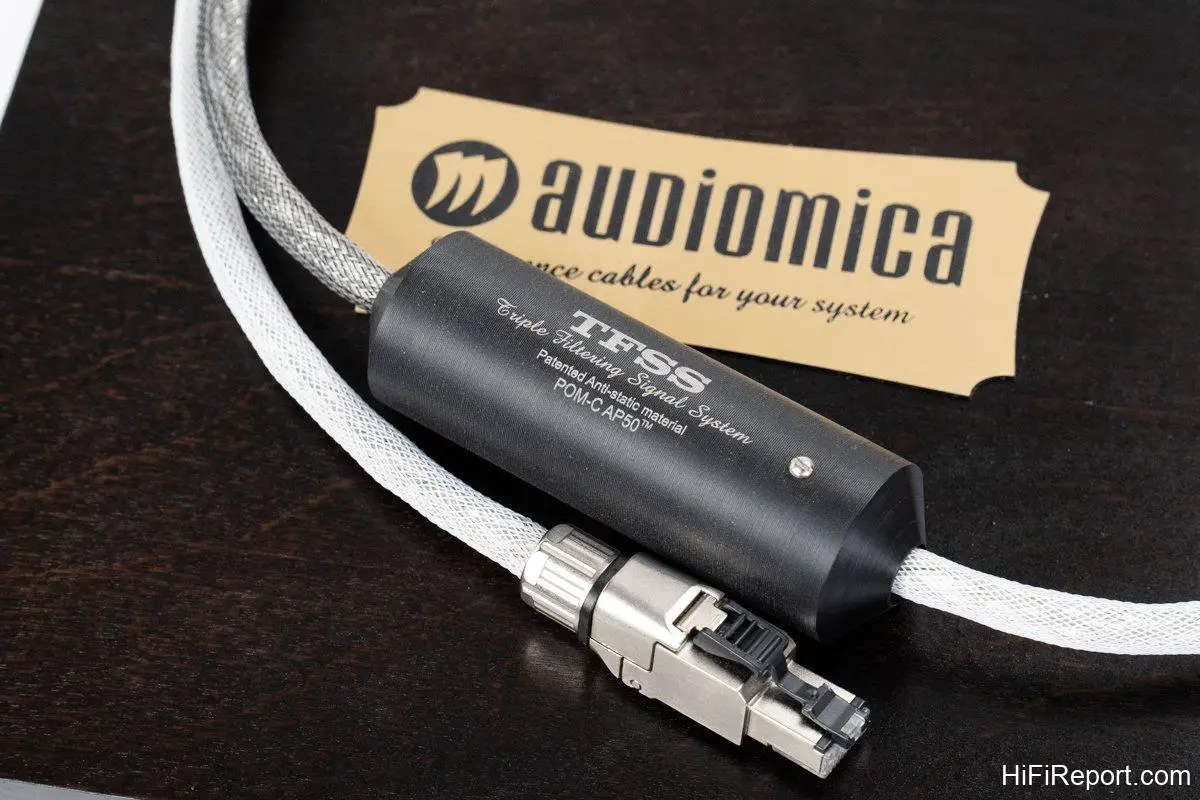
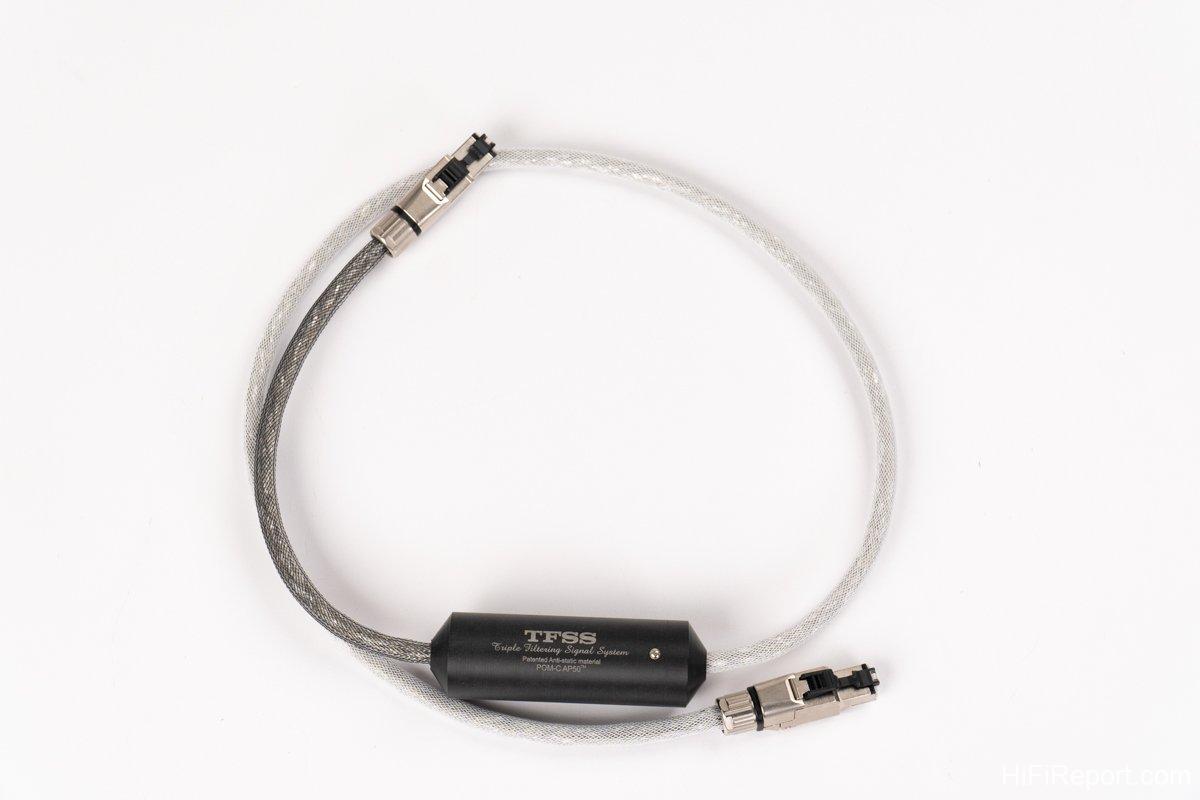
A characteristic feature of many Audiomica cables is a cylindrical component attached to the cable itself. What is this for? Filtering.
Audiomica believes that factors influencing cable sound performance extend beyond conductors, structure, insulation, and shielding. Noise interference, particularly ubiquitous electromagnetic interference, is also a critical element. Therefore, Audiomica utilizes a filter to mitigate noise, reducing signal interference. The Anort Consequence network cable, the subject of this review, exemplifies this approach.
Emphasis on Noise Filtering
Audiomica’s filters are primarily designed to eliminate electromagnetic interference. While some of this interference originates from natural sources, a significant portion stems from various radio waves and household appliances. These disturbances can be transmitted through the air or via the power supply to home audio systems, negatively impacting sound quality.
To address this, Audiomica has developed two types of filters. One is specifically for signal cables, including analog interconnects, digital cables, USB cables, network cables, phono cables, and more. This category is further divided into DFSS (Double Filtering Signal System) and TFSS (Triple Filtering Signal System) grades.
The other type is designed for power cables and is known as TFCT (Two Filters Current Tension).
Notably, speaker cables do not incorporate filters.
Let’s first examine the DFSS filter, short for Double Filtering Signal System. It primarily comprises two toroidal magnets, with Teflon and PVC-covered aluminum foil running through the center, forming a unique structure. Crucially, maintaining a precise distance between the magnets and between the filter and the connectors is essential for effective filtering.
Furthermore, for different cable types, the size, composition, and spacing of the magnets, as well as the distance to the connectors, must be precisely adjusted. This underscores that a single filter design is not universally applied.
This highlights why Audiomica considers its filtering technology a key factor in achieving superior sound quality.
What differentiates TFSS? TFSS, or Triple Filtering Signal System, increases the number of magnets from two to three, along with an increase in size, providing enhanced interference suppression.
Interestingly, the choice between DFSS and TFSS is not solely determined by cable tier. Higher-end cables don’t automatically use TFSS while lower-end ones use DFSS. Audiomica’s cable tiering is based on factors beyond just filtering, including conductor material, structure, shielding, and connectors. In fact, Audiomica offers almost every signal cable model with DFSS, TFSS, or a non-filtered version, allowing consumers to choose based on their preferences, offering considerable flexibility.
TFCT, the filter used in power cables, stands for Two Filters Current Tension. It incorporates capacitors and inductors to more effectively eliminate noise in the ground loop.
POM-C AP50 Filter Housing
The subject of this review, the Anort Consequence, is Audiomica’s flagship network cable. “Consequence” is the series name, while “Anort” is the specific model.
Audiomica assigns a unique name to each product. Therefore, even without mentioning the series, “Anort” immediately identifies the flagship Consequence series network cable.
The Anort reviewed here is the top-tier “Luxury” version, equipped with the TFSS filter.
The filter’s dark gray housing does not resemble metal or wood, nor does it quite feel like typical plastic. This material is another of Audiomica’s specialized technologies, known as POM-C AP50.
POM-C AP50 is a unique material developed by Acoustic Points, a company within the Audiomica group. Its key characteristic is static dissipation, protecting enclosed components or sensitive circuits from electrostatic interference.
Additionally, POM-C AP50 contains 10% Teflon, making it highly durable and wear-resistant. Users need not worry about wear and tear or scratches when connecting and disconnecting cables.
Beyond filter housings, Audiomica also utilizes POM-C AP50 to manufacture various cable accessories, including RCA connectors, XLR connectors, power plugs and sockets, spade connectors, banana plugs, and more. This means Audiomica connectors are in-house designed and produced, rather than sourced from external suppliers, a remarkable feat in the industry.
7N OCC Single Crystal Copper Conductors
Moving beyond the filter, let’s examine the rest of the Anort cable.
The Anort employs 7N purity OCC single crystal copper conductors. A total of eight conductors, each 0.7 mm in diameter, are arranged in four twisted pairs to achieve CAT 8.2 specifications, supporting bandwidths exceeding 2,000 MHz.
This bandwidth is ample for even streaming content at resolutions beyond 10K.
Anort features a three-layer shielding system. The first layer is a dense copper braid, followed by aluminum foil, and finally a metallic film layer, ensuring maximum shielding effectiveness.
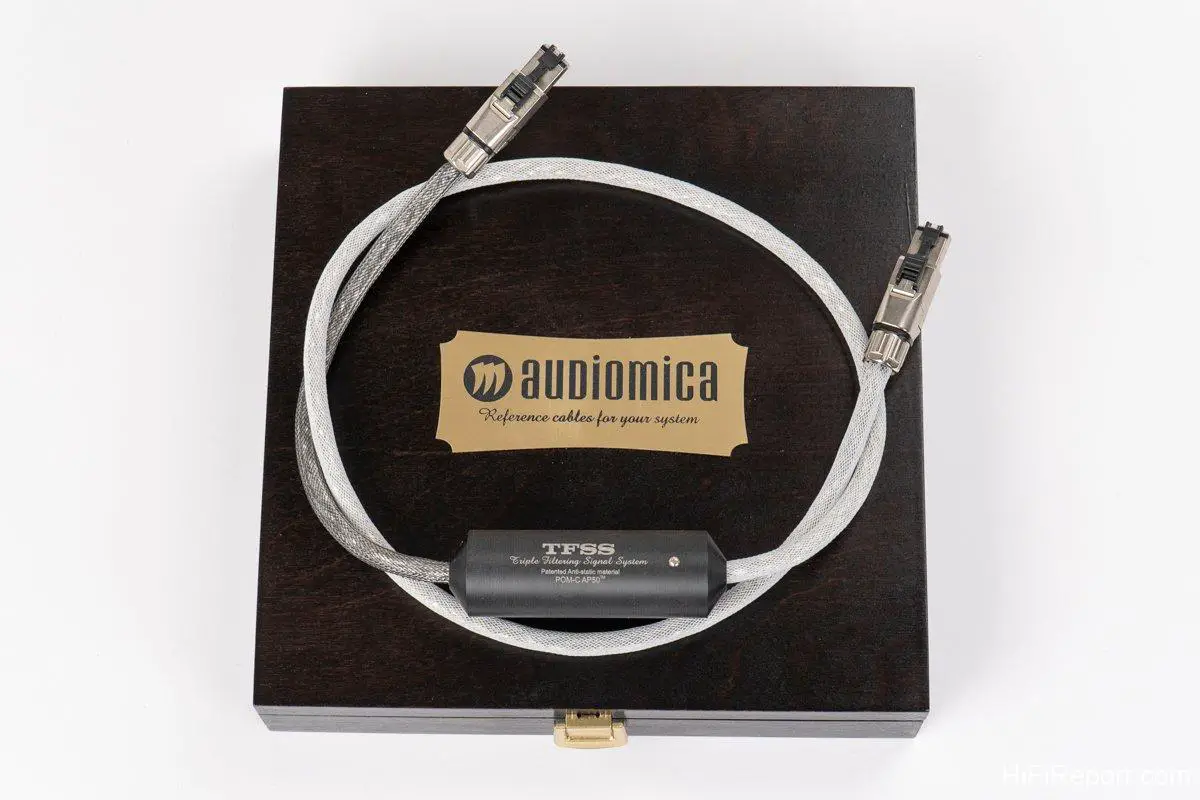
Visually, the Anort cable presents a two-tone design in white and gray. The TFSS filter marks the boundary between the two colors, and closer inspection reveals that the TFSS is positioned off-center, closer to the gray section of the cable.
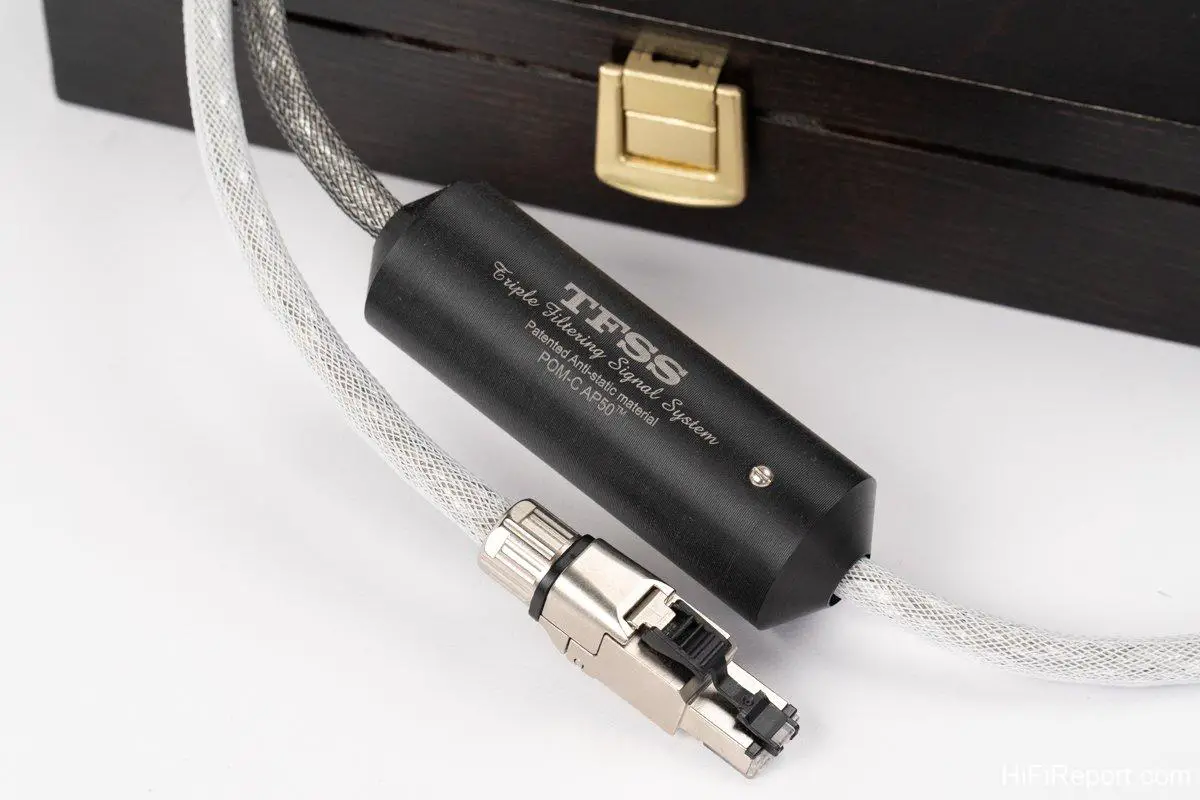
The review sample I received is 1 meter in length. For longer lengths, the additional length would be in the white section. The gray section may remain unchanged or slightly increase. In any case, the filter is always positioned closer to one end, not in the middle. Audiomica does not explicitly indicate which end is the source or load end.
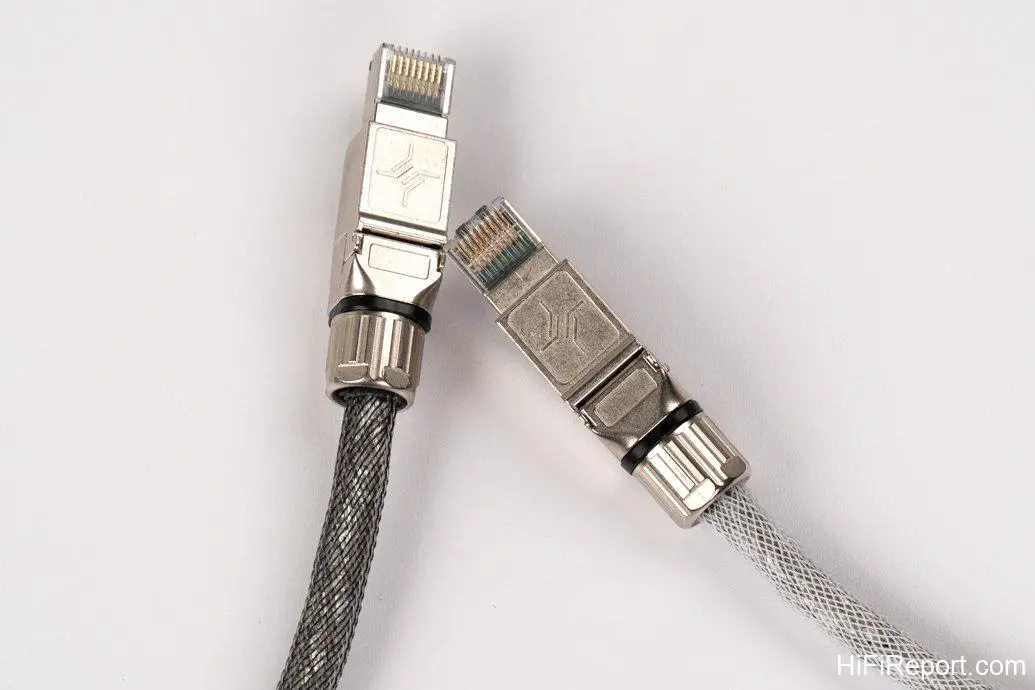
For connectors, Anort does not use custom-designed RJ45 plugs, a significant investment. Instead, it utilizes industry-leading German Telegartner RJ45 connectors, featuring gold-plated pins and incorporating Acoustic Points’ anti-static sleeves internally for enhanced electrostatic protection.
Noticeable Performance Improvement
The listening evaluation was conducted in the HiFiReport listening room. The source was a Telos EMP streaming player, and the DAC was a North Star Design USB DAC32, connected via a Tromba Cypher-OCC USB cable.
A ZyXEL GS-108B V2 network switch was used during the listening session. I connected the Anort between the ZyXEL and the Telos EMP, comparing it to a reference industrial-grade Linkomm CAT.8 network cable with double shielding.
Other equipment included a North Star Design USB DAC32, Electrocompaniet EC 4.8 preamplifier, EAR 509 power amplifiers, and Wilson Audio Alexia 2 speakers. Neither the EMP nor the DAC end of the Anort cable is marked for directionality. Audiomica acknowledges that cable directionality can audibly affect sound, with one direction potentially sounding better than the other. However, the optimal direction can vary depending on the system. Therefore, Audiomica does not mark directionality on the cable but recommends users experiment to find the preferred orientation.
After some experimentation, I found that the sonic difference between directions was quite noticeable with the Anort. I ultimately decided to orient the cable with the filter closer to the EMP side.
Using Tidal as the primary audio source, even casual listening revealed that Anort noticeably improves the focus and projection of vocals and instruments. Images become more cohesive and three-dimensional, with enhanced outline definition. The sonic texture is cleaner and purer, with improved density.
In previous network cable reviews, a consistent characteristic of good network cables has been improved image solidity and sharper outlines. The Anort exhibits this trait prominently, with a very noticeable degree of improvement.
Refined and Elegant Sound
Taking the soundtrack of the Korean drama “Mr. Sunshine,” specifically the song “A Day Without Tears” performed by Korean singer Kim Yoon-ah, as an example.
This song has a slow melody, a melancholic tone, but with significant musical dynamics and emotional intensity.
The song begins with simple piano accompaniment, with strings added later in the middle section. The recording intentionally creates a close-miked effect, resulting in a relatively large vocal image and a spacious soundstage.
With the Anort cable in place, the musical theme became more pronounced. The overall sound became more focused towards the center of the soundstage, and the singer’s image became more concentrated and elevated, resulting in a more prominent and solid image with improved body.
Furthermore, in the more emotionally charged passages, the Anort concentrated and intensified the singer’s dynamic impact, making volume variations more distinct and captivating the listener’s attention more effectively.
In comparison, the reference network cable presented a soundstage that felt lower and wider, with a more diffuse and relaxed image, and a flatter soundstage overall. It lacked the same ability to convey the musical focus.
On the other hand, Anort also significantly improved the timbre. The sonic background became blacker and more transparent, improving overall transparency. The texture, while revealing, also possessed a wonderful sense of richness, resulting in a more refined and elegant sonic presentation.
Richer Musical Expression
Switching to a larger-scale piece, I chose Bruckner’s Symphony No. 7, 2nd Movement, performed by the Dresden Staatskapelle Orchestra under the direction of Otmar Suitner.
This movement is a very solemn and slow Adagio, lasting over 21 minutes. Dramatic peaks are infrequent, with the climax occurring at the end of the movement. However, listening through the Anort, it never felt tedious. The cable enhanced quieter passages, making them clearer, while also increasing the impact of louder sections. Even with subtle dynamic shifts, the distinct layers and rich micro-dynamic contrasts kept the music engaging.
The soundstage performance was particularly noteworthy. Anort transformed the previously spacious but somewhat flat soundstage, immediately adding depth and a more concrete spatial dimension. It not only separated the orchestra’s front, middle, and rear layers but also improved the separation between instrumental sections. The structure of each frequency band became clearer, creating a more ordered musical presentation.
Simply put, the sound became cleaner, the musical picture sharper, and the overall sonic atmosphere felt refreshed.
Additionally, while enhancing the brightness and texture of the strings, Anort also increased the sense of flow due to improved clarity. The tighter bass further contributed to a more agile lower register. The result was a livelier and more dynamic musical experience with richer musical expression.
Another example is Chick Corea’s “Akoustic Band” album, featuring a jazz trio of piano, double bass, and drums, playing in a fast-paced fusion jazz style.
Through the Anort, the piano’s timbre sounded even more like a real piano.
Despite being called “Akoustic Band,” Chick Corea certainly recorded using an acoustic piano, not a keyboard. My point is that the Anort made the sound feel even more like a piano being played right in front of me, enhancing realism. Not only were the textures and details clearer and the timbre richer, but the tactile sensation of each keystroke also became more tangible.
Furthermore, the plucked notes of the double bass and the drum textures became denser and more prominent, with improved speed and density. The position of each drum was also more precisely defined, resulting in a more powerful and energetic sound. The music became more vibrant, exciting, and brilliant, yet retained a sense of naturalness, ease, and coherence. In contrast, the reference cable sounded rather sluggish and somewhat dull.
Exceptionally User-Friendly
Another significant advantage of the Anort is its exceptional ease of use.
Many high-end network cables are often stiff, thick, and heavy. They can be difficult to maneuver in tight spaces and even cause some switches to tilt. This can make them quite cumbersome to use.
The Anort completely avoids these issues. Even with its substantial filter component, it remains lightweight and flexible, making connections and disconnections exceptionally easy.
Specifications
* Type: Ethernet Network Cable
* Conductor: Solid-core 7N OCC conductor
* Conductor Diameter: 0.7 mm × 8
* Outer Diameter: 8.2 mm
Reference Equipment
* Source: Telos EMP Streaming Player, ZyXEL GS-108B V2 Network Switch
* DAC: North Star Design USB DAC32
* Preamplifier: Electrocompaniet EC 4.8
* Power Amplifier: EAR 509
* Speakers: Wilson Audio Alexia 2
* Cables: Linkomm CAT-8 Network Cable / Tromba Cypher-OCC USB Cable / Tromba Mandolin XLR Signal Cable / Tromba Marina OCC-1 Speaker Cable
* Accessories: MYSTJ Audio CMS Equipment Rack / ASI Tuning Devices