
Aurender A20 Music Server Player Review
Aurender has recently undertaken a significant streamlining of its product lineup. This refresh involved updating certain models to newer iterations and retiring some of the more redundant or ambiguously positioned units. The result is a considerably simplified range, making it easier for consumers interested in Aurender to make informed decisions and find the model that perfectly suits their needs.
Currently, Aurender’s website clearly categorizes its music server players into three main series: the N series, featuring digital outputs only; the A series, equipped with analog outputs (while also providing USB Audio out); and the ACS series, designed for metadata editing, file management, CD ripping, and storage expansion.
The subject of this review, the Aurender A20, belongs to the A series. This all-in-one unit combines file storage, music serving, and network streaming capabilities. With its analog outputs, it simply connects to your amplifier, offering an effortless pathway to enjoy the convenience of streaming and high-quality music reproduction.
Streamlined Flagship
Within the A series, Aurender currently offers four models, ranked from highest to lowest: A30, A20, A15, and A200. While the A20 sits one step below the flagship A30, its circuit architecture is essentially derived from the A30, making it, in essence, a streamlined version of the flagship model.
Where has this streamlining occurred? Judging by the internal chassis photographs, the A20 appears to have simplified only the power supply and headphone amplifier sections. It also omits the Teac slot-loading optical drive, meaning the A20 cannot rip CDs. However, all other functionalities remain the same. Crucially, the digital audio processing circuitry and DAC circuitry – the components most directly impacting sound quality – are directly carried over from the A30 without modification. Therefore, describing the A20 as a streamlined flagship is entirely accurate.
Moreover, the A20 offers a user-friendly feature absent in the A30: a removable hard drive bay.
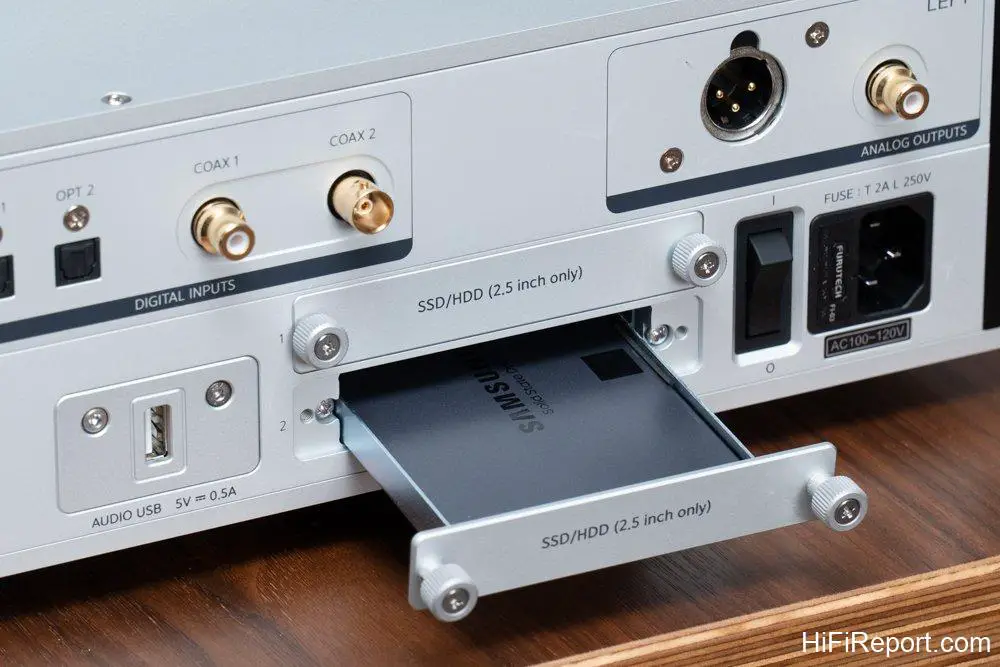
The A30 utilizes an internal 3.5-inch HDD, located within the chassis, making user replacement somewhat cumbersome. The A20, in contrast, adopts a hot-swappable hard drive design. Without needing to open the chassis, users can simply extract the drive tray from the rear panel, facilitating easy self-replacement. Furthermore, the unit itself is shipped without a hard drive, allowing users to purchase storage capacity according to their needs. Alternatively, if you primarily stream online content and don’t require local storage, you can opt to install a drive only when necessary, offering greater flexibility in usage.
The A20 features two 2.5-inch hard drive slots, each capable of accommodating up to an 8TB SSD or HDD, providing a total of 16TB, which should be more than sufficient for most users.
For file playback, the A20, like other Aurender models, employs a cache-based playback system.
Internally, the A20 boasts a 480GB M.2 NVMe SSD cache. When playing music files, the data is first read from the storage drive to the cache and then played from the cache. This design not only reduces the frequency of storage drive access, thereby extending its lifespan, but also accelerates playback speed. Frequently listened-to music resides in the cache, enabling instant playback with lightning-fast response times.
Linear Power Throughout
While the A20’s power supply is simplified compared to the A30, it remains remarkably sophisticated in its own right.
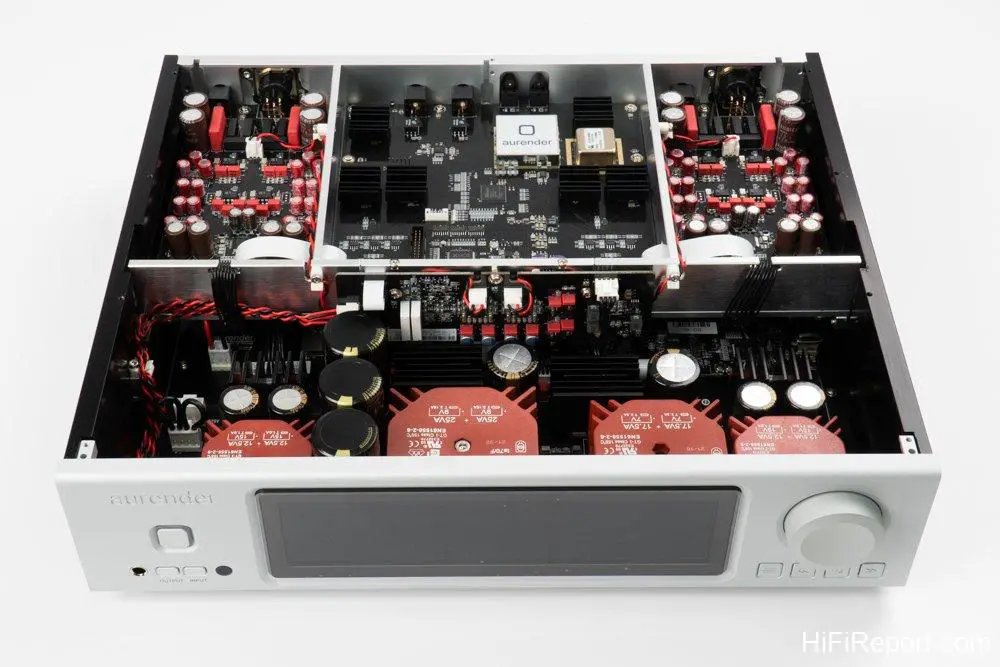
The A20 employs a fully linear power supply design throughout, complemented by extensive power supply shielding to prevent noise from reaching the sensitive DAC circuitry.
The A20 houses four sealed toroidal transformers, dedicated to powering the server system, digital output, and the left and right channel DACs, respectively. It is also equipped with a supercapacitor-based UPS (Uninterruptible Power Supply) system, ensuring safe shutdown in the event of a sudden power outage.
The A20’s DAC section not only features independent power supplies for the left and right channels, but also completely discrete circuit boards. These are physically separated, occupying the rear left and right sections of the chassis, ensuring optimal channel separation.
Each channel in the A20 utilizes a single AKM AK4497 DAC chip, supporting playback of PCM up to 32bit/768kHz and Native DSD 512. Users can also choose to upsample PCM signals before decoding, up to a maximum of 705.6/768kHz.
Furthermore, the A20 offers full MQA decoding support.
For master clocking, the A20 employs a temperature-compensated crystal oscillator (OCXO) with a femtosecond jitter rating of less than 100fs. This is paired with an FPGA-based master control circuit to reduce time-base errors to negligible levels, ensuring highly precise data transmission.
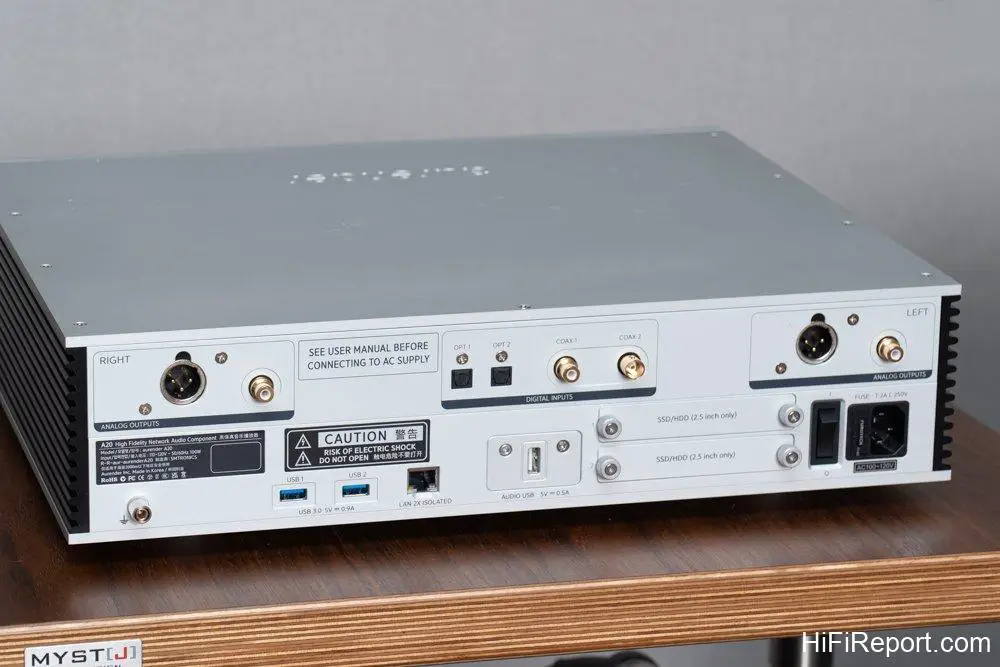
In addition to file and streaming playback, the A20 provides three digital input interfaces: RCA coaxial, BNC, and optical, facilitating connection with other playback devices in your system.
Analog outputs include both RCA unbalanced and XLR balanced options. The output can be configured for either fixed or variable volume. Setting it to variable volume allows direct connection to a power amplifier, simplifying the system configuration.
The A20’s output also offers two gain settings: high and low. In low gain mode, the output is 2.0Vrms (RCA) / 4.0Vrms (XLR), while in high gain mode, it is 2.7Vrms (RCA) / 5.4Vrms (XLR). These gain options allow for easier matching with downstream equipment.
Catering to headphone enthusiasts, the A20 includes a 6.5mm headphone amplifier jack. While simplified in quantity compared to the A30’s three headphone outputs, the A20 retains quality. The headphone amplifier in the A20, like the A30, utilizes a pair of TPA6120A2 amplifier chips, delivering a commendable level of performance.
Exquisite Craftsmanship
The A20’s exterior deserves special mention.
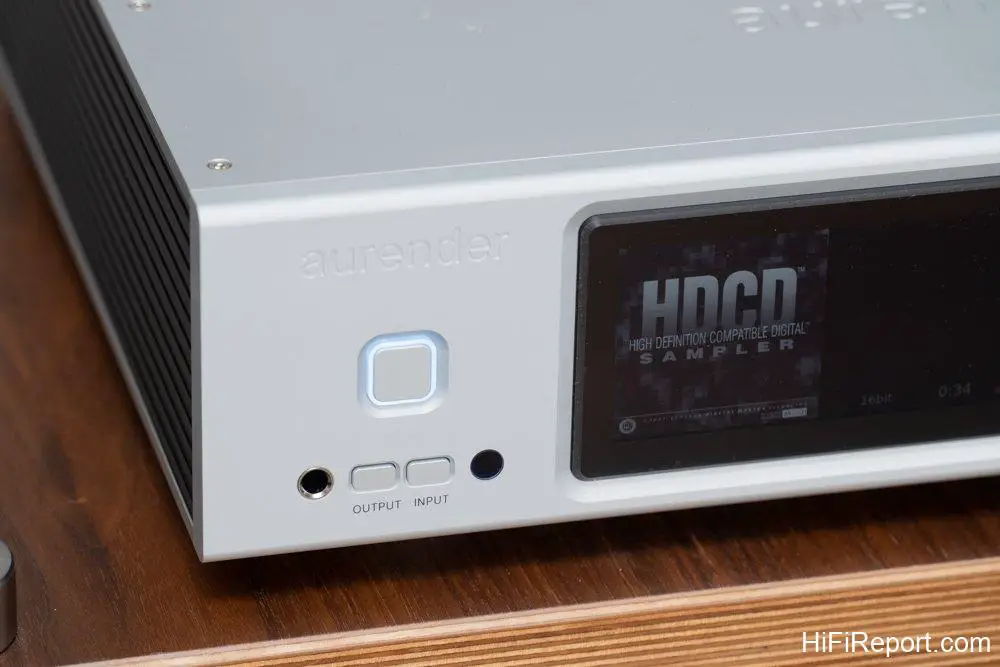
It exhibits an exceptionally high level of manufacturing precision and quality. The metalwork of the chassis and front panel is meticulously machined, and the surface finish is exquisitely refined and detailed. The inclusion of a large, full-color display screen immediately signals its status as a high-end component, fully justifying its premium price point.
Operationally, all playback controls and function settings for the A20 are managed through Aurender’s proprietary Aurender Conductor app. This app is available free of charge for both iOS and Android platforms.
The Aurender Conductor app adopts a predominantly single-page layout, integrating all functions and control buttons within a single screen. While this can present a wealth of information and smaller text, it minimizes the need for page navigation or searching during use.
The Aurender Conductor app also seamlessly integrates Tidal and Qobuz. Subscribers to these services can log in to their accounts and stream Tidal or Qobuz through the A20, complete with search functionality.
In terms of usability, a major advantage of the A20 and the Aurender Conductor app is their stability, inspiring absolute confidence.
Throughout the entire listening evaluation, the A20 performed flawlessly without any issues. The transitions between various music formats were seamless and fluid, without any stuttering or unexpected noises.
Furthermore, the Aurender Conductor app proved equally robust, without any crashes or lag. Even after being idle for an entire day, reopening the app on the iPad Pro instantly restored the previous playback screen, offering immediate and responsive playback.
In contrast, my personal Roon system, controlled via an iPad, experiences app crashes at least daily, demonstrating a less stable performance.
All-Encompassing Performer
Listening to the A20 was an exceedingly enjoyable experience. Beyond its exceptional sound quality, its “three-in-one” comprehensive functionality made daily listening remarkably convenient.
My personal streaming playback system is comprised of three separate components: a NAS running Roon Core, an Auralic Aries G1 wireless streaming transport for playback, and a Holo Audio Spring 3 DAC. This three-component setup necessitates three power cables, network cables, digital cables, and dedicated space for each unit, which can be somewhat cumbersome. The A20 consolidates the functions of these three devices into a single unit, potentially even eliminating the need for a preamplifier, greatly simplifying the system.
Moreover, the manufacturer recommends leaving the A20 powered on continuously, only requiring shutdown via the front panel button or app if it will be unused for several days.
The A20 lacks a standby mode; once listening is finished, simply leave it as is. It will automatically enter a low-power state. When you wish to listen again, simply pick up your control device, press play, and playback resumes instantly without any waiting.
During normal playback, the A20’s chassis gradually warms to a moderate temperature. This is often when it sounds its best, exhibiting a sound profile that is cohesive, open, and vibrant, with excellent sonic density.
After playback ceases, the temperature slowly decreases, indicating the A20 is in a low-maintenance, standby state, ready for immediate use. This suggests that while the A20 doesn’t need to be turned off, it does benefit from a warm-up period to reach its optimal sonic performance.
The listening evaluation was conducted in my home, using the following associated equipment: Electrocompaniet EC 4.8 preamplifier, NuPrime Evolution One power amplifier, and Aurum Cantus Grand Harmony loudspeakers.
The A20 offers multiple analog and digital filter modes, allowing users to fine-tune the sound to their preferences or system characteristics. During the review, I utilized the default factory settings without making any adjustments.
Sonic Qualities
The sonic strengths of the A20 are primarily evident in two areas: first, its exceptional sonic density and weight, capable of conveying the authority of large-scale orchestral works; and second, its superior soundstage and imaging, rendering music with picture-like clarity.
Take, for example, the 2017 Hi-Fi Show Commemorative CD, featuring selections from Steinway & Sons recordings, including piano solos, concertos, strings, and vocals.
Track 3, Bruckner’s “Fantasy in G major,” is a slow, melodically beautiful piece. Through the A20’s playback, I noted that the piano’s timbre was not characterized by crystalline brightness, but rather emphasized the instrument’s resonance and rich reverberation, imparting a slightly nasal, yet lush and fragrant quality to the piano tone.
Being a slow piece, it further accentuated the A20’s excellent sonic density. Piano notes were clear and prominent, with a steady and solid touch. Combined with the substantial scale of the instrument’s lower register, the sound possessed considerable weight.
These characteristics were even more pronounced in Track 5, Beethoven’s “Diabelli Variations, ‘Theme'”. Several phrases consisted of delicate high notes followed immediately by descending passages. Here, the lower register notes exhibited not only decisive force and authoritative weight, emphasizing the solidity of the lower frequencies, but also a remarkably tangible piano image, making for a highly satisfying listening experience.
Similarly, listening to Harry Belafonte’s renowned “Belafonte Sings the Blues” album through the A20 further highlighted Belafonte’s controlled and resonant baritone voice. The double bass pizzicato notes were distinct, with a taut and springy texture, full of “catgut”-like elasticity. The saxophone, in particular, possessed a rich, resonant nasal quality, making it exceptionally captivating.
Orchestral Prowess
Beyond its excellent sonic density, the A20’s imaging and soundstage performance left an even stronger impression.
For instance, listening to Canadian pianist Stewart Goodyear’s performance of Tchaikovsky’s Piano Concerto No. 1, even from the opening piano and orchestral unison, the overall musical structure was clearly and methodically presented, perfectly organized. The piano was stable and weighty, authoritative and powerful, showcasing a commanding presence. This demonstrated the A20’s effortless handling of large-scale orchestral works, executed with ease and confidence.
Another example is the 2016 Hi-Fi Show Commemorative CD, featuring a live concert recording by Lü Shao-Chia conducting the National Symphony Orchestra (NSO) at the National Concert Hall.
I have listened to this recording on numerous systems and am quite familiar with it. Immediately upon playback through the A20, I noticed the exceptional soundstage depth, significantly deeper than I had previously experienced. Furthermore, it conveyed the spatial characteristics and scale with remarkable clarity, not just a vague sense of depth. This allowed for clear presentation of the separation, localization, image outlines, and front-to-back layering of each section of the orchestra, avoiding any sense of sonic confusion.
In tracks such as Track 2, Bizet’s “Carmen Suite ‘Overture'”, and Track 3, “Aragonaise”, the A20 precisely reproduced the low-frequency elements, including timpani, low brass, and low strings, with remarkable precision, as if dissecting each layer. Not only were the shapes and locations clear, but the timbral distinctions between different low-frequency instruments were also easily discernible.
This level of clarity and precision is not solely attributable to the A20’s exceptional resolution, but also to its accurate clock circuitry, effectively minimizing jitter to extremely low levels. This ensures accurate transmission of audio data, faithfully preserving the original recording.
A Top-Tier Integrated Solution
Priced as it is, the A20 is not inexpensive. However, considering its components individually, the A20 is essentially a three-in-one device, encompassing a high-end music server, a feature-rich streaming player, and a dual-mono DAC. Each of these sections is built to the highest standards, powered by linear power supplies, leaving no room for compromise. Purchasing these three components separately, along with suitable high-quality cables, would likely be even more costly. Crucially, the stability and reliability might not match that of the integrated A20.
If you prioritize system simplicity, ease of use, comprehensive functionality, stability, reliability, premium build quality, and high-caliber sound, the A20 should definitely be on your shortlist.
Associated Equipment
* **Source:** Auralic Aries G1 Wireless Streaming Transporter
* **DAC:** Holo Audio Spring 3
* **Amplifier:** Electrocompaniet EC 4.8 Preamplifier / NuPrime Evolution One Power Amplifier
* **Speakers:** Aurum Cantus Grand Harmony
* **Cables:** Harmonic Technology Para-I Balanced Interconnects / Linkomm CAT-8 Network Cable / Telos QAC Power Cables / Neotech NES-3001 Speaker Cables / Gortham 85025 Power Cable
* **Accessories:** MYSTJ Audio CMS Audio Rack / ASI Tuning Devices / Telos GNR V5.1 Active Grounding Noise Reducer
Specifications
* **Type:** Music Server Player
* **Bit Depth and Sample Rate:** Up to 768kHz / 32bit PCM, DSD DoP 256, Native DSD 512 (Internal File Playback)
* **Hard Drive Space:** Two rear-panel removable 2.5-inch drive bays
* **Cache:** 480GB M.2 NVMe
* **DAC:** AKM AK4497 chip, dual-mono design, dual-mono linear power supply
* **Power Supply:** Linear power supply
* **Display:** 8.8-inch 1920 × 480 Color IPS LCD
* **Digital Inputs:** SPDIF RCA, SPDIF BNC, Toslink, USB Audio 2.0, USB 3.0 for data
* **Network:** RJ45
* **Digital Output:** USB Audio (up to 32bit / 768kHz PCM, Native DSD 256, DSD DoP 128)
* **Analog Outputs:** RCA, XLR, 6.3mm headphone
* **Internal UPS:** Supercapacitor UPS
* **Dimensions:** 430 × 111 × 355 mm
* **Weight:** 17 kg