
Ayre QX-8 DAC Review
Opening the box and taking out the QX-8, the unit is surprisingly light.
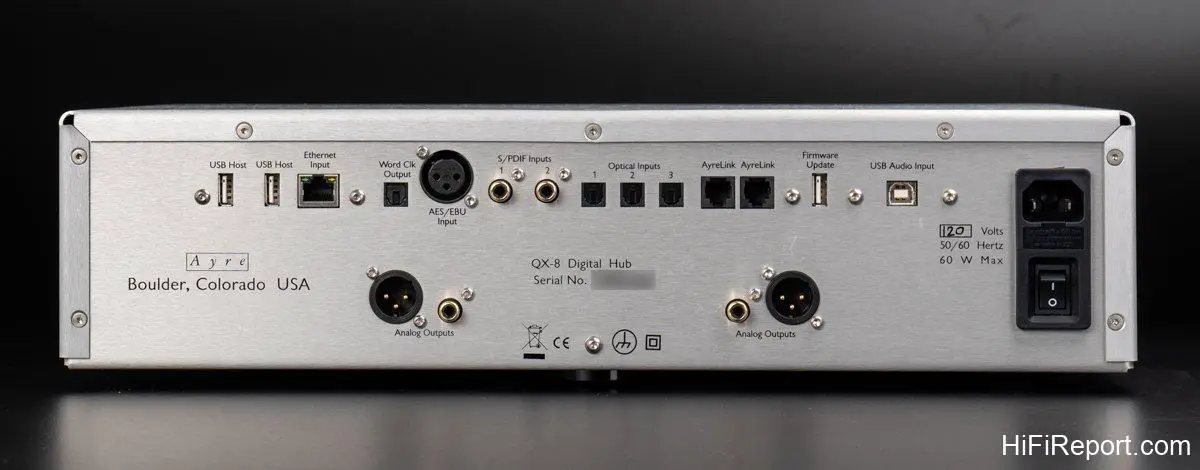
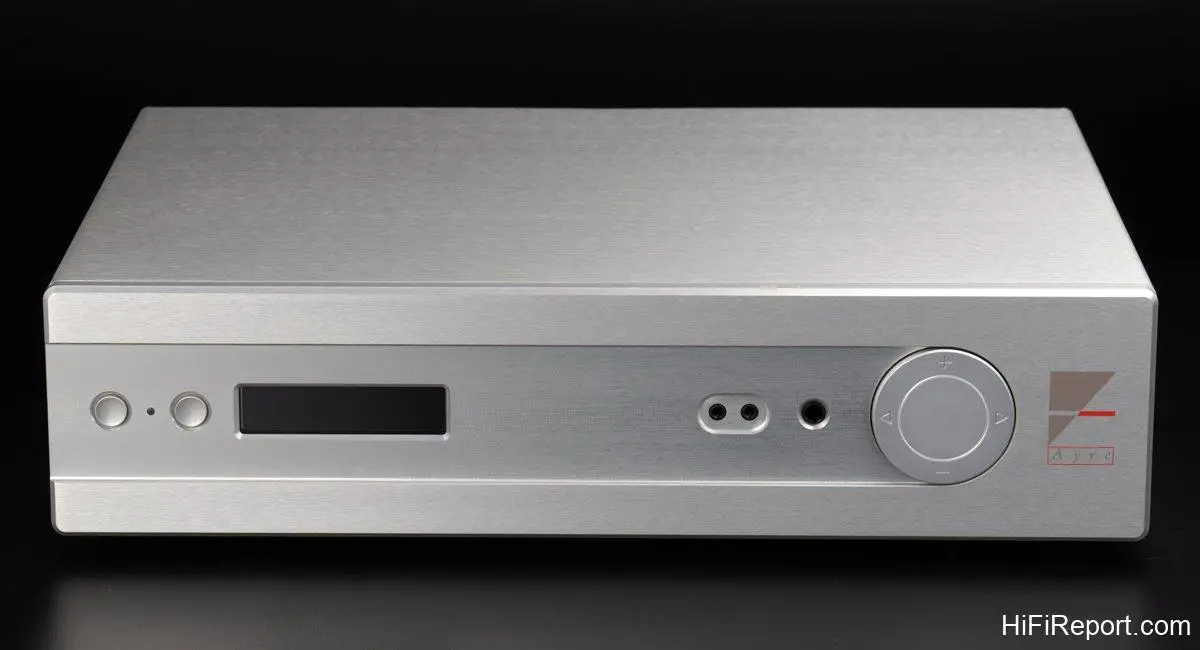
The chassis design is almost identical to the EX-8 integrated amplifier, which we previewed at the editorial office two years ago. The buttons, display screen, headphone jack, and trim panels are all the same.
The only difference lies in the knob. The EX-8, being an integrated amplifier, requires a volume knob, while the QX-8, as a digital source, does not. Instead, it uses a control disc of the same size.
Currently, the 8 series also includes the CX-8 CD player, which has also been showcased. It shares the same design, but with the addition of a drawer-type CD tray.
Like the previous 7 series, Ayre’s 8 series features a unified design, giving the entire line a cohesive aesthetic.
The QX-8 is essentially a version of the EX-8 without the amplification circuitry.
Ayre’s International Sales Manager, Brent Hefley, stated in a 2018 interview that the 8 series is designed to meet various consumer needs. For those wanting an all-in-one audio solution, there’s the EX-8 integrated amplifier. For those needing only a digital source, there’s the QX-8. For better drive and sound performance, there are the KX-8 and VX-8 pre- and power amplifier separates (not yet released). For CD listening, there’s the CX-8 (not yet released), and for vinyl, there’s the PX-8 (not yet released).
Moreover, for the QX-8, the factory offers modular configuration options. Starting with a pure S/PDIF input version, users can separately purchase asynchronous USB input and network streaming functionalities. The unit I have on hand is the fully equipped deluxe version.
Ayre aims to personalize audio equipment selection, allowing you to experience customization options similar to those offered by high-end car manufacturers.
When the EX-8 first arrived in Taiwan in 2018, Editor-in-Chief Guo Hanchen wrote a review. Since the QX-8 is almost identical to the EX-8, just without the amplifier circuits, did I still need to write a review? Rereading the Editor-in-Chief’s article put my mind at ease.
His focus at the time was on the amplifier performance, with more emphasis on the product’s story and spirit.
Good! I still have something to write about.
Up to 8 Digital Inputs
Ayre calls the EX-8 integrated amplifier with built-in streaming DAC an “Integrated Hub,” while the QX-8, with its amplifier circuits removed, is termed a “Digital Hub” as a DAC with streaming capabilities. This indicates Ayre’s intention for the EX-8 to be the central hub of an audio system, and for the QX-8 to be the central nexus of digital sources.
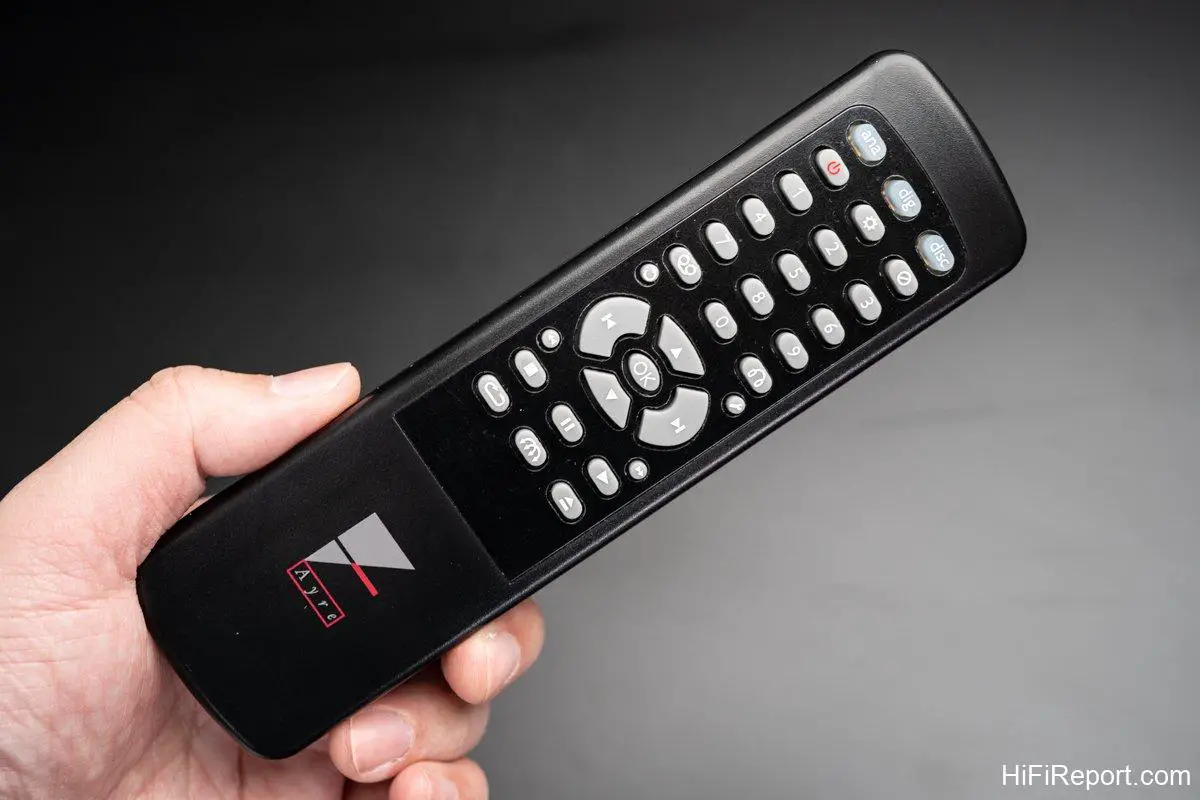
As a Hub, the QX-8 is equipped with a rich array of input terminals: it has 1 AES/EBU, 2 RCA coaxial inputs, and 3 optical inputs—more than the EX-8. These terminals support PCM signals up to 24bit/192kHz and DSD64 (DoP) file decoding.
The fully equipped deluxe version I have also includes a USB Type-B input and an RJ45 network input. Network streaming supports the highest sampling rates, up to PCM 24bit/384kHz and DSD128 (DoP).
It might seem that the digital decoding specifications haven’t kept up with the market’s top standards. In fact, the decoding core of the Ayre QX-8 uses an ESS ES9038Q2M DAC chip. This common 32-bit DAC can handle up to 384kHz and DSD512 data.
Ayre hasn’t fully unlocked all the chip’s capabilities, choosing only what they deem necessary.
In practical use, these decoding specifications are already more than sufficient.
Do you really have that many DSD128 or PCM 384kHz and above files? Considering the files offered by mainstream streaming platforms like Spotify, Tidal, and Qobuz, the QX-8’s specifications are more than adequate.
Multi-Technology Digital Circuitry
Moreover, audio equipment should not be judged solely by specifications. Beyond the numbers often lie a manufacturer’s true expertise.
For the QX-8, its S/PDIF input is equipped with Ayre’s own asynchronous transmission technology, similar to the USB input, resulting in even lower jitter.
It also incorporates Ayre’s custom ultra-low phase noise master clock and employs Ayre’s proprietary minimum phase digital filter. After the digital signal input, a Spartan 6 FPGA chip performs 16x oversampling.
Do you see? What you’re paying for isn’t just impressive numbers, but the manufacturer’s design and technology.
Analog Stage Inheriting Brand Philosophy
In terms of analog circuitry, the QX-8 continues to uphold Ayre’s design principles, which have been insisted upon since Charles Hansen’s era: zero negative feedback, fully balanced discrete circuitry. Charles firmly believed that this approach leads to more natural and purer music reproduction.
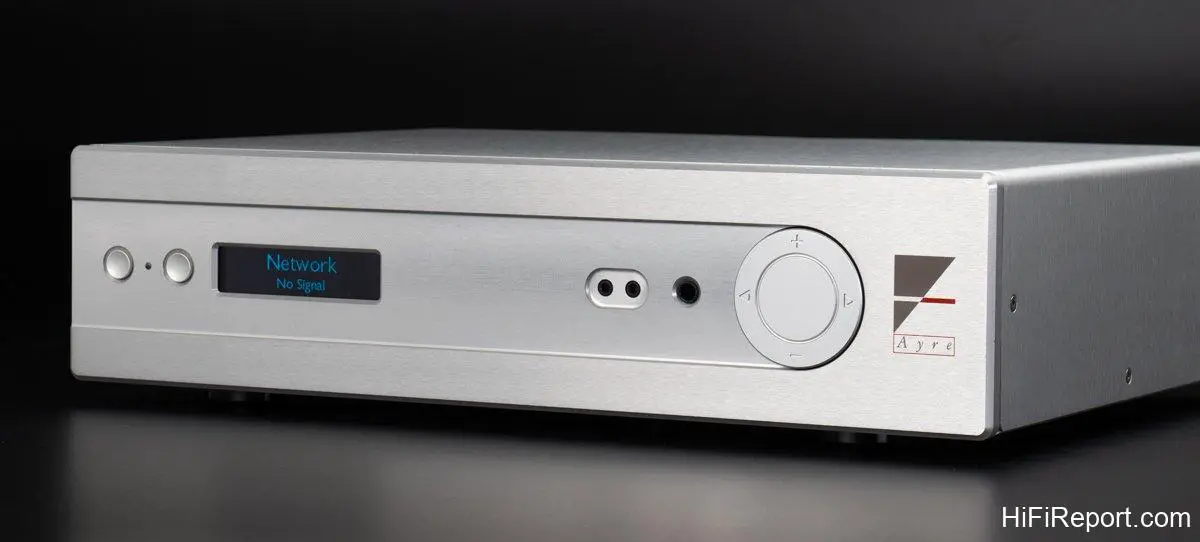
The gain stage utilizes Ayre’s unique Equilock gain circuit, employing JFET transistors for voltage amplification. The output stage features a Diamond circuit for output buffering. Connectivity includes one set each of XLR balanced and RCA single-ended outputs.
Power Supply Investment
Ayre has also invested heavily in the power supply.
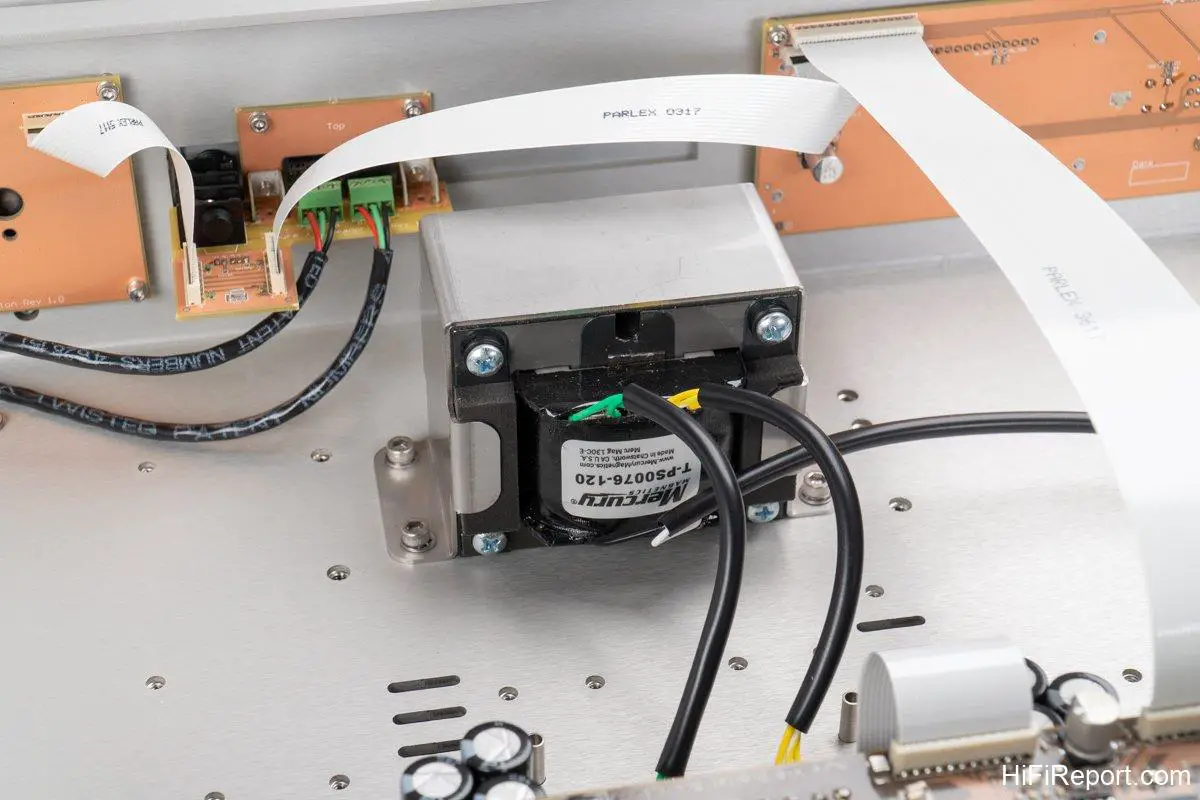
The power supply is linear, using a custom EI transformer paired with low ESR Rubycon filter capacitors to provide the cleanest power possible.
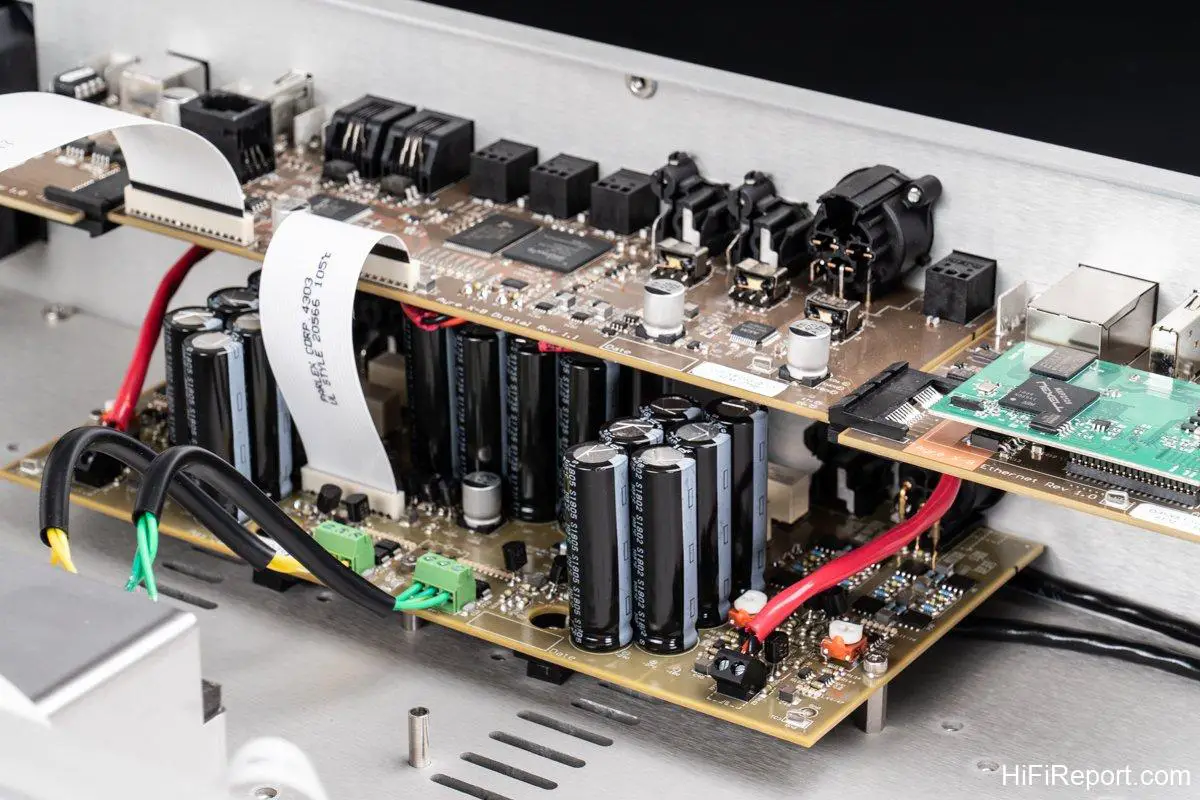
Each section of the circuit, including the analog circuits, DAC, and crystal oscillator, has its own dedicated voltage regulation path. The regulation employs Ayre’s AyreLock voltage regulation circuitry.
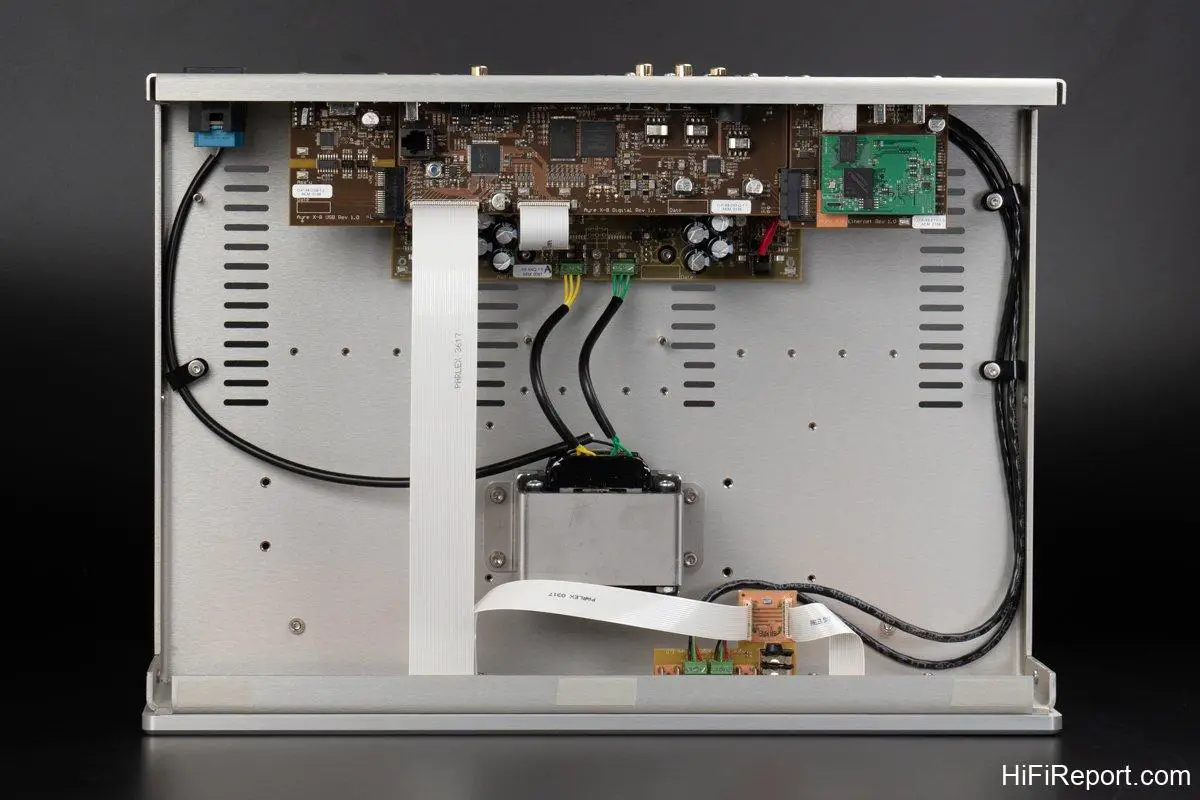
To further minimize interference, the QX-8 uses a 6-layer circuit board, allowing each circuit path to be routed optimally without internal wiring or stacking, and without requiring an excessively large circuit board.
Diamond Headphone Amp from Codex
The headphone jack on the front panel offers both single-ended and balanced headphone outputs.
For the headphone amplifier circuit, it uses the same Diamond amplifier circuit found in Ayre’s popular Codex headphone amplifier.
However, Ayre, whether in the Codex or the 8 series, has chosen dual 3.5mm jacks for the balanced headphone output. Compared to the more common 4.4mm, 2.5mm, or XLR connectors, headphones with dual 3.5mm connectors are quite rare. Perhaps the manufacturer could consider using other types of connectors in the future.
Don’t just look at Ayre’s internal photos and say they are selling “air.” The depth of their engineering is something you might not realize.
Piano Performance: Rich, Full, and Powerful
The depth of technology translates into the depth of sound.
The QX-8’s understated and simple appearance belies its rich musicality.
I brought the QX-8 home to savor it slowly and carefully.
My home system consists of JMR Abscisse Jubile speakers, Lavardin IS Reference and Audiomat Adagio amplifiers. Music playback is primarily via Roon, with files from Tidal and Qobuz, as well as my NAS storage. A network switch, the Ansuz PowerSwitch A2, is incorporated into the streaming path.
Once everything was set up, I opened the Roon Remote app on my iPad, pressed play, and the intoxicating musical experience began.
Listening to Danilo Rea’s *Lirico* album, featuring opera excerpts, all tracks are brilliantly re-arranged by Danilo Rea, infused with jazz improvisation while retaining the vocal quality of piano solos.
This is an exceptionally brilliant piano album.
The piano sound from the Ayre QX-8 is particularly round and full, with a rich texture and a clean sonic background, making each note sound robust and powerful.
In “Sogno di Doretta,” the syncopated rhythms create a musical improvisation that is both poetic and intoxicating.
The delicate grace notes, faint yet distinct, are not glossed over. The QX-8 renders these soft, fleeting embellishments with clarity and finesse.
The piano notes are solid and full-bodied, making musical phrases even clearer. Listening to the soaring highs, the glistening sparkle of the struck keys warms the entire space.
Then, listening to “Mon Coeur S’Ouvre a Ta Voix Da,” the famous aria from *Samson and Delilah*, Danilo’s pauses are like breaths and shifts in singing, so full of emotion that one cannot help but feel as lost in Delilah’s seductive charm as Samson himself.
Listening to the continuous bass notes wandering in the lower register at the end of the piece, deep and weighty, they weave a profound black hole, drawing the listener’s soul in.
Don’t accuse me of being overly sentimental; listening to opera is about being emotional. Only emotional people understand opera, even when it’s dressed in jazz attire. It’s worth exchanging your soul for it.
The QX-8 portrays the piano exquisitely and renders music richly.
Expansive Soundstage, Layered Sound
If a solo piano performance is convincing, adding an orchestra only amplifies the scale and grandeur, which still poses no challenge for the QX-8.
Brahms’ Piano Concerto No. 1, the first movement starts with somber entanglement and awe, followed by tender lyrical themes. A single movement contains diverse expressions and intense tension.
I listened to the version performed by Helene Grimaud on piano, with Andris Nelsons conducting the Bavarian Radio Symphony Orchestra.
Nelsons excels at clarifying the interwoven layers of music, guiding you through a clear textual understanding. The Bavarian orchestra is known for its transparent and detailed timbre. Combined with Grimaud’s elegant yet composed and rational piano playing, the performance avoids sentimentality and excessive weight, making it an easily enjoyable version.
The powerful, conflicting, and tense introduction unfolds clearly. Nelsons and the Bavarians deliver such clarity and transparency.
I appreciate the soundstage presented by the QX-8 here, wide and deep, with high cohesiveness in the musical notes. The interspersed woodwinds have clear outlines.
When the fortissimo passages arrive, the full orchestra emerges with composure. Nelsons’ handling is truly masterful, and the QX-8 exhibits such ease and composure in conveying these dynamic shifts.
After a lengthy introduction, Grimaud’s piano solo enters, with such elegance, crisp yet solid, the crystalline, luminous piano notes shimmer like starlight.
The QX-8’s piano performance not only conveys rich and full texture but also exhibits a crystalline and translucent color palette.
Musicality and Tangible Presence
Regarding the texture of instruments, the QX-8 is also truly captivating.
Although its appearance is unadorned, its sonic character is richly flavorful.
Take Beethoven’s Violin Sonata No. 10, performed by Liza Ferschtman on violin and Inon Barnatan on piano, as an example.
This piece is dedicated to Archduke Rudolf, and the music radiates a joyful atmosphere.
The opening motif of the first movement is first played by the violin with vibrato phrases, accompanied by the piano. Subsequently, the roles are reversed, with the piano taking the lead and the violin supporting, clearly stating the theme of mutual appreciation and companionship in this piece.
Listen to the sweet and elegant violin, the sonorous notes full of presence, singing continuously and smoothly.
The texture of bow-string interaction is clearly audible but not intrusive. Is this what we commonly call “musicality”? Yes, the QX-8 is just like that, subtly conveying the music to you, not just the sound.
The delightful fourth movement uses a folk-like melody as its theme, followed by seven variations.
Listening to the diverse facets brought by each variation, a simple and unadorned melody can transform into so many postures and styles.
Some are gentle, some are passionate, some are joyful, and some are lyrical.
Listen to the decisive triplets in the second variation, the intense emotion of the third, the delicate and ethereal fourth, and the melodious and profound fifth variation in adagio.
The expressions of piano and violin change constantly. The QX-8 depicts the piano notes with more than just grain, solidity, bow friction, delicacy, softness, fullness, and power. That almost tangible presence, along with the flowing and changing music, stirs the heart.
Warm and Detailed Vocals, Realistic Vocal Lines
If you believe that vocal reproduction should have a human touch, with a warm and full-bodied sound that is not overly thick and loses liveliness, then you will likely be satisfied with the QX-8’s performance.
Take Renée Fleming’s crossover album *Christmas in New York*, for instance. It features collaborations with various elites, creating a brilliant Christmas album.
Fleming’s bel canto style, with a slower tempo and richer body resonance, imbues these Christmas songs with extra warmth.
In “Have Yourself a Merry Little Christmas,” she duets with jazz singer Gregory Porter. Porter’s voice is round and magnetic, while Fleming’s voice has soft contours. The drum accompaniment in the background has clear articulation, providing a steady rhythm after the soulful duet.
In “Merry Christmas Darling,” she collaborates with trumpeter Chris Botti. Fleming’s singing here departs from operatic style. The way she tapers off the final notes shows she is not a novice in singing jazz-pop songs.
The QX-8 depicts these vocal nuances not just by giving you warmth, breath, and sibilance. When you understand the nuances of the singing style, feel the texture, and further recognize the performer’s skill and effort, the listening experience becomes much more rewarding.
Here, the QX-8 acts like a teacher, pointing out details, making you hear this and that. Ah, music is indeed so beautiful!
Streaming Software Operation
If you are a Roon enthusiast like me, you will probably instinctively use Roon to play music.
If you are not a Roon user, there are other options.
Ayre does not offer its own app and recommends using third-party software. The manufacturer suggests using mConnect for operation.
mConnect is a practical control app that I have also downloaded. It can be used with any UPnP/DLNA compatible player. The interface is intuitive, and you can become familiar with it after using it a few times.
Besides accessing NAS storage within the local network, it also provides connections to streaming services like Tidal and Qobuz.
Alternatively, if you are hesitant to pay for a Roon subscription, you can choose players like Audirvana, which costs significantly less. These types of playback programs, installed on a computer, are also very user-friendly, and operating them on a larger screen is more convenient.
Further Exploration
There are still ways to further improve the sound of the QX-8.
You can enhance the power supply, including changing the power cord and adding power conditioning. You can also use the small wooden tuning blocks that Ayre provides as isolation feet. Furthermore, you can optimize your network environment to improve streaming performance.
Who says digital equipment offers no room for tweaking? Who says digital music is a one-dimensional experience?
Pure Listening Pleasure
Although arriving late, the Ayre QX-8 delivers pure listening pleasure, making the wait worthwhile.
In classical music, it conveys the inherent texture of instruments and provides a wide and deep soundstage with layers. Whether it’s small-ensemble chamber music, solo pieces, or large-scale orchestral works, it exhibits effortless confidence.
Its full, rich, powerful, open, and relaxed sound is equally at home with jazz and pop music.
Its rich features and versatile connectivity allow it to serve as the digital hub of your system.
This is the second Ayre 8-series component I’ve experienced. What will be the next one? And when will we get to see it?
Specifications
* Type: Digital-to-Analog Converter
* Input Methods: USB, Optical, SPDIF, AES/EBU, Network
* Supported Sampling Rates: Up to 384kHz PCM, DSD128 (DoP)
* Inputs:
* USB x1 (PCM 24bit/384kHz, DSD128/DoP)
* Optical x3 (PCM 24bit/192kHz, DSD64/DoP)
* Coaxial x2 (PCM 24bit/192kHz, DSD64/DoP)
* AES/EBU x1 (PCM 24bit/192kHz, DSD64/DoP)
* Network/Ethernet (PCM 24bit/192kHz, DSD64/DoP)
* Outputs:
* RCA x1 (2.2 Vrms)
* XLR x1 (4.4 Vrms)
* 6.3mm Single-Ended Headphone Output x1 (4.5Vrms)
* 3.5mm Balanced Headphone Output x1 (9.0Vrms)
* Dimensions: 440 x 330 x 115 mm (W x D x H)
* Weight: 5.7 kg