B&W Nautilus Review
Among the world’s most famous high-end loudspeakers, the British B&W Nautilus undoubtedly ranks in the top three. First unveiled in 1993, it immediately sparked global discussion. After more than thirty years, the Nautilus remains the Nautilus, a dream for many audiophiles. However, many have only “seen” the Nautilus and never “heard” it. Worry not, HiFiReport Audio has gone to great lengths to set them up and make them sing. Those wishing to make a pilgrimage, bring your running shoes and head straight to HiFiReport Audio to investigate!
The True Nautilus Unveiled
I recently received a call from Mr. Lai of HiFiReport Audio (we use Line these days), who mentioned he had been busy with the Nautilus and that it was almost ready for adjustment. He invited the editor-in-chief to visit if time permitted.
I asked, “Is it the recently released Nautilus 801 Abbey Road Limited Edition? I heard HiFiReport secured the first pair?” Mr. Lai replied, “No, it’s the one and only Nautilus, and it’s the latest version.” The editor was taken aback and responded, “Really? Four-way active crossovers require four sets of high-power amplifiers. Won’t a dynamic demonstration be quite costly?” Mr. Lai said, “Otherwise? We have to show our firepower! Arrange a time for you to come and guide us.”
The Editor Rushes to HiFiReport to Learn
Oh dear, Mr. Lai has managed to tease me again. Although I’ve been writing audio reviews for over twenty years, and have interviewed Nautilus owners, and occasionally caught a glimpse at audio shows, I’ve never actually owned or extensively worked with one. How could I possibly understand the intricacies of Nautilus setup and calibration? Mr. Lai wants me to guide him? I wouldn’t dare! I quickly replied to Mr. Lai, “I’ll be at HiFiReport next week, but not to guide, rather to learn. Please don’t tease me, Mr. Lai.” HiFiReport Audio is a venerable establishment. The story of HiFiReport and Mr. Lai was recently featured in an article earlier this year on u-audio.com.tw (https://feature.u-audio.com.tw/featuredetail.asp?featureid=4458), detailing the store’s efforts and dedication to foundational audio engineering. Now, in the latter half of the year, Mr. Lai has impressively brought out the Nautilus, giving me another opportunity to admire this absolute classic of audio history up close.
Inheriting the Founder’s Legacy
The development of the Nautilus project was initiated by B&W founder John Bower in 1987. The research goal was to explore the limits of loudspeaker design without regard for cost. The key objective was to eliminate the negative effects of traditional speaker cabinets, including cabinet resonances, vibrations, and back-wave interference. Sadly, John Bower passed away in the same year, leaving the Nautilus project as his final ambition.

The Nautilus research project was conducted at the Steyning Research Establishment (SRE) in the UK. This research facility was originally established by B&W in the 1970s and specialized in fundamental research in acoustics and loudspeakers. In an environment free from commercial pressures, engineers were able to focus on innovation and experimentation. Early developments like the Matrix cabinet structure were a result of SRE’s research and became the core technology of B&W’s Matrix 800 series.
SRE Invests Five Years in Research
After the passing of founder John Bower, SRE took up his legacy and continued the Nautilus development project. Led by chief engineer Laurence Dickie, with experimental projects supervised by SRE R&D Director Dr. Peter Gryer, and in collaboration with Alison Risby from Brighton College of Art to enhance the industrial design aesthetic of the Nautilus. After five years of development, the Nautilus finally made its debut in 1993.
Traditional speaker cabinets are typically made from MDF due to its reasonable manufacturing cost and ease of creating simple rectangular shapes. However, the material itself can produce resonances and reflections, known as cabinet coloration or, as audiophiles often call it, “tonal impurity.” The research team initially explored bi-directional (dipole) or boxless designs, but the results were unsatisfactory, with obvious discontinuities in frequency response. Numerous prototypes were built, but to no avail.
Practical Application of the Transmission-Line Tapered Tube
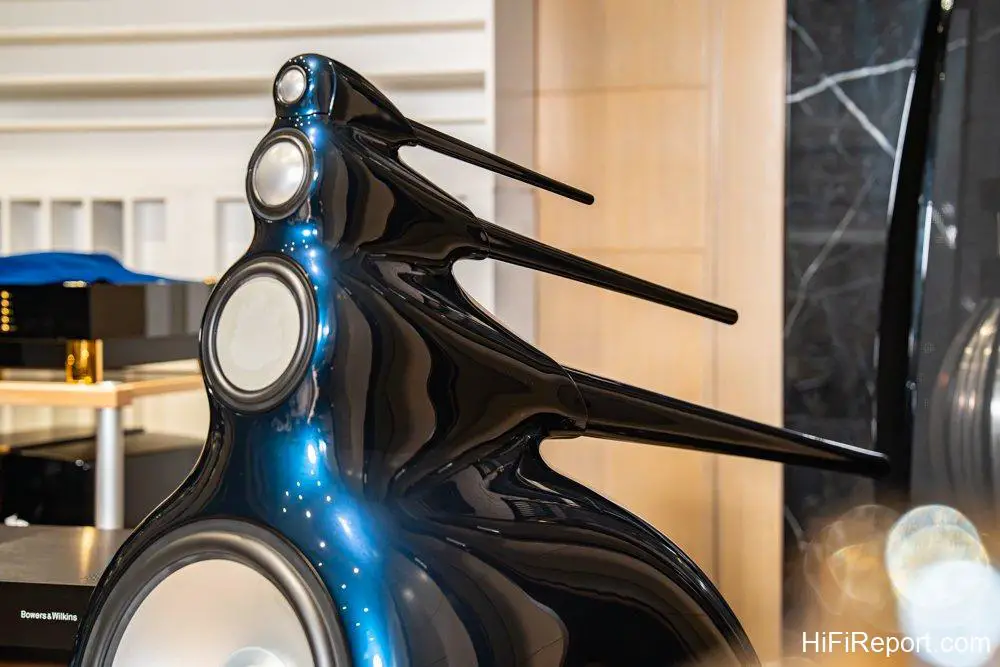
Chief engineer Laurence Dickie ultimately abandoned traditional cabinet materials and bi-directional designs. Instead, he drew inspiration from transmission-line enclosures and designed the Transmission-Line Tapered Tube. This transformed the conventional speaker cabinet into a long transmission-line tube, achieving initial breakthroughs but introducing new challenges. For a four-way speaker, the required length of the bass tube would be 3 meters, making it practically impossible to place outside a laboratory setting.
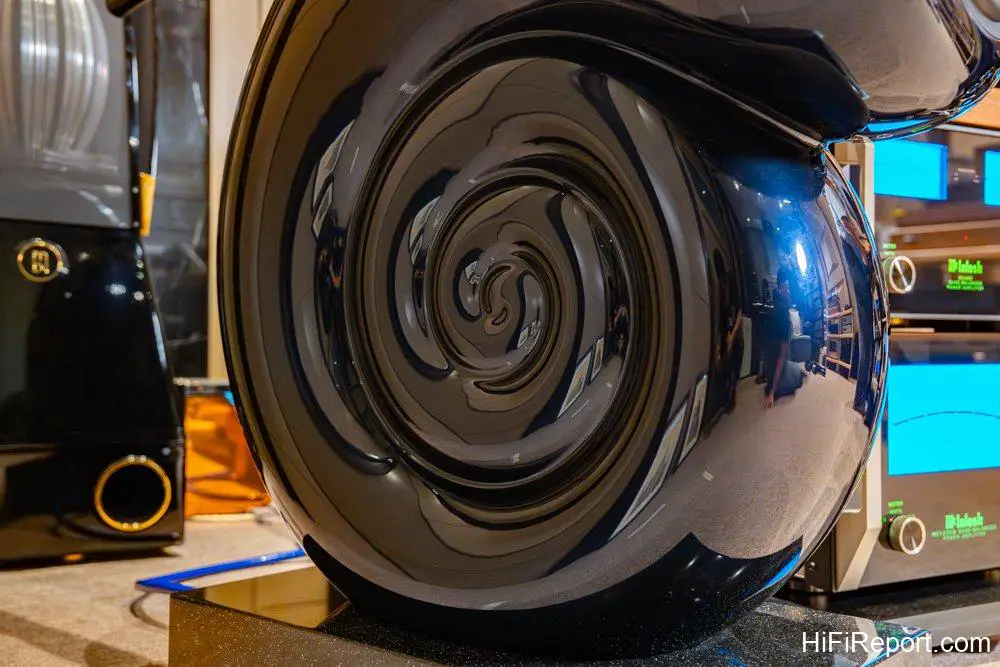
The impracticality of an elongated cabinet led Dickie to a stroke of genius: he transformed the long tubes into “tapered tubes,” wider at the front and progressively narrowing towards the rear. He also bent the straight tubes into a spiral shape, forming the early design prototype of the Nautilus.
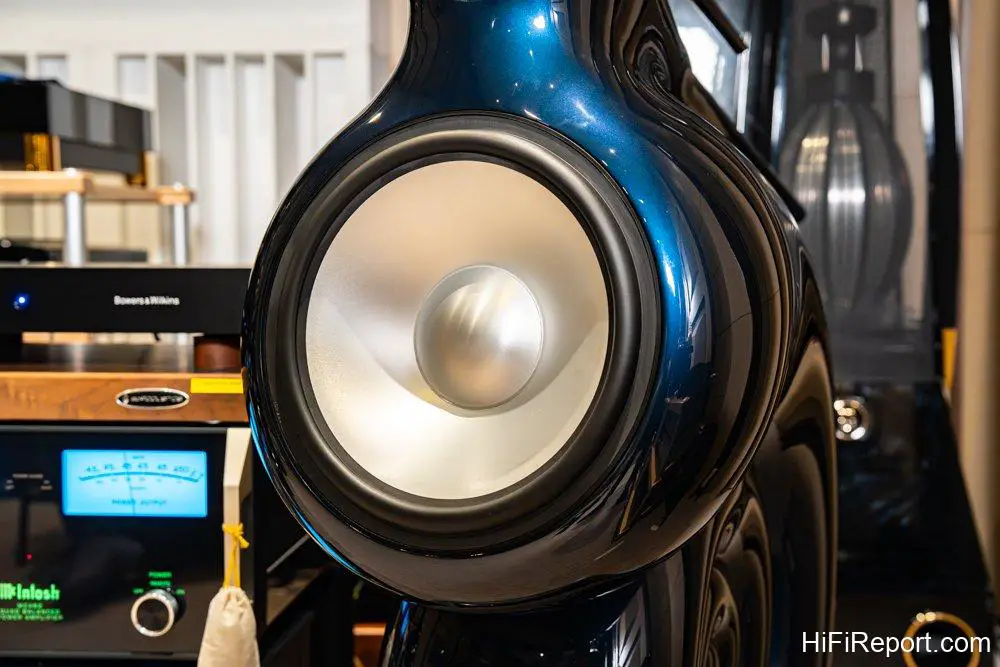
The question then arose: sketching a Transmission-Line Tapered Tube on paper is one thing, but actually fabricating it? Using MDF was nearly impossible. To facilitate shaping, Dickie opted for 10mm thick glass-fiber reinforced ABS material. This offered a lightweight, high-stiffness, and easily moldable solution, allowing for the creation of a seamless Nautilus cabinet. Later, Alison Risby enhanced the exterior design, transforming the “ugly duckling” into a swan.

When the Nautilus first debuted in 1993, market reception was polarized. Enthusiastic audiophiles praised its “unprecedented” innovative design, while many audio magazines published satirical cartoons, mocking the idea of using a snail shell for a loudspeaker. Nevertheless, the Nautilus has remained a B&W flagship for over thirty years, spawning the Nautilus 800 series, which continues to represent B&W’s core loudspeaker technology DNA, possessing immense influence and historical significance.
An Artwork That Sings
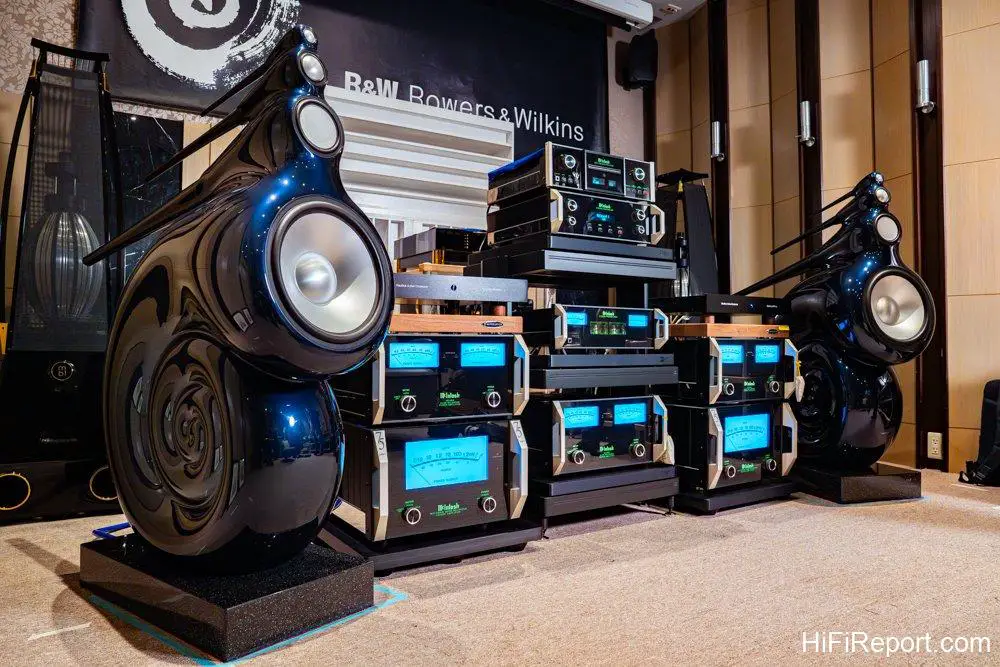
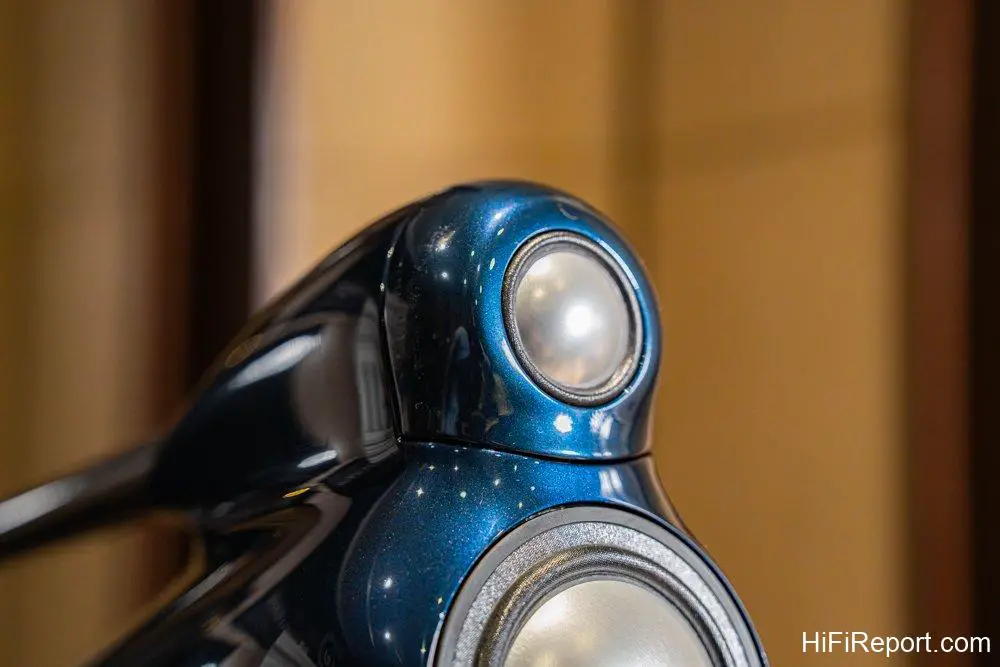
My visit to HiFiReport to audition the Nautilus was, for me, a pilgrimage. Upon entering the HiFiReport Audio listening room, the four-way active crossover Nautilus, in its deep midnight blue finish, was truly stunning. I believe anyone seeing the Nautilus in person would marvel at it as “an artwork that sings.”
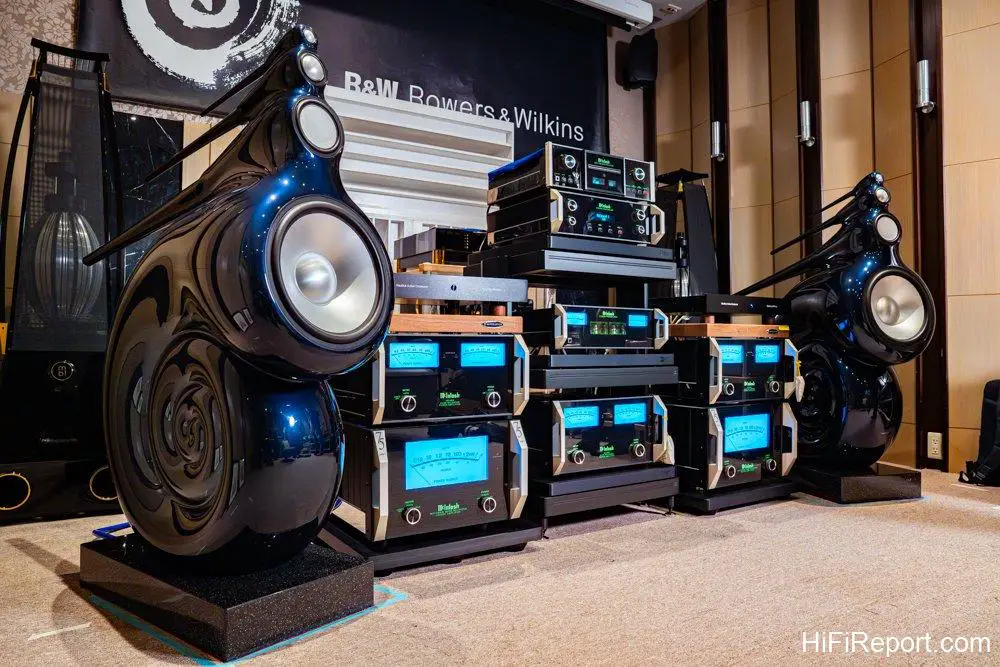
To drive the Nautilus, HiFiReport deployed a full suite of McIntosh amplification. The preamplifier was the C12000 + Controller. Three MC462 stereo power amplifiers drove the high, mid, and low frequencies. The largest 12-inch (300mm) subwoofer was powered by a single MC 1.25 KW monoblock amplifier. For digital sources, a McIntosh MCD 1100 CD player was present. However, anticipating the preference of many for digital streaming, an MBL C41 digital streaming DAC was also set up, subtly positioned behind the McIntosh stack.
Sit Down to Truly Appreciate the Nautilus’s Brilliance
As I stated earlier, I came to HiFiReport as a pilgrim, not intending to write a review. Settling into the prime listening position, I immediately understood why the Nautilus is so enduringly classic. Even in near-field listening from the sweet spot, the Nautilus vanished from the room, creating a remarkably lifelike 3D soundstage behind the speakers. The soundstage width wasn’t confined to the center between the speakers but expanded fully into the space. It was simply magnificent.

Before sitting down to listen, I had been pacing around, examining the Nautilus. The music never stopped, as this pair at HiFiReport had only recently been unboxed and had only a few days of playing time. They were still in the process of “running-in.” As I walked and listened, I thought to myself, “This speaker has a huge reputation, but it sounds rather ordinary.” However, the moment I sat down, I felt an immediate sense of reverence. Indeed, this was the true musical allure of the Nautilus – absolutely brilliant.
Therefore, if you plan to visit HiFiReport to experience the Nautilus, do not begin your audition by standing and listening. You must sit in the sweet spot and then select your preferred music for listening. Otherwise, standing or walking around while listening might lead you to a mistaken judgment.
Thirty Years Ago, They Understood Vertical Dispersion Control
Why is it essential to sit down to listen to the Nautilus? Because the seamless integration of its four-way crossover requires a specific listening position. Furthermore, the Nautilus, designed over thirty years ago, already addressed the issue of vertical dispersion. Its vertical dispersion angle was narrowed to a mere 10 degrees, while the horizontal dispersion exceeds 60 degrees. Consequently, when standing, the soundstage appears to be plastered to the floor, and vocal imaging is indistinct. However, by sitting in the correct position, you can fully appreciate the Nautilus’s extraordinary sonic capabilities.
After sitting and listening to the Nautilus for a while, I reflected on the stark difference between standing and sitting. Mr. Lai then asked me to stand up so he could listen. Following this, Mr. Lai and his colleague began adjusting the toe-in angle. The Nautilus speaker unit itself weighs 44.5 kg, and the base weighs 42 kg, totaling 86.5 kg per speaker. It’s best to have two people adjust them, as it’s otherwise very difficult.
A Small Adjustment Makes a Huge Difference
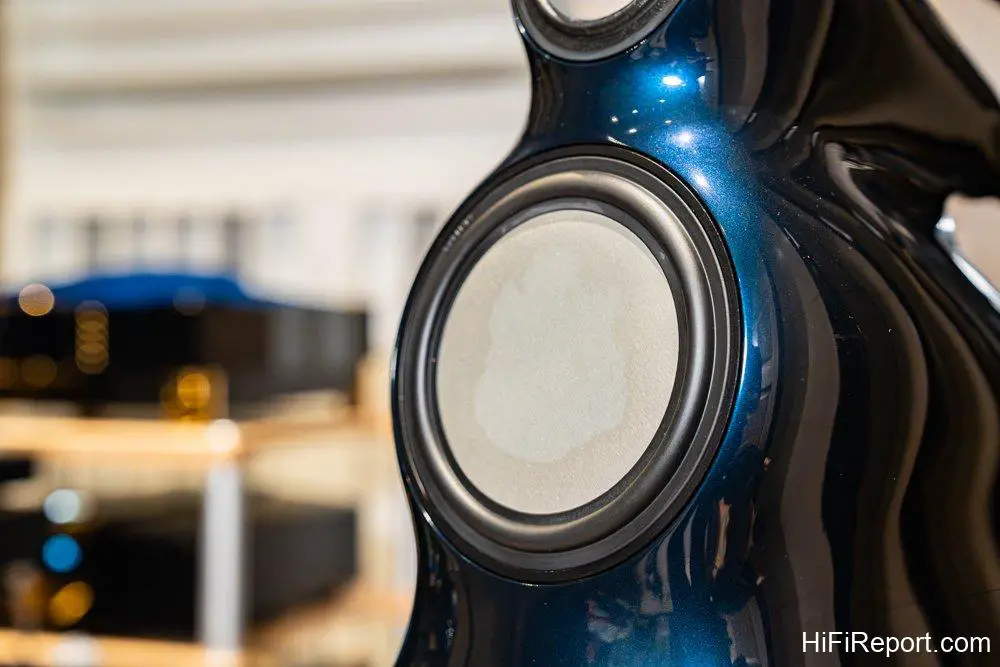
Mr. Lai proceeded to toe the speakers inward by approximately 0.5 cm. This minute adjustment was barely visible to the naked eye, yet upon sitting back down to listen, the improvement was stunning. This small change rendered the 3D soundstage even more vivid, and the bass gained improved depth and elasticity. This pair of Nautilus clearly requires expert calibration to perform at its best.
Mr. Lai explained that over the years, they have sold countless pairs of Nautilus speakers, and they meticulously adjust each one. The speakers are unpacked in two parts. The base is positioned first, and the dedicated Nautilus speaker cable is threaded through it. The cable’s position is slightly secured but not tightened. Then, the main speaker unit is placed on top, and the two parts are assembled.
At this stage, the Nautilus’s tilt angle is not yet finalized. The speaker placement is then determined, followed by fine-tuning the tilt angle based on the listening distance to find the appropriate vertical alignment. Only then can the speaker cables be fully tightened to the main unit. Finally, the toe-in is fine-tuned. These steps are all based on years of accumulated experience. Even though the Nautilus is an exceptional loudspeaker, it may not deliver optimal sound without meticulous fine-tuning.
Fortunately, Reviewers Are Not Suited for Four-Way Active Crossover Speakers
When purchasing audio equipment, it’s always best to buy from knowledgeable individuals. HiFiReport Audio’s decades of experience selling B&W have clearly resulted in a refined expertise. As I’ve mentioned, my visit was a pilgrimage, not a review assignment. The caliber of the Nautilus calibrated by HiFiReport Audio is something you need to experience firsthand; I will refrain from elaborating further.
However, while this audition of the Nautilus was an excellent experience, I’m fortunate I didn’t succumb to temptation. The four-way active crossover configuration presents a challenge for reviewing. If I were to review amplifiers, I would need four units sent simultaneously. It’s unlikely I’d have amplifiers sent to HiFiReport for review purposes. After listening, they would need to be offered as display units at a discount, and having four units sent to me for review would be prohibitively expensive. Therefore, audio reviewers are not suited to purchasing the Nautilus.
Hear It to Truly Understand Its Magnificence
I’ve digressed. Price is a subjective matter for everyone. However, for audiophiles who have never heard the Nautilus, an opportunity now exists. Visit HiFiReport Audio to experience the Nautilus firsthand and understand the profound sonic charm of a classic that has dominated the audio market for over thirty years!