
Cambridge Audio EXA100 Review
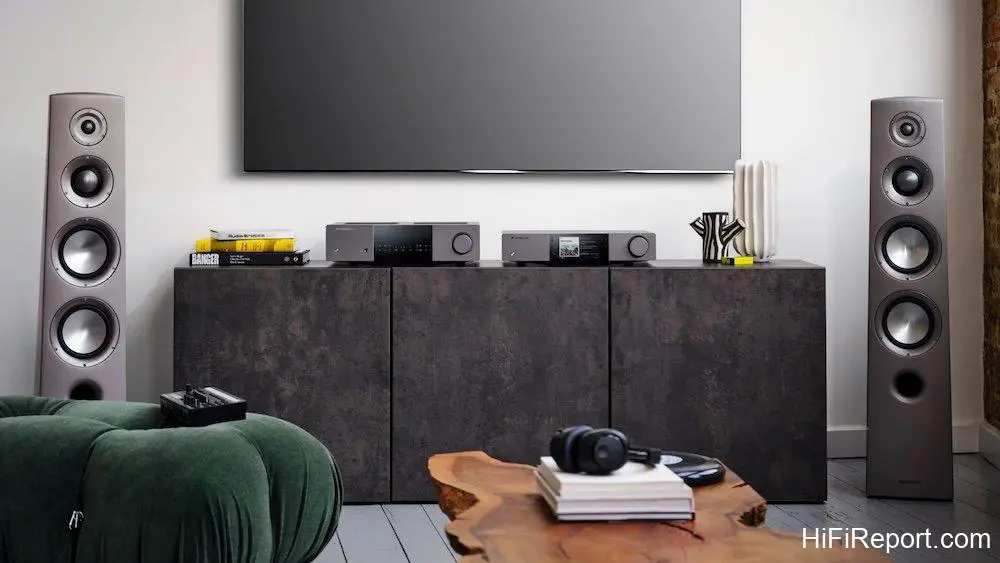
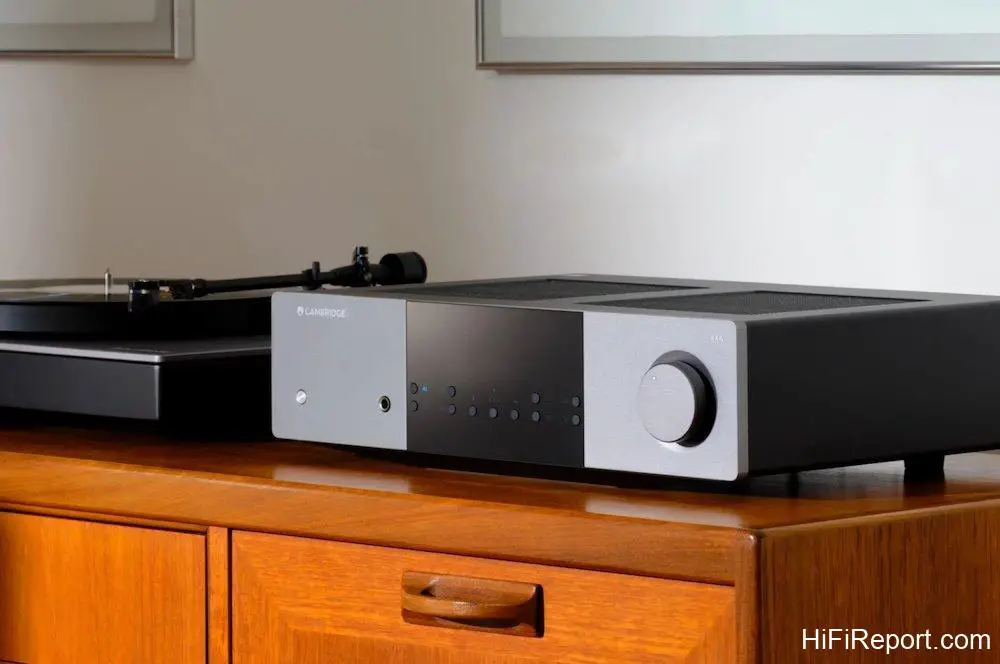
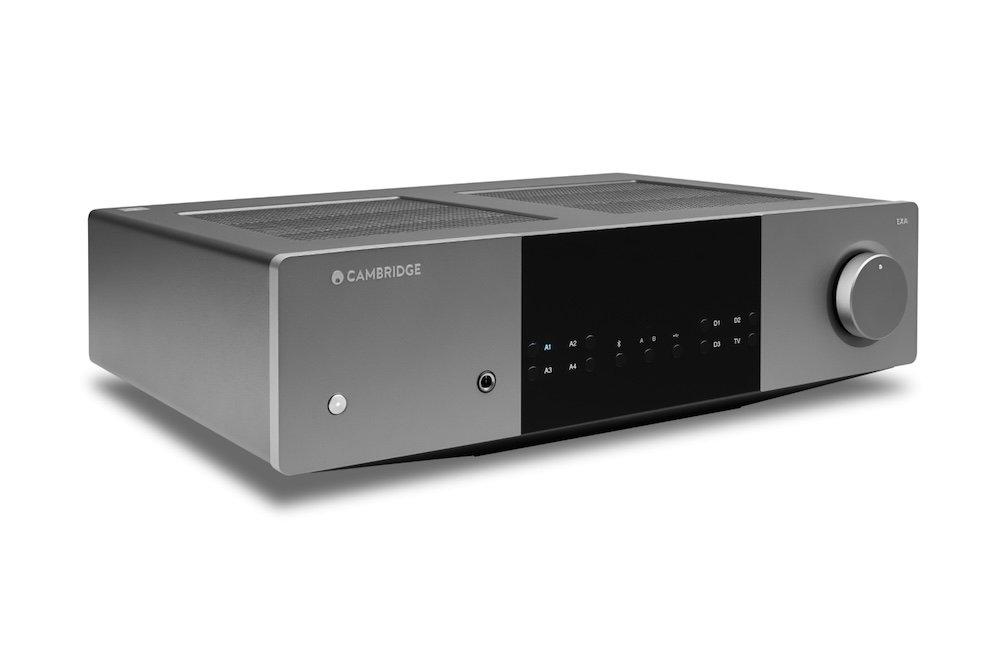
It’s been a while since I last auditioned a product from the British brand, Cambridge Audio. This time, it’s the EXA100 integrated amplifier. Boasting trickle-down amplifier technology from their high-end Edge series, yet returning to a competitive price point, the EXA100 is certainly worth considering if you’re looking for an integrated amp under $3000 that includes a built-in DAC and Bluetooth wireless capabilities. If your budget for an amplifier falls between $1500 and $3000, I strongly recommend adding the EXA100 to your audition list.
Renewed Market Presence
While listening to the EXA100, I found myself reflecting on why I haven’t encountered Cambridge Audio products much in recent years. Reviewing past interviews here at HiFiReport, I suspect the issue lies with changes in distribution. Before J.A. Ning took over the agency for Cambridge Audio, there were two different distributors, which explains the reduced exposure.
J.A. Ning secured the distribution rights for Cambridge Audio in 2024, concurrently adding KEF home speakers to their portfolio. Pairing amplifiers with speakers from these two brands in their marketing efforts is likely to reignite enthusiasm for Cambridge Audio within the audio market.
Owner’s Passion Driving Success
Founded in 1968, Cambridge Audio’s key figure is James Johnson-Flint. I’ve met him twice, although I’ve only written one feature interview about him. The first time, James was accompanied by marketing and sales staff, so I interviewed the sales representative about new products. The second meeting was at a 2018 audio show where James personally launched the flagship Edge series, leading to the feature interview with the CEO.
For readers interested in Cambridge Audio’s history, a simple Google search will yield the company’s brief history on Wikipedia. With over fifty years of history, the initial Cambridge Audio changed ownership twice before becoming a wholly-owned company under James Johnson-Flint. Since the 1990s, it has consistently been a profitable British audio brand. This success is largely due to James himself, whose passion for music drives product development, balancing quality with competitive pricing, making Cambridge Audio a prime choice for many audio newcomers.
Over Three Years in Development
According to Cambridge’s official website, the EXA100 underwent over three years of research and development, including more than 1,000 days of testing and fine-tuning at their London headquarters. Its power amplifier circuit incorporates technology descended from the high-end Edge M monoblock amplifiers, resulting in a refined 100 watts of power capable of effortlessly driving high-end Hi-Fi speakers.
This statement is a direct translation from the Cambridge website, clearly indicating their immense confidence in the EXA100.

Edge Aiming for Hi-End
Recalling my 2018 meeting with James at the audio show and hearing the new Edge pre/power amplifiers for the first time, James excitedly explained how the Edge amplification circuit achieved “less is more,” using fewer components to create the shortest possible signal path. They adopted direct coupling to eliminate potential coloration from coupling capacitors and even employed expensive Ladder DACs paired with MDAC digital volume control to avoid reducing bit resolution.
In essence, the Edge flagship was arguably the most expensive Cambridge Audio amplifier ever, and they placed high hopes on it.

After the interview, I privately asked James if he thought the Edge series, priced between £5,000 and £10,000, would sell well. James, of course, expressed great confidence. After all, the 2018 audio show was the Edge’s debut, and new products generally perform well initially with a global rollout. However, my concern back then was whether the Cambridge Audio brand could support a price point competing with Hi-End brands. Cambridge Audio had long been associated with “affordable good sound,” and raising prices to compete with Hi-End players left me with questions seven years ago when I interviewed James.
Returning to Value-Oriented Audio
Seven years later, encountering Cambridge Audio products again, the market has evidently provided an answer. While the Edge series remains Cambridge Audio’s flagship, it’s clearly not the primary marketing focus anymore.

In 2024, it’s evident that newly launched products like the EVO One, designed almost like a soundbar but functioning as an all-in-one music system, are priced under $1600. While not strictly “serious audio products,” the EVO One offers the simplest path into an audio system for most people seeking easy music listening. Coupled with three levels of “relatively great value” amplifier series, it appears Cambridge Audio has returned to its roots, focusing on delivering “affordable good sound.”
Back in a Competitive Price Range
The protagonist of this review, the EXA100, outputs 100 watts, features a built-in DAC with USB connectivity for computers, and includes Bluetooth wireless – it only lacks digital streaming services. The amplification circuit benefits from trickle-down technology from the high-end Edge series. With a reference price of around $2400, it’s intriguing! Cambridge Audio is back in a price range where they are highly competitive.

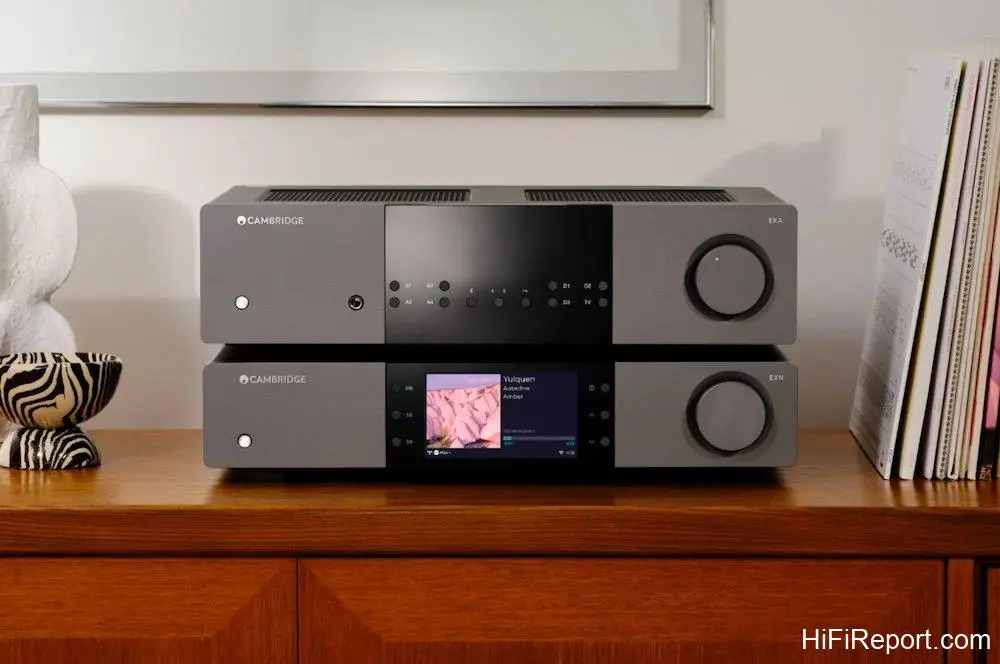
With the addition of the EXA100 to the Cambridge Audio family, their integrated amplifier lineup now spans four tiers: Edge at the top, followed by the EXA100, and then the CX and AX series below. However, as I mentioned earlier, the Edge series seems to have too much brand premium. Therefore, the new EXA100 is likely a key focus for Cambridge Audio, establishing a clear Good, Better, Best hierarchy corresponding to the AX, CX, and EX series’ market positioning.
The Current Flagship Integrated
To serve as the current “kingpin” of Cambridge Audio’s integrated amplifiers, the EXA100 indeed has the substance. Feature-wise, the digital inputs are a highlight. Besides USB, coaxial, and optical, it also boasts aptX Bluetooth wireless input. Apart from lacking digital streaming services, the EXA100’s feature set is quite comprehensive. It uses the ES9018K2M SABRE 32 DAC chip. Compared to the ES9028K2M used in the corresponding EXN100 network streamer, it’s slightly older, but still quite generous. After all, if you spend more for the EXN100 network player, Cambridge Audio naturally provides a newer DAC chip to differentiate the products.
Using the ES9018K2M means the EXA100 supports PCM up to 24bit/384kHz and DSD 256. While not top-tier specifications, it’s more than sufficient for a DAC built into an integrated amplifier.
HDMI and XLR Inputs
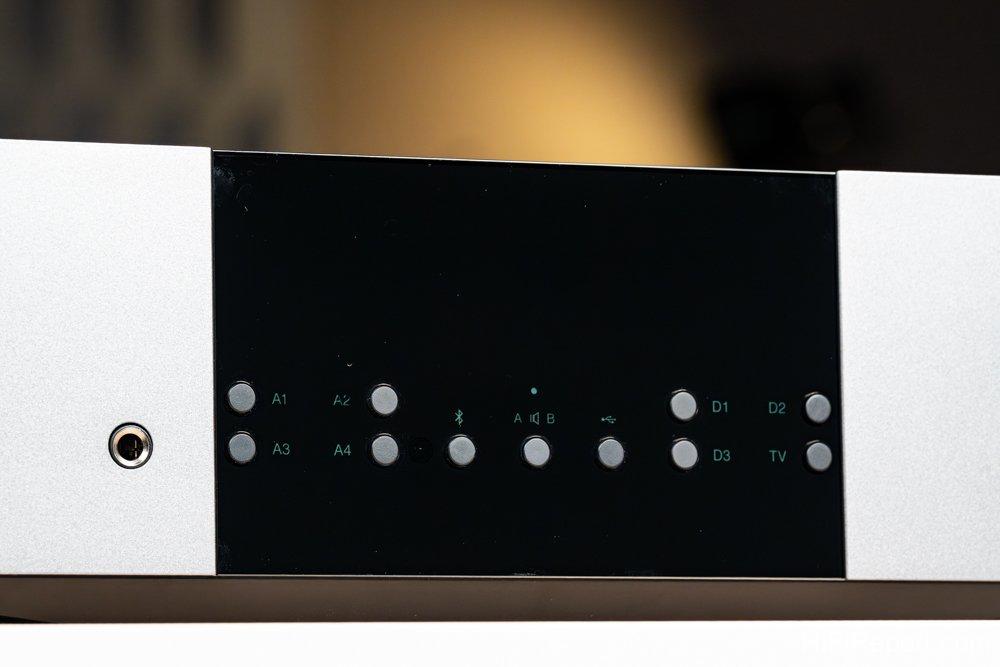
The complete digital input suite allows the EXA100 to function as a digital audio hub. This includes not just traditional S/PDIF inputs but also the addition of HDMI eARC, meaning you can connect your TV to the EXA100 to enhance movie viewing audio quality.
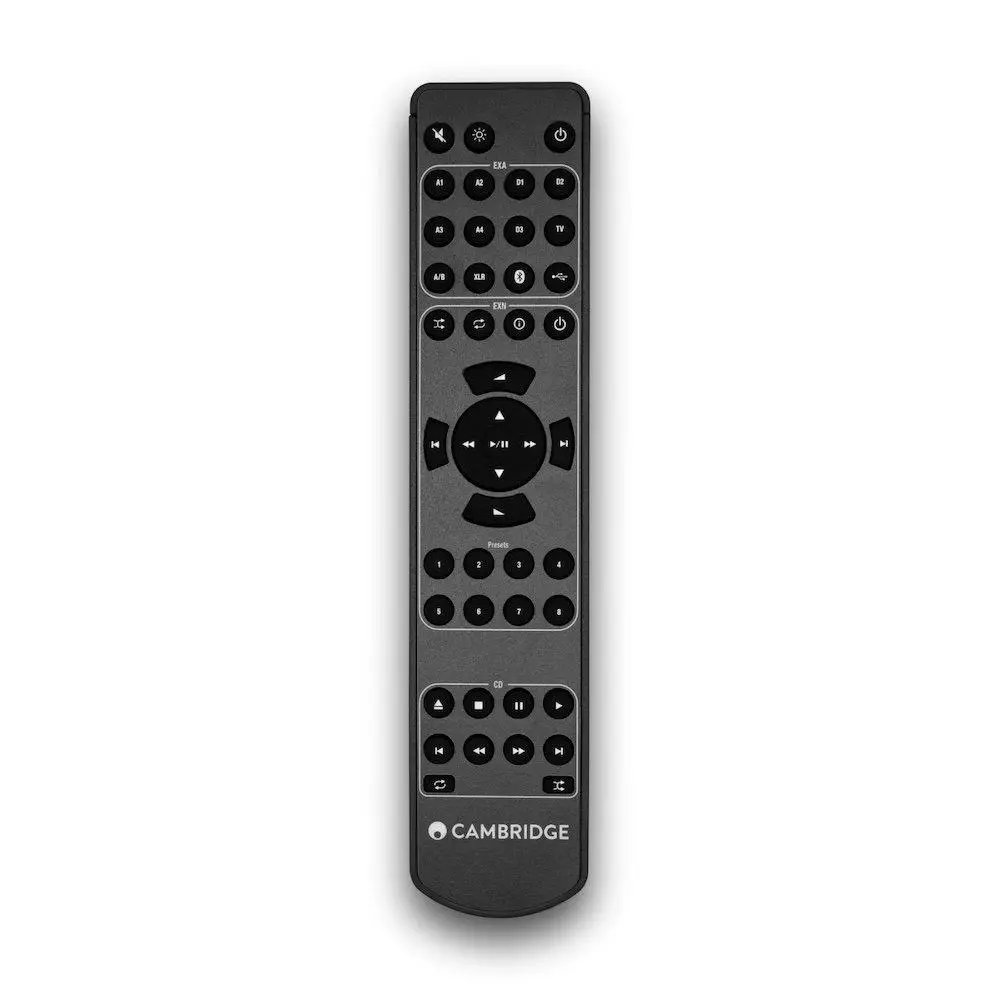
On the analog input side, the EXA100 generously includes XLR balanced inputs, a rarity at this price point. Furthermore, Cambridge Audio provides a complete preamplifier and power amplifier circuit setup. The EXA100 has a Pre-Out and can also switch the A1 input position to function as a “pure power amplifier.” This provides ample flexibility for future system expansion, allowing the EXA100 to act as a preamplifier or power amplifier, or integrate into a multi-channel setup.
To enhance the EXA100’s versatility, Cambridge Audio has equipped it with dual speaker terminals (A+B) that can drive two pairs of speakers independently. If you want to set up a multi-room system using a single EXA100 to power two pairs of speakers, you can.

Massive Shielded Toroidal Transformer
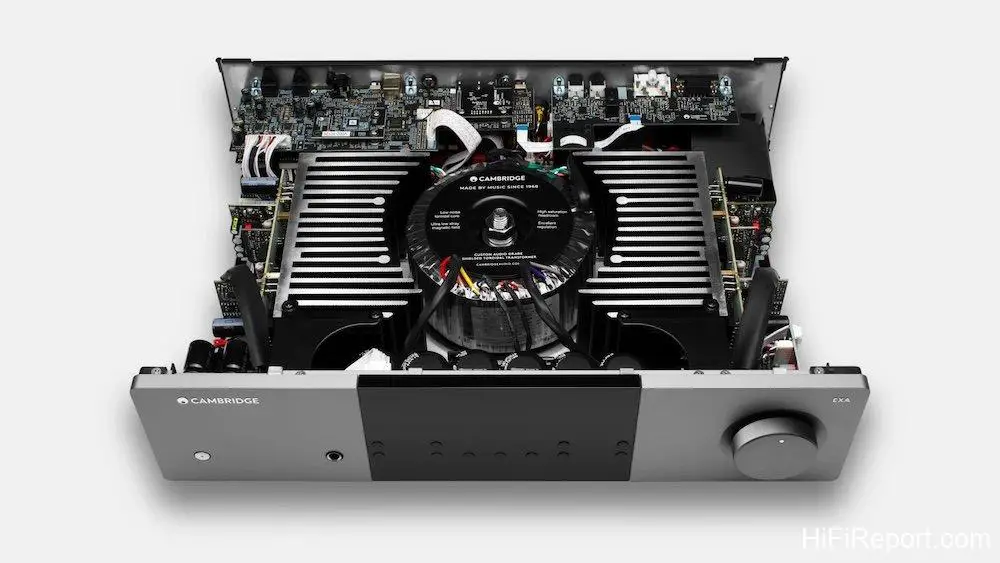
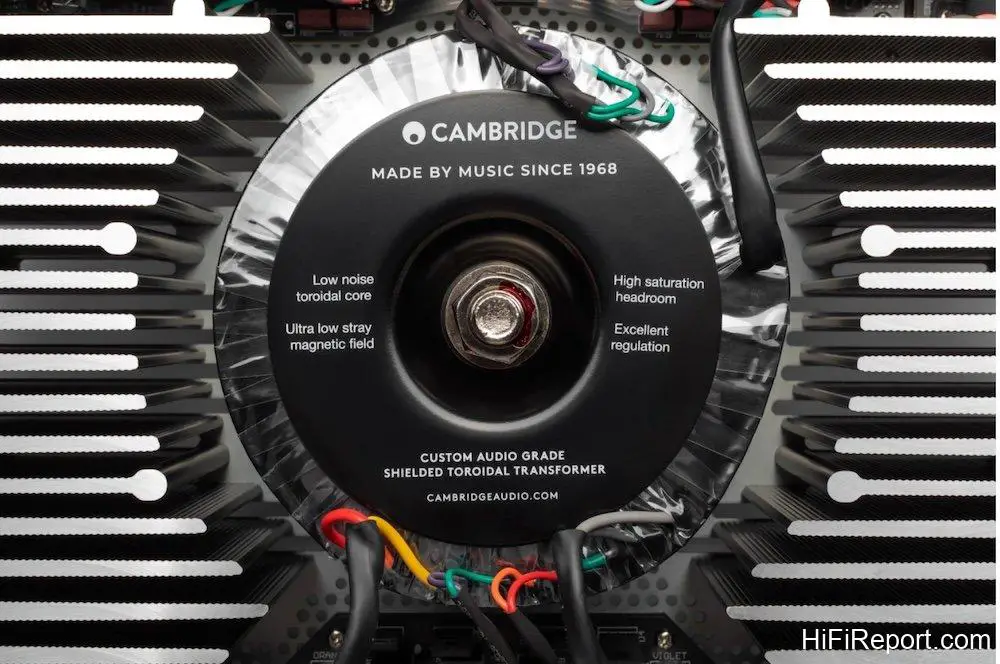
In terms of digital and analog features and applications, the EXA100 is quite comprehensive, supporting wired and wireless, digital and analog, and even multi-room use. However, as an audiophile, what struck me most was the EXA100’s massive toroidal transformer. For a 100-watt integrated amplifier, it’s truly huge and heavy. The EXA100 is specified at 12.8 kg (about 28.2 lbs), with most of that weight likely coming from this transformer.
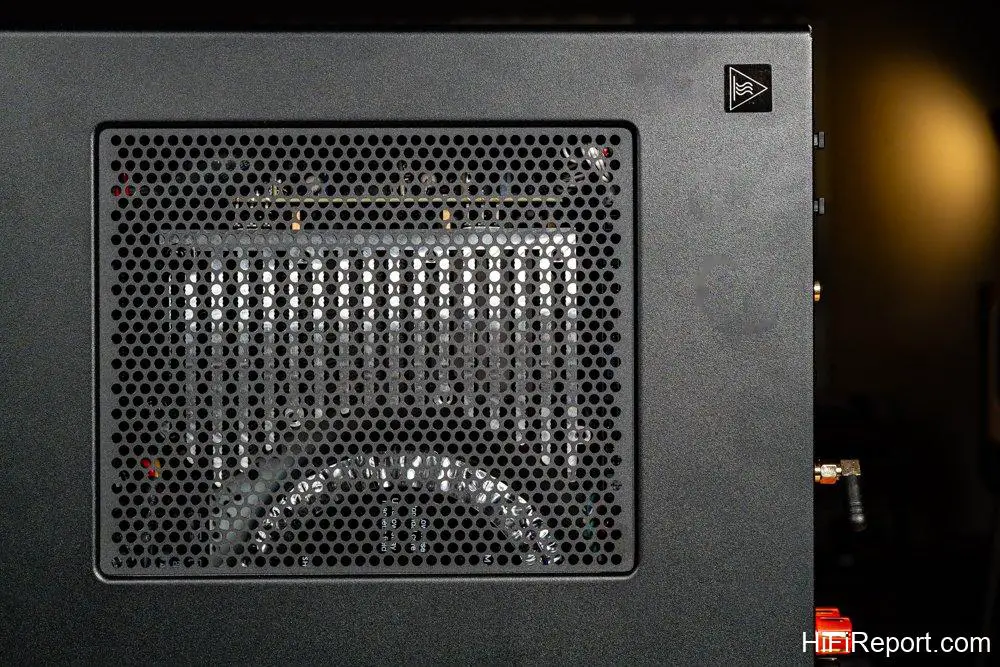
Looking down at the EXA100 from the top through the vents, you can see the large toroidal transformer centrally positioned, flanked by heat sinks. The power amplifier circuits are located at the ends of the heat sinks, arranged symmetrically and cleanly.
Reinforced Chassis Base
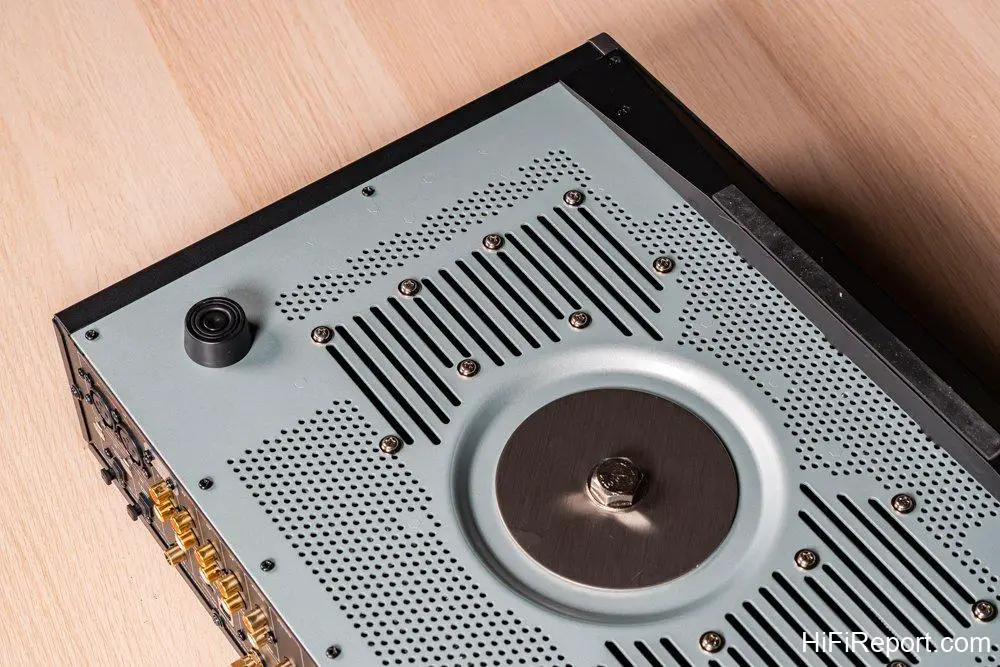
The preamplifier circuit is located at the front of the unit, with the digital-to-analog conversion circuit behind it. The entire unit is quite heavy, so the design of the chassis base incorporates thoughtful details. There is a supporting crossbar at the front and two circular feet at the rear, resembling a three-point support system but with a larger contact area at the front.
I suspect the central super-large toroidal transformer is so heavy that relying solely on feet might cause the chassis to sag over time. Therefore, the front supporting bar is added to reinforce the chassis’s support structure and rigidity.
Furthermore, Cambridge Audio specifically highlights that the EXA100’s toroidal transformer is rigorously shielded. This serves two purposes: first, to eliminate magnetic leakage interference, improving the quietness of the EXA100’s amplification circuit; and second, to prevent interference with nearby video equipment.
USB Grounding Switch
Having covered the EXA100’s features and design, it’s time for some real-world testing. My primary source was a Macbook Air connected via USB, mostly playing Apple Music.
Regarding the USB input, the EXA100 has a unique feature: a switch to select between single-point grounding (Single) and floating grounding (Lifted). This choice depends on the specific setup and requires comparative listening. The key points of comparison are the fullness of the low frequencies and the focus of the soundstage. There’s no single “correct” answer; I mostly used single-point grounding during my listening.
Full-Bodied, Rich Midrange
In terms of sonic signature, the EXA100 very much has that classic Cambridge Audio character: the music possesses excellent body and substance. If you feel your current amplifier lacks depth, or the midrange sounds thin, the EXA100 might be just what you’re looking for.
However, upon initially connecting the EXA100, while the thick soundstage was satisfying, the high frequencies seemed somewhat dark. When I first listened with the Monitor Audio Gold On-Wall 6G and Focal Aria EVO X N°1 speakers, I found the EXA100’s treble a bit subdued. Just as I was contemplating what might be amiss, a Japanese Tiglon TPL-3000A “White Tiger” power cable arrived. I initially intended to just connect it to the EXA100 for break-in, but unexpectedly, it brought the EXA100’s mid-high frequencies to life. This suggests the amplifier is quite sensitive to the power cable used.
With its inherent thick soundstage and the addition of the “White Tiger” power cable enlivening the mid-high frequencies, the EXA100 was ready for serious music listening.
Since I was also reviewing the Monitor Audio Gold On-Wall 6G and Focal Aria EVO X N°1, which are similarly priced to the EXA100, the 100 watts of the EXA100 drove both pairs of speakers with ease, demonstrating the ample power supply that is a hallmark of the EXA100.
Floorstanders Reveal 100W Prowess
Is that enough? Let’s try a larger speaker. I brought in the Dynaudio Contour 60 to test the low end. Listening to “Also Sprach Zarathustra” conducted by Erich Kunzel with the Cincinnati Pops Orchestra – a piece famous for its use in the movie “2001: A Space Odyssey” – the opening organ passage is recorded quite dramatically. Switching from bookshelf speakers to the floorstanding Contour 60, the EXA100’s low-frequency presence immediately surged, showcasing the power of its solid 100 watts.
The opening organ’s sustained low growl caused the Contour 60’s dual 8-inch woofers to subtly pulsate, supporting the weight of the bottom end. When the brass section entered, the mid-high frequencies exhibited a warm yet substantial sheen. The final triangle strikes twinkled in the rear of the soundstage. Partnering the Contour 60 with the EXA100 is somewhat exceeding its typical class, but the EXA100 handled it remarkably well. The low-frequency control and responsiveness were well-balanced, providing a solid yet elastic foundation.
Fast and Punchy Bass
Another test for low frequencies: the title track from the album “Tricycle.” The piece starts with seemingly innocuous electric piano chords, then is suddenly hit by a explosive kick drum. The EXA100 provided stable low-frequency energy with sufficient speed and punch to make the Contour 60 produce a taut and energetic kick drum. This contrasted with the crisp and bright hi-hat splashes. Electric piano notes and chords were underpinned by full-bodied electric bass notes, creating a lively rhythm.
The most exciting part, of course, was the jazz drum solo in the latter half. With drum hits falling like rain, the EXA100 displayed powerful control, driving the Contour 60’s dual 8-inch woofers to render a vivid and dynamic drum performance.
Rich Flute Breath Details
After testing the EXA100’s low-frequency control, let’s examine its tonal quality. I chose the album “Piazzolla For Two” by Patrick Gallois and Göran Söllscher, specifically listening to “Piazzolla: Histoire Du Tango – 1. Bordel 1900.” This piece, with its simple guitar and flute instrumentation, challenges the amplifier’s ability to reproduce midrange thickness and mid-high frequency delicacy.
The EXA100 clearly reproduced the breath sounds of the flute playing. The classical guitar notes were crisp and lively, supporting a high and low sound image. The guitar was positioned to the right, slightly lower, while the flute was slightly to the left, positioned a bit higher. I understand these are likely positions created in the recording studio, but the EXA100’s clear reproduction brought the listener closer to the recording session.
Excellent Soundstage Layering and Positioning
Despite being an integrated amplifier, the EXA100 boasts excellent channel separation, demonstrating superb soundstage positioning and the ability to “hear where sounds are located.” For example, listening to The Fairfield Four’s a cappella, I chose “These Bones.” The bass vocal emerged from the center-left of the soundstage, while the high harmonies appeared behind and slightly above the bass voice on the left, and also in the rear-right of the soundstage. The high voices echoing on the sides created a vivid a cappella scene around the central bass image. Moreover, the EXA100 reproduced the human voice’s midrange thickness very well, making the a cappella voices sound full-bodied.
With its excellent soundstage depiction and rich midrange body, listening to Mozart’s “Ave Verum Corpus, K.618,” the EXA100 allowed the Contour 60 to showcase the beauty of vocals and orchestral interplay. The hymn’s music drifted from the string section, with the EXA100 laying down the cello’s thick sustained notes. The soaring human choir floated above the strings, imbued with a lively spirit, supported by the added low-frequency weight of the organ. The canon before the finale built layer upon layer, creating a thick musical texture. The EXA100’s excellent control over the speakers highlighted the layering of vocals and orchestra, making the performance warm and moving.
While I’ve highlighted many of the EXA100’s strengths, there were a few minor drawbacks during my use. First, the speaker terminals occasionally experienced poor contact when using spade connectors. Initially, I thought the amplifier was faulty, but I later realized it was due to the smaller contact area of the spades not being properly tightened. It’s best to use banana plugs, which are less prone to this issue. Second, the Bluetooth wireless connection does not automatically search for previously paired devices upon power-on, unlike true wireless earphones. The EXA100 requires manual pairing initiation each time, which is slightly inconvenient. Hopefully, this could be addressed with a future firmware update to allow the EXA100 to automatically search for paired mobile devices.
An Excellent Student Worth Auditioning
Listening to the EXA100 reminded me of the familiar Cambridge Audio sound. Of course, in terms of price, the CX and AX series are more competitive. The EXA100 enters the mid-range price segment. However, Cambridge Audio equips it with a heavy-duty shielded toroidal transformer, providing a robust 100 watts of power, and incorporates trickle-down technology from the high-end Edge series. This results in a substantial sonic foundation while also delivering an expansive soundstage. At this price point, the EXA100 is definitely an excellent contender worth auditioning.
Specifications
* **Type:** Integrated Amplifier
* **Output Power:** 100W @ 8 ohms, 155W @ 4 ohms
* **Analog Inputs:** RCA x4, XLR x1
* **Analog Outputs:** RCA Pre-Out x1, RCA Subwoofer Output x1, 6.3mm Headphone Output x1
* **Digital Inputs:** Coaxial x1 (24bit/192kHz), Optical x2 (24bit/96kHz), USB type B x1 (PCM 24bit/384kHz, DSD256), HDMI for eARC x1 (24bit/192kHz)
* **Frequency Response:** 3Hz~40kHz (+/-1dB)
* **Total Harmonic Distortion:** <0.002% @ 1kHz
* **Signal-to-Noise Ratio:** >91dB
* **Crosstalk (@1kHz):** >90
* **Damping Factor:** >160
* **Dimensions (WxHxD):** 430 x 115 x 341mm
* **Weight:** 12.8 kg (approx. 28.2 lbs)