
Cambridge EXN100 Streamer Review
It had been quite some time since I last spent any quality time with a Cambridge Audio product.
A fleeting glance at an audio show rarely leaves a lasting impression, let alone allows for any in-depth familiarization.
This time, I had the opportunity to dive deep into their mid-range EX series. I spent two months using the EXN100 as my primary source component at the office for review work. But that wasn’t enough to truly grasp its essence; to complete this review, I brought it home for some focused, critical listening.
In terms of practicality, it’s a jack of all trades, mastering them remarkably well.

When it comes to sonic performance, it’s genuinely excellent.
And regarding the price? It’s incredibly approachable and appealing.
Add to this the fact that this isn’t some niche product from a two-person garage operation, but from a venerable “Cambridge” brand with over half a century of history, and you truly have a killer product on your hands.

Let’s delve into the points mentioned above, exploring layer by layer, why I’m so enthusiastic about the Cambridge EXN100.
Edge Technology Trickle-Down
If we’re talking about long-standing names in the audio world, Cambridge Audio, founded in 1968, undoubtedly ranks among the pioneers. For over half a century, they’ve been dedicated to producing affordable audio products, a commitment that remains unwavering.
In 2018, Cambridge launched the Edge series, which redefined expectations for the brand. Named after Gordon Edge, one of the company’s founders, as a tribute and a celebration of their 50th anniversary, the Edge series products represented a significant leap in price point compared to previous Cambridge Audio offerings. However, the leap wasn’t just in price; it was equally significant in design and performance.

From the outset, Cambridge Audio set a “no limit” direction for the Edge series development, aiming to surpass themselves and set a new benchmark. The Cambridge engineering team combined their accumulated know-how with new technologies developed specifically for these flagship products, allowing the Edge series to embody the brand’s heritage and aesthetics while forging a path of cutting-edge performance.
What followed, as one might expect, was the trickle-down of these flagship technologies, allowing other Cambridge products to benefit from the advancements. The EX series, launched in 2024, is a testament to this philosophy, directly drawing inspiration from the Edge series and filling the product gap between the Edge and CX lines.
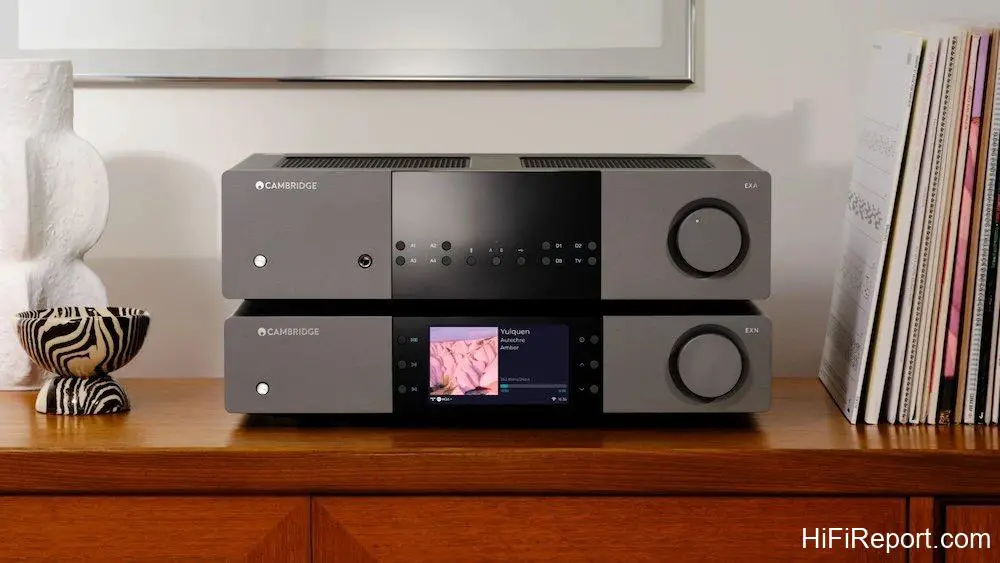
The EX series currently includes two products: the EXA100 integrated amplifier and the EXN100 streamer. The former’s amplification circuitry takes cues from the Edge series, while the latter aligns itself with Edge in terms of functionality and performance.
Understanding Streamers
The EXN100 is a streamer, but it’s more than just a streamer. Audio streaming devices can broadly be categorized into two types. One type includes a built-in DAC, often referred to as a “streamer” or “network player.” Regardless of the nomenclature, this first category is essentially “streamer + DAC.”
The other type does not contain a DAC; it solely handles digital streaming playback and requires a digital output to an external DAC. These are generally considered “digital streaming transports.” Again, names vary, such as “network transport” or “streaming transport.”
These two classifications are purely based on the presence or absence of a built-in DAC, similar to how we’ve traditionally distinguished between CD players and CD transports at HiFiReport.

However, if we delve deeper, the first category (“with DAC”) can be further subdivided. One type is a streamer that only offers streaming playback with no other digital inputs. The other includes various digital inputs, allowing it to function as a DAC for other digital sources. Some refer to these as “streaming DACs,” meaning “DACs with streaming capability.”
Similarly, the second category of streaming transports can be roughly divided into those that can accommodate internal hard drives and those that cannot. The former can store digital files on an internal drive, while the latter can only stream from online platforms or access local files via DLNA from a NAS or server (or through USB from a flash drive or external HDD).
A Versatile Streamer DAC
The EXN100 falls into the category of devices with a built-in DAC and multiple digital inputs. Furthermore, the EXN100 includes volume control. This means users can utilize it purely as a source component with an integrated or pre/power amplifier, or they can connect it directly to a power amplifier or active speakers, allowing the EXN100 to handle volume and input selection for a simpler system setup.

The manufacturer classifies the EXN100 as a streamer. In my view, the EXN100 should really be seen as a “streamer DAC capable of replacing a preamplifier” – it’s a streamer, a DAC, and it can even function as a preamp. Is that not high in practicality?
Feature-Rich Connectivity
If you’re not convinced yet, let’s continue. Not only is it multi-functional, but it’s also multi-interface. Let’s count its digital inputs: it has one coaxial, one optical, one HDMI eARC, one USB type A, one USB type B, plus Bluetooth and streaming. Network connection can be via WiFi or Ethernet.
If you have an old CD player you want to upgrade using an external DAC, it can do that. If you want to improve your TV’s sound, just connect it via HDMI to the EXN100, and you’re set. If you have valuable music files stored on an external hard drive or flash drive, it has a USB type A input – no problem.

High-Resolution Decoding & Broad Streaming Support
The EXN100 is equipped with the ESS ES9028Q2M DAC chip, capable of decoding up to PCM 32bit/768kHz and DSD 512. Handling high-resolution files is certainly not an issue. However, this is limited to USB and streaming inputs. S/PDIF and HDMI inputs are restricted by their transmission specifications, with PCM limited to a maximum of 24bit/192kHz, although optical and coaxial inputs also support DoP 64.
So, the EXN100 is not just a DAC; it’s a capable DAC. Since it has streaming functionality, the supported streaming services are crucial. Cambridge entered the streaming playback arena quite early and has extensive experience in this area.
The EXN100 supports streaming platforms such as Spotify, TIDAL, Deezer, and Qobuz. It also supports AirPlay 2, Chromecast, and is Roon Ready, making multi-room control straightforward. Its Bluetooth specification is Bluetooth 5.0, supporting aptX and aptX HD, allowing for better-than-CD quality playback when used with compatible devices. Via the EXN100, users can easily play music from their phones, tablets, or computers.

User-Friendly Display & App Control
On the interface side, the Cambridge EXN100 utilizes a 4.76-inch IPS TFT display with a resolution of 1280 x 569. The color display not only shows the current operational status but also displays album art and track information.
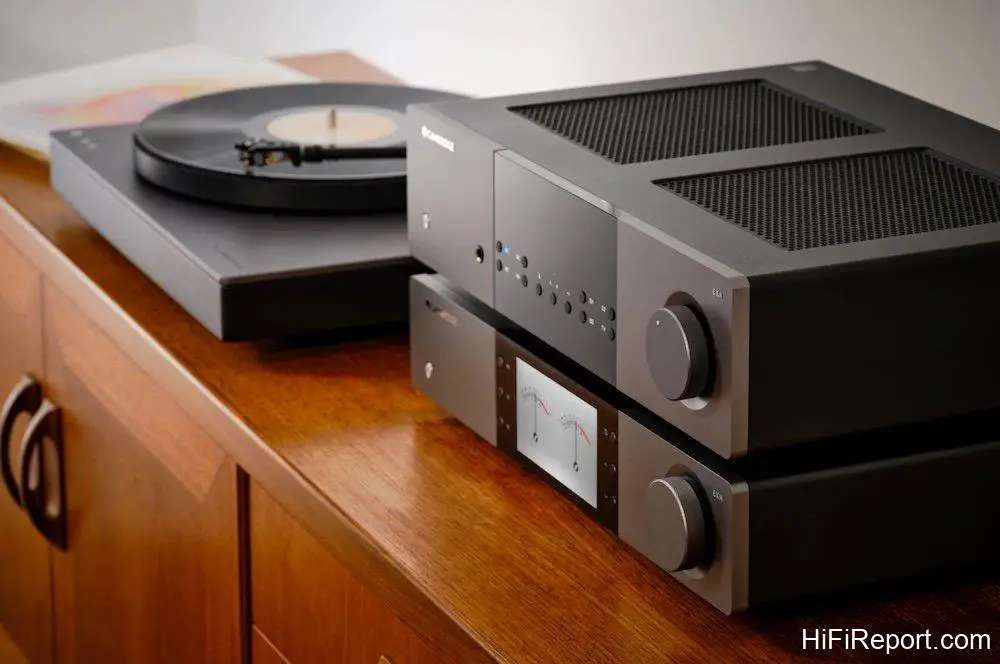
This full-color screen offers various style options, such as switching to VU meters, adding a touch of fun to the user experience. Of course, the most convenient way to control a streamer is through a dedicated app. Cambridge’s StreamMagic app is available for download on the App Store and Google Play, suitable for both Apple and Android users. All functions and settings, including various music playback controls, can be managed within the StreamMagic app. For a streamer, your mobile device truly is the best remote control.
Consequently, the EXN100 does not come with a physical remote control. However, if you also purchase the EXA100 integrated amp, its remote does include some playback-related buttons such as play/pause, track selection, volume, mute, and screen brightness, all of which are functional. But trust me, when playing streaming music, you’ll likely never reach for a physical remote.

Specification-Rich, Feature-Packed, Exceeds Expectations
Now, let’s talk about the sound. The Cambridge EXN100 is packed with specifications and loaded with features. That’s impressive enough, but its sonic performance, considering the price point, exceeded my expectations.
Its sonic foundation is clean yet warm, completely free of harshness or coldness. The soundstage is open and expansive, never feeling narrow or constrained. Its sound is lively and energetic, becoming more engaging the longer you listen. Its dynamics exhibit excellent control, allowing musical ebb and flow to be rendered with greater expressiveness. While natural, its sound also maintains a smooth and fluid quality, making the music sound direct and authentic, yet always listenable without becoming tiring or frustrating.
Unassuming Looks, Exceptional Dynamics
Listening to Mariss Jansons conducting the Royal Concertgebouw Orchestra in a live recording of Mahler’s Symphony No. 1, I fully experienced the EXN100’s ability to be “unassuming yet extraordinary.” The first movement begins with extremely soft music, like the gradual awakening of the earth from deep winter. Subsequently, within this movement reminiscent of nature’s sounds, thematic melodies flow, intertwine, and echo each other.

The EXN100’s clean sonic foundation provides a transparent stage image. The interplay and gentle ensemble passages of various sections and woodwinds are rendered clearly and distinctly, with natural timbres and precise localization. Towards the end of the first movement, transitioning from the development section to the recapitulation, there’s a dramatic crescendo from *pp* to *ff*. As the orchestra’s energy explodes, the timpani delivers a powerful blow, its accumulated force unleashed in an instant burst.
I was using the EXN100’s analog outputs, meaning this sonic performance was largely attributable to its built-in DAC. I absolutely did not feel like I was listening to a streamer (or streamer DAC) priced around $2,000 USD. The scale of the stage, the dynamic range, and the clarity of the presentation were all reminiscent of the sound I might expect from a $3,000 USD streaming transport feeding a $3,000 USD DAC.
Lifelike Vocals and Realistic Imaging
It’s not just large orchestral works that showcase the EXN100’s ability to express musical dynamics; often, vocal performances are equally demanding. Take Sara Bareilles’ live album, “Brave Enough: Live at the Variety Playhouse.” Sara Bareilles possesses a broad vocal range and powerful delivery, her high notes are clear, and her singing is full of personality.
During quieter passages, the EXN100, through rich detail and clear imaging, imbues the singer’s performance with a lifelike presence. When she reaches soaring heights, her voice projects with penetrating power. That sense of energy, that feeling of power rising from stillness, the transition from soft to loud is smooth and effortless. Furthermore, this is a live recording, and Sara Bareilles frequently interacts with the audience on stage. The lively back-and-forth atmosphere is also clearly conveyed. The EXN100’s ability to render live performances with realism is truly commendable.
A Touch of Warmth and Smooth Detail
Or consider Eva Cassidy’s album “Nightbird.” The Cambridge EXN100 provides a wealth of information, rendered with a slightly warm tone and a smooth, delicate texture that perfectly complements Eva Cassidy’s emotionally charged singing. Each song is captivating.
In slow songs like “Ain’t No Sunshine,” Eva Cassidy’s voice enters following a guitar intro. Listening to her sustain steady long notes, her skillful use of head resonance, and the surge of power when she reaches high notes, the vocal intensity conveys immense emotional tension. Listening to this, one realizes that vocal dynamics are by no means small; that power has the force to truly penetrate. Her nuanced phrasing and use of falsetto introduce variations in her vocal style that support the emotion conveyed by the lyrics and melody.
Besides the vocals, the guitar in this track is also a highlight. The high frequencies are bright and clear, while the mid-low range blends the guitar’s body resonance, sounding rich and steady. For the upbeat jazz classic “Cheek to Cheek,” the addition of piano and drums provides a clear, defined beat, and the bass adds depth to the rhythm. The recording quality of this album isn’t as high as “Brave Enough”; it’s a bit coarser. The differences in sonic texture are clearly discernible through the EXN100’s playback.
Impressive Bass Performance
The Cambridge EXN100 is quite light, weighing only 4.1 kg (approximately 9 lbs). While a source component generally requires less power and doesn’t need a large transformer or heatsinks for amplification circuits, leading to a lighter weight, we often fall into the trap of assuming a light machine equates to light sound.
In fact, the EXN100’s sound is not heavy or ponderous; rather, it is quite lively and agile. However, this by no means implies its bass lacks impact. I was quite impressed by its low-frequency performance. Take the title track from Bela Fleck & The Flecktones’ album “Flight of the Cosmic Hippo.” The bass in this track, coupled with the kick drum, provides two distinct facets of low-frequency performance. The bass guitar’s low notes are slow and resonant, offering rich expression as it carries the melody in the low register. The kick drum’s impact is strong, a clear display of weight. Listening to these two low-frequency instruments in this piece confirms that the EXN100’s bass is truly high-quality.
Pure, Transparent Sound Reveals Tonal Beauty
Some audio equipment might initially sound very appealing but proves fatiguing for long listening sessions. Other components might immediately strike you with their impressive performance and superb audio effects but fail to draw you into the musical experience itself. The Cambridge EXN100 is not like that.
When I listen to music through it, my immediate impression isn’t of a distinct sonic signature. However, as the music plays on, I find myself forgetting about the equipment and just letting one song flow into the next. Moreover, listening to music with it feels like the music has come alive, like the world after rain – the sky is blue, the mountains green, the view expansive, the air fresh and invigorating.
Consider the album “Big 3,” a collaboration between the masters Milt Jackson, Joe Pass, and Ray Brown. This is one of my personal favorite albums. Although I own the vinyl, it’s a used copy rated VG+, so streaming is how I most frequently listen to it.
The EXN100’s beautiful tonal palette provides stunning rendition of the vibraphone and jazz guitar timbres, allowing the vibrant musical tapestry woven by Milt Jackson and Joe Pass to be fully realized in a deeply satisfying way. Especially the vibraphone, with its metal keys, metal resonator tubes, and adjustable tone flaps, offers a wealth of tonal variations. Among streamers or streamer DACs in this price range, I believe the EXN100 is one of the few that truly excels at revealing the richness and expressiveness of this piece’s tonality and agility.
A Killer Product Not To Be Missed
With over half a century of history, the Cambridge brand is deeply ingrained in the hearts of many audio enthusiasts. Perhaps you, or someone you know, began their audio journey with Cambridge equipment. They don’t chase flashy designs; instead, they steadily build features and refine their sound.
The EXN100 isn’t extravagant, yet its minimalist, modern aesthetic exudes a quiet confidence and enduring appeal that speaks of a different kind of sophistication. Sonically, it doesn’t feel out of place even when paired with systems costing hundreds of thousands of dollars in my office.
And this Cambridge EXN100 is priced incredibly appealingly. Its suggested retail price is NTD 63,900, which converts to approximately $1,997 USD – potentially even lower than the price in the UK before tax. If a product like this isn’t a killer, what is? I hope there’s sufficient stock and supply from the manufacturer, because the EXN100 is poised to claim a spot on audio racks in countless homes.
Specifications
* Cambridge EXN100
* Type: Streamer
* Frequency Response: 20Hz-20kHz +/- 0.1dB
* Total Harmonic Distortion: < 0.0005 % * Signal-to-Noise Ratio: >120dB
* Crosstalk: <-120 * DAC Chip: ES9028Q2M * Maximum Sample Rate Decoding: PCM 32bit/768kHz, DSD 512 * Analog Outputs: RCA x1, XLR x1 * Digital Inputs: Optical x1, Coaxial x1, USB type B x1, USB type A x1, HDMI eARC x1, RJ45 x1, Bluetooth 5.0 (supports SBC, aptX, aptX HD) * Supported Files: ALAC, WAV, FLAC, AIFF, DSD (x512), WMA, MP3, AAC, HE AAC, AAC+, OGG Vorbis * Standby Power Consumption: <0.5W * Maximum Power Consumption: 30W * Dimensions: 430 x 90 x 305mm (WxHxD) * Weight: 4.1kg