
Chario Aviator Cielo Review
What does “Cielo” mean in Italian? It means “sky”! Chario Audio’s Aviator series from Italy is aptly named. This series of four speakers, comprising two bookshelf and two floorstanding models, each carries a name steeped in aviation history. The smallest, Ghibli, is named after the Italian Air Force fighter plane used in World War II (Caproni Ca. 309 Ghibli). The larger bookshelf, Nobile, commemorates the Italian aviator Umberto Nobile, who completed a flight over the North Pole. Stepping up in size, the floorstanding Amelia honors Amelia Earhart, the first woman to fly solo across the Atlantic. And then there’s the speaker I’m reviewing today, the Cielo, representing the essence of the Aviator series: soaring through the sky.
As “Cielo” translates to “sky,” it naturally embodies the culmination of all Aviator series technologies, inheriting core technologies from the high-end Academy series.
Italian Craftsmanship: A Legacy of Over Forty Years
Founded in Milan, Italy, in 1975, Chario Audio boasts a history spanning over four decades. Throughout this journey, one of the founders, Mario Marcello Murace, has remained at the helm of speaker design. While global business and operations have transitioned to the second generation, with International Marketing Managers Michele Nobel and Alessandro Migliorini actively expanding markets in Asia, my encounters with them have been almost annual. In 2018, I even had the privilege of interviewing designer Mario at the Munich High End Show.
During that interview, Mario, with over forty years of speaker design experience, consistently emphasized that technology should always serve music.

Mario recounted that when he established Chario in 1975, everything was crafted in-house – from drivers and crossovers to cabinets. Starting from a small woodworking workshop, each pair of Chario speakers was meticulously handcrafted. This workshop ethos persists today. Chario dedicates considerable time to allow raw wood to dry properly before crafting speaker cabinets. Even the drivers are manufactured in-house, reflecting their proud “Made In Italy” spirit, a tradition upheld for over forty years. The Cielo, too, embodies this artisan spirit, meticulously crafted within the Chario factory.
Premium Wood Cabinetry: A Commitment to Excellence
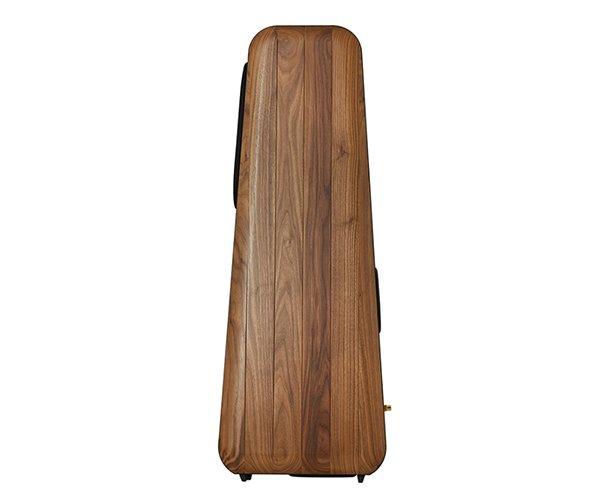
Utilizing solid wood in speaker construction is a hallmark of Chario’s expertise, and the Cielo is no exception. The walnut wood side panels of the Cielo exhibit exquisite craftsmanship and a rich hue, transforming the speaker into a piece of sonically resonant, high-end furniture.
However, discerning audiophiles might argue that solid wood isn’t the optimal material for speaker cabinets due to its inconsistent density, potentially leading to sonic variations between pairs. This is a valid concern, as uniformity in sound is paramount.
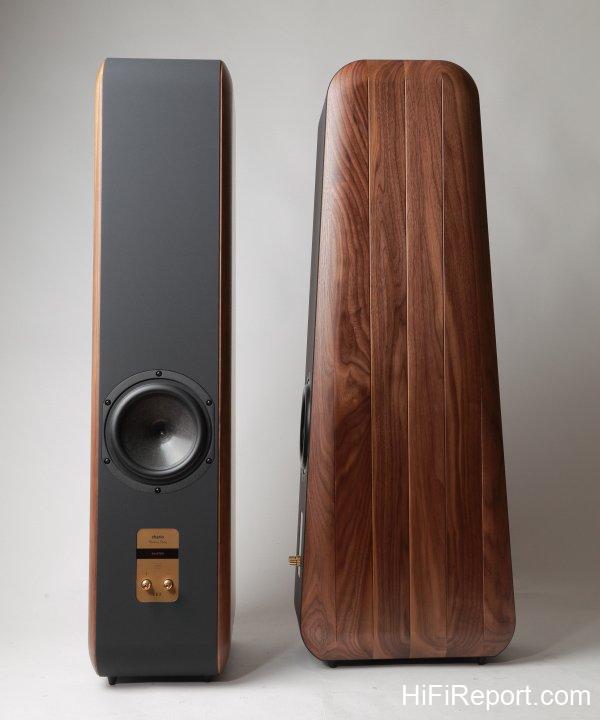
With over forty years of speaker manufacturing under their belt, Chario is acutely aware of these nuances. Observe where the beautiful solid walnut is placed on the Cielo – the side panels.
Imagine removing the walnut sides; you’d still have a complete speaker. Chario employs High-Density Fiberboard (HDF) for the main cabinet structure, a superior grade to standard Medium-Density Fiberboard (MDF). The addition of walnut side panels is not merely for aesthetics; the combination of HDF and solid walnut enhances mass, rigidity, and cabinet damping.
Chario’s official website highlights the demanding nature, high cost, and patience required when using solid wood in speaker construction.
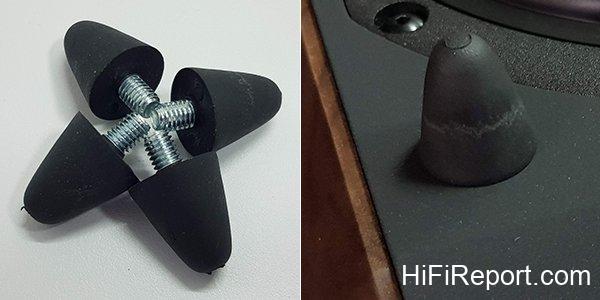
The Cielo stands approximately 104.5 cm tall. Subtracting the rubber feet, the walnut panels extend roughly 100 cm. Lengthy wood pieces are prone to warping over time, potentially leading to cracks. To mitigate this, Chario undertakes a six-month wood drying process before utilizing it in speaker production. This commitment to solid wood construction underscores a significant investment in quality.
Academy Series Driver Technology
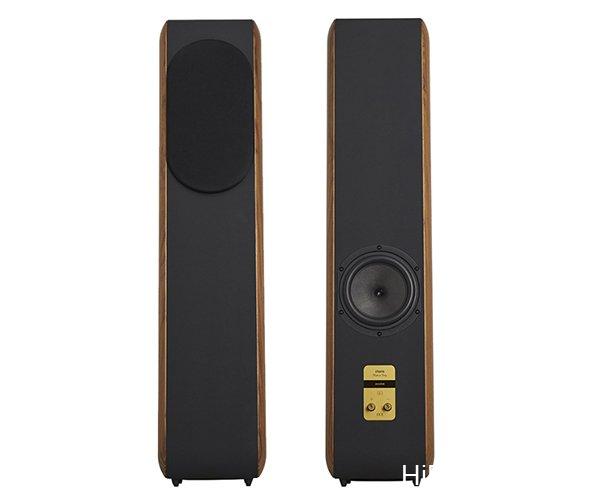
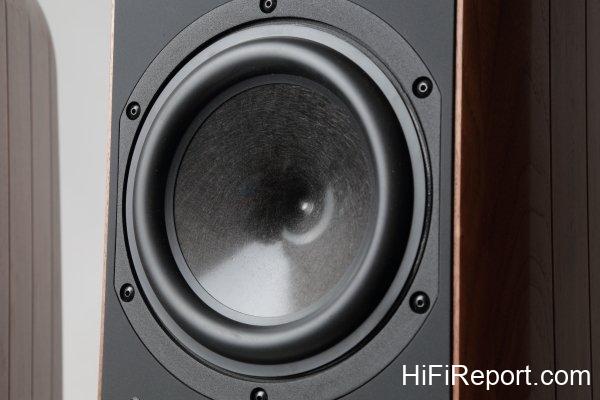
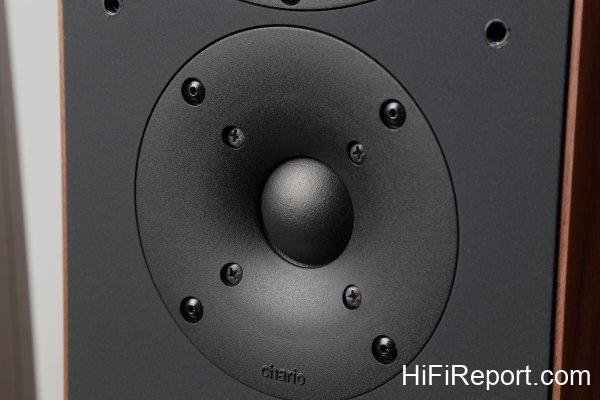
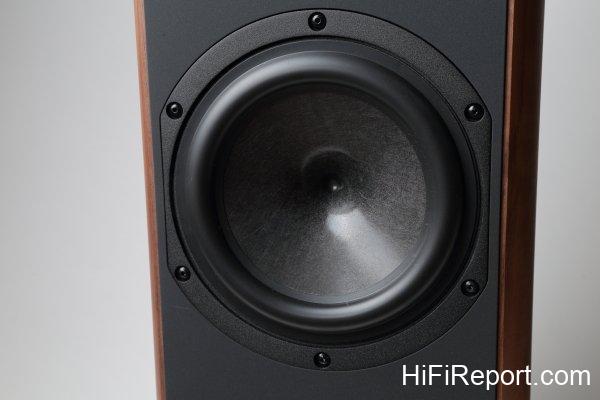
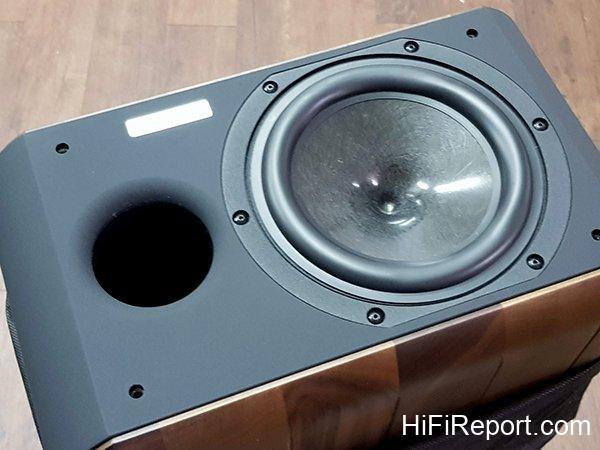
Let’s delve into the drivers employed in the Cielo. The tweeter is Chario’s own T38 Waveguide, a 38mm silk soft dome design. For the midrange, a 165mm Rohacell Full-Apex driver is utilized, and the bass frequencies are handled by two identical 165mm Rohacell Full-Apex drivers, with one positioned at the rear and the other at the bottom. The bass reflex port is also located at the base, employing a down-firing configuration. All drivers feature high-flux, lightweight Neodymium (NdFeB) magnets.
The large 38mm tweeter, almost double the size of conventional tweeters, is not aimed at extending high-frequency reach but rather enhancing the lower midrange extension. This design facilitates a smoother frequency transition between the tweeter and midrange, moving the crossover point away from the ear’s most sensitive frequency range.
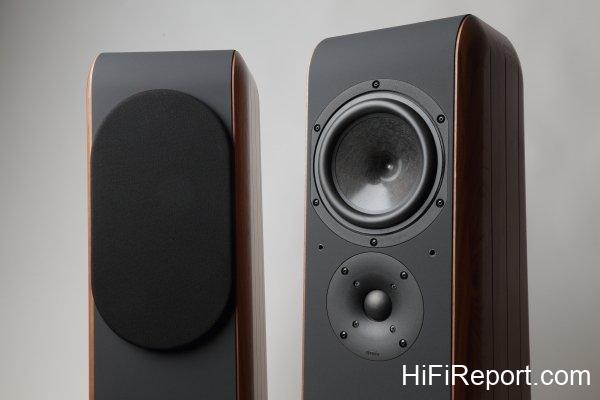
Notably, Chario often inverts the driver arrangement, placing the tweeter below the midrange. However, the tweeter’s position is roughly at ear level when seated in a typical listening position.
Standing while listening to the Cielo might create a perception of a low soundstage. However, when seated comfortably, with the tweeter at ear level, the Cielo’s spatial magic unfolds effortlessly.
Rohacell Aluminum Sandwich Diaphragm
The Rohacell Full-Apex drivers inherit technology from the high-end Academy series. Rohacell is a foam material characterized by its exceptionally light weight and high internal damping. Chario utilizes Rohacell as a core layer, sandwiched between aluminum diaphragms, creating a composite structure. This design leverages the high rigidity of aluminum while capitalizing on Rohacell’s damping properties to eliminate unwanted diaphragm resonances, preserving the purity of music reproduction.
This Rohacell aluminum sandwich diaphragm is not unique to Chario; many top-tier speaker manufacturers employ similar designs, a testament to its efficacy.
Turning to the Cielo’s bass section, it features dual 165mm Rohacell sandwich woofers, one rear-mounted and one bottom-firing. This dual-woofer configuration effectively boosts low-frequency output and efficiency. The down-firing bass reflex port directs airflow towards the floor, utilizing floor reflection for even bass dispersion. The narrow gap between the speaker and floor also accelerates airflow, further enhancing bass response.
According to Chario’s data, this down-firing woofer and port design can increase bass output by approximately 3dB.
Neodymium Magnets: Midrange and Bass Innovation
Finally, it’s crucial to highlight the Cielo’s driver magnet assemblies, all utilizing powerful Neodymium (NdFeB) magnets. While Neodymium magnets are commonplace in tweeters, favored for their significantly lighter weight compared to traditional ferrite magnets, their application in midrange and bass drivers is less common. This is due to their higher cost and design considerations.
Despite their light weight and powerful magnetic force, Neodymium magnets are susceptible to heat. Temperatures exceeding 70 degrees Celsius can halve their magnetic strength. Midrange and bass drivers, with their larger excursions, generate more heat than tweeters. This temperature rise could potentially compromise the Neodymium magnets’ performance. Therefore, enhanced heat dissipation is crucial in designs using Neodymium magnets for these drivers.
Chario’s design, termed the Poly-Ring NdFeB magnet assembly, employs multiple Neodymium magnets arranged in a ring. This configuration increases the magnet surface area and optimizes the rear driver structure for airflow, thereby enhancing heat dissipation. These driver technologies, again, are inherited from the high-end Academy series.
Expansive Soundstage, Substantial Imaging
Setting up the Cielo speakers in the HiFiReport listening room, I positioned them away from the back and side walls to minimize reflections. Spacing them approximately 2 meters apart, the listening position was around 2.5 meters from the Cielos.
The Cielo’s tweeter incorporates a shallow waveguide, contributing to excellent sound dispersion. Initially, with no toe-in, the soundstage was already remarkably expansive. However, seeking even more precise image focus, I introduced a slight toe-in, just enough to still glimpse the inner walnut cabinet sides from the listening position, rather than a full frontal view. This subtle adjustment further solidified image solidity.
Moving the Cielo speakers wasn’t overly strenuous; at 30 kilograms each, they are substantial but not unwieldy. The bottom-firing bass port provides convenient handholds. Handling the Cielo, the fine craftsmanship of the walnut wood is immediately apparent. The natural wood texture is exquisite, and the slender, shallow grooves carved into the walnut side panels enhance the speaker’s elegant, furniture-like aesthetic, making them visually captivating.
An All-Italian Audio System Synergy
The Cielo speakers graced the editorial listening room for an extended period, affording me the opportunity to experiment with various amplifier pairings.
With a specified sensitivity of 92dB, the Cielo is not demanding to drive. I began with my familiar Linear Acoustic LAV 60 MK II, a 100-watt amplifier, which drove the Cielos effortlessly, producing a wide soundstage and potent bass. Subsequently, the NAD M10, also rated at 100 watts, arrived. It too paired seamlessly with the Cielo, delivering a smoother sonic profile with warmer midrange frequencies. While initially contemplating a shootout between these two amplifiers for the final Cielo review, the Unison Research Unico Due entered the picture.
The Unico Due, also delivering 100 watts, features a tube-solid-state hybrid design. This piqued my interest, as pairing it with the Cielo would create an all-Italian sonic chain. From the North Star Design digital source to the Unison Research amplifier driving the Chario speakers, it was a complete Italian ensemble. I even considered sourcing Italian ART speaker cables for a truly 100% Italian system! Focus, I reminded myself, already a fully Italian system, no need to get sidetracked.
While the LAV 60, M10, and Unico Due, all around 100 watts, effortlessly powered the Cielo, the Unico Due and Cielo exhibited exceptional synergy. The midrange richness was optimal, and the sound was most refined, particularly the high-frequency performance, characterized by a captivating sweetness. The decision was made: the Unico Due would drive the Cielo, completing the all-Italian audio pairing.
Full-Bodied, Smooth Low-Frequency Performance
As the flagship model of the Aviator series, I decided to challenge the Cielo right from the start. I selected the soundtrack from the film “Tous les matins du monde” (All the Mornings of the World). The opening track is a powerful march, with bright strings and harpsichord melodies underpinned by robust drum beats. Wave after wave of percussive force emerged, and the Cielo’s low-frequency output was remarkably full, substantial, and expansive. Perhaps due to the rear-firing woofer, the soundstage was exceptionally wide, extending well beyond the speaker boundaries, creating a vast, spacious, and effortless sonic panorama.
The Cielo’s bass is plentiful yet relaxed, never strained. The mid-bass region possesses a supple dynamism, with a rounded, elastic quality.
Continuing with the “Tous les matins du monde” soundtrack, track two features a cello solo. I let the CD play on, continuing to revel in the Cielo’s relaxed, smooth bass.
The Cielo not only imbued the low frequencies with a supple character, rendering the cello image substantial and intimately close, but also captured the subtle breathing sounds of the performer, alongside the cello’s poignant melody.
Natural, Fluid Musicality
Details, indeed, are what captivate in music. The Cielo presents them naturally and seamlessly, with a subtly feminine beauty in the mid-high frequencies.
Despite its Italian origins, the Cielo doesn’t lean towards a bright, forward sonic profile. Instead, it employs slightly subdued highs to recreate a smooth, musically engaging listening experience.
Listening to Rachel Barton’s “Homage to Sarasate,” specifically “Andalusian Serenade,” the gentle piano introduction leads into the vibrant violin. As the piece transitions into passionate, rapid passages, the Cielo portrays the violin image as both close and substantial. Even in the upper registers, the violin retains considerable body, avoiding thinness. The timbre maintains excellent warmth and richness. During piano fortissimo passages, the Cielo exhibits a solid weight, intertwining with the violin’s smooth tone to create fluid musical lines.
Indeed, the Cielo’s most alluring quality is its natural and fluid musicality. Take, for instance, Quasthoff’s rendition of “Schubert: Die Schöne Müllerin” (Schubert: The Fair Maid of the Mill), specifically the opening track, “Das Wandern.” The miller sings joyfully of wandering, the stream also loves to wander, and the water wheel turns day and night. Behind the cheerful vocals, the piano’s left-hand bass line continuously repeats a flowing motif, like a gently meandering stream. The Cielo presents the piano’s bass register with density and clarity. Quasthoff’s vocals interact vibrantly with the piano in the midrange, and the Cielo captures subtle breath nuances in his dynamic phrasing. The slightly subdued highs lend a warm thickness to the baritone’s voice.
Gentle, Comfortable High-Frequency Performance
Warmth and rich detail best describe the Cielo’s sonic character. This sonic signature is conducive to extended, fatigue-free listening. However, this isn’t to imply the Cielo lacks high frequencies. Rather, its highs are non-aggressive, not brightly dazzling, but akin to the gentle warmth of an autumn sun. This non-aggressive high-frequency presentation encourages higher listening volumes, allowing one to revel in the smooth, comfortable midrange and treble even at louder levels.
Consider Eric Lu’s live recording from the Leeds International Piano Competition, Beethoven’s Piano Concerto No. 4, third movement. The bright, playful rondo begins with the orchestra, softly in unison. The piano then enters with a relaxed, effortless demeanor, accompanied by the cello’s resonating lines. The Cielo captures it all. Intentionally increasing the Unico Due’s volume and re-listening revealed a difference.
The orchestra’s soft introduction gained added ambience, with subtle audience noises becoming more apparent. The soundstage expanded due to these added details. The subsequent fortissimo entry brought forth the Cielo’s substantial, plentiful bass, yet without any sense of pressure, maintaining the Cielo’s inherent elegance. During the cadenza, the piano’s solo passages showcased the Cielo’s full, articulate piano notes, never muddy. The piano’s ascending high-frequency brilliance was particularly smooth and comfortable.
Warm, Harmonious “Pines of Rome”
Is it solely about smoothness and comfort? Rest assured, the Cielo is capable of portraying bright timbres, but it avoids transforming brilliance into harshness. Its high-frequency extension is beautiful, yet devoid of excessive edginess.
To illustrate, let’s turn to a piece evocative of the Italian sunshine: Respighi’s “Pines of Rome,” specifically the version conducted by Doráti with the Royal Philharmonic Orchestra, a favorite test record among audiophiles. Let’s put the Cielo to the test. Inserting the CD and increasing the Unico Due’s volume, the opening track, “I Pini Di Villa Borghese,” explodes with the bright timbres of the brass section, interweaving with the rapid high-frequency runs of the strings. Respighi intentionally omits low-frequency instruments in this section, allowing the high frequencies to soar, depicting the dappled sunlight filtering through swaying treetops, creating dynamic light and shadow contrasts.
The Cielo renders the brass section with ample brilliance, yet even at high volumes, it remains free of unpleasant harshness. Within the expansive soundstage, the Cielo exhibits excellent layering. The broad brass and string sections, coupled with the lively woodwinds, and the shimmering triangle adding further brightness, are all distinctly rendered by the Cielo. The Phase 4 recording, known for its excellent channel separation, allows the Cielo to vividly portray the interplay between different instrumental sections. This “Pines of Rome” evokes a warm and harmonious Italian sunshine.
Gentle and Charming Sonic Foundation
In conclusion, the Cielo is a speaker with a gentle disposition. It’s not demanding to drive; a 100-watt integrated amplifier should be sufficient to make the Cielo sing joyfully. Its bass output is ample, providing sufficient sonic weight even at modest volumes. As power increases, the bass becomes more substantial, anchoring the musical foundation with stability.
The all-Italian system comprising North Star Design, Unison Research, and Chario further enhances the musicality, lending an added smoothness and ease to the sound. However, even when paired with other components, the Cielo retains its gentle and charming sonic foundation, revealing rich details and emotional depth within recordings.
Specifications
* Type: Floorstanding Speaker
* Drivers:
* 1 x 38mm T38 Waveguide Tweeter
* 1 x 165mm ROHACELL Full-Apex Poly-Ring NdFe Midrange
* 2 x 165 mm ROHACELL Full-Apex Poly-Ring NdFeB Woofers
* Low Pass Filter Frequency: 40Hz @ -3dB /4Ω sr referred to C4 WETS
* Crossover Frequencies: 200Hz-1345Hz @ -6dB Fourth Order Filter
* Sensitivity: 92 dB
* Nominal Impedance: 4Ω (Minimum 3.6Ω @95Hz)
* Enclosure Design: Bottom Bass Reflex Port
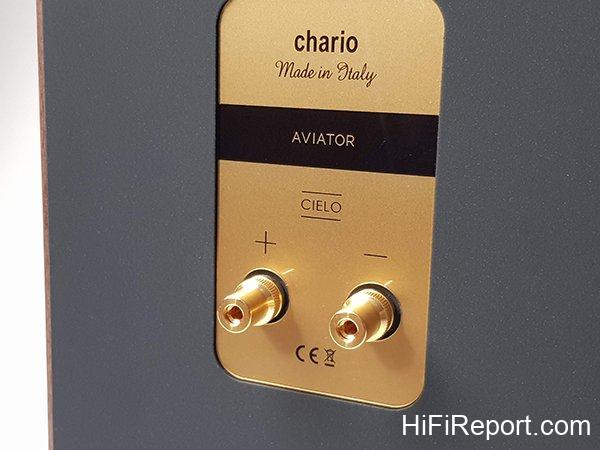
* Finish: Walnut and HDF
* Dimensions: 1045 x 235 x 390 mm
* Weight: 30 kg