
Constellation Audio Inspiration Series Review
It’s already day three with the Constellation Audio Inspiration Series, but I’ve been engrossed in listening and running them through their break-in period – as our HiFiReport Facebook fans might already be aware. To mark the arrival, here’s a snapshot: this Constellation Audio Inspiration Series pre-power amplifier combo is fresh out of the box!
The Inspiration PREAMP 1.0, at 11.3kg, is reasonably manageable. However, the STEREO 1.0 power amplifier, tipping the scales at 24.9kg, is a hefty lift for one person. The front panels are clean, featuring dual rotary controls and a display screen. A note inside the packaging directs users to the official website for the most up-to-date specifications and user manuals.

Rear Panel and Remote
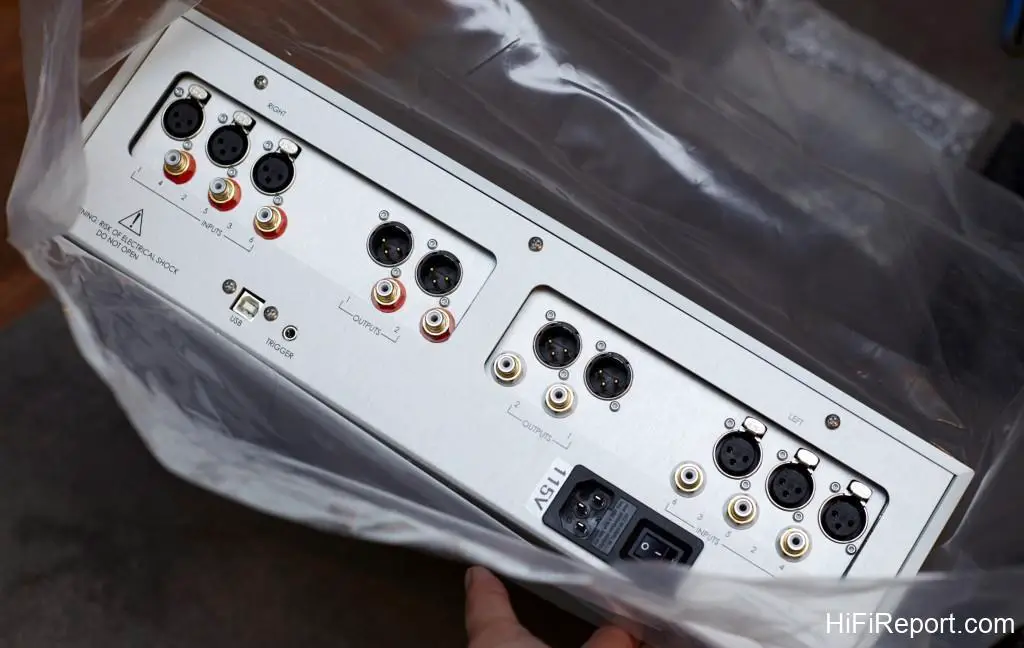
Connectivity at the rear is comprehensive, offering three sets of both XLR and RCA inputs, and two sets of XLR and RCA outputs. The USB port isn’t for digital-to-analog conversion but is designated for firmware updates.

A dedicated remote control is included for user-friendly operation.

Design and Build Quality
Examining the underside reveals three noteworthy details. Firstly, you’ll observe that Constellation Audio components are designed with concealed screws on all sides except the bottom panel, resulting in a remarkably clean and elegant aesthetic. Secondly, the integrated footers are high-quality components from the esteemed US-based manufacturer, Harmonic Resolution Systems (HRS).

Thirdly, beneath the front display, you’ll find five control buttons, a design cue mirrored in Constellation’s flagship Altair II preamplifier.

Inspiration STEREO 1.0 Amplifier
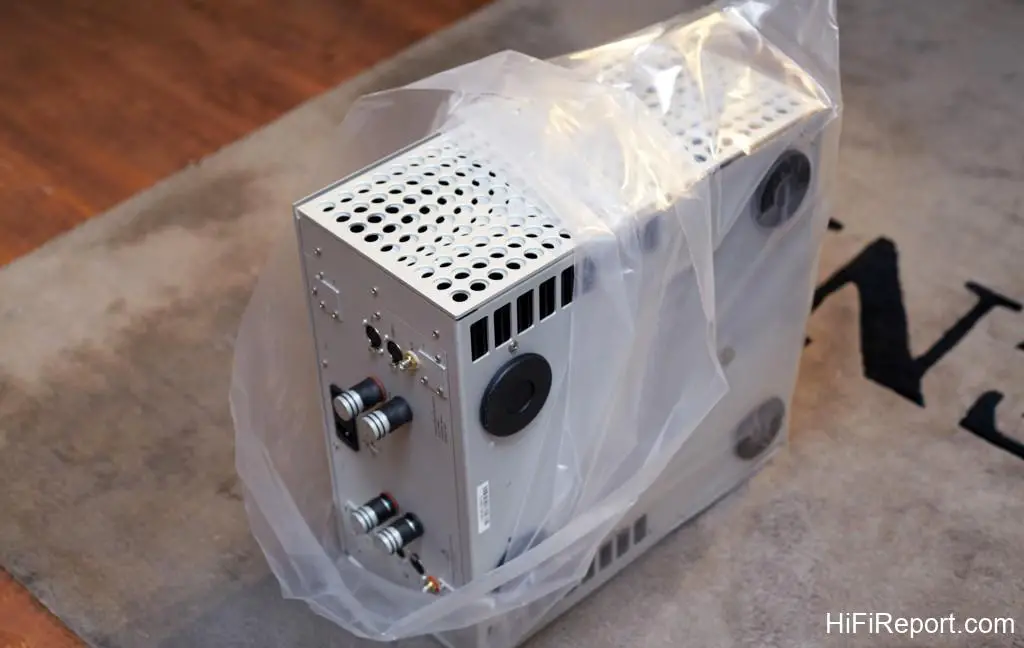
The STEREO 1.0 power amplifier provides versatile input options: XLR, XLR (Direct), and RCA. When paired with a Constellation preamplifier, the XLR (Direct) input is recommended. This bypasses an amplification stage, resulting in an even cleaner and more transparent sound. For use with preamplifiers from other manufacturers, the standard XLR input should be used.

The speaker binding posts are a proprietary Constellation design, adorned with their logo, and are exclusively compatible with spade connectors (Y-plugs). This is an important point to note. The USB port, again, serves solely for firmware updates. Additionally, a mute switch is included for convenient silencing.
Powering Up and Display
Mirroring the preamplifier and other Constellation components, all screws are located on the underside, maintaining the seamless aesthetic. The footers are, once again, sourced from HRS.

With cabling complete, powering up the system reveals a unique feature of the power amplifier: the power switch is integrated into the horizontal bar on the front fascia. A three-second press-and-hold is required to toggle the power, preventing accidental activation or deactivation.

The front panel incorporates a touch-sensitive display, allowing for adjustments to brightness and contrast to suit user preferences and ambient lighting conditions.

Constellation Audio – Brand Overview
Hailing from the USA, Constellation Audio was founded in 2009, making them roughly six years young at the time of writing. Despite their relative youth as a company, Constellation is built upon the foundation of a highly experienced team of industry veterans. This wealth of expertise translates to remarkably mature and refined products right from the outset. Like many, my initial impression of Constellation was one of ultra-high-end, and correspondingly high prices.

This perception was shaped by their initial offerings: the flagship Reference Series, followed by the Performance Series. While the Performance line represented a step down in price, it still remained in the higher echelons for most audiophiles. However, the introduction of the Inspiration Series last year, the very subject of this review, has significantly broadened Constellation’s appeal by offering a more accessible price point.
This more attainable pricing opens up the possibility of ownership to a wider audience. With the barrier of entry lowered, the key question now is whether the Inspiration Series delivers on the sonic promise associated with the Constellation name.

Sonic Impressions – Soundstage and Musicality
This Inspiration pre-power amplifier pairing has resided in the HiFiReport listening room for approximately two weeks. Throughout this period, daily listening sessions have revealed consistently stable sonic performance. While a complete break-in cannot be definitively confirmed, the most striking and captivating aspect of the Inspiration’s sonic character is undoubtedly its natural and exceptionally transparent soundstage.
Beyond its technical prowess, the system excels at conveying the emotional core of music. Extended listening sessions with the Inspiration are never fatiguing or harsh, and the richness of its harmonic texture is truly captivating.
PREAMP 1.0 Internal Design
This image, specifically provided to showcase the internal architecture of the Inspiration Preamplifier, reveals a meticulously executed dual-mono, fully balanced, and symmetrically laid out circuit design. Upon initial encounter with the Inspiration components, a particularly unique design element became apparent. The chassis of the PREAMP 1.0 exhibits an unexpected degree of internal “elasticity.”
During cable installation, for instance, when inserting signal cables into the PREAMP 1.0’s rear panel, one notices that the panel is not rigidly fixed but possesses a discernible give. My initial thought was that the rear panel screws might be loose. However, closer inspection and gentle manipulation revealed that even the front touch panel exhibits this flexible characteristic. This approach to vibration isolation is a novel concept, unlike anything I have encountered previously.
Furthermore, three transformers and the primary circuitry are meticulously shielded by a substantial aluminum plate, minimizing potential interference.
PREAMP 1.0 Technology Highlights
The PREAMP 1.0’s design philosophy draws heavily from its higher-tier siblings, sharing the same fundamental core circuit design principles. Key features include the implementation of three transformers: dedicated R-Core transformers for each left and right channel, and a separate EI transformer for control circuitry. The preamplifier employs a true dual-mono configuration, and the chassis is meticulously crafted from CNC-machined aluminum.
A cornerstone technology in Constellation preamplifiers is the Line Stage Gain Module. This fully balanced circuit topology ensures perfect symmetry between the positive and negative signal phases. When used in conjunction with the Inspiration power amplifier, the ‘Direct’ input mode can be engaged. This bypasses the power amplifier’s input stage, resulting in an even more direct and pristine signal path.
STEREO 1.0 Amplifier Technology
The STEREO 1.0 power amplifier’s design mirrors that of Constellation’s higher echelon models, employing a core architecture based on Balanced Bridged circuit topology. This ingenious approach integrates multiple single-ended amplifier modules to create a fully balanced output stage. Exclusively utilizing B-type output transistors, the design prioritizes maintaining perfect signal balance throughout the amplification process. The STEREO 1.0 delivers a robust 200 Watts per channel.
Power is supplied by a custom-engineered toroidal transformer and a substantial array of 24 capacitors, totaling 240,000 μF of capacitance. This robust power supply ensures exceptionally clean power delivery and ample reserves of voltage and current to meet demanding musical transients.