
Cyrus CDi CD Player Review
Ever since I embraced Computer as Source (CAS), I methodically ripped my extensive CD collection into digital music files, storing them on a NAS for network streaming playback. My home subsequently became devoid of CD players. My CDs, once cherished, were relegated to shelves, more like ornaments than functional media. They only emerged during holidays, dusted off, mildew spots cleaned, inner sleeves perused with a touch of nostalgia, briefly handled, and then returned to their dormant state. Seeking to rekindle the joy of CD listening, I seized the opportunity to review the Cyrus CDi CD player, bringing it home to truly savor the straightforward pleasure of playing CDs.
Robust Aluminum Chassis
It might seem paradoxical, given the prevailing notion of streaming’s convenience, that I would emphasize the “enjoyment of CD convenience.” While streaming undoubtedly offers operational ease, my extensive experience reveals that achieving truly exceptional sound quality from a streaming system is far from simple. From the music server, playback software, DAC, to network transmission – every element demands meticulous attention. Frankly, it can be quite intricate. In contrast, a CD player requires just a single component to deliver music. There are minimal complex settings to navigate, resulting in a system that is inherently more streamlined and user-friendly.
Moreover, the Cyrus CDi boasts a footprint just half the size of typical audio components. For those with spatial constraints, this compactness is an undeniable advantage.
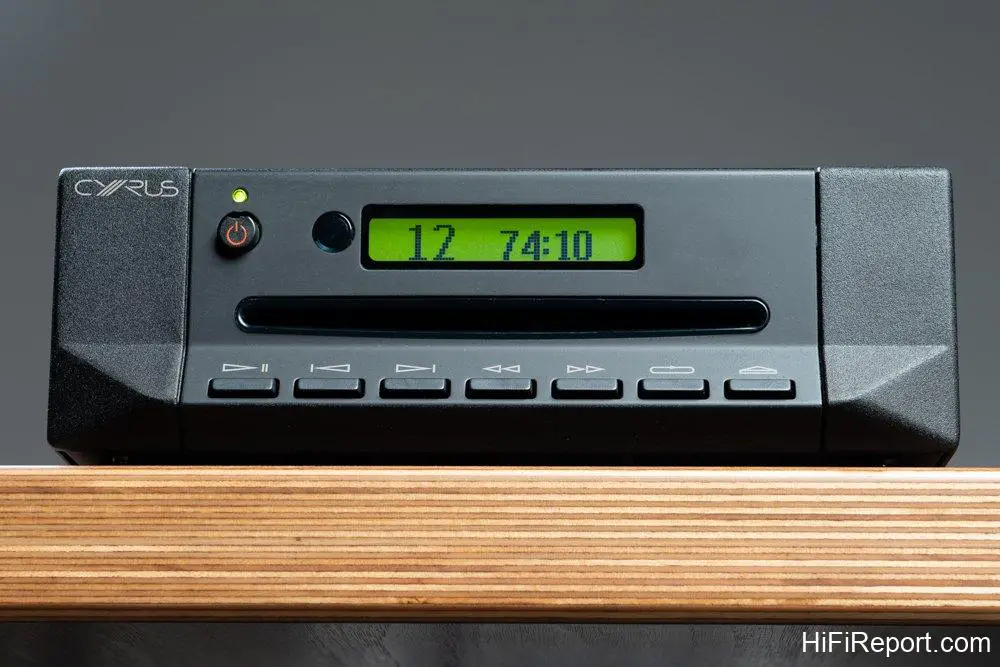
The CDi’s aesthetic aligns seamlessly with Cyrus’s signature design language, featuring a robust cast aluminum chassis, a departure from the more common extruded or folded aluminum enclosures. Despite its diminutive size, the CDi possesses a surprising heft, a testament to its solid construction.
Why opt for a cast aluminum chassis? Superior resonance control. A cast aluminum chassis, akin to CNC machining, is formed as a single, solid piece with substantial thickness. Internal, raised ribbing further reinforces the structure, resulting in exceptional rigidity and inherent resistance to resonance. Cyrus’s unwavering commitment to cast aluminum chassis for nearly three decades has become a defining characteristic of the brand.
Custom Servo Circuitry
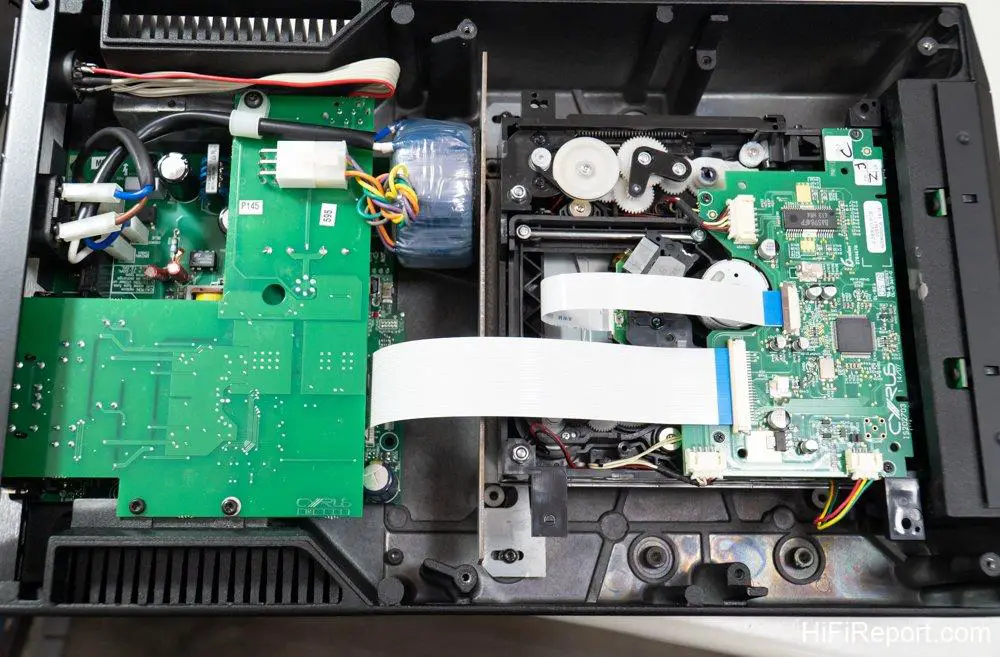
Due to the unibody chassis design, the CDi’s disc loading mechanism is located underneath. All internal components, including the slot-loading optical drive, power supply, DAC, and more, are mounted inverted within the chassis.
Internally, the CDi is thoughtfully partitioned into front and rear sections. The front section houses the optical drive and its associated servo circuitry, while the rear section accommodates the power supply and DAC. A dividing partition separates these zones, effectively minimizing potential interference between them.
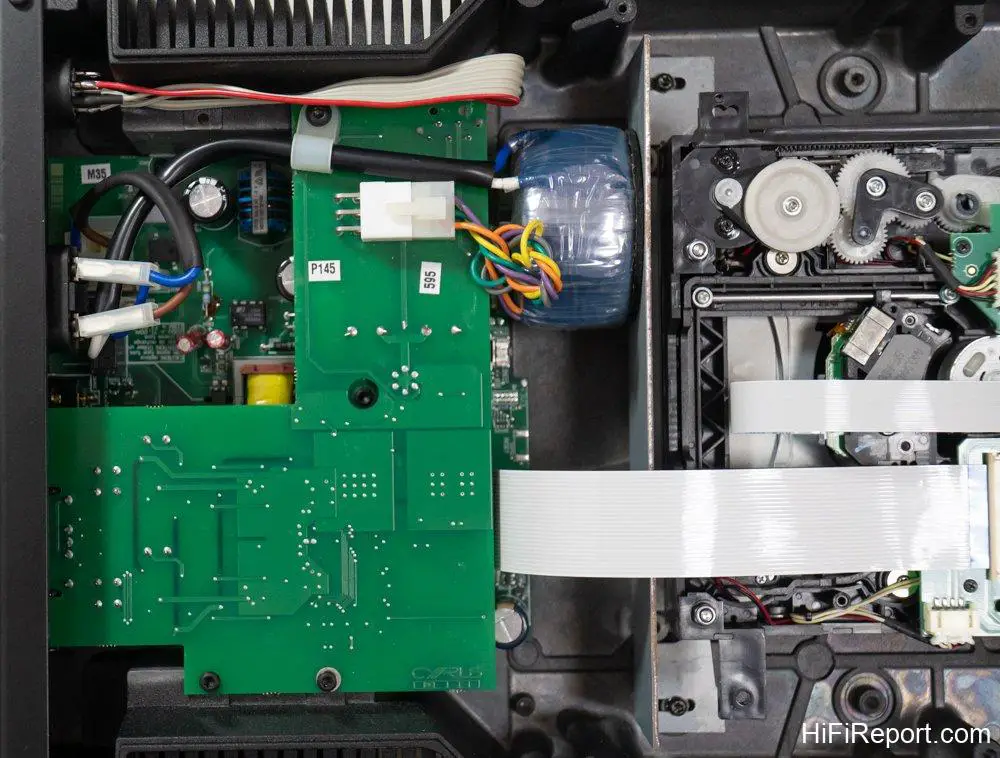
A key distinguishing feature of the CDi is its custom-designed servo circuitry for disc reading. This is subtly indicated by the Cyrus logo and associated serial numbers imprinted on the servo circuit’s printed circuit board.
Why would Cyrus go to the considerable effort of designing their own servo circuitry? The CDi utilizes a slot-loading optical drive mechanism commonly found in computers. These drives are designed to repeatedly read and perform error correction to ensure data integrity, a crucial function for computer data. However, for audio playback, this process can generate “servo noise,” increasing the overall noise floor and potentially degrading sound quality. Cyrus’s bespoke servo circuit is engineered to enable the optical drive to accurately read the audio track information on the first pass, minimizing the need for re-reads or error correction.
This very design philosophy, HiFiReport notes, is also implemented in Cyrus’s higher-tier CDi-XR CD player and CDt-XR CD transport. This consistent technological approach ensures that the CDi benefits from the same advanced engineering principles found in its more upscale siblings.
Dual Power Supplies
Regarding the DAC section, the manufacturer hasn’t explicitly disclosed the specific DAC chip employed in the CDi, but they have confirmed it operates at a 32-bit resolution.
Power supply architecture in the CDi is dual-pronged. A switching power supply is dedicated to powering the disc-reading mechanism, servo circuitry, and logic control functions. A separate linear power supply, built around a compact toroidal transformer, is tasked with delivering clean power to the more sensitive DAC and analog output stages.
These two independent power supplies operate in isolation, preventing mutual interference and ensuring the musical signal remains free from power-related noise contamination.

Furthermore, the CDi offers upgradeability via Cyrus’s proprietary PSX-R2 external power supply. Employing the PSX-R2 provides complete power isolation for the CDi’s internal DAC, delivering an even more abundant and stable power source.
In terms of output connectivity, the CDi thoughtfully provides dual sets of RCA analog outputs, enabling simultaneous connection to two separate audio systems, eliminating the hassle of cable swapping. Moreover, the CDi also includes a coaxial RCA digital output and an optical digital output, making it perfectly viable for use as a dedicated CD transport.
Operationally, the CDi features a comprehensive array of physical buttons on its front panel, providing full control. Remote operation is also supported via the included remote, which is of notably high quality and even includes a backlight, ensuring effortless control even in dimly lit environments.
Operational Excellence
One might question the operational finesse of a slot-loading mechanism. Would there be noticeable rotational noise or excessive vibration during playback? Initially, I harbored similar doubts. However, after experiencing the CDi firsthand, I can confidently say those concerns were unfounded. The CDi exhibits only a faint mechanical sound during disc insertion and ejection, which is inherently unavoidable (even traditional tray-loading mechanisms produce gear sounds, and some are even louder). During disc rotation and playback, the CDi operates with remarkable quietness. Overall operational quality is thoroughly commendable.
The listening evaluation took place within my home listening environment, utilizing a system comprising the Electrocompaniet EC 4.8 preamplifier, NuPrime Evolution One power amplifier, and Aurum Cantus Grand Harmony loudspeakers. Connecting the CDi to the EC 4.8 preamp with Supra Cables EFF-I interconnects, I commenced listening. This immediately bypassed the complexities of booting up a NAS, streaming player, and DAC – and eliminated the need for network switches. Truly, a streamlined and convenient experience.
The CDi’s sonic character mirrors this operational simplicity – it’s all about effortless music enjoyment, allowing you to effortlessly connect with the atmosphere and emotion the recording intends to convey. In essence, the CDi is a paragon of “small yet beautiful,” comprehensively equipped and delivering everything one could reasonably expect.
Smooth Texture
The CDi’s primary sonic attribute is its smooth, almost silken texture. The sound is unconstrained, relaxed, and possesses a captivating approachability.
Consider, for example, the “Frozen” soundtrack, a frequent listen of mine. The standout elements are undoubtedly Elsa and Anna’s vocal performances – pristine, pure, bright, and soaring, evoking vivid imagery through sound alone. However, such powerful vocals can become strident or harsh if a system lacks sufficient smoothness, tonal balance, or overly emphasizes analytical precision. This is never the case with the CDi. It allows me to indulge in Elsa’s powerful vocals at high volumes without the slightest hint of discomfort.
Another compelling example is the acclaimed audiophile recording of Vivaldi’s “Four Seasons” violin concertos, featuring Giuliano Carmignola and the Sonatori De La Gioiosa Marca ensemble. The recording is remarkably transparent and clean, brimming with detail, and boasting commendable layering and imaging. Yet, it can occasionally sound slightly dry or edgy during louder passages, lacking a certain sonic appeal. Through the CDi’s playback, this recording retains its dynamic contrasts and defined string textures, but with a noticeable softening and a warmer overall character, resulting in a more comfortable and engaging listening experience.
Focused and Defined Soundstage
The CDi’s second notable characteristic is its focused, clear, and tangible soundstage. Instrument separation and imaging are demonstrably above par. The CDi presents a soundstage that is somewhat smaller in scale and leans towards a centralized, cohesive presentation rather than a vast, expansive panorama. This characteristic contributes to the CDi’s overall sonic intimacy and approachability, making it ideally suited for smaller ensemble music like chamber and jazz, as well as genres such as pop and rock.
Take, for example, Naim’s “True Stereo” demonstration disc. This recording employs a unique “True Stereo” technique, utilizing only two precisely positioned microphones throughout the entire recording process. The recording venue itself boasts naturally favorable acoustics, and the sound is captured directly in stereo, without subsequent mixing or artificial processing. The “True Stereo” disc features primarily small-scale jazz and pop vocal performances. Played through the CDi, I experienced a palpable and finely rendered soundstage unfolding before me. While not expansive, it created a compelling sense of immersion. Furthermore, excellent instrument separation and realistic proportions ensured clarity and prevented any sonic muddiness.
Balanced Frequency Response
The CDi’s third defining attribute is its remarkably balanced frequency response. The high, mid, and low frequencies are presented in harmonious proportion, creating a well-structured sonic foundation. Instrumental and vocal images are rendered with accurate scale and believable dimensions, resulting in a natural and authentic musical presentation. Initially, this characteristic might seem unremarkable, almost subtle. However, with extended listening, I realized this balance fosters a profound sense of ease and naturalness. The sound is fluid, balanced, and harmonious, allowing me to effectively forget about the equipment and simply immerse myself in the music.
Truthfully, the availability of CD players in today’s market is diminishing, not expanding. Particularly as the market polarizes towards high-end offerings, manufacturers increasingly favor premium-priced models, making mid-to-lower-priced options increasingly scarce. If you still cherish the tactile pleasure of playing CDs and are considering adding a CD player to your system as a future-proof backup source, the CDi emerges as an eminently sensible choice. Its distinctive aesthetics, exclusive design elements, UK origin, and reasonable price point make it a formidable contender in its class, arguably without peer.
Specifications
* Type: CD Player
* Analog Outputs (Fixed Volume): RCA × 2
* Digital Outputs: SPDIF Optical × 1, SPDIF Coaxial × 1
* Dimensions: 215 × 73 × 360 mm (Width × Height × Depth)
* Weight: 3.6 kg