
Esoteric N-05 Network Audio Player Review
Japanese High-End manufacturer Esoteric has finally released its first network music player, the N-05. A Network Audio Player is designed to directly connect to an Ethernet cable and read music files from other storage devices, such as NAS or computers, and transmit them to the player for processing. Esoteric, a renowned Japanese source component manufacturer, has always been highly praised for its disc mechanisms.
Now, it has stepped into the realm of high-end, disc-less network audio players, fulfilling the long-awaited expectations of many Esoteric enthusiasts.
The N-05’s appearance is consistent with Esoteric’s past products, featuring a sleek and textured aluminum alloy chassis that embodies the brand’s signature design language.
Long-Awaited New Model
Those familiar with Esoteric will know that its parent company, Teac, has been releasing network players for quite some time. Therefore, Esoteric’s R&D team is no stranger to network streaming. As an independent brand within the Teac group, Esoteric specializes in manufacturing top-tier audio equipment, with the finest technology and craftsmanship invested in its products.
For a high-end brand like Esoteric to venture into a new domain, a rushed approach is unacceptable and could damage its reputation. Network players, in particular, require extensive software integration, which I believe is a major reason why the N-05 is only being released now.
High-Resolution DAC and Precision Clock
Currently, network streaming players on the market mainly fall into two categories: those with built-in DAC decoding capabilities that output analog signals, and those that are purely digital streamers requiring a separate DAC for digital-to-analog conversion.
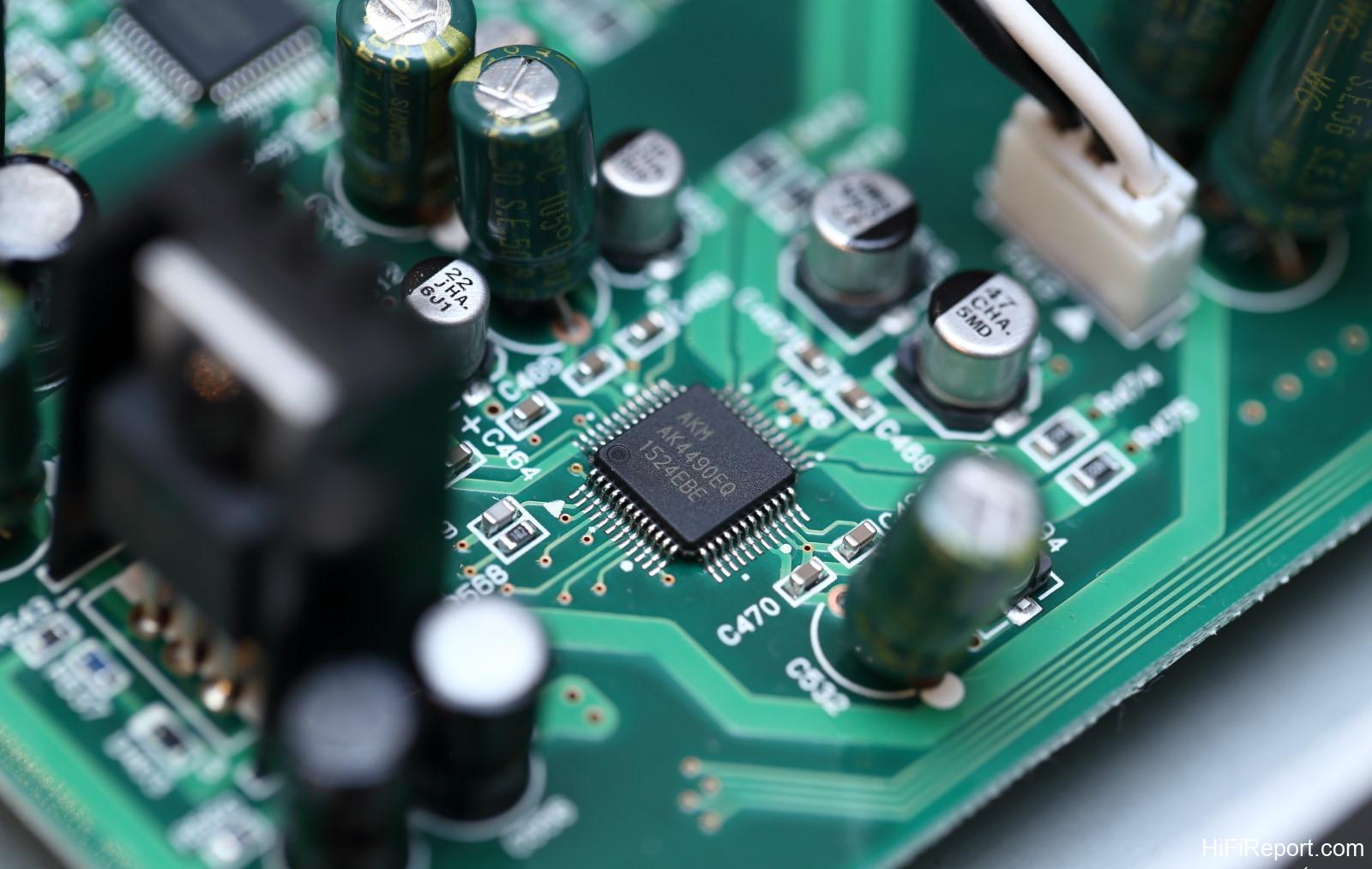
The N-05 boasts a superb dual-mono balanced DAC circuit internally. Each channel utilizes four AKM AK4490 DAC chips, configured in a parallel and differential circuit design. This digital-to-analog conversion circuit design empowers the N-05 with 34-bit processing capability.
If you believe that 24-bit decoding already delivers excellent sound quality, then 34-bit processing elevates detail retrieval and sonic continuity by 1,024 times compared to 24-bit, offering a smoothness that is closer to the analog curve.
Another hallmark of Esoteric is its expertise in independent clock signal devices, often simply referred to as “clocks.” They possess exceptional manufacturing standards and extensive experience in this area. The N-05 incorporates a high-precision VCXO (voltage controlled crystal oscillator) clock internally, providing accurate clock signals to the digital circuits. This VCXO is co-designed and manufactured with the leading clock manufacturer NDK (Nihon Dempa Kogyo).
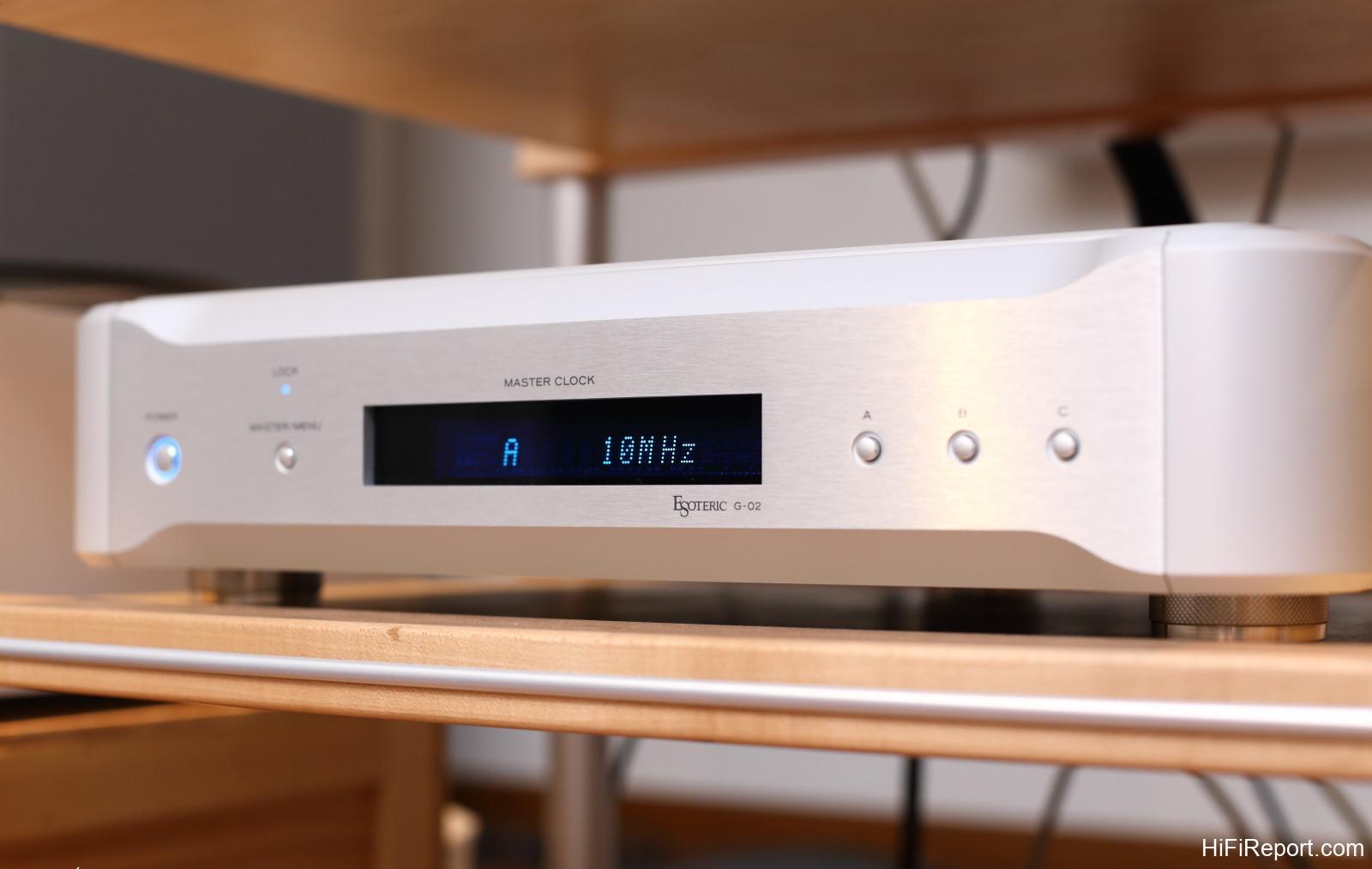
Of course, you can also connect Esoteric’s own external clock to the rear panel. The manufacturer recommends the G-02 as the most suitable choice, which can provide even more precise clock signals to the digital signal processing circuits, supporting master clock frequencies of 44.1/88.2/176.4kHz, as well as 10MHz and 22MHz.
Dual USB Digital Inputs
Despite being named a Network Audio Player, the N-05, after such a long period of development by Esoteric, certainly offers more than just network connectivity. In terms of music signal input, in addition to the Ethernet port, the N-05 also features two USB ports. One can directly connect to a computer, bypassing the network, and transmit music signals asynchronously via USB.
The other USB port can connect to a USB flash drive; as long as it contains music files, they can be played through the N-05.
Traditional Digital Inputs and Outputs Retained
Furthermore, on the input side, there are also two sets of traditional RCA digital inputs and one Optical digital input, supporting up to PCM 192kHz/24bit and DSD2.8MHz (DoP) transmission. There is also one set of RCA digital outputs, capable of transmitting PCM 192kHz/24bit and DSD2.8MHz (DoP).
In addition to digital inputs and outputs, the N-05 provides two sets of analog output terminals: one balanced XLR output and one RCA single-ended output. At the lower center of the rear panel, there are a clock input and a clock output. For this review, we also connected the G-02 clock for listening tests, with the G-02 transmitting the master clock signal to the N-05 via Esoteric’s proprietary clock cable.
The G-02 providing a 10MHz clock signal to the N-05.
Easy Playback via USB Connection to Computer
So, how do you use the N-05? Here, we introduce two main usage methods. The first is connecting via USB to a computer. When connecting to a MAC computer, no additional driver installation is required. After plugging in the USB, the following option will appear in the sound menu. Simply select it, which is very straightforward. For Windows systems, driver installation is necessary, and compatible versions are specified in the user manual.
Playback is then controlled using the playback software on your computer. The official recommendation is to use Esoteric’s own HR Audio Player playback software, but other playback software can also be used. I found playback with Audirvana to be very smooth. DSD playback is also seamless. Via USB, the N-05 can support PCM music sampling rates up to 384kHz/32bit, and DSD sampling rates up to 11.2MHz (4x DSD).
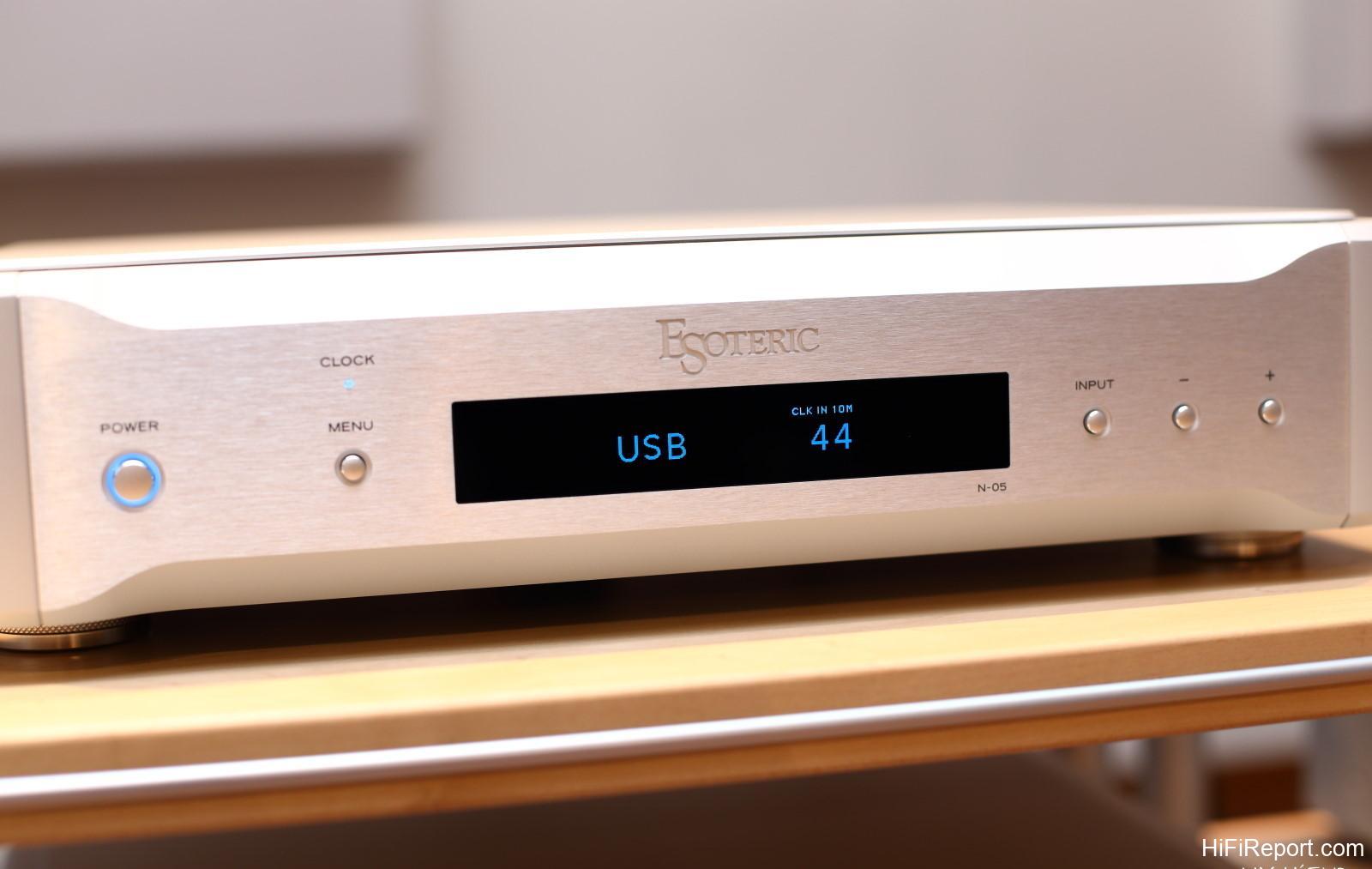
The display screen of the N-05 when using USB transmission. The right side shows the sampling rate, and the upper right indicates the clock signal when an external clock is connected.
New App for Network Streaming Control
The other playback method, and the main focus here, is network streaming. First, you need to download Esoteric’s playback app “Esoteric Sound Stream,” designed for the N-05, from the Apple App Store on your phone or tablet. Currently, only the iOS version is available, with an Android version planned for the future.
Opening Esoteric Sound Stream, it automatically connects to the N-05 and searches for music storage devices on the same network. As you can see from the bottom, although it is the same NAS, there are three options. This is because different server software is installed on the NAS. I selected MinimServer, which is currently a highly recommended server software for music playback.
The Esoteric Sound Stream app is very user-friendly and easy to navigate. There are numerous settings available, all fully translated, making operation effortless. There are also various options for arranging the music library, such as cover art display, artist name sorting, song list view, etc., allowing for personal customization.
The screen displayed on the N-05 unit when streaming music files from a NAS. The top left shows the file format. For DSD, it displays the sampling rate, and the same for PCM files. The track number corresponds to its position in the playlist. When using network streaming, the file support is up to PCM 384kHz/32bit and DSD 5.6MHz.
In terms of music file formats, DSD supports DSF and DSDIFF (DFF) files. PCM supports FLAC, AppleLossless (ALAC), WAV, AIFF, MP3, AAC, and other formats.
Upsampling, Conversion, and Filter Options
The N-05’s internal DD (Digital to Digital) conversion capability is also impressive. It can upsample incoming PCM signals by 2/4/8 times, and provides PCM and DSD digital filters, allowing users to subtly alter the sonic characteristics according to personal preference. It can also convert PCM music files to DSD for playback.
Next, let’s examine the internal structure of the N-05 and introduce some exclusive technologies.
Esoteric’s internal layout is always meticulously organized. A large toroidal transformer is positioned at the front, with the power supply circuitry on the left when facing the front panel, and the digital and analog circuits at the rear.
The power supply section on the left.
Dual-Mono DAC Circuit Design
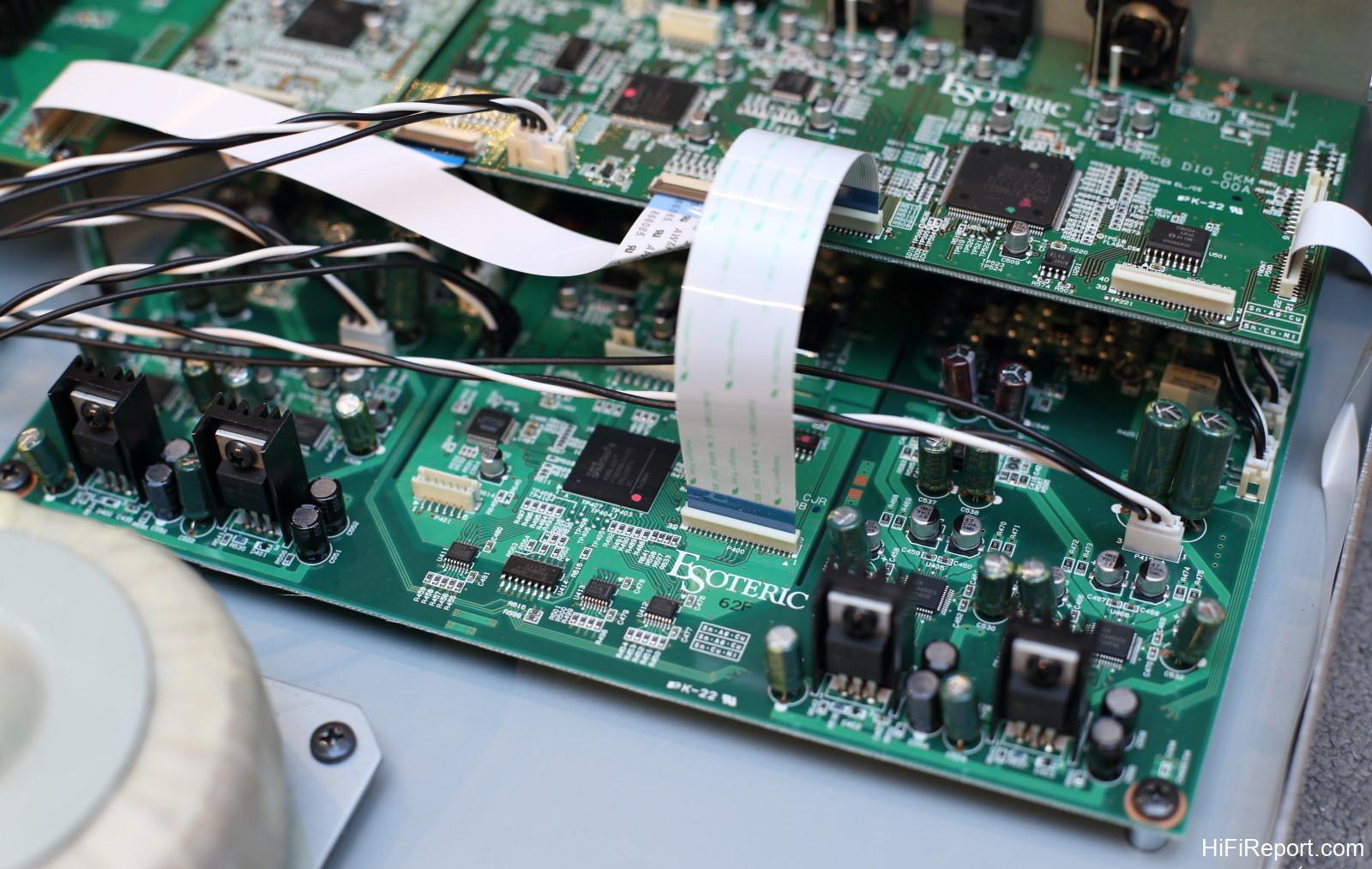
The circuit distribution at the rear. The digital input/output circuits are located at the top. The clock and digital circuits are in the center below, flanked by dual-mono designs on both sides, each with a dedicated DAC circuit and analog output for each channel.
In terms of signal receiving circuits, the larger one on the left, equipped with a large heatsink, is the network streaming receiver circuit and the USB storage device file receiver circuit. The smaller one on the right is the USB receiver circuit for connecting to a computer.
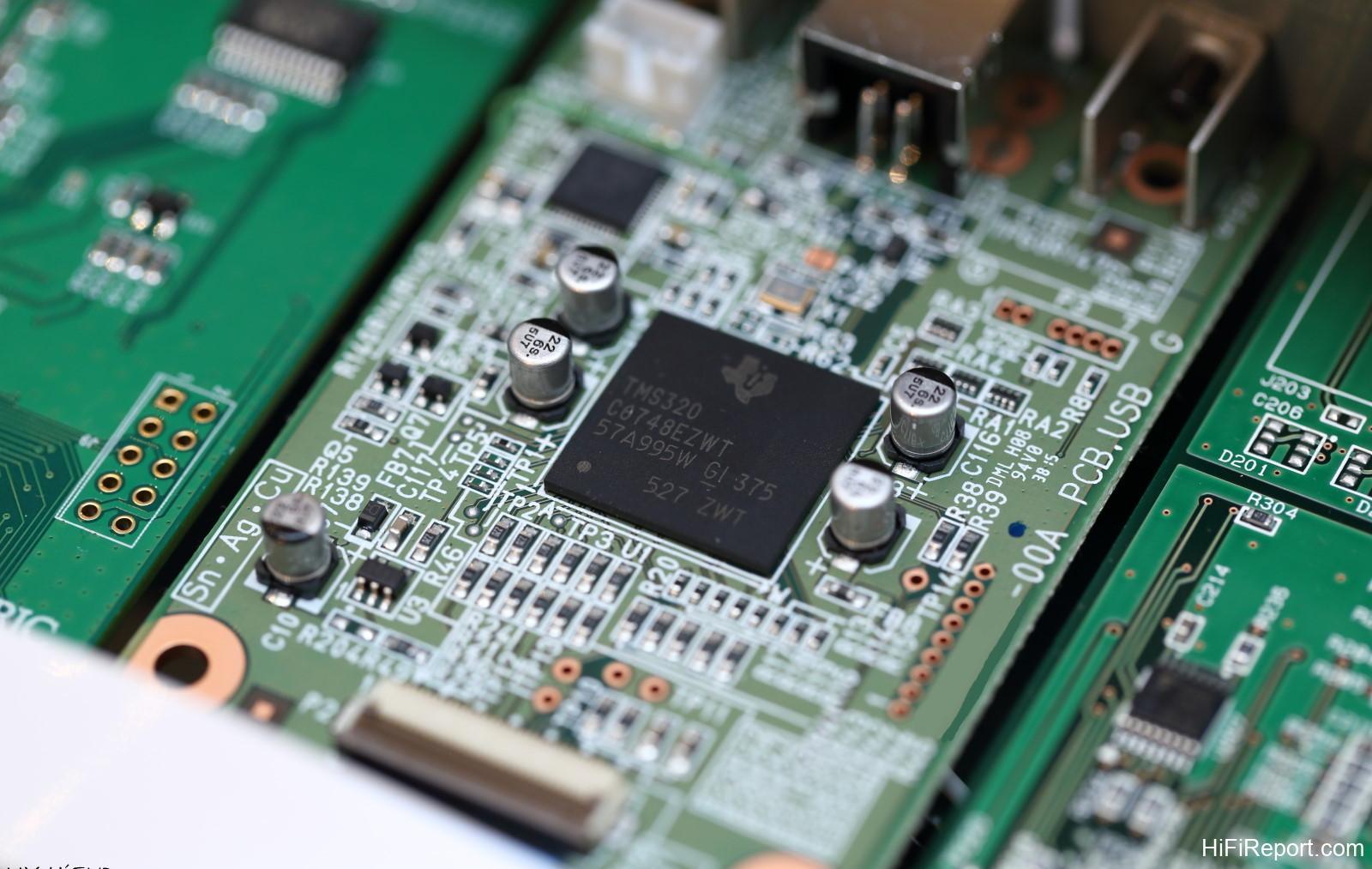
The USB receiver circuit for computer connection, utilizing a Texas Instruments TMS320 digital signal processing chip.
Another digital circuit mainboard, from left to right: two sets of RCA digital inputs, optical digital input, and the RCA digital output on the far right.
EDLC and HCLD Exclusive Technologies Specifications
The clock circuit is located in the lower central inner area, while the digital processing circuit is in front of it. Digital signals are transmitted to the left and right mono DAC circuits for digital-to-analog conversion, and then the signals are sent to the rear terminals for analog output.
The DAC circuits on both sides utilize EDLC (Electric Double-layer Capacitor) technology, the same technology used in the Grandioso C1, featuring capacitors with a capacity as high as 500,000μF, and Esoteric’s high slew rate HCLD Type 2 (High Current Line Driver) output buffer stage.
* XILINX SPARTAN-6 FPGA digital processing chip is used.
* AKM AK4490 32bit DAC digital-to-analog conversion chip is used.
* Power supply and menu selection control circuit.