
darTZeel CTH-8550 MKII Review
The darTZeel brand was established by Hervé Delétraz in 2000. Born in 1962, Hervé Delétraz’s interest in audio began at the tender age of nine when he built his first two-band radio from a Philips kit. By twelve, he was engrossed in hi-fi magazines, attending audio shows, and had firmly decided on a career in the audio industry. At fifteen, he enrolled in the Swiss E.I.G. (School of Electrical Engineering, now HEPIA), graduating in 1984 with a Class D amplifier as his final project.
However, dissatisfied with his Class D design, he returned to researching traditional amplifier topologies, a pursuit that lasted sixteen years. During this extensive period, he naturally held various jobs to make a living, including stints as a control and debugging technician at LeCroy and later as Technical Director at Mandrake Telecommunications Ltd. By 1993, he was working for the City of Geneva government.
In 1999, Hervé Delétraz completed an amplifier that his friends found impressive, encouraging him to put it into production. This amplifier, never officially released, was known as Model 0. In 2000, he founded darTZeel, and in 2001, he obtained a patent for a specific circuit within the NHB-108 Model One amplifier. The first official product, the NHB-108 Model One stereo power amplifier, was completed in 2002 and debuted at the Stereophile audio show in New York.
Its distinctive color scheme and high price tag immediately garnered attention, making a significant splash. Sales commenced in the United States in 2003. This power amplifier employed the most minimalist circuit design, achieving an extremely wide bandwidth with only a small amount of local negative feedback.
Following the NHB-108 Model One, darTZeel has consistently released new products: the NHB-18NS preamplifier, the LHC-208 digital streaming integrated amplifier, the NHB-458 and NHB-468 monoblock power amplifiers, the NHB-108 Model Two stereo power amplifier, the CTH-8550 integrated amplifier, and the CTH-8550 MKII (launched in 2020). Frankly, darTZeel products are not accessible to everyone.
Even the CTH-8550 MKII integrated amplifier carries a price tag of nearly one million NTD (approximately $31,000 USD at the time of the article). A budget of nearly a million NTD offers numerous choices, including separate preamplifiers and power amplifiers. However, if you ever have the opportunity to hear the darTZeel sound signature, I guarantee it will stay with you. If your pockets are deep enough, it might just inspire you to fight tooth and nail to own one.
Distinctive Design & Philosophy
From an aesthetic standpoint, darTZeel exhibits two particularly unique design choices: the logo and the chassis color. Both are sure to spark curiosity and, from a marketing perspective, are highly successful design elements. The darTZeel logo is special because Hervé Delétraz greatly admired Wilhelm Studer (1912-1996), the founder of Studer/Revox.
Since the central “V” in the Revox logo is capitalized, Hervé Delétraz modified his own surname to create the darTZeel logo, paying homage to Wilhelm Studer. Moreover, the “Z” also represents the Zener diode, aligning with the electronic characteristics of an amplifier.
The colors of the darTZeel chassis are also highly distinctive. Hervé Delétraz stated that he chose these two colors (red and yellow/gold) because he personally liked them and felt they paired well with traditional wooden furniture. Coincidentally, red and yellow are the colors of the flag of Geneva, a fact he only discovered years later. The ability of even the chassis color to generate discussion is a testament to his undeniable genius.
Beyond its unique appearance, darTZeel amplifiers also feature many distinctive internal design aspects. For instance, darTZeel amplifiers do not employ balanced designs, a significant departure from the vast majority of amplifiers on the market. Why avoid a balanced architecture? Hervé Delétraz explains that balanced architecture is primarily useful for long-distance signal transmission to avoid noise interference and for the convenience of external phantom power when using microphones.
If you were to examine the console in a recording studio, you would find that incoming balanced signals are converted to single-ended signals internally.
Furthermore, loudspeaker crossovers are also single-ended designs; you won’t find balanced crossovers. Based on these two reasons, coupled with Hervé Delétraz’s design philosophy of using the fewest possible components and the shortest signal path, his amplifiers exclusively employ single-ended architecture. Although you may see XLR connectors on the back panel of his preamplifiers or integrated amplifiers, the signal is converted to single-ended once it enters the preamp.
They are essentially included as a courtesy.
Technical Quirks
Another characteristic of darTZeel amplifiers is that the power output stage utilizes an open-loop (no feedback) design, with only a very small amount of feedback applied to the input stage. Hervé Delétraz states that the advantage of this design is that the frequency response does not rely on internal corrective compensation, and the circuit’s phase and gain do not change with frequency.
An open-loop circuit does not correct errors; as long as the circuit design is good enough, it simply faithfully amplifies the music signal. Moreover, closed-loop (negative feedback) designs always inherently involve time delays.
While open-loop design offers these benefits, the challenge lies in the circuit’s susceptibility to interference. Once interfered with, an open-loop design lacks automatic correction, and the interference will be amplified and output. Closed-loop designs, with feedback, can compare the output signal to the input signal and apply automatic correction to reduce the impact of interference on the output.
In essence, because both approaches have their pros and cons, both open-loop and closed-loop circuits are used, the key is who applies them skillfully.
Unique Controls and Connectivity
darTZeel also has a distinctive approach to volume control. Whether on a preamplifier or an integrated amplifier, the volume knob has a peculiar feel – soft, slightly loose, with distinct detents – very different from typical volume knobs. This is one of Hervé Delétraz’s ingenious creations. Why did he design the volume control this way? He explained that when designing a preamplifier to pair with the NHB-108 Model One, he encountered difficulties with the volume control.
Since the NHB-108 stereo power amplifier’s signal path uses no relays, it’s ultra-short and direct. If the preamplifier were to use relays for input switching, it would compromise this purity. Furthermore, he couldn’t use traditional variable resistors for volume control, and using an R2R volume control would require a relay array and MOSFETs, which again violated his core philosophy.
One day, a flash of inspiration struck: why not use a photoresistor for volume control? Under specific wavelengths of light, these resistors rapidly decrease in resistance. Changing resistance allows for volume control. The challenges were that photoresistors are not linear and require software control, making the design complex. Ultimately, Hervé Delétraz spent several years researching and solving two problems, leading to the birth of the NHB-18NS preamplifier.
darTZeel amplifiers feature 50-ohm BNC connectors, which are not found on other brands, and are referred to as darT connectors. darTZeel even produces special BNC signal cables, recommending users prioritize these 50-ohm BNC connectors for connecting their preamplifiers and power amplifiers. BNC connectors come in two types, 50-ohm and 75-ohm, and are not interchangeable.
Both 50-ohm and 75-ohm BNC connectors are typically used in video equipment due to their secure connection, stable and precise impedance, and ultra-wide bandwidth. Having seen so many amplifiers, darTZeel is the only brand that uses BNC connectors for connecting preamplifiers to power amplifiers or sources, highlighting just how different Hervé Delétraz’s ideas are.
Finally, another unique feature is the requirement to use a USB flash drive for unlocking and registration, with the display window capable of showing the dealer’s name. While most amplifiers start playing music simply by pressing the power button, darTZeel amplifiers are locked at the factory. They require the included USB drive to be inserted into the rear panel for unlocking. This USB drive can also be used for future firmware upgrades.
If the unit is not registered, the amplifier will automatically power off after 15 minutes of operation, even if stolen, rendering it useless to a thief.
An even more ingenious move is the ability to input the dealer’s name into the amplifier, which is then displayed in the window every time the unit powers on. Of course, other relevant information is also shown. This feature is clearly intended to protect local dealers and also allows for monitoring the flow of grey market units.
The CTH-8550 MKII’s front panel controls use intuitive buttons. On the left is a row of nine small round buttons with no text labels. On the right are eight small round buttons, each with a text label indicating its function. The labeled buttons’ functions are obvious. What about the unlabeled ones? Don’t worry; a corresponding row of text appears below the display window, indicating the corresponding inputs such as Line 1-4, MC, Z1, Z2, XLR.
Wait, that’s only eight labels, but there are nine buttons! The fifth is MM; if not selected as an option, MM and MC won’t be displayed. So, if your input source is connected to L1 (the first set of RCA terminals), you need to press the first small round button to play music, and so on.
The eight small buttons on the right each have function labels and require no further explanation. Oh, and the “Time” button is also unique to darTZeel. Pressing it displays the date (day, month, year) and time in the upper left corner of the display. To be honest, this feature seems a bit redundant, as we all check our phones for the time these days, and the numbers on the display are quite small. Another function of this feature is setting automatic power-on time.
Is this perhaps to set the amplifier to turn on two hours before you get home from work, so you can immediately enjoy a “warm” sound upon arrival? Okay, I admit this feature has practical value, at least for me. By the way, there’s a status light on the left side of the panel. It shows red when plugged in, orange when the Power button is pressed (at which point the volume knob also shows an orange ring), and turns green when controlled by the remote.
Clearly, Hervé Delétraz is incredibly meticulous.
The rear panel of the CTH-8550 MKII features nine sets of input terminals: RCA inputs 1-4, one set of XLR inputs, two sets of BNC inputs (darTZeel’s proprietary 50-ohm terminals), and MM/MC phono inputs. All input terminals can be assigned as Home Theater Bypass terminals, meaning their volume is not controlled by the volume knob. There are three sets of output terminals: RCA, REC, and BNC (the proprietary darT 50-ohm terminals).
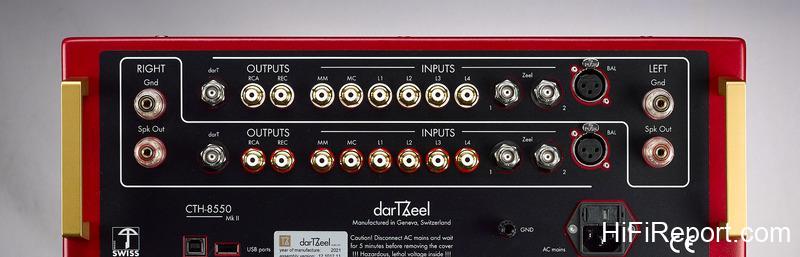
Additionally, there are two USB slots and speaker terminals for the left and right channels. Of the two USB slots, the slender Type A connector is for inserting the USB key to unlock the unit, while the square Type B connector is likely for firmware upgrades. Neither is for connecting to a computer or NAS for music playback.
Next, let’s explain the Menu functions. Pressing the Menu button displays three main options: Record Out, Display, and Parameters. The bottom of the display window shows 1, 2, 3. These numbers correspond to the three small buttons below them. For example, pressing button 1 selects Record Out, and so on. After entering the Record Out option, the display bottom shows “-” and “+”, which are controls for selecting a source to record.
When entering a different option setting, the display bottom will show various icons like plus, minus, left/right arrows, up/down arrows, OK, RST (Reset), etc. You simply press the corresponding small round button to control the settings. Honestly, having become accustomed to setting options using a rotary knob, returning to this button-based intuitive setting feels a bit unusual. However, for some old-school audiophiles, this intuitive setting might actually be easier to use.
In the menu, Record Out is for selecting the source to be recorded, Display controls screen brightness or auto-off, etc. Parameters is the more important option. Entering this option brings up five sub-options: Rename, Settings, Others, Clock, and Diag (version, registration status). These settings are easily configured by following the instructions in the manual.
The Settings option is more complex; it allows independent configuration of the Level, Balance, Stereo or Mono mode for each input terminal, as well as assigning which terminal serves as the Home Theater Bypass. Furthermore, Settings also allows you to disable the power amplifier stage, using the unit purely as a preamplifier.
In this mode, the large toroidal transformer powering the power amplifier will not operate, leaving only the smaller toroidal transformer supplying power to the preamp and control circuits.
Most modern amplifiers offer various settings; honestly, I’m not a fan. These settings not only confuse the user but also increase costs and can potentially be sources of interference. Haven’t preamplifiers and power amplifiers without such settings worked perfectly fine for decades? An amplifier’s job is simply to faithfully reproduce music; why all these fancy settings?
But designers are often caught in this dilemma: if others have it and you don’t, you might be at a disadvantage in marketing, so you feel compelled to follow suit.
CTH-8550 MKII: The Heart of the Matter
Having covered darTZeel’s unique characteristics, let’s now turn our attention to the protagonist of this article, the CTH-8550 MKII integrated amplifier. darTZeel launched the first generation CTH-8550 in 2008. Do you know what the CTH-8550 model number stands for? CTH means “Close To Heaven.” And 8550 signifies that 50% of the budget allows for 85% of the sonic performance. Do you remember what NHB stands for? “Never Heard Before.”
The CTH-8550 MKII was released in 2020. What are the differences between the second generation and the first? I asked the local distributor to inquire with the factory, and I received a simple response. The first generation chassis was made of steel, while the second generation is made of 2.5mm aluminum alloy, which provides better RFI shielding. The second generation MC phono stage circuit has increased gain by 6dB, allowing it to accommodate more low-output MC cartridges.
Additionally, the overall power supply has been improved in the second generation, with Mu metal used to block transformer leakage flux. Are there any other improvements? Those, presumably, are the factory’s secrets. In any case, the second generation’s price is certainly higher than the first, and its sonic performance is undoubtedly superior; otherwise, the factory would lose face.
The CTH-8550 MKII is rated at 200 watts per channel into an 8-ohm load. When the load impedance drops to 4 ohms, it outputs 330 watts per channel. At 2 ohms, the output power does not increase further, remaining at 330 watts, although the peak output can reach 400 watts. In terms of frequency response, if specified as +0/-6dB, the bandwidth is 3Hz-300kHz; if +0/-0.5dB, the bandwidth is 20Hz-20kHz; and within +/- 0.5dB, the bandwidth is 20Hz-50kHz.
The CTH-8550 MKII unusually lists rise time and slew rate: the former is less than 0.8us, and the latter is greater than 88V/us – these are excellent specifications.
Regarding Total Harmonic Distortion (THD), the specification is less than 1%. For an amplifier, this number seems astonishingly “poor.” Most amplifiers specify THD with two, three, or even four zeros after the decimal point. However, the CTH-8550 MKII’s THD is specified across a range of 7Hz-77kHz, not just 1kHz. More importantly, the CTH-8550 MKII’s Transient Intermodulation Distortion (TIM) is unmeasurable, which is arguably more significant.
Hervé Delétraz has stated that THD is not as important and is difficult for the human ear to discern, but transient intermodulation distortion caused by negative feedback is audible. Indeed, loudspeakers and tube amplifiers often have very high THD, yet people still enjoy listening to them immensely. Every designer has their own priorities; it’s up to you whether you agree with their approach.
Physical Design
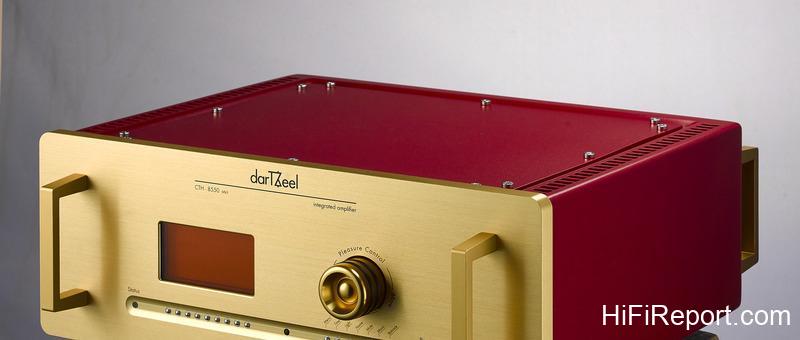
The CTH-8550 MKII’s faceplate is yellow, and the chassis is red. This color combination is unique in the audio industry. The faceplate is 15mm thick, and the chassis is 2.5mm thick. Both the front and back panels feature sturdy handles, making it easier for the user to lift the unit. The heatsinks for the CTH-8550 MKII are concealed internally, enclosed within the chassis, but there are grilles on both sides ensuring adequate ventilation and heat dissipation.
In fact, the CTH-8550 MKII does not get very hot during operation. I left it on all day and touched it occasionally; it was only mildly warm.
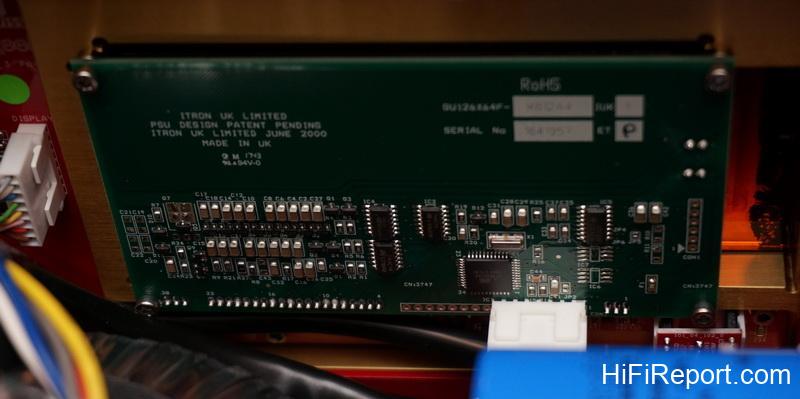
On the left side of the front panel of the CTH-8550 MKII is a small display window, a VFD (Vacuum Fluorescent Display) manufactured by Itron UK Limited. Upon power-up, the display first shows various information for a few seconds before switching to the normal display (volume level, etc.). To the right of the panel is the volume control knob. This knob is inlaid with two rubber rings, providing a pleasant feel when turned, and it’s a custom-made component from Swiss company Elma.
The volume knob is labeled “Pleasure Control” instead of the common “Volume,” and features “Less” and “More” indicators, again highlighting its distinctiveness.
Internal Structure
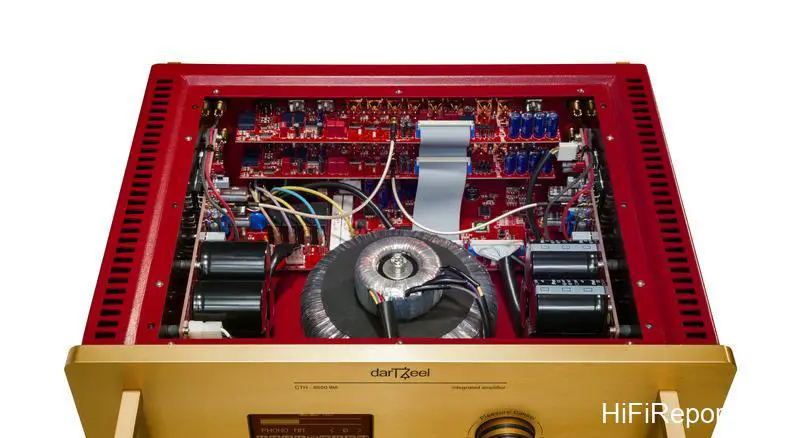
Lifting the top cover reveals a large toroidal transformer positioned squarely in the center. Stacked directly on top of the large transformer is a smaller toroidal transformer – seeing two Noratel transformers stacked like this is quite unusual. Each of these transformers has two independent windings. The large transformer supplies power to the power output stage, while the smaller one powers the preamplifier circuitry and the front panel display.
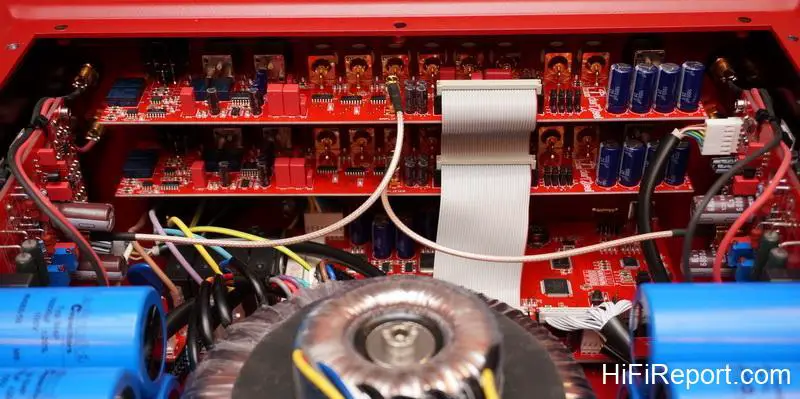
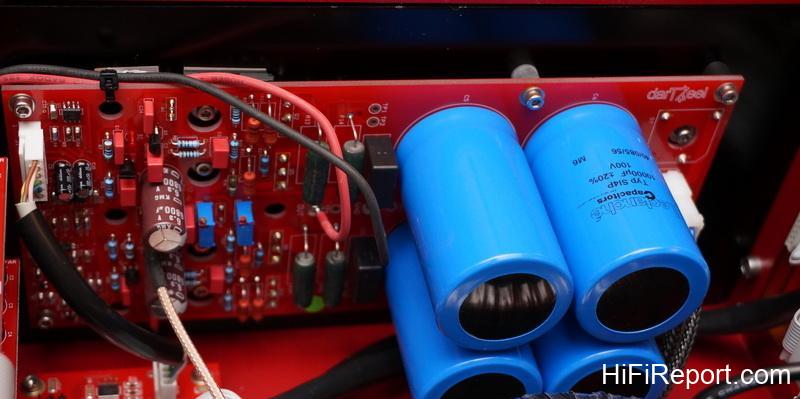
To the left and right, you can see four Leclanche 10,000uf/100V filter capacitors per channel. This company, founded in 1909, initially manufactured dry cells.
Each channel has four capacitors and a rectifier/voltage regulator circuit board vertically mounted on either side. This clearly indicates that the CTH-8550 MKII’s power supply is separated for the left and right channels. The input and preamplifier circuits of the CTH-8550 MKII also have separate circuit boards for the left and right channels. These boards are directly connected to the rear panel terminals without using connecting wires and are suspended and fixed in place.
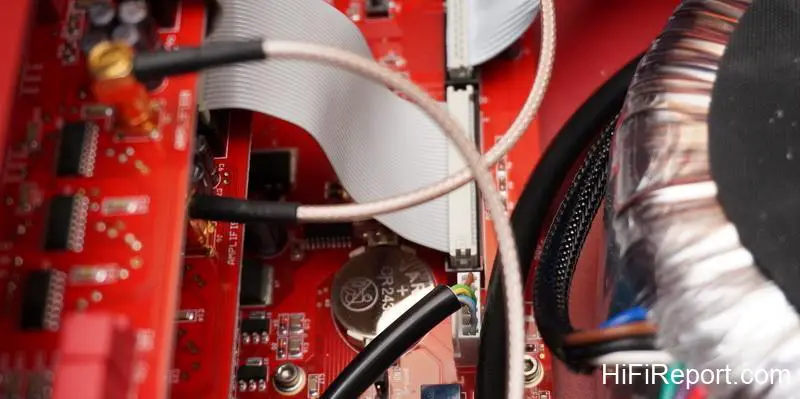
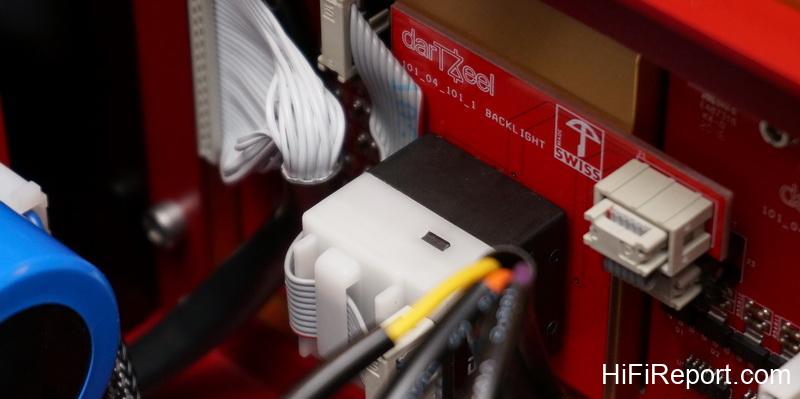
Below, there is a large circuit board containing the USB circuitry, a CPU, and a large button cell battery, which provides power for memory when the unit is off. The circuit boards for the front panel display, input terminals, and controls are installed on the inside of the front panel.
darTZeel’s power amplifiers initially used only one pair of bipolar power transistors per channel (NHB-108) because Hervé Delétraz believed that paralleling multiple pairs always introduces delay time, preventing optimal focus. However, subsequent power amplifiers, as their output power increased, had to adopt multiple parallel pairs, like the NHB-458 which uses four pairs. Hervé Delétraz stated that it took him over nine years to solve the issues with paralleling multiple pairs.
As for the CTH-8550 MKII, it uses two pairs of complementary bipolar power transistors per channel. Since they are mounted beneath the power supply circuit board, it’s impossible to see the manufacturer or model number used. However, based on previous models, I suspect they might be ON Semiconductor power transistors.
Listening Impressions
I listened to the CTH-8550 MKII in my open-plan living space, pairing it with DynamiKKs! Monitor 10.15 and AER Momentum speakers. My digital sources were the emmLabs TSDX SE CD transport and DAC2 SE digital-to-analog converter, along with the Weiss DAC 502. Comparing the two pairs of speakers, I ultimately chose the DynamiKKs! for the final evaluation.
The reason is that these speakers are best able to fully reveal the CTH-8550 MKII’s fast transient response and better express the beauty of its sound quality (timbre). I’m not saying the AERs can’t reveal the CTH-8550 MKII’s sound quality, but the AERs’ midrange has its own charming color, which would “obscure” the expression of the CTH-8550 MKII’s intrinsic sound quality.
Evaluating the Phono Stage
Before discussing the CTH-8550 MKII’s performance with high-level inputs, I want to first talk about its MC phono stage. The unit sent by the distributor came equipped with the MC phono circuit, and I couldn’t wait to try it. The first thing I noticed was something special: I didn’t connect the tonearm ground wire, yet there was no hum, only a tiny bit of current noise! As for amplification level, is it enough?
When listening to classical music, I needed to turn the volume up to -5dB to be satisfied (compared to around -20dB for digital sources). For pop music, a lower volume is fine. Basically, the new MC phono circuit has increased gain by 6dB and works well with MC cartridges having outputs around 0.2mV.
Next, how does this MC phono circuit sound? Honestly, it’s excellent, nothing to complain about. The sound is different from listening to the MC cartridge via a high-level input, but I believe this is due to the inherent sonic characteristics of the MC cartridge itself. In other words, with the built-in MC phono stage, you don’t need to buy an external phono preamp. The only slight drawback is that the built-in MC phono stage doesn’t allow load impedance adjustment; it’s fixed at 1k ohm.
But in actual listening, the inability to adjust the load impedance doesn’t matter because it already sounds so good.
Core Sonic Attributes
After spending many days with it, the first thing I must praise about the CTH-8550 MKII is its sound quality (timbre). I rank sound quality as the most important element in the “Audio Twenty” criteria because it is the most crucial aspect of audio equipment performance. If the sound quality isn’t good enough, no matter how good the other 19 aspects are, they cannot compensate for this weakness. Sound quality is like the quality of fabric.
If the fabric isn’t good, it’s uncomfortable to wear, no matter how cleverly the clothing is designed. Sound quality is also like the quality of beef. Why are there so many grades of beef? Why are some people so concerned about whether it’s Japanese Wagyu or Australian/American Wagyu? Ultimately, it’s the difference in meat quality.
Most people can easily distinguish the difference in fabric or meat quality, but the difference in sound quality requires listening to a lot of audio equipment over time to develop the ability to discern.
I have listened to many audio systems with excellent sound quality, so I am very sensitive to its performance. I can tell whether it’s good or bad the moment I hear it. The sound quality of the CTH-8550 MKII is absolutely first-rate. A significant portion of the price you pay for the CTH-8550 MKII is for its sound quality. Good sound quality allows the inherent beauty of instruments or voices to be presented more completely.
I don’t need to elaborate on how beautiful the CTH-8550 MKII makes violins, cellos, pianos, or vocals sound. Because when I put a CD into the player and the music starts, I immediately instinctively feel that the sound is more beautiful – this is the overall enhancement of sound quality.
Next, I want to discuss the CTH-8550 MKII’s transient response, which is often referred to as speed. Some audiophiles have a misunderstanding of speed, claiming that certain audio equipment sounds faster than a real live instrument performance. In reality, this might be a misperception caused by emphasized treble. An amplifier’s transient response can be assessed from its rise time and slew rate specifications, which most amplifiers do not list, so we must rely on listening.
An amplifier’s transient response, no matter how fast, cannot exceed that of the original instrument. The inherent speed of the instrument is the amplifier’s ceiling; the amplifier can only approach this ceiling, never surpass it. Truly fast transient response sounds very natural. For example, at the moment a bass drum is struck, the air mass is expelled rapidly, not softly. Or when listening to a string quartet, if the players suddenly play a forte passage, you’ll feel startled awake.
In fact, if the transient response is fast, listening to any music will feel vibrant and full of life – this is true speed.
The CTH-8550 MKII embodies this. When playing various types of music, it makes you fully feel the changes in power originally applied to the instruments by the performers. For instance, when listening to the Quatuor Ebene’s renditions of Ravel, Debussy, and Fauré string quartets, even in the slow, long-lined melodies, you can hear the rapid changes in subtle dynamics. When playing pizzicato, it’s even more apparent; each note seems to pop out instantly.
Listening to Evgeny Kissin and the Emerson String Quartet’s performance of Dvořák’s Piano Quintet Op. 81, you feel the music’s progression like several dragons rapidly rolling, diving, and soaring in the sky. Even at a moderate volume, you sense the music is full of kinetic energy – clear evidence of fast transient response.
And when listening to Yannick Nézet-Séguin conducting the Philadelphia Orchestra in Stravinsky’s “The Rite of Spring,” the sudden dynamic shifts and the powerful strikes of the timpani and bass drum clearly demonstrate the swift transient response.
Clarity & Detail
The CTH-8550 MKII’s crystal-clear transparency is also exceptional, and from this clarity, it reveals rich detail. Clarity and transparency simultaneously make the music sound very comfortable, like eating premium cod fillet with no tiny bones. This aesthetic of clear transparency in the CTH-8550 MKII is particularly beautiful when listening to Baroque music or string-centric compositions.
For example, when listening to Alexandra Conunova leading Vivaldi’s “The Four Seasons,” the CTH-8550 MKII allows you to hear beautiful sheen and a special sweetness and fragrance in the string sounds. Listening to Bernstein conducting the New York Philharmonic in Vaughan Williams’ “Fantasia on Greensleeves,” the luster of the strings and their hair-thin beauty, combined with the clear transparent background, further enhance the music’s moving power.
The CTH-8550 MKII’s resolution is also very natural; at first listen, it might not seem remarkable, but upon closer listening, you realize its power. When I listened to Bernstein conducting the New York Philharmonic in Mahler’s “Symphony No. 2” (DG recording), the faint string sounds at the beginning of the first movement clearly revealed a sense of trembling, rather than just a flat sound.
This natural yet potent resolution is particularly evident in quiet passages, where you can hear how lively the subtle, quiet underlying string section variations are, making the music more engaging instead of flat and boring. During intense tutti passages, the CTH-8550 MKII’s resolution is even better at separating the various orchestral sections, allowing me to hear the subtle melodies and dynamic changes within the inner voices, which further elevates the music’s moving power.
And when listening to Stokowski conducting “Rhapsodies,” the CTH-8550 MKII’s performance was even more spectacular. It not only clearly separated the string, brass, and woodwind sections of the orchestra – a resolution as fine as a strand of hair – but it also elevated the overall musical energy. I believe this increase in musical energy comes from its excellent handling of both large dynamic contrasts and subtle dynamic nuances, as well as its fast transient response.
The CTH-8550 MKII compels me to forget everything else and listen to the entire album from start to finish, giving you a glimpse into its powerful allure.
Power & Presence
I’m not entirely sure about the CTH-8550 MKII’s driving power because the speakers I used have a high sensitivity of 95dB. With 200 watts of output power, the CTH-8550 MKII handles such high-sensitivity speakers with ease – it’s a piece of cake, so it’s hard to gauge its true power capability. However, when listening to Malia & Boris Blank’s “Convergence,” the CTH-8550 MKII firmly gripped the electronic bass frequencies in each track, rendering them focused and elastic.
This demonstrates its excellent control over the low frequencies.
The CTH-8550 MKII’s sound is rich, solid, expansive, and composed, giving a sense of great stability. The high, mid, and low frequencies are well-balanced with no particular emphasis. You could say its treble is restrained, while its midrange and bass are full. Vocals sound relaxed, full, and warm. When listening to large orchestral works, the bass is very full and stable, without becoming chaotic or tense during loud tutti sections.
Instruments and voices have a prominent shape, a strong sense of 3D presence, and a warm quality. The layering is effortless due to its natural yet powerful resolution, easily separating the orchestra into distinct layers.
The CTH-8550 MKII’s sound is focused, with excellent density and weight. This is evident when listening to string quartets, piano, and cello. Thanks to its crystal-clear transparency, the CTH-8550 MKII also presents a very clear sense of space. When the sense of space is clear, the details emanating around the outlines of the instruments appear like a halo of light, making the instruments and voices sound richer, especially the piano.
The Allure
Frankly, when listening to the CTH-8550 MKII, what I experience is pure pleasure, no dissatisfaction. As I listened, I couldn’t help but mutter to myself: “Hervé Delétraz is truly mischievous! Knowing that the amplifier he created sounds so captivating, he priced it prohibitively high, unafraid that no one would buy it.” But there are many people like me who want to enjoy such wonderful sound but whose pockets aren’t deep enough!
Every time I finish reviewing a darTZeel amplifier, the thought of buying one crosses my mind. This review of the CTH-8550 MKII is no exception. But ultimately, reason intervenes: “What the editor needs is not necessarily the best equipment, but equipment that allows for comparisons and evaluation – equipment that can serve as a reference.” As for the average audiophile, if your pockets are deep enough, it’s something worth fighting tooth and nail for!
Specifications
* Type: Stereo Solid State Integrated Amplifier
* Output Power per channel: 200 Watts (8 ohms), 330 Watts (4 ohms), 330 Watts (2 ohms)
* Gain: 12dB, maximum 22dB
* Frequency Response: 20Hz-50kHz +/-0.5dB
* Rise Time: Less than 0.8µs
* Slew Rate: Greater than 88V/µs
* Total Harmonic Distortion: Less than 1% (7Hz-77kHz)
* Signal-to-Noise Ratio: Greater than 115dB (A-weighted)
* Dimensions: 440 × 170 × 335 mm (W×H×D)
* Net Weight: 28 kg