
DC Cable M-1 Review
At the TAA Audio Show last month, HiFiReport unveiled their new M-1 speaker cables, alongside the Unis 5-pin tonearm cable and the Lelio pure silver linear power cable, positioning them as the key new products for the exhibition.
A 5-pin tonearm cable isn’t a necessity for everyone; if you don’t listen to vinyl, you certainly won’t need it. Even if you do enjoy vinyl, not every setup requires a 5-pin cable. Similarly, the Lelio pure silver linear power cable is specifically designed for equipment with external power supplies when paired with a linear power source – again, not universally applicable.
In my view, the product most deserving of attention, and one that’s indispensable for nearly every audio system (active systems being the exception), is the DC Cable M-1 speaker cable.
Understated Luxury Design
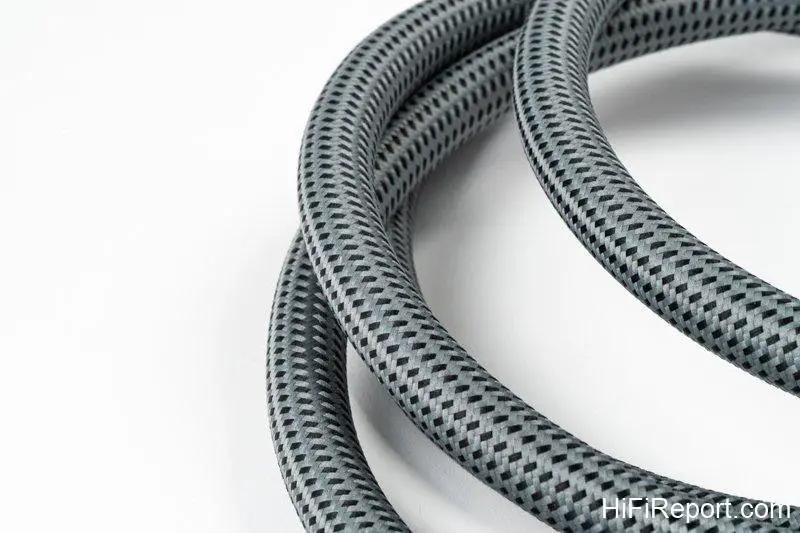
Wrapped in a grey and black nylon braid, the M-1 cable presents a subtly understated appearance. However, its solid construction is immediately apparent, and it carries a substantial weight in hand, conveying a sense of quality and reliability.
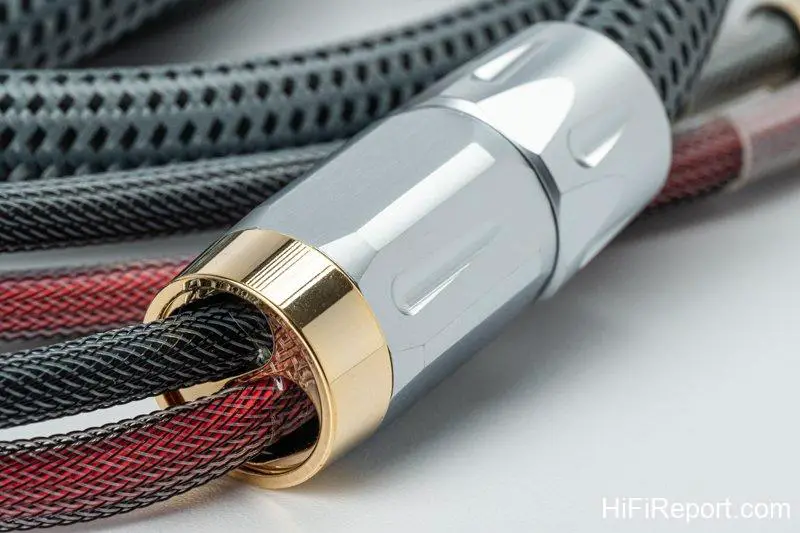
The splitters are a new design from HiFiReport introduced in recent years. Crafted from non-magnetic aluminum alloy, the outer shell features a textured finish with a matte surface, complemented by gold-plated rings at the cable exits. This combination achieves a touch of refined luxury within its discreet aesthetic.
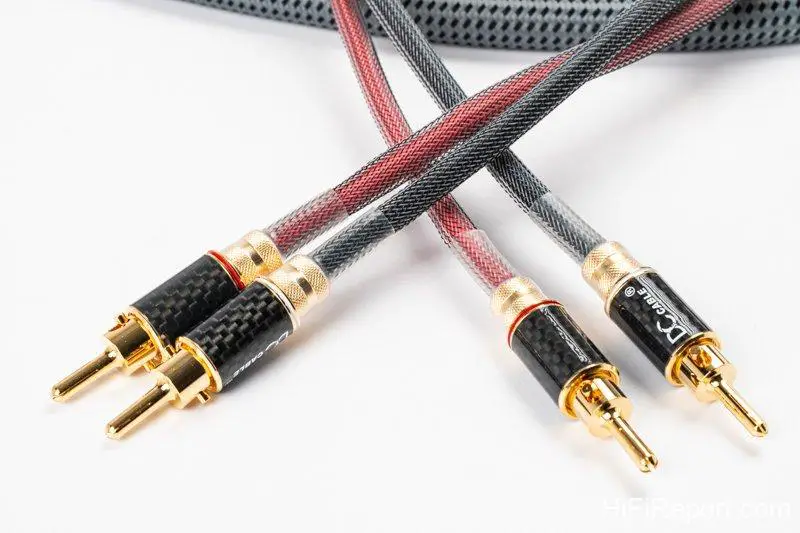
Beyond the splitter, the positive and negative leads remain encased in nylon braiding, easily distinguishable by their red and black colors for clear polarity identification.
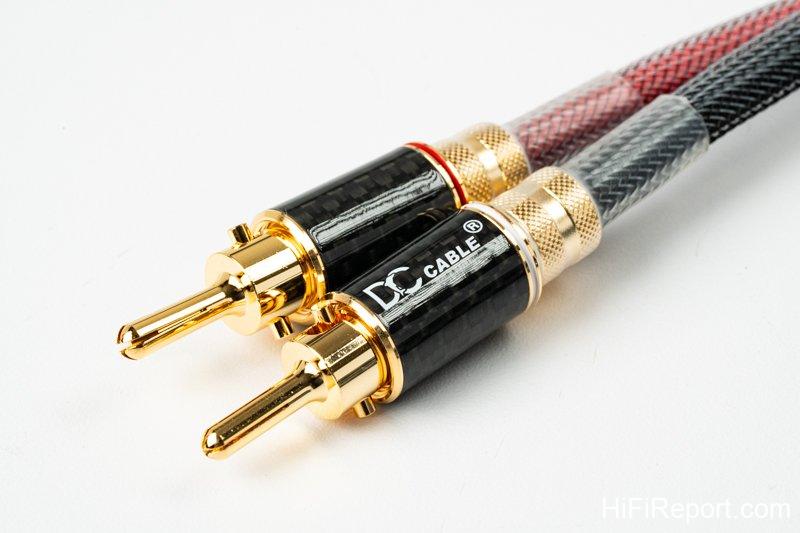
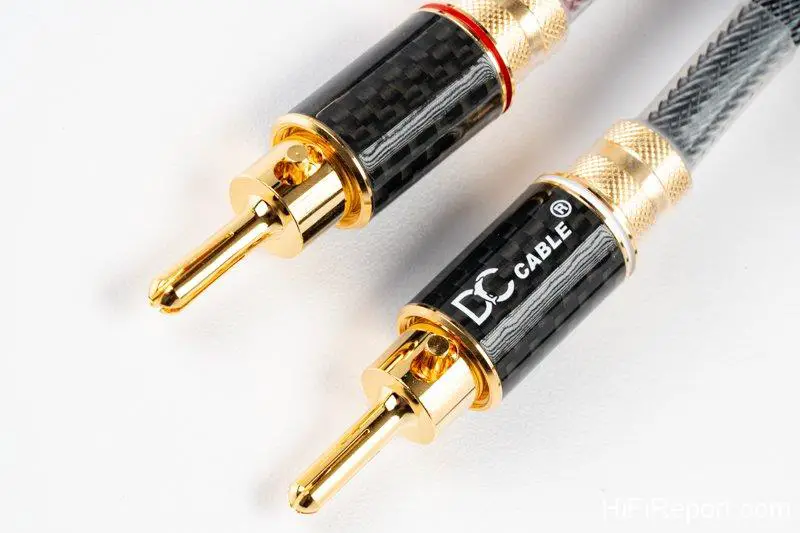
The speaker connectors are also custom-made by HiFiReport. They feature pure copper bodies with gold plating, housed within carbon fiber shells, and employ a locking-type design.
HiFiReport favors this locking connector style. The banana plugs are secured by rotating the outer ring, which expands the contact surface. This ensures the connectors are firmly seated and provides a more complete electrical connection. Of course, a spade terminal version is also available for those who prefer this type.
Signature Multi-Gauge Conductor Design
The conductor arrangement continues HiFiReport’s signature “mixed-gauge strand” structure. Both the positive and negative conductors are composed of seven strands each. This includes six strands of 0.1mm x 80 pure copper conductors, paired with a central, independently insulated, thicker 0.32mm core conductor.
This multi-strand configuration, combining finer conductors with a thicker single core, is intended to achieve a more balanced and extended frequency response, particularly enhancing low-frequency performance.
Evolving from the T-4 Foundation
The M-1 introduced by HiFiReport belongs to the new Mission series, positioning it as an intermediate-to-advanced level product within the company’s lineup. It offers users a high-quality yet accessible option situated above the value-oriented entry-level T series (Three Heart) but below the flagship Lelio and DC Cable Mix series.
Consequently, HiFiReport built upon the foundation of their T series flagship speaker cable, the T-4, upgrading it to deliver more comprehensive and outstanding sonic performance.
Balanced, Layered, Open, and Defined Sound
Overall, the M-1 speaker cable presents a genuinely pleasing sonic profile. It offers a balanced frequency distribution, clear layering, and quick transient response. Details are abundant, imaging is sharp, separation is high, and the soundstage is notably open and expansive.
Regardless of the music genre, the M-1 delivers a satisfying performance. It pairs well with both floorstanding and bookshelf speakers. It’s also beneficial to allow the cable a little break-in time – not excessively long. In my experience, after about a week of use, the sound becomes more open, relaxed, and exhibits better extension at both frequency extremes compared to when it’s fresh out of the box.
Quality, Clean, Articulate Bass
Li told me that he included a thicker 0.32mm conductor, independently insulated, within the M-1 specifically to enhance low-frequency extension. Based on this, I initially expected the cable to produce a rich, full bass response. However, that wasn’t the case.
Li’s term was “extension,” not “fullness” or “richness.” After listening for a week, I confirmed that even with further break-in, the kind of thick bass I anticipated wouldn’t materialize. But please, don’t misunderstand this to mean the cable lacks bass or has insufficient low end.
The M-1 provides ample bass quantity and can delve deep. I simply misinterpreted Li’s statement about “enhancing low frequencies.” The M-1 delivers sufficient bass quantity, yet it remains clean, articulate, and rich in detail, with fast low-frequency transients. With this kind of bass support, the music springs to life, engaging the “turbo” boost right from the start.
Solid, Punchy Drums Like Jabs
Taking Dire Straits’ “Money for Nothing” as an example, the opening’s distant vocals blended with the accompaniment create an ethereal, dreamy atmosphere. The powerful drum hits signal the true opening, followed by the electric guitar, awaiting Mark Knopfler’s vocal entry.
Listening to those drums, they sound full and solid, hitting with genuine force. The M-1 makes the drum hits sound particularly tight and impactful, like rapid, stinging jabs. The electric guitar unfolds with a bright, vivid timbre, painting across the sonic canvas. The M-1 provides a clear, layered sonic picture, allowing the lead vocals, harmonies, guitar, bass, drums, and keyboards to remain distinctly separated while simultaneously layering harmoniously.
Excelling at Guitar Reproduction
On Nils Lofgren’s “Acoustic Live” album, the track “Keith Don’t Go” begins with rich guitar body resonance accompanying the sharp, clear notes plucked from the strings. This opening alone is captivating for any audiophile. The M-1 is a copper cable, but the high frequencies are anything but blurry. The tone is bright yet natural, capturing the intricate details of finger work, string vibration, and the resonance of the soundboard and body, combining to create an excellent acoustic depiction.
Nils Lofgren’s clear vocals paired with the guitar are passionate and energetic, truly stirring the listener. The enthusiastic audience sounds also add to the lively atmosphere. The M-1 truly excels at reproducing guitar music, faithfully and vividly conveying the player’s passion, whether it’s the vibrant colors of an electric guitar or the resonant body sounds of an acoustic.
Revealing Vocal Texture and Lively Percussion
The DC Cable M-1 speaker cable’s ability to etch clear, defined sonic outlines, combined with abundant detail and a bright, lively presentation, makes it particularly adept at rendering vocals.
Consider Cassandra Wilson’s “Rendezvous” album. The track “Old Devil Moon,” with its reimagined, hazy, and elusive arrangement, stands in stark contrast to common versions. Listen to the back-and-forth percussion – the hits are tangible, and the impact has a palpable texture. The piano, focused yet warm, plays a responsive role in the mid-high frequencies of the accompaniment, offering more than mere decoration. Cassandra Wilson’s voice is deep and rich, occasionally revealing a certain roughness in places; those vocal textures are rendered with remarkable clarity.
In the track “Tennessee Waltz,” the opening’s full, deep bass pizzicato contrasts beautifully with the crystalline piano notes. The M-1’s bass dives deep while retaining form and definition, confirming it provides quality low frequencies.
Clear Layering, Expansive Soundstage
Because it can unfurl an expansive soundstage and delineate clear layers, the M-1 instills a sense of confidence when reproducing orchestral music, drawing the listener deeply into the performance.
Using Anne-Sophie Mutter’s “Across the Stars” album as an example, the M-1’s resolution reveals subtle sonic information within the music, expressing it clearly. Its balanced frequency presentation also ensures the musical narrative is natural and unforced.
Take the “Yoda’s Theme” track. It begins with a delicate violin passage accompanied by harp arpeggios. First, the subtle violin tremolo, followed by Mutter’s expressive solo. I can clearly hear the soft dynamics; both the violin and harp possess a clear sense of presence. The theme is later echoed by the clarinet, its rounded woodwind timbre exhibiting natural texture. The glockenspiel strikes at the beginning of “Hedwig’s Theme” are crisp and lingering, possessing both impact and pure overtones. As the music develops, the mid-section becomes more sprightly, the violin soaring in the high registers as the orchestra joins in the dance.
The violin’s dramatic solo is rendered with a thin, clear tone that is neither dry nor harsh. When the orchestra responds to the solo, the sectional layout is clearly layered, and the soundstage is open and deep. As someone who enjoys classical music, hearing the stage deconstructed and reassembled by the M-1—this level of sophisticated resolution—provides considerable listening pleasure. If you appreciate a clear view of the musical stage, the M-1 can certainly assist.
The Promising Mission Series
What’s next for HiFiReport’s Mission series? I haven’t asked Li yet. However, my experience with the M-1 speaker cable has left a highly positive impression. If they plan to develop the Mission series into a complete range including speaker, interconnect, and power cables, I’m very much looking forward to seeing the entire family assembled. If the Mission series is intended to focus solely on speaker cables, perhaps like the T series with different levels from M-1 upwards, then I’m even more eager to hear the M-2, M-3… What further improvements can HiFiReport achieve while managing cost and price compared to the M-1?
Specifications
* DC Cable M-1 (A+ Version)
* Type: Speaker Cable
* Conductors: Mixed-gauge copper conductors