
Denon AVR-X2700H Review
Modern enthusiasts are quite savvy when it comes to budgeting. Before purchasing an AV receiver, some will meticulously research and compare multiple models within their set price range. If you’ve done this, you’ll notice that mid-range and budget AV receivers, if priced similarly, often boast comparable channel counts, output power, features, and even weight. This is largely due to the constraints imposed by production costs and selling prices.
However, I must emphasize: even receivers with similar price tags can differ significantly in performance. When cost differences are limited, technology and experience become the decisive factors in determining audio performance.
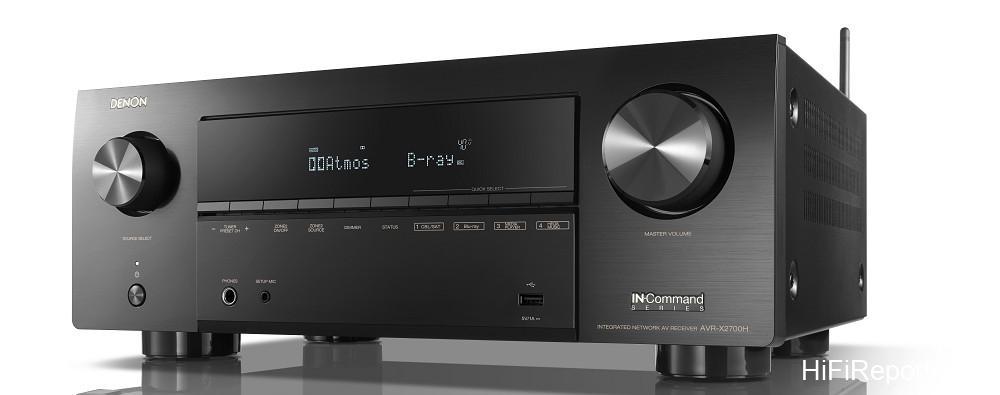
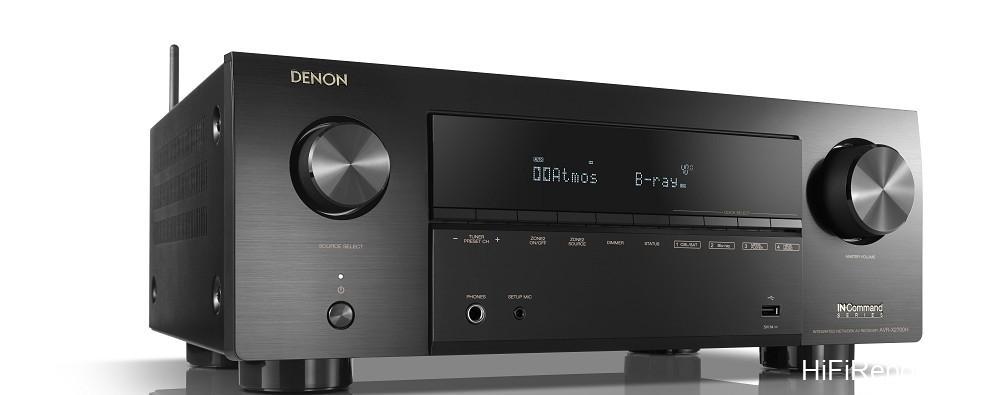
The Denon AVR-X2700H, which I’m reviewing today, is positioned slightly above the entry-level segment in the budget category. Typically, enthusiasts don’t hold high expectations for AV receivers at this price point. I initially felt the same, but the AVR-X2700H’s performance truly exceeded my expectations.
Video and Audio File Compatibility
Let’s start with the AVR-X2700H’s features. In terms of video, the unit is equipped with one HDMI 2.1 port, making it compatible with 8K/60p and 4K/120p. This is a major difference compared to its predecessor. For music file compatibility, the AVR-X2700H supports playback from network servers and USB storage devices, including WMA, MP3, WAV, MPEG-4 AAC, FLAC, Apple Lossless, and DSD.
Multibit lossless music files (WAV, FLAC, and Apple Lossless) are supported up to 192kHz/24bit, while DSD is compatible with DSD64 (2.8MHz sampling rate) and DSD128 (5.6MHz).
Channel Configuration and Virtualization
The AVR-X2700H is a 7.2-channel AV receiver. For small to medium-sized living spaces, considering the practicality of speaker placement, especially when the rear wall is close (making rear surround speaker placement inconvenient), I typically recommend a 5.1.2 channel speaker setup. The AVR-X2700H also offers comprehensive virtual height capabilities, including Dolby Atmos Height Virtualization and DTS Virtual:X.
This means that even if the user doesn’t install overhead speakers on the ceiling, these features can still be used to deliver the three-dimensional soundstage effect of Dolby Atmos and DTS:X, creating an overhead sound field and the perception of sound objects moving above.
Furthermore, content that doesn’t originally have overhead channels (like PCM 5.1, Dolby TrueHD, and DTS-HD) can also undergo virtual height processing (e.g., adding Dolby Surround) to achieve a three-dimensional sound experience.
Circuit Design Insight
The reason the AVR-X2700H performs noticeably better than other similarly priced AV receivers, in my opinion, lies in its preamp circuit design.
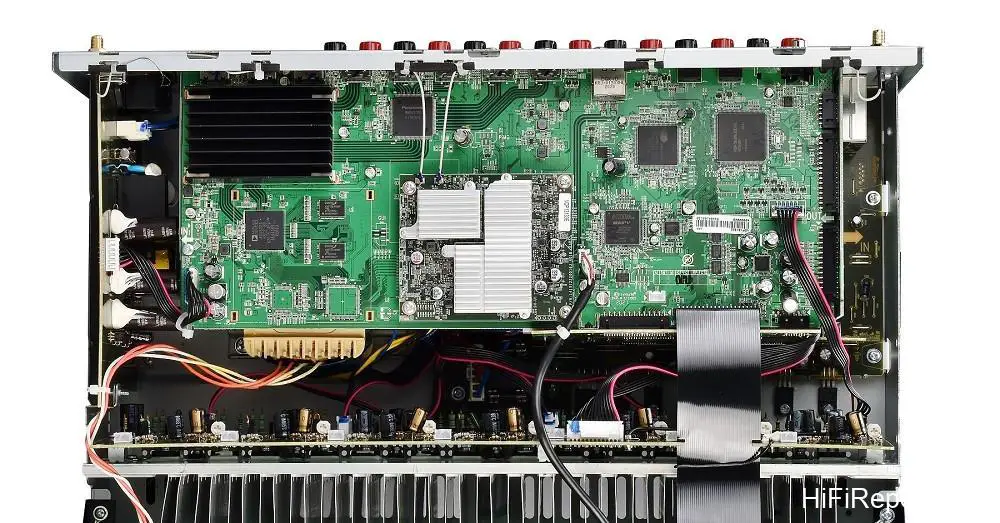
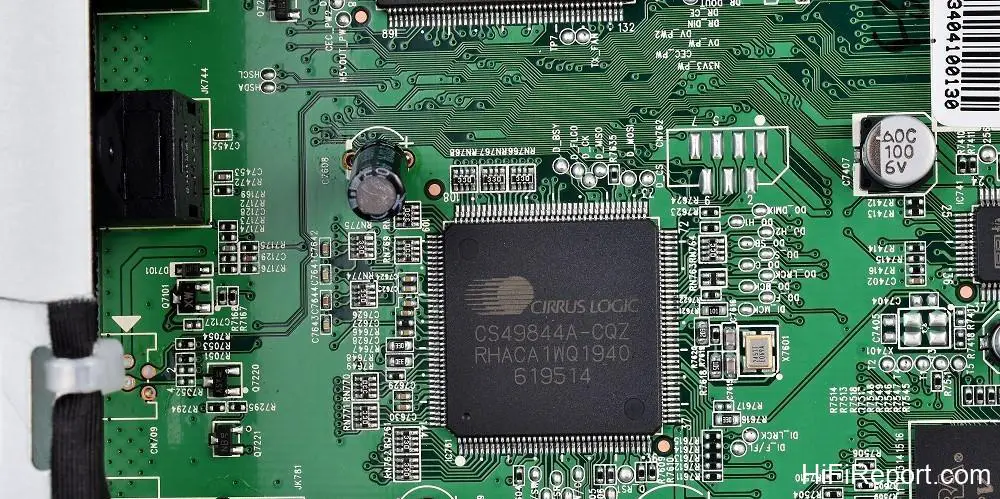
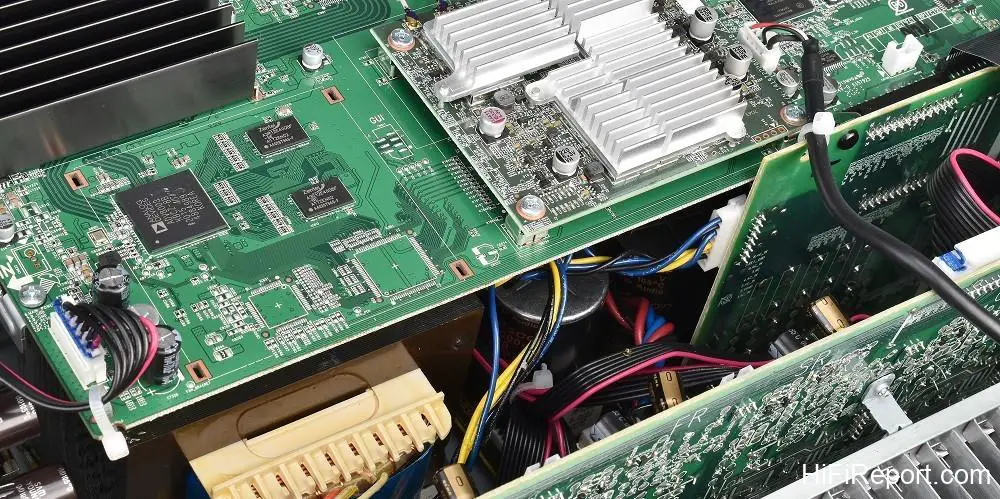
In mid-range and high-end models, the main parts of an AV receiver’s preamp are generally divided into: the digital circuit main board (including HDMI input/output interfaces, streaming modules, digital video, and digital audio processing circuits), the digital-to-analog conversion circuit board (including DAC and LPF), and the multi-channel preamp amplification circuit board (including source selection, volume control, and high-level amplification).
Finally, the multi-channel preamp outputs connect to the rear panel PRE OUT terminals and the built-in multi-channel power amplifier circuits.
The layout for budget products is typically quite different. To save costs, they often place the DAC chip directly on the digital circuit main board, and sometimes even the LPF (analog low-pass filter circuit after the DAC) is integrated there. Slightly more elaborate designs might put the LPF on a separate board, which also serves as the connection board from the DAC to the multi-channel preamp amplification circuit.
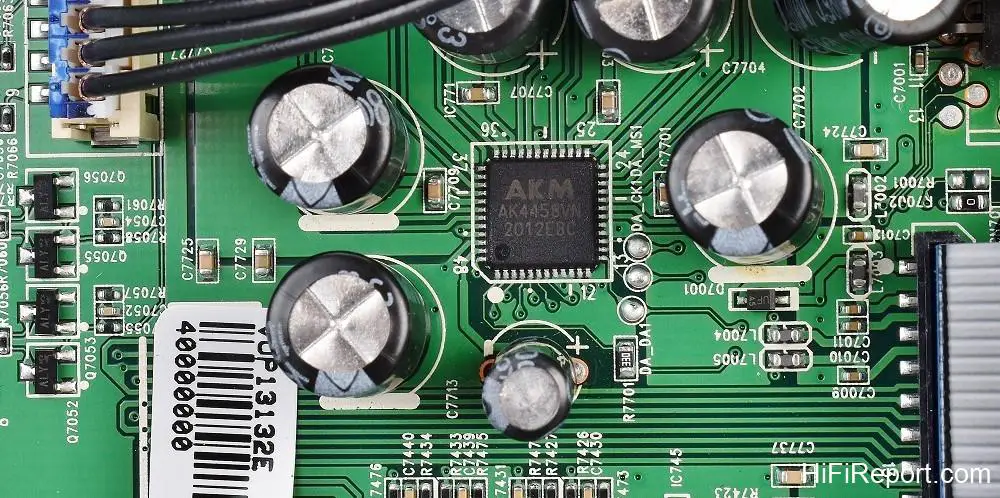
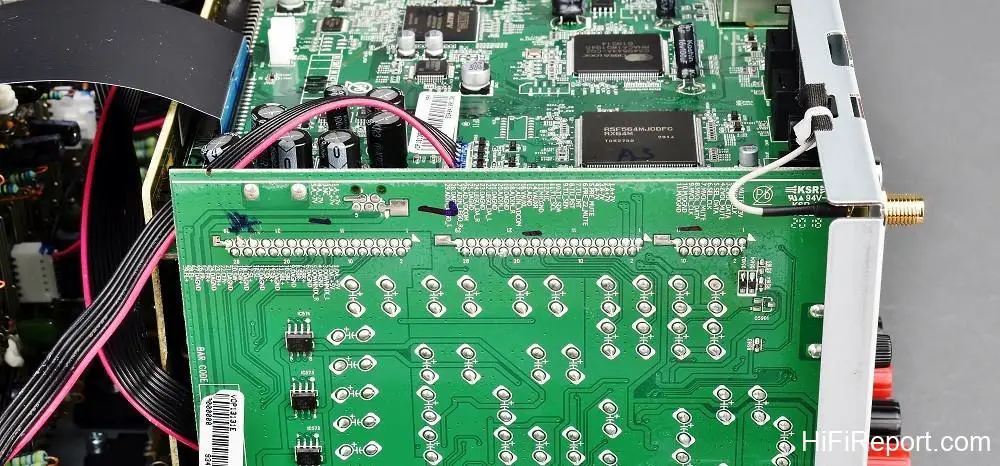
I believe the AVR-X2700H’s approach is both “smart” and “meticulous.” The smart part is that while the DAC chip (AKM AK4458VN) is still on the digital circuit main board, instead of having separate boards for the LPF and the preamp amplification circuit after the DAC chip, it combines the LPF, source selection, volume control, and high-level amplification onto a single circuit board.

This significantly shortens the signal path “from the DAC chip output to the preamp output,” reducing the number of connection points between the digital-to-analog conversion circuit and the power amplifier input for each channel by at least four. This is a clever method to improve sound quality within the cost constraints typical of lower-priced models.
Hi-Fi Pedigree
For digital audio equipment, the very beginning of the audio (analog) signal chain is the LPF after the DAC chip. As I’ve mentioned before, this stage can be considered a “pre-preamp.” It is even more sensitive than the preamp amplification circuit itself. Although the circuit is small, it has a crucial impact on the overall sound quality and sonic character.
The AVR-X2700H’s LPF utilizes a key technique from Denon’s higher-end models: running the operational amplifier chips in Class A. Back in 2018, Denon’s second-highest model, the AVR-X6500H, used this technique to achieve sound quality close to the flagship AVR-X8500H, despite differences in DAC chip levels. The X2700H now also benefits from this, optimizing the linearity of low-level signals in the LPF (avoiding crossover distortion) and enhancing the reproduction of subtle sounds and textures.
Denon also effectively leverages its past successes, such as knowing which components (not necessarily the most expensive ones) result in good sound, or customized components that they have already invested in developing. These are cascaded down from flagship models to step-down, mid-range, and even budget models.
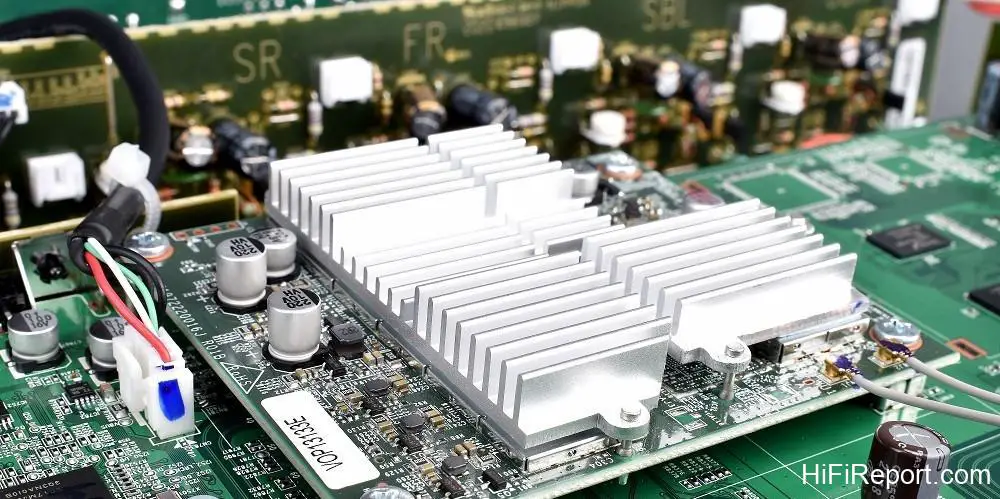
For instance, the paired transistors used for differential amplification in the input stage of the AVR-X8500H’s power amplifier have subsequently been incorporated into the power amplifier circuits of lower-tier models, and the new AVR-X2700H is no exception. Furthermore, the signal switching, volume control, and preamp output components used in the AVR-X2700H’s multi-channel preamp are custom parts jointly developed by Denon and JRC specifically for the AVR-X8500H.
I believe many enthusiasts might think that budget AV receivers aren’t serious about or capable of achieving good sound quality. I think the manufacturing details mentioned above clearly demonstrate Denon’s commitment to the sound quality of the X2700H.
Listening Impressions – Music Playback
For this review’s listening test, I used a 5.1.2 channel speaker configuration, primarily pairing the AVR-X2700H with Pioneer EX series speakers and an M&K X10 active subwoofer. In the first stage of testing, I switched the AVR-X2700H to Pure Direct mode to play music files, using only the left and right channel Pioneer S-1EX floorstanding speakers. This effectively used the AVR-X2700H as a two-channel streaming integrated amplifier.
Music Sound Character
Experienced enthusiasts are well aware that it’s challenging for an AV receiver costing under ~$1333 USD to compete in sound quality with an integrated amplifier of a similar price. To be more specific: AV receivers often have a tonal character that sounds brighter and drier, with less body in the mid-range and insufficient weight in the bass. Sonic images tend to sound less solid.
It’s understandable – a similarly priced integrated amplifier only needs to handle two channels, while an AV receiver has to include a 7-channel power amplifier circuit. How can the sound quality possibly compare?
Denon, however, has genuinely put effort into building and voicing the AVR-X2700H as a “multi-channel Hi-Fi amplifier.” If you were to listen purely based on sound quality, without knowing beforehand that this was an AV receiver playing music in two channels, you could easily mistake it for a two-channel amplifier. Its core character is built around a warm, layered, and relaxing mid-range.
The bass is thick, loose, and full-bodied, allowing me to clearly hear the very low sub-bass frequencies of pipe organs and electronic bass in pop music when using medium to large floorstanding speakers. The treble is sweet, smooth, and ripe, with a slight tendency towards refinement, which is highly appealing to most listeners. It skillfully reduces high-frequency harshness, making the listening experience quiet, relaxed, and easy to immerse in the music.
Its warm, mature, and flavorful character might even lead one to believe it’s a British-style integrated amplifier! I believe its sound quality, balance, and musical enjoyment are comparable to streaming integrated amplifiers in the ~$1333 USD price range.
Listening Impressions – Movie Playback
In terms of movie sound performance, I believe the AVR-X2700H is ultimately limited by its production costs. Its speaker driving capability doesn’t exceed its price bracket and remains within the average for AV receivers at this level.
Therefore, strategically, I recommend users set the subwoofer crossover point for all speakers at 80Hz or 100Hz, even if using floorstanding speakers for the left and right channels (Pure Direct 2-channel playback still outputs full frequency, and the subwoofer doesn’t intervene). This slightly reduces the burden on the power amplifier and power supply circuits, allowing the overall movie soundtrack to achieve higher sound pressure levels.
Movie Performance Description
Under these settings, I believe that as long as the speakers have at least medium efficiency and the subwoofer is reasonably good, the AVR-X2700H’s energy, dynamics, and impact can satisfy the needs of an urban living room up to approximately 250 square feet (7). When playing in 5.1.2 channels, the surrounding and overhead three-dimensional envelopment is quite good. In terms of soundstage, balancing “spaciousness” and “density,” this unit leans towards the latter, being “density-focused.”
Sound objects moving within the space exhibit good localization and coherence. The “Hi-Fi amplifier characteristics” mentioned earlier regarding music performance also translate to movie playback: it makes complex soundscapes sound well-ordered and allows the listener to appreciate the beauty of the movie score.
Virtual Surround Performance
Subsequently, I changed the settings, changing the overhead speakers (Top Middle) from Small to None, and testing the AVR-X2700H’s virtual height speaker effect using a 5.1 channel setup. For DTS:X and Dolby Atmos, I believe the corresponding DTS Virtual:X and Dolby Atmos Height Virtualization (Speaker Virtualizer) can indeed provide the user with a sense of overhead sound field envelopment and vertical sound image movement, even without physical overhead speakers, by using “virtualization.”
Compared to a 5.1.2 channel setup with physical overhead speakers, the “virtual” overhead speakers achieve roughly 70% of the performance of “physical” ones.
If installing overhead speakers is inconvenient for you, this feature has absolute practical value for delivering “movie sound effects.” However, I must also remind you that virtual overhead speakers cause the existing speakers to emit sound components that “originally do not belong to this channel and have different phases.” This inevitably affects the focus and texture of sound objects.
Therefore, for listening to multi-channel “music software,” I still recommend using Direct or Pure Direct modes (without virtual surround).
Conclusion
Most people buy AV receivers primarily for movie sound effects. In this regard, the AVR-X2700H not only “lives up to its price” but also offers comprehensive virtual height speaker functionality, allowing users to still experience movie soundtracks with “overhead sound field envelopment” even if they cannot install physical overhead speakers. Furthermore, I believe the AVR-X2700H is not like other budget AV receivers that simply add music streaming capabilities as a mere formality.
Denon’s focus on its sound quality is “for real.” Perhaps you won’t watch movies at home every day, but you can use it daily to enjoy music and let it help you de-stress.
Specifications
* **Type:** 7.2 Channel AV Receiver
* **Output Power:** 185 Watts (6 ohms, 1kHz, THD 10%, 1ch driven), 150 Watts (6 ohms, 1kHz, THD 1%, 1ch driven), 125 Watts (6 ohms, 1kHz, THD 0.07%, 2ch driven), 95 Watts (8 ohms, 10Hz–20kHz, THD 0.08%, 2ch driven)
* **Speaker Impedance:** 4 to 16 ohms
* **Frequency Response:** 10Hz–100kHz (+1, -3dB)
* **Signal-to-Noise Ratio:** 100 dB
* **Input Terminals:** HDMI × 6 (1 supporting 8K), Component Video × 2, Composite Video × 2, Analog Audio × 4, Phono × 1, Toslink Optical × 2, Digital Coaxial × 1, USB × 1
* **Output Terminals:** HDMI × 2 (supporting 8K), Component Video × 1, Composite Video × 2, 0.2 Channel Preamp Output (Subwoofer), 2 Channel Zone 2 Preamp Output, Headphones
* **Other Terminals:** Ethernet × 1, Calibration Microphone Jack × 1, FM Antenna × 1, AM Antenna × 1
* **Dimensions (W×H×D):** 434×167×341mm
* **Weight:** 9.5 kg