
Arcam AVR31 Review
The AVR31 is the successor to the AVR30 and stands as Arcam’s new flagship surround sound receiver. The most significant upgrade from the AVR30 to the AVR31 is in the HDMI input/output interfaces, moving from HDMI 2.0 to HDMI 2.1, enabling support for 8K/60p and 4K/120p digital video.
Amplification Power and Channel Count
While the AVR31 holds the title of flagship surround receiver, its internal power amplifier section is limited to 7.2 channels. As seasoned enthusiasts know, European and American manufacturers typically avoid inflating power output specifications. Movie soundtracks inherently require higher power to drive speakers effectively, demanding robust built-in amplification. To ensure sufficient power supply capability, they often choose to reduce the number of built-in amplifier channels.
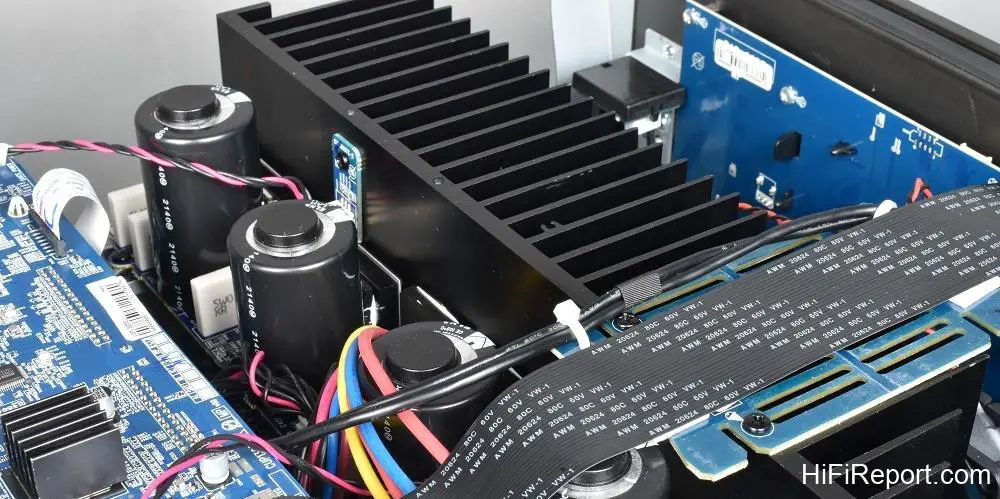
This explains why the AVR31 is equipped with only 7 channels of onboard amplification.

In the “7 channels driven simultaneously” scenario, the rated power for “all channels” reaches 100 Watts (8 ohms) and 180 Watts (4 ohms). When listening to music in stereo mode, the left and right channels boast a rated power of 120 Watts (8 ohms) and 200 Watts (4 ohms), with total harmonic distortion across the full frequency range below 0.02%.
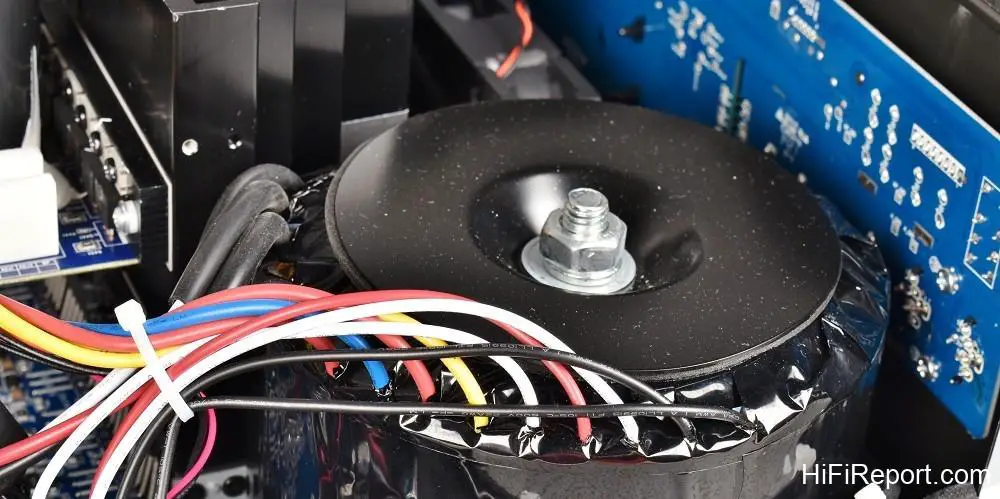
Considering these genuinely conservative specifications, the Arcam AVR31 possesses speaker driving capability comparable to stereo integrated amplifiers in a similar price range.

Processing Flexibility and Configuration
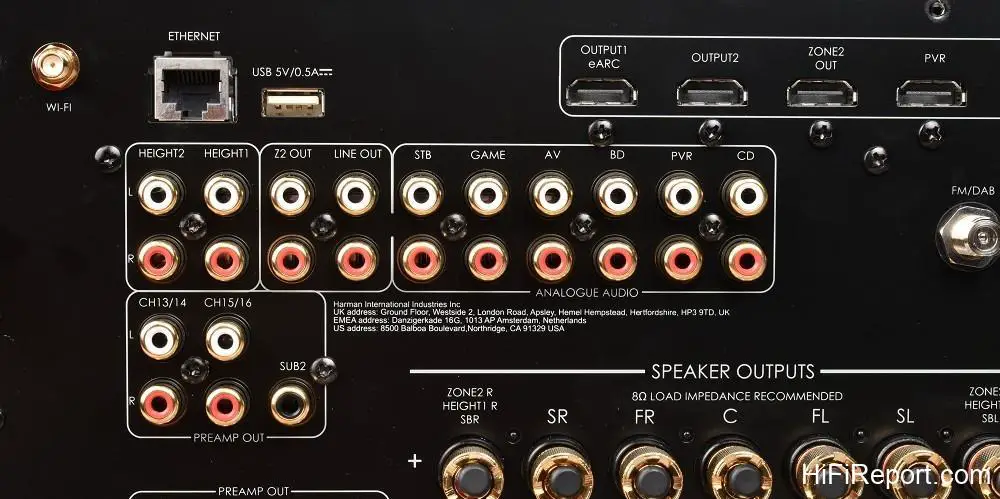
Continuing the discussion on channel count, the Arcam AVR31 functions as a 7.2 channel integrated receiver. However, its “surround processing preamp section” is far more extensive, supporting up to 16 channels. As shown in the diagram (referencing the image in the original text), in addition to the labeled 7.2.4 channels in the preamp outputs, the unit offers configurable channels 13 through 16. These can be set up for additional subwoofer channels, height channels, or even Front Wide speakers.
Configuring for 9.2.4 or 7.4.6 channels is certainly possible. This flexibility allows users and installers to tailor speaker configurations based on the specific room layout, using the Arcam AVR31 combined with external power amplifiers to drive a larger number of speakers simultaneously.
Streaming and Room Correction Features
The Arcam AVR31 includes built-in Wi-Fi and Bluetooth, offering streaming features such as Chromecast, AirPlay 2, Spotify Connect, Tidal Connect, and UPnP. It also supports MQA, and Bluetooth transmission can handle high-quality aptX HD. Furthermore, a highly valued feature among enthusiasts is the AVR31’s integrated Dirac Live room correction.
The manufacturer provides a very good quality test microphone with the unit, and the AVR31’s Dirac Live implementation is the “Full Frequency” version out of the box. For users who wish to upgrade Dirac Live further, the “Single Subwoofer” version of Dirac Live Bass Control is available for purchase online for $349, while the “Multiple Subwoofer” DLBC upgrade costs $449.
Internal Circuit Design – Preamp and DACs
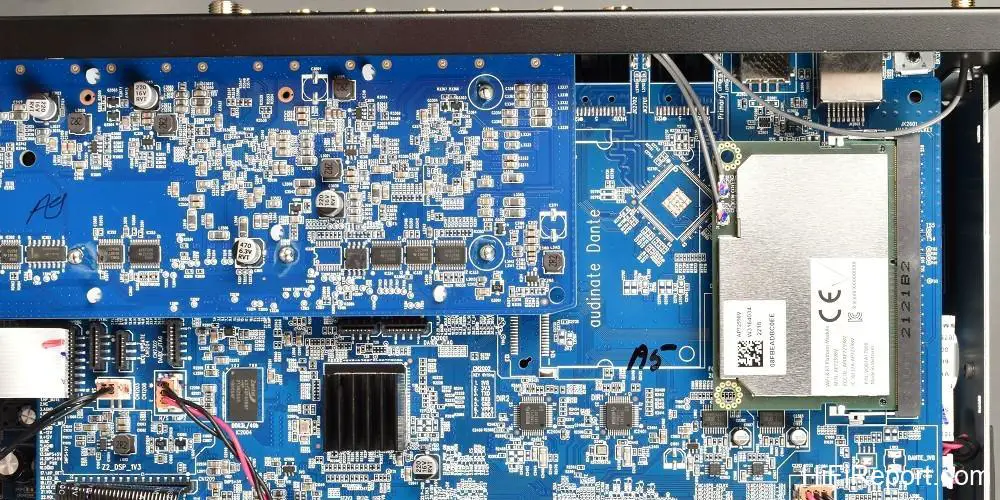
Moving on to the Arcam AVR31’s circuit design, upon initial inspection, I immediately felt a strong sense of familiarity. How could this be? Hadn’t I just seen the AVR31 for the first time? While true, I quickly realized that the AVR31 shares significant similarities with two other Arcam products I’ve reviewed. Its preamp circuitry is about 70% similar to Arcam’s flagship surround processor, the AV40.
There are two primary differences: first, the HDMI interface – the earlier AV40 featured HDMI 2.0b, while this unit has HDMI 2.1; and second, the AV40 preamp includes balanced audio output circuits, whereas the AVR31 uses single-ended preamp circuits.
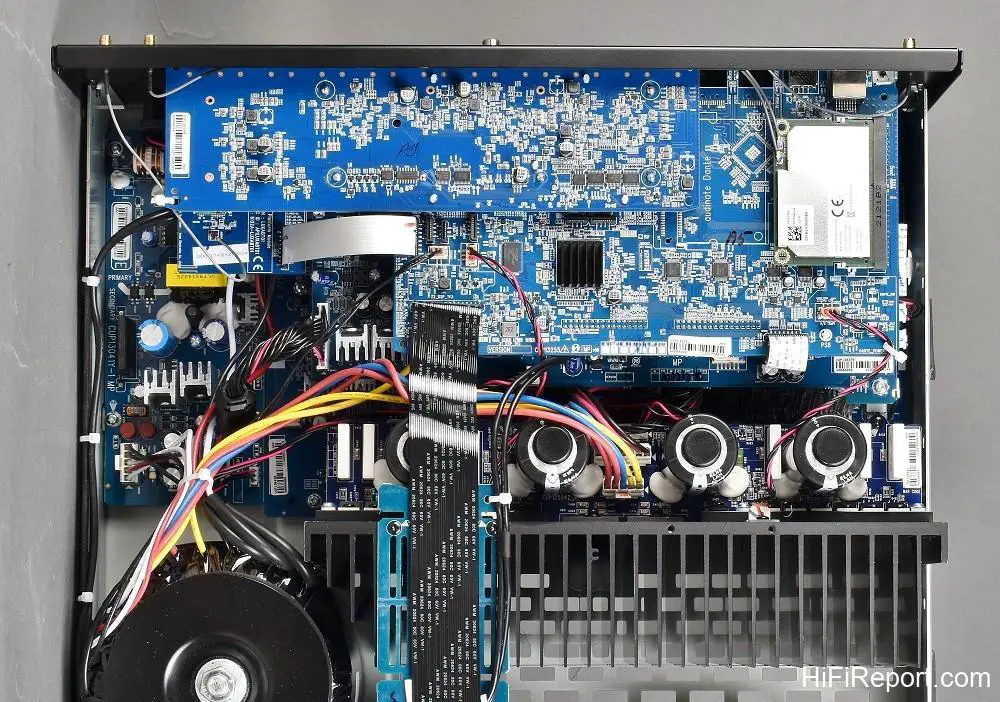
Aside from these two distinctions, the AVR31’s digital mainboard is the same as the AV40’s (identical hardware), and its functionalities and decoding channel count are also identical. The multi-channel digital-to-analog converter board is located beneath the digital mainboard, employing two high-performance 32-bit 8-channel DAC chips, the ESS ES9026PRO, known for their 124dB dynamic range and -110dB total harmonic distortion (totaling 16 channels).
This DAC also incorporates Time Domain Jitter Eliminator technology to reduce clock errors. Subsequent small signal amplification in the preamp section is handled by low-noise operational amplifier chips.
Internal Circuit Design – Class G Amplification
The AVR31’s amplifier circuitry and power supply reminded me of Arcam’s PA720 seven-channel Class G power amplifier. In recent years, only Arcam’s flagship surround receivers have been granted the privilege of utilizing Class G amplification. Most power amplifier circuits employ the linear amplification type known as Class AB. Class AB is most energy-efficient only at its rated power output – that is, at maximum output.
Therefore, under typical usage conditions, half or even more of the power consumption in Class AB is not driving the speakers but is converted into heat. The development of Class G was intended to solve this problem. It utilizes at least two sets of power supplies, a low voltage and a high voltage. During low power output, the low voltage supply powers the output stage power transistors, switching to the high voltage supply for high power output.
This minimizes the voltage difference between the power supply and the amplifier output, improving power efficiency. However, some argue that while Class G is necessary for PA systems, it might not be essential for home amplifiers.
Arcam’s rationale for using Class G is not solely power saving, but primarily for sound quality. In essence, it’s designed to combine the characteristics of Class A and Class AB. For comfortable music listening, when the amplifier is operating at low to medium power output, their Class G amplifiers work under the low-voltage supply in a Class A amplification state. Using a low-voltage supply helps reduce the energy loss and heat generated by low-power Class A amplification.
The main advantage of Class A amplification is the absence of crossover distortion, offering optimal low-level linearity and achieving impressive sound quality.
The Unique Class A Component
Precisely because of Class G amplification, the AVR31 is one of the rare current surround receivers whose power amplifier circuitry incorporates a “Class A component.” This is certainly unique! Arcam doesn’t explicitly state the specific wattage range within which it operates in Class A. However, based on Arcam’s past “habits” with their Class G power amps and integrated amps, the estimated Class A power output of this unit is 20 Watts.

Above 20 Watts output, it switches to the high-voltage supply and employs Class AB amplification. As shown in the image (referencing the original text), each output channel of the AVR31’s output stage uses a pair of temperature-sensing power transistors from On Semi, the NJL3281D / NJL1302D, capable of a maximum current output of 15 Amperes.

AVR31’s Architecture: A Familiar Combination
Having explained this, you should understand that the AVR31 is essentially a combination of Arcam’s flagship processor and its seven-channel Class G power amplifier. Not only is the number of preamp processing channels the same, but the amplifier type and rated output power of the power amp section are also identical. With a reference price of nearly $10,000 (assuming the original NTD 300,000 is roughly $10,000), the AVR31 is still more affordable than purchasing the AV40 and PA720 separately.
▲
Listening Impressions – Music Performance
Below are my listening impressions of the Arcam AVR31. Although I’ve said it many times, I must emphasize it again: high-end, especially flagship, surround sound receivers are *expected* to perform well with movie soundtracks. The crucial factor that sets them apart is the charm and quality of their music reproduction. Just like testing a car, when reviewing audio equipment, one must keenly perceive the system’s feedback and identify the condition under which it sounds its best.
A key characteristic of the AVR31’s power amplifier circuit is its “Class A operation at low power.” Therefore, the strategy for listening to music should be to maintain a “comfortable listening level.” I listened in 2.1 channel mode (with a crossover point at 70Hz) to ease the load on the left and right channel amplifiers below 70Hz. All these efforts were aimed at keeping the power output per channel for music listening within approximately 20 Watts.
In this state, the sound is warmer and has more body than at higher volumes. Subtle sounds are clear, the audio is pure, and the soundstage has remarkable transparency. The listening experience is incredibly comfortable, allowing every detail to be heard without needing to turn the volume up high.
I also compared the sound quality with Dirac Live on and off. I believe that to get the best sound quality from the AVR31, users must approach it with the mindset of a high-end audio enthusiast. This involves diligently adjusting the placement of the left/right speakers and subwoofer(s), and carefully integrating them. Even without using Dirac Live, you can achieve excellent imaging, soundstage symmetry, and balanced frequency response.
In this state, you can turn off Dirac Live for music listening to hear more of the “sound of the space” from the musical performance itself. The midrange texture is refined, and the treble is fresh, lively, and completely free from harshness.
Maintaining the aforementioned comfortable listening level and avoiding pushing the volume allows the AVR31 to reveal its ethereal quality and the genuine sense of being in the same room as the musical performers, operating within the Class A range of the Class G amplifier circuit. If you approach it with the same attitude and spirit as optimizing a two-channel audio system, the AVR31 will deliver sound quality that listeners might find hard to believe comes from a surround sound receiver.
Stereo streaming amplifiers in a similar price range would find it quite challenging to surpass its musical charm. It is one of the rare surround receivers that fully demonstrates the advantages of linear amplification, effortlessly exuding musical richness.
The analog flavor of 1960s and 70s popular music, with warm, smooth yet clearly textured midrange and mid-bass, is reproduced with such convincing authenticity that I can’t recall another surround receiver I’ve heard that captures the vintage feel of old recordings so profoundly.
Listening Impressions – Movie Performance
When playing movie content, I highly recommend using Dirac Live room correction. Users can pre-configure a “custom movie mode” that “boosts the extreme low frequencies and subtly refines frequencies above 10kHz,” emphasizing the impact of cinematic bass and enhancing the overall theatrical atmosphere. The unit allows storing three Dirac Live settings. I suggest users set up different target curves and compare the movie sound listening experience, keeping the best one.
Then, use that as a base to design new target curves and overwrite the less favorable setting. Continuously doing this will allow you to optimize your home theater sound over time.
Regarding movie soundtrack performance, I believe there are two paths to maximize the AVR31’s potential. First, if the room conditions permit, add external power amplifiers and additional speakers to increase the channel count and utilize more active subwoofers. The AVR31 itself offers excellent channel separation, creating a vast and deep soundstage with clear and precise imaging and movement.
Increasing the number of channels further densifies the soundfield and enhances the sense of immersion.
Secondly, speaker matching is crucial. Since the AVR31’s main seven-channel amplifiers cannot be reassigned to other channels when external amplifiers are added, the external amplification is primarily used for secondary channels. In other words, for users seeking “extremely powerful” movie sound, the overall sound pressure capability must still be evaluated based on the combined output of the AVR31’s power amplifier output, speaker sensitivity, and active subwoofer output.
In this scenario, the sensitivity of the front three speakers becomes critical. The higher their sensitivity and power handling, the more “violent” the movie sound the entire system can achieve when paired with the AVR31.
Conclusion
It was genuinely surprising how good the AVR31’s music performance turned out to be. Frankly, at its price point, using it purely as a high-end streaming amplifier just for music listening would not be excessive. In my opinion, its musical expressiveness ranks among the top two current surround receivers (deciding which one is number one is simply too difficult). In terms of movie sound, its built-in seven-channel amplification provides outstanding speaker driving capability.
The preamp processing section handles up to 16 channels, offering great flexibility for expanding the system’s speaker count with external amplifiers. Leveraging the advanced room correction capabilities of the Full Frequency Dirac Live, it can effectively address and overcome issues related to room symmetry and frequency response. The refined sound quality also makes movie sound effects exceptionally realistic.
While the Arcam AVR31 carries a significant price tag, I believe it still exceeds the standard of being worth the cost. For enthusiasts who desire something truly “distinctive,” I urge you to take the time to experience this unique high-end product firsthand.
Specifications
* Type: Class G Surround Receiver
* Preamplification Processing Channels: 16 channels
* Power Amplifier Channels: 7 channels
* Stereo Power Output (THD < 0.2%): 140W per channel (8 ohms), 220W per channel (4 ohms) * Seven Channels Driven Simultaneously Power Output (THD < 0.2%): 100W per channel (8 ohms), 180W per channel (4 ohms) * Signal-to-Noise Ratio: 110dB * Frequency Response: 20Hz–20kHz (±0.2 dB) * HDMI Terminals: 7 inputs, 2 outputs * Dimensions (W×H×D): 433×171×425 mm * Weight: 18.1 kg