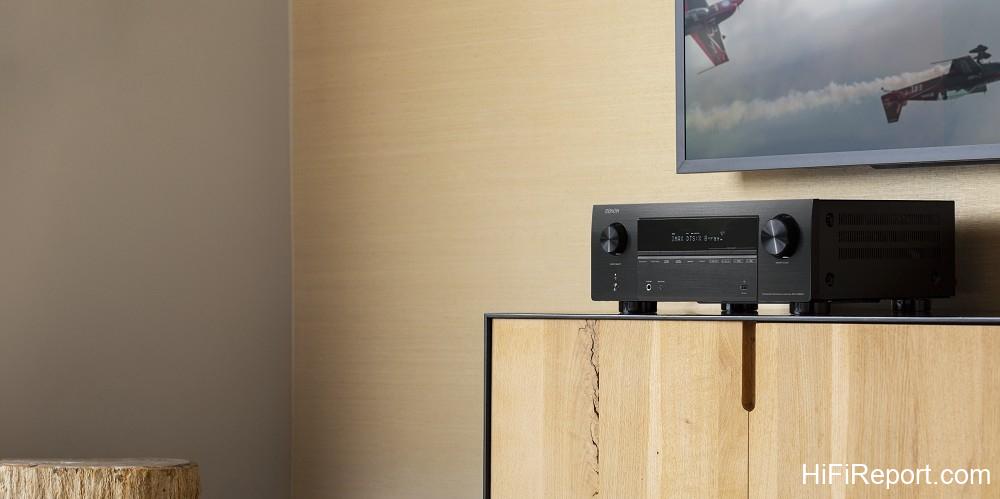
Denon AVR-X3800H Review
Historically, Denon’s “3000 series” models have typically held the fourth position within their surround sound receiver lineup. However, Denon has made significant adjustments in their latest 2023 models. While previously only the flagship and the second-tier “6000 series” models were manufactured at the Denon factory in Shirakawa, Japan, the 6000 series is absent this year.
It has been confirmed that the new “4000 series” model, the AVR-X4800H, marks the return of the “Made in Japan” designation. The AVR-X3800H, on the other hand, is the highest-positioned surround receiver manufactured by Denon outside of Japan, placing it as the third model in the latest generation lineup.
Amplifier and Processing Capabilities
The AVR-X3800H features a built-in 9.4-channel power amplifier circuit, allowing for simultaneous output from speaker configurations such as 5.1.4 (up to 5.4.4) or 7.1.4 (up to 7.4.2). Its surround decoding pre-processor section boasts a processing capacity of 11.4 channels. By adding a two-channel power amplifier or integrating a pair of active speakers, the total system output can be expanded to 7.4.4 channels.
Pre Amp Mode Functionality
The AVR-X3800H also includes a “Pre Amp Mode,” which disables the internal power amplifiers, allowing the unit to function purely as a surround processor and preamplifier.
IMAX Enhanced and DTS:X Support
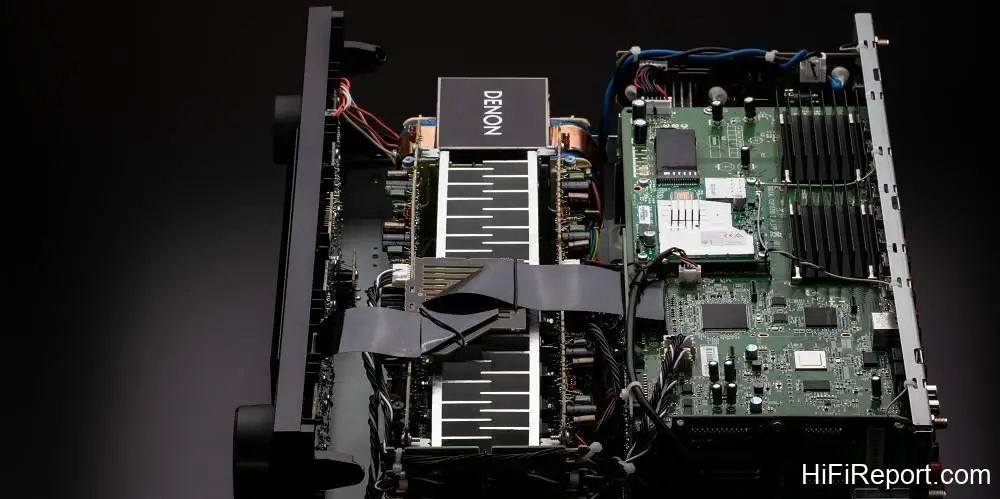
The AVR-X3800H is an IMAX Enhanced certified receiver. While this means the unit can deliver the more immersive, dense, and powerful IMAX Enhanced audio experience when playing compatible Blu-ray discs, such discs remain relatively scarce. This year, Disney+ is set to offer streaming content encoded with DTS:X and featuring IMAX Enhanced sound. Official sources have confirmed that Denon surround receivers will support DTS:X decoding and IMAX Enhanced audio for this content.
If you’re interested in this feature, you’ll also need to consider the “TV side” compatibility for IMAX Enhanced audio. Official confirmation indicates that new mid-to-high-end Sony and LG TVs purchased in 2023 will support this via eARC digital audio output.
Significant Feature Upgrades
Compared to its predecessor, the AVR-X3800H presents substantial changes in both functionality and hardware design. The primary functional enhancement lies in automatic room correction. In addition to the built-in Audyssey MultEQ XT32, users requiring more precise frequency response correction (especially for subwoofers), improved transient response, or the ability to set custom target curves can now upgrade to use Dirac Live.
Dirac Live Upgrade Option
The limited bandwidth version costs $259, while the full bandwidth version is $349. Note that a separate test microphone (such as the miniDSP UMIK-1) must also be purchased.
Enhanced Connectivity
Regarding HDMI connectivity, the AVR-X3800H is no longer limited to just one or two ports. All six HDMI input terminals on the rear panel now support 8K/60p, 4K/120p, ALLM, VRR, and QFT. HDR compatibility includes HDR10, HDR10+, Dolby Vision, and HLG. The unit retains the built-in HEOS network music platform from previous models and is compatible with AirPlay 2.
It can play music files shared from a NAS, PC, or smartphone on the same network, including MP3, WMA, WAV, MPEG-4/AAC, FLAC, ALAC, and DSD. Multi-bit Hi-Res music files are supported up to 192kHz/24bit, and DSD playback is supported up to 5.6MHz.
Internal Circuitry: Digital and Preamplifier
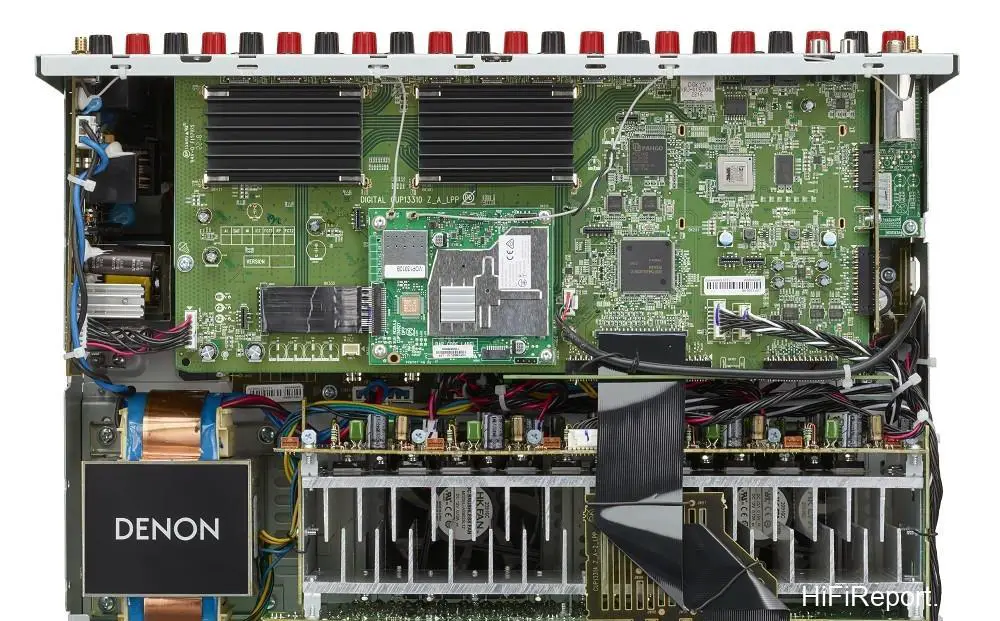
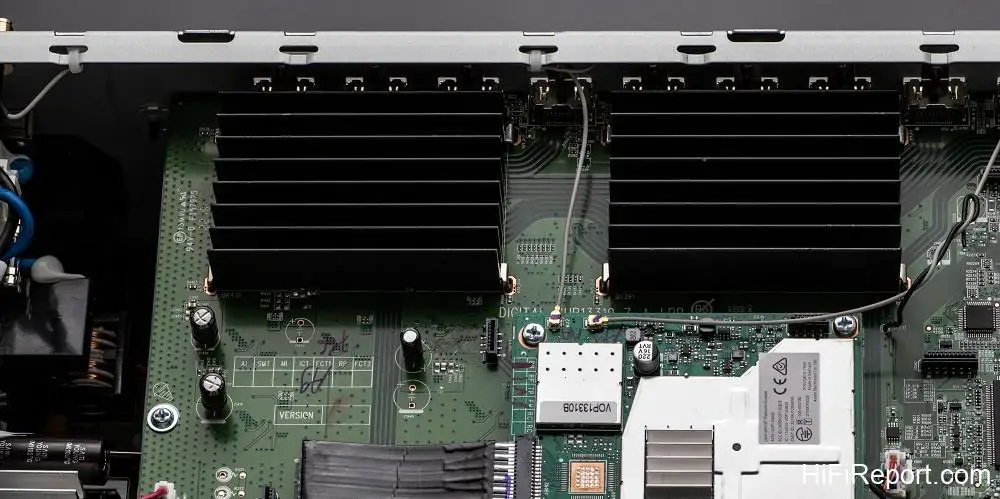
Let’s delve into the AVR-X3800H’s internal circuitry. The rear section of the chassis houses the electronics in a three-layer structure: the upper layer (digital main board), the middle layer (preamplifier), and the lower layer (power supply and speaker output connections). The upper circuit board primarily contains the HDMI input/output interfaces, HEOS network card, and digital audio processing circuitry.
Previously, Denon’s mid-to-high-end models used four SHARC DSP chips for multi-channel decoding, post-processing, and room correction. As shown in diagrams (referencing the hypothetical diagram from the original text), the AVR-X3800H now mirrors the design of the latest flagship AVR-A1H, using a single 1GHz “Dual-SHARC+” DSP chip (ADSP-21593) to replace the four previous DSPs, resulting in a slight improvement in processing performance.
Internal Circuitry: Digital-to-Analog Conversion
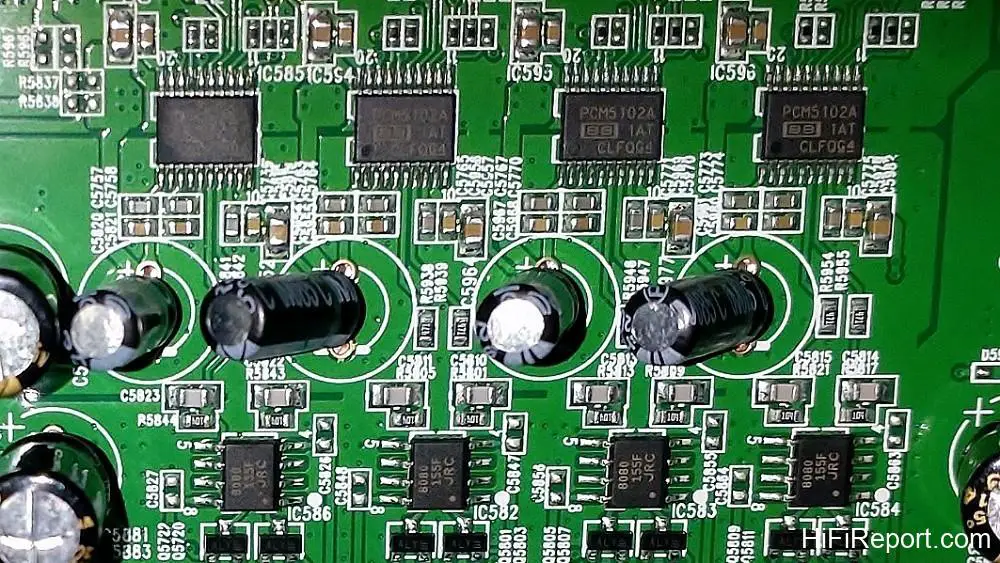
The AVR-X3800H’s digital-to-analog conversion circuit also shares similarities with the AVR-A1H. Typically, non-flagship surround receivers use 8-channel DAC chips for D/A conversion. With the AVR-X3800H’s total preamplifier processing capability of 11.4 channels, two 8-channel DACs would suffice. However, it adopts a “dual-channelized” DAC structure, utilizing a total of eight 32-bit dual-channel DAC chips (TI PCM5102A, with a dynamic range of 112dB).
These are paired with buffer amplifier circuits built using dual OP Amps (JRC NJM8080) known for their low noise, low distortion, and wideband characteristics, along with passive components.
This D/A conversion circuit is a vertically mounted, independent circuit board. It also functions like a “connector board,” linking the digital main board and the preamplifier board above and below it, respectively. This arrangement effectively shortens the audio signal path and reduces the number of connection points the audio signal passes through, preserving more subtle details of the original audio information.
In the preamplifier section, key components, including audio switching/distribution and volume control chips, are custom-designed in collaboration between Denon and JRC.
Internal Circuitry: Amplifier Design
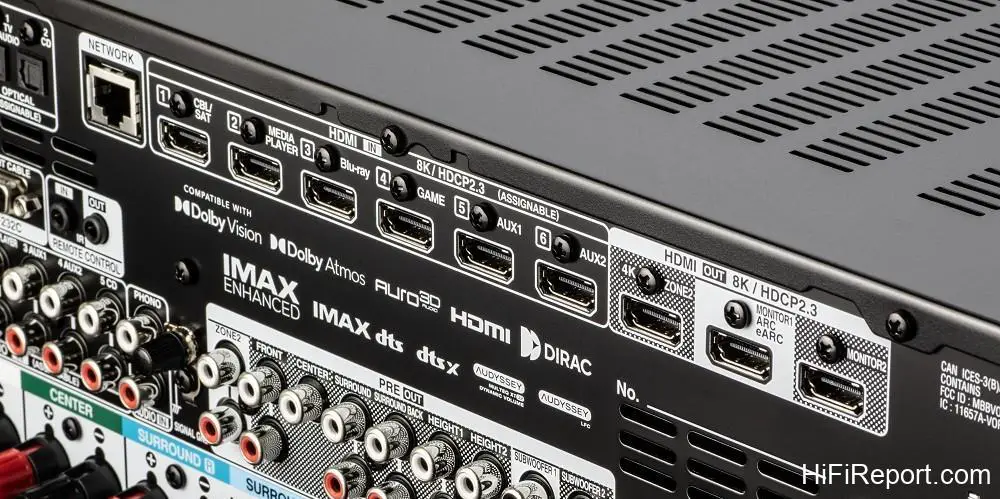
The unit’s power amplifier circuitry is located in the front half of the chassis, configured with a total of 9 channels (4 in the front, 5 in the rear). The circuit design concept is derived from the previous generation flagship, the AVR-X8500H. In terms of tuning, the goal is to achieve the clear objectives set by Denon’s “Sound Master,” Shinichi Yamauchi: sharp and clear imaging, high resolution, and smoothness.
Audiophiles who frequently experiment with tuning will appreciate that achieving both high resolution and smoothness simultaneously is no easy feat.
The output stage of the power amplifier circuit uses a pair of Sanken 2SD2560 / 2SB1647 power transistors per channel. Thick aluminum extruded heat sinks are employed to enhance heat dissipation efficiency and reduce the impact of vibration.
Internal Circuitry: Power Supply Details
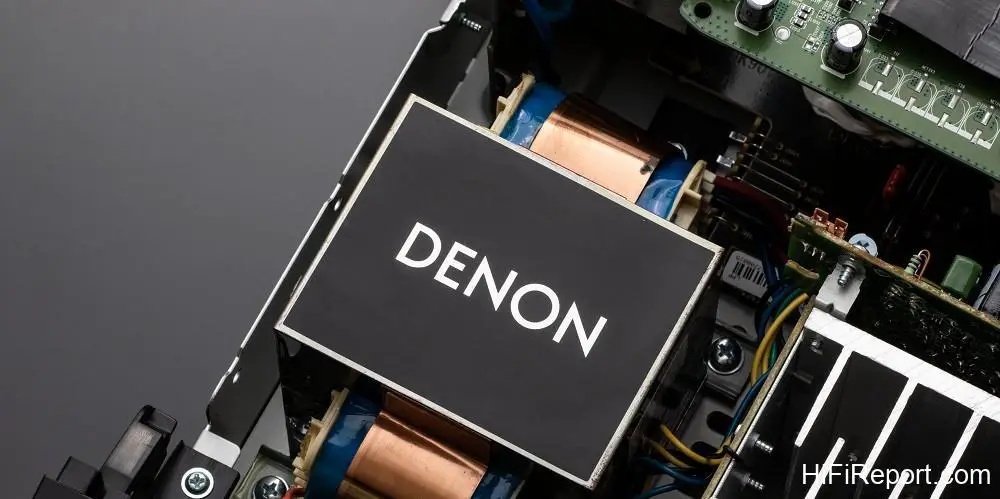
The power supply circuitry continues to use separate provisions for digital (via a switching power supply board) and analog (via an EI transformer) sections.
The filter capacitors for the power amplifier circuit are two custom-ordered 12,000μF/71V electrolytic capacitors from Nichicon.
Multi-Subwoofer Performance
For this review, I used a 5.2.4 channel speaker configuration. During the testing process, I compared the performance of the dual subwoofers set to “Standard” and “Directional” modes. Standard mode outputs the same signal to all subwoofers and is suitable for placing multiple subs together side-by-side or stacked. Compared to Directional mode, the bass and ultra-low bass are faster and the impact is strong and solid.

Directional mode divides the two subwoofers into left/right or front/rear pairs. If using four subwoofers, they would typically be positioned front-left, front-right, rear-left, and rear-right. Frankly, the force and speed are not as impactful as in Standard mode, but the soundstage is wider (though this is less noticeable if the crossover point is equal to or below 80Hz). Separating multiple subwoofers can help to even out the frequency response.
For subwoofers without built-in equalization capabilities and surround receivers that cannot precisely correct subwoofers, this mode makes it easier to achieve a flatter bass and ultra-low bass response. These findings are offered for the reference of users who plan to purchase this unit (or other new Denon and Marantz high-end surround receivers) and wish to install 2, 3, or 4 subwoofers.
Music Performance
In terms of music playback, Pure Direct remains the best mode on this unit. When playing lossless music files in this state, the texture of vocals and instruments is quite close to high-end models priced around the $3,000 range. Furthermore, I believe that in Pure Direct mode, it qualifies as a “pure audio component,” with musicality and richness comparable to streaming integrated amplifiers in a similar price range.
Even when playing videos with compressed audio encoding from sources like YouTube, such as live recordings from The First Take, it still manages to convey the weight and thickness of vocals and the richness and warm tone of instrument sounds.
Driving Power and Audyssey for Music
Although the unit’s stated output power is similar to its predecessor, I felt a noticeable improvement in actual driving capability. Driving the Pioneer S1-EX floorstanding speakers in Pure Direct full-range mode produced a rather thick sound foundation, managing to drive even the ultra-low frequencies competently. In Stereo mode, the subwoofer can be included. If you want to use the results of Audyssey room correction, I recommend setting Audyssey MultEQ XT32 to Flat for music listening.
This yields a neutral sound and mitigates booming caused by standing waves, resulting in solid and taut bass. Listening to music, I also detected a difference in tuning between the X3800H and its predecessor. It is more willing to express detail and sparkle in the upper treble and has added “muscle” to the mid-bass and bass frequencies.
Movie Performance
When playing movies, I switched Audyssey MultEQ XT32 back to the default Reference mode. Having tested the music performance, I already anticipated that the AVR-X3800H would demonstrate excellent power with movie soundtracks. The sound is bright, clear, and transparent – and my actual listening experience confirmed this. The X3800H made me feel like it was no longer just another 3000 series model; it closely resembled the AVR-X4700H that I reviewed in 2020.
A shared characteristic is their performance with three-dimensional sound. Compared to other surround receivers in a similar price range, you can perceive an unusual sense of openness in outdoor scenes in movies. The soundstage extends outward without boundaries, as if the walls and ceiling of the listening room have completely disappeared.
Spatial Imaging and Immersion
With four overhead speakers engaged, the shapes and movements of sonic objects are exceptionally clear. For example, in the scene of Iceman’s funeral in “Top Gun: Maverick,” as the four fighter jets fly overhead in formation and one breaks away and climbs, the changes in formation, sound image, relative position, and trajectory are very distinct. Even with eyes closed, you can pinpoint the location of the sound.
The AVR-X3800H’s open three-dimensional soundstage also accentuates the difference between outdoor and enclosed spaces. In the scene where Maverick attempts to reach the target in 2 minutes and 15 seconds, you feel the pressure within the cockpit’s confined space. During rapid flight, you can clearly hear the “entire surface” of the mountainside and ground moving relative to the fighter jet flipping and rolling on its side and overhead.
In the opening of the Netflix series “1899,” the transition from a vast sense of space to the soundstage fully enveloping and spinning around and overhead as they pass through a vortex is palpable. The AVR-X3800H’s ability to create a strong sense of being “immersed in the scene” is something users should definitely take the time to experience during a demo.
Conclusion and Recommendation
From a practical standpoint, the channel count provided by the AVR-X3800H is sufficient for most users’ rooms. Its capable sound quality allows users to enjoy music happily in addition to daily viewing and watching movies. Its performance in terms of 3D soundstage and object movement is particularly strong. It is also one of the very few newly released models, outside of flagship surround receivers, that can connect “.4” subwoofers.
Therefore, based on my subjective assessment of its sound performance and its objective hardware capabilities, I believe the Denon AVR-X3800H is worthy of our highest recommendation.
Specifications
* Type: 9.4 Channel Surround Receiver
* Max Processing Channels: 11.4
* Output Power Per Channel: 215W (6 ohms, 1kHz, THD 10%, 1 ch driven), 135W (6 ohms, 1kHz, THD 0.7%, 2 ch driven), 105W (8 ohms, 1kHz, THD 0.08%, 2 ch driven)
* Frequency Response: 10Hz ~ 100kHz (+1, -3dB)
* Signal-to-Noise Ratio: 100 dB
* Speaker Impedance Compatibility: 4 to 16 ohms
* Input Terminals: HDMI × 6, Analog Audio × 5, Phono × 1, Toslink Optical × 2, Digital Coaxial × 2
* Output Terminals: HDMI × 3, 11.4 ch Pre-out × 1, 2 ch Zone 2 Output, Headphone × 1
* Other Terminals: USB × 1, Ethernet × 1, Room Correction Microphone Jack × 1, RS-232C × 1, DC Trigger Out × 1, IR Input/Output × 1 each, Wi-Fi/Bluetooth Antenna Terminals × 2, FM Antenna × 1, AM Antenna × 1
* Dimensions (W×H×D): 434 × 167 × 388mm
* Weight: 12.5 kg