
Denon AVR-X4800H Review
Previously, when reviewing high-end surround processors, I had already experienced Spatial Music in its “ideal state.” The sense of being transported into the live performance space made me completely forget about sound quality itself (though the quality was already excellent). However, the surround processor and multi-channel power amplifiers I used back then totaled around $25,000 USD.
High-end audiophiles might not consider this excessive, but for the “average” enthusiast, it’s well beyond their budget. This reinforces my belief that musical performance (not just movie effects) is the ultimate challenge for any multi-channel system. For the past few months, I’ve been seeking solutions to enjoy Spatial Music on a lower budget, searching for the optimal balance between price and performance. The Denon AVR-X4800H has emerged as a highly satisfying answer.
Price Justification?
Wait, the Denon AVR-X4800H? Some high-end audio enthusiasts might find this answer surprising, and frankly, I can see why, at first glance. I reviewed its predecessor, the AVR-X4700H, in 2020. Four years have passed, and the AVR-X4800H has a similar size, appearance, number of amplifier channels, core features, HDMI video compatibility, and weight. Yet, its reference price has increased from around $2,100 USD to about $3,050 USD. How can this be?
Is there any justification for Denon’s third-tier surround receiver commanding such a price?
Let me tell you this upfront: based on my understanding and experience, this unit represents the most significant change in the Denon 4000 series in a decade. Compared to its predecessor, the modifications to the internal circuit structure and manufacturing approach are far more than a mere revision or upgrade. It should be seen as a completely redesigned and manufactured, higher-tier model.
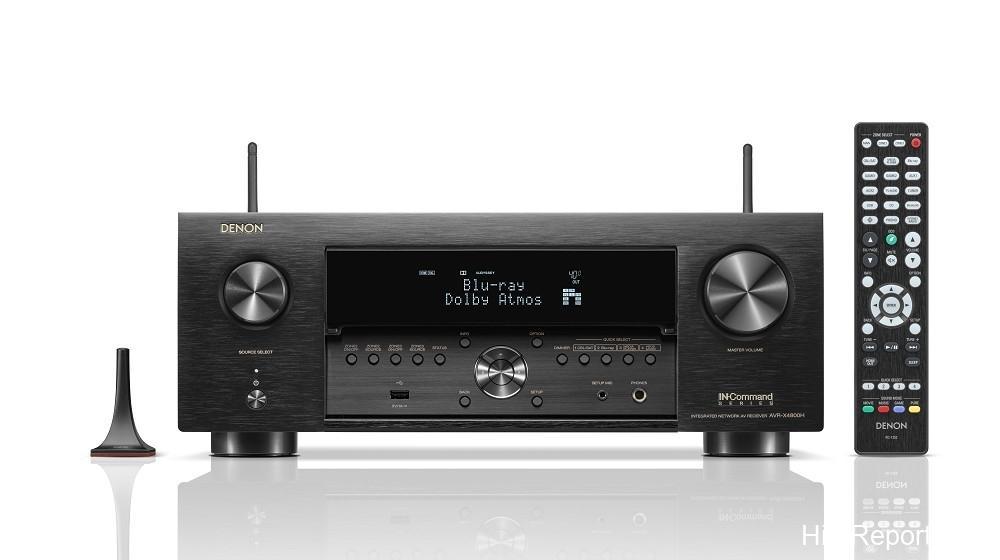
In fact, structurally speaking, its “younger sibling,” the AVR-X3800H, shares a much greater similarity with the AVR-X4700H than the X4800H does.
Shirakawa Quality
The Great East Japan Earthquake on March 11, 2011, severely impacted the Denon and Marantz “Made in Japan” base – the Shirakawa Audio Works factory in Fukushima Prefecture. After gradually restoring production lines, the Shirakawa factory was exclusively used for manufacturing high-end and flagship products, while mid-range and budget models were produced at overseas factories (primarily in Vietnam).
Players with hands-on experience will likely agree that Denon products made in overseas factories offer excellent value for money, but the models originating from the Shirakawa factory in Japan belong to an entirely different level of sound quality.
In recent years, with the depreciation of the Japanese Yen, Denon’s headquarters evaluated moving some key models back to the Shirakawa factory for manufacturing. To my knowledge, the AVR-X4800H is the first Denon surround receiver to follow this path. It is the first “4000 series” model to be produced at the Shirakawa factory since the AVR-X4000H, which was manufactured overseas in 2014.
Key Evolutions
Can switching from Vietnam to Japan manufacturing alone justify such a price increase? I wouldn’t accept just that reason. Let me detail the key evolutionary steps of the AVR-X4800H one by one. First is the channel count. The previous generation was 9.2 channels (connecting two subwoofers), while the AVR-X4800H is 9.4 channels, capable of connecting four subwoofers.
Each subwoofer can be individually configured and calibrated, and they can also be set directionally, with each of the four subwoofers handling the “front left, front right, rear left, rear right” sections of the listening space.
With the AVR-X4800H’s built-in amplifiers and subwoofer outputs, users can implement speaker configurations ranging from 5.1.4 (up to 5.4.4) or 7.1.2 (up to 7.4.2). Furthermore, its preamplifier section supports up to 11.4 channels. Therefore, by adding a two-channel power amplifier or an integrated amplifier with an HT Bypass function, you can have up to 7.4.4 channels simultaneously active.
Dirac Live Support
Knowledgeable users seeing “four subwoofers” might immediately think of Dirac Live Bass Control. Yes, the second major difference between the AVR-X4800H and its predecessor is support for upgrading to Dirac Live. The AVR-X4800H ships with the high-level Audyssey MultEQ XT32 room correction built-in. If a user needs Dirac Live to more accurately measure response, define custom target curves, and calibrate, they can purchase it through the Dirac online store.
The introductory Dirac Live LE, covering frequency response correction from 20 to 500Hz, costs $259 USD. The full-range Dirac Live Room Correction Full Bandwidth is $349 USD. Dirac Live Bass Control, featuring advanced phase optimization (between all channels and subwoofers), is $349 USD for the “single-subwoofer version” and $499 USD for the “multi-subwoofer version.”
The microphone and stand required for Dirac Live testing need to be purchased separately; I recommend the miniDSP UMIK-1 as a basic setup.
Internal Design Insights
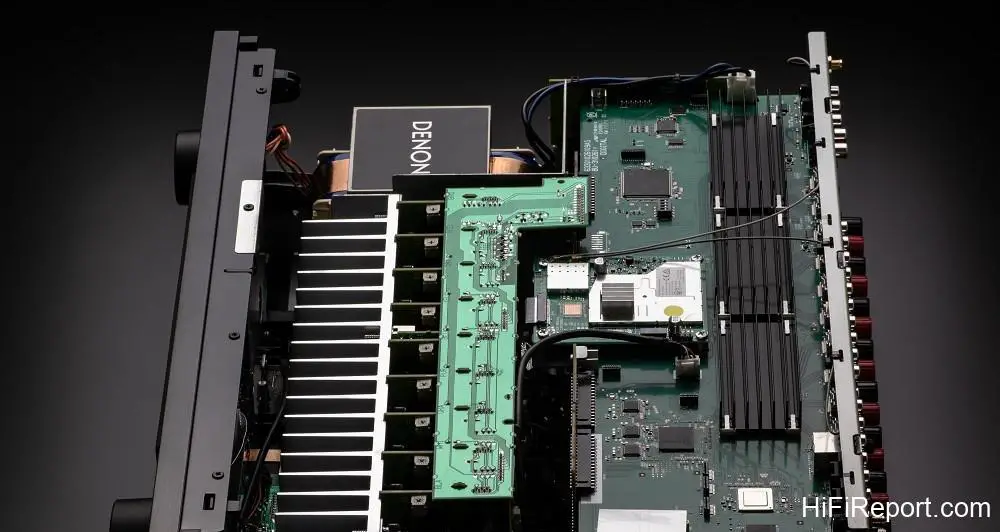
Now, let’s delve into the internal circuitry of this unit. From the location of various circuits, there seems to be little difference at first glance. However, a quick comparison of the internal top-down views of the AVR-X4800H and X4700H reveals significant changes. Firstly, the digital circuit mainboard at the rear top: the previous generation only had the 7th HDMI input supporting 8K/60p and 4K/120p video input, whereas the AVR-X4800H has *every* HDMI input supporting these specifications.
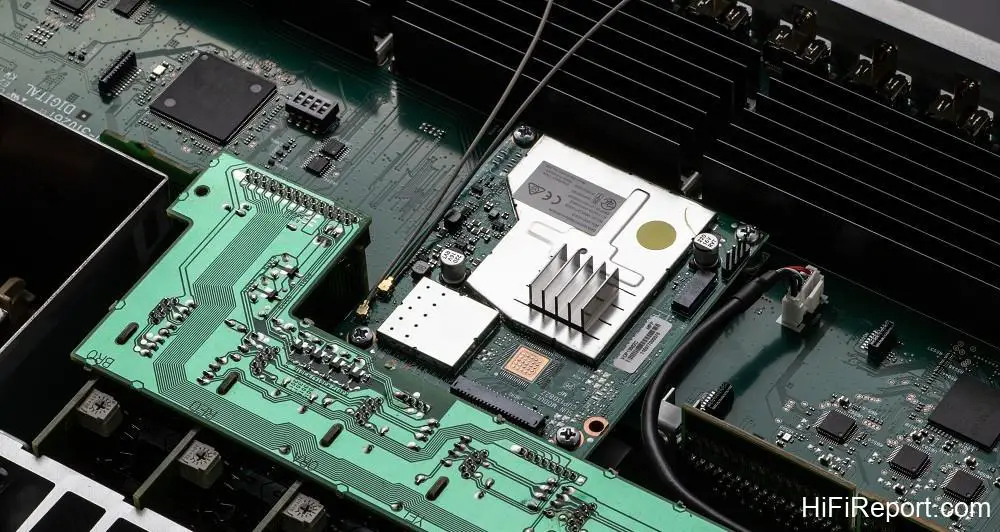
Furthermore, the HEOS network card located in the center of the digital mainboard has been updated to a new version with more rigorous shielding in the AVR-X4800H.
Digital Processing Core
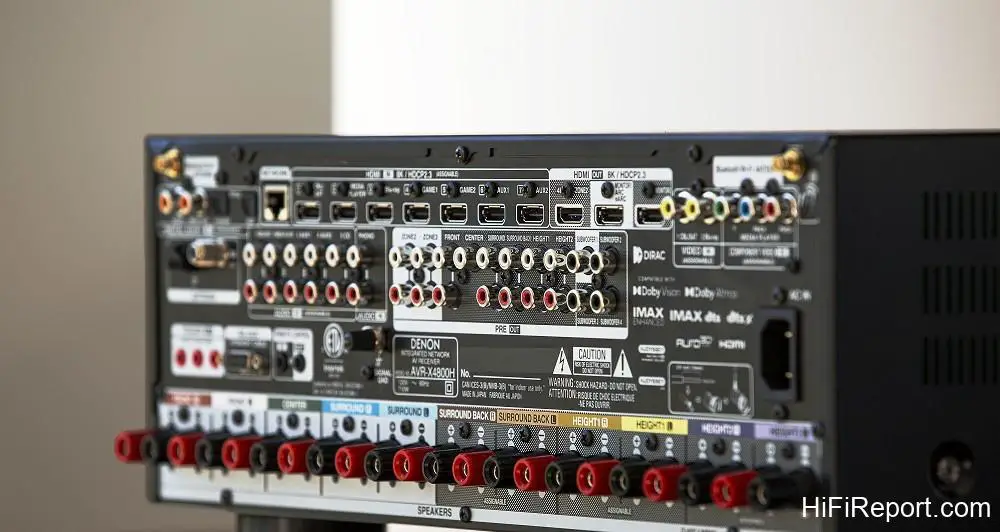
The core of the digital audio processing, which previously used two Analog Devices Griffin Lite DSP chips (ADSP-21573), has been replaced with a single dual-core SHARC DSP chip with higher overall processing power: the Analog Devices Griffin Lite XP ADSP-21593 (the silver chip in the image below).
This chip is responsible for multi-channel decoding, post-processing (such as IMAX Enhanced), and room correction (Audyssey and Dirac).
AL32 Multi-Channel
Among these, I believe the most important digital audio processing is Denon’s proprietary “AL32 Multi-Channel” technology. Regardless of whether the input digital audio is 16bit or 24bit, two-channel or multi-channel, this unit expands the input audio to 32bit and increases the sampling rate. This process optimizes the linearity of the audio signal and enhances the reproduction capability of small signals.
To put it more simply, it means “upsampling and bit-extending all digital audio to Hi-Res.”
Audio Circuitry Overhaul
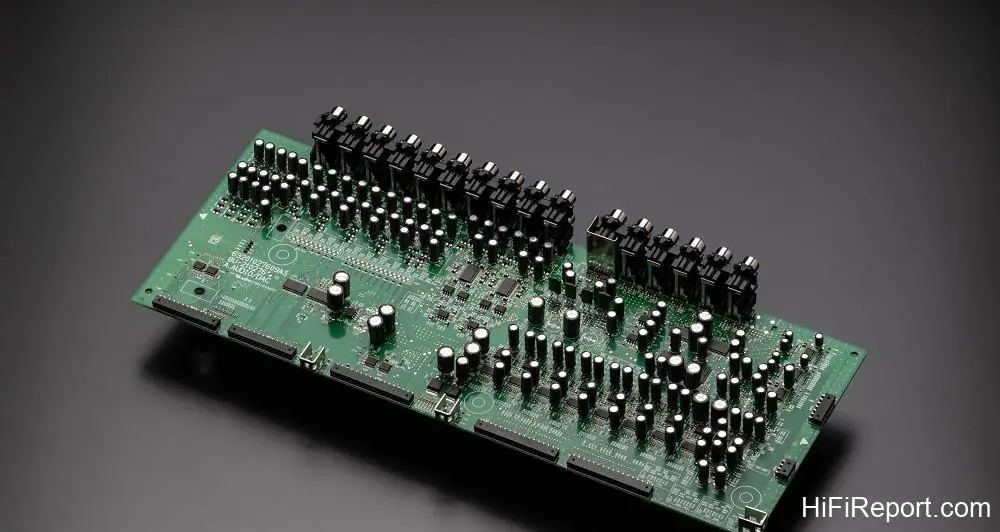
In terms of audio circuits, the AVR-X4800H features significant changes. Firstly, the integrated design of the digital-to-analog conversion circuit and the preamplifier circuit. Previously, the AVR-X4700H had the DAC circuit as a separate board, which also served as a bridge connecting the digital mainboard and the preamplifier board. The upper end connected to the multi-channel audio output processed by the digital mainboard.
After multi-channel D/A conversion, the lower end connected to the source selection and volume control circuit of the multi-channel preamplifier.
Please see the image above: The AVR-X4800H now adopts a “shortest audio path” design. The multi-channel D/A conversion and multi-channel preamplifier are integrated onto the same circuit board. They are directly connected without any connecting boards, connectors, or wiring. This eliminates at least four contact points in the path of the audio signal for each channel, simultaneously reducing audio loss and noise.
From these “small details” that normal users and reviewers might not notice, I sense that the designers of this unit genuinely aimed to make the AVR-X4800H a “multi-channel Hi-Fi” or even “multi-channel Hi-end” amplifier. Competing with two-channel streaming amplifiers on sound quality has always been challenging for surround receivers due to their complex circuit structures and disadvantages in signal path transmission connections.
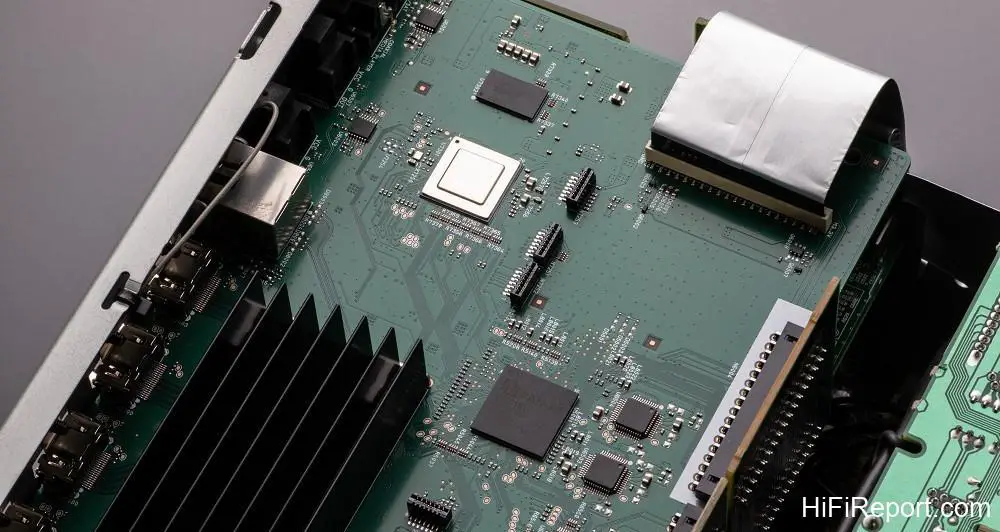
However, the directness of the audio signal transfer between the DAC and preamplifier circuits in this unit is absolutely comparable to that of two-channel audio products.
Premium Components
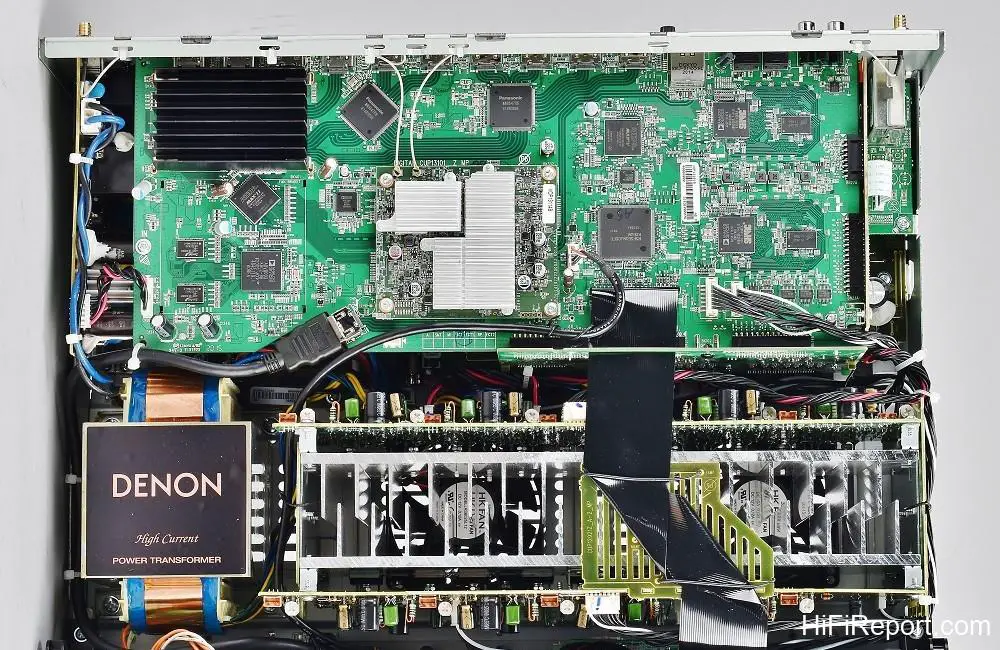
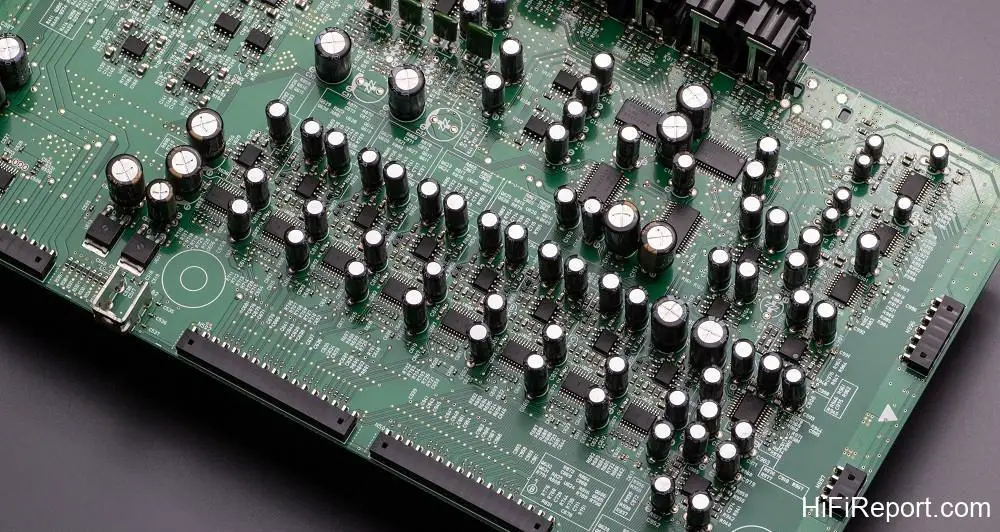
Following this, you can expect a series of design choices focused on sound quality. Please see the image below: In the digital-to-analog conversion section, this unit utilizes a two-channelized design, employing a total of 8 pieces of the 32bit two-channel DAC chip, TI PCM5102A (whereas previous models used 8-channel DAC chips).
Denon’s head of surround receiver circuit design, Yusuke Takahashi, consistently employs a specific technique: having the OP Amps operate in Class A for small signal amplification to achieve excellent linearity without crossover distortion. This is still utilized in the AVR-X4800H, using the audio-specific dual OP Amp chip NJM8080 from Nisshinbo Micro Devices (formerly JRC), known for its wide bandwidth (15MHz) and low distortion (0.0005%), for small signal amplification.
Immediately after the NJU72750 from Nisshinbo handles source switching, the NJU72343 8-channel volume control chip is used for main channel volume control and high-level amplification (Zone 2 and Zone 3 use two separate two-channel volume control chips). For the preamplifier output section, an output buffer amplifier circuit constructed with transistors and passive components is used.
Mono-Block Amplification
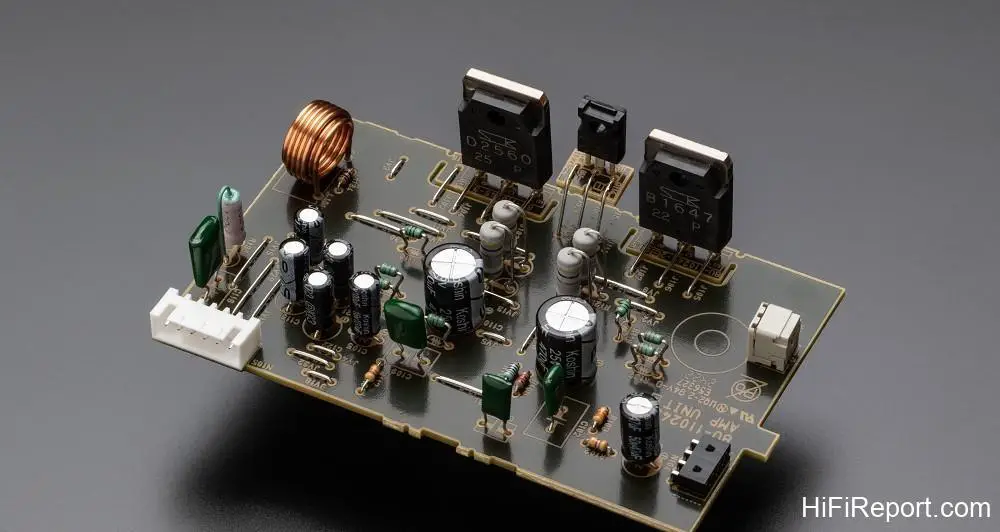
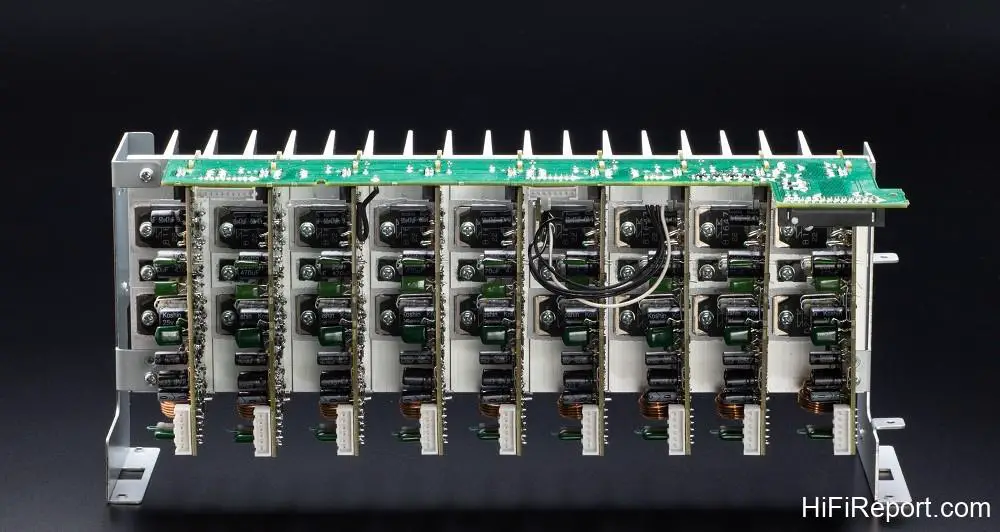
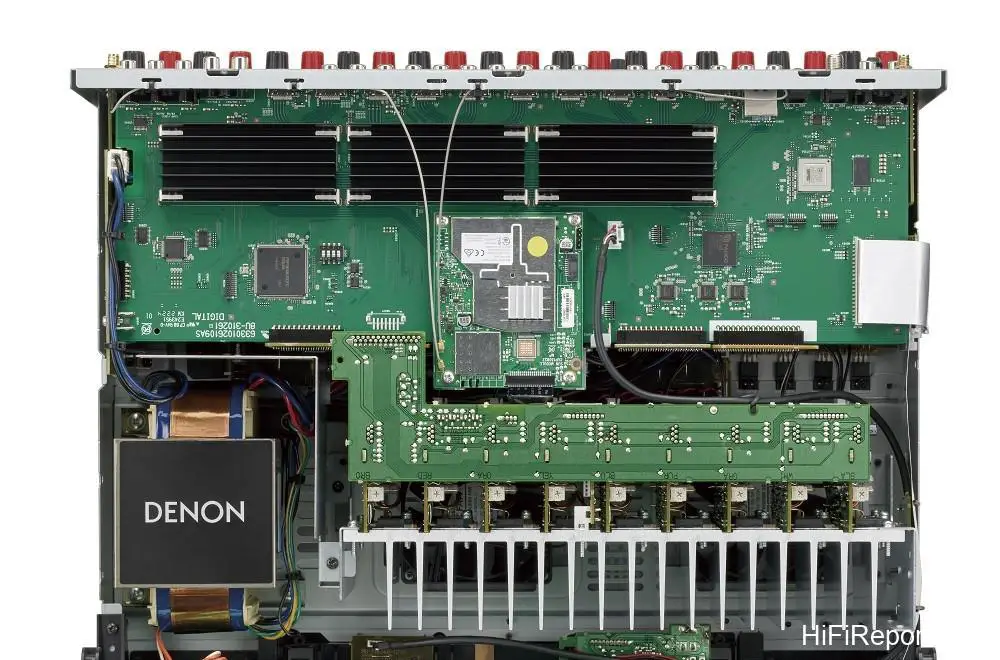
The previous generation X4700H divided the 9-channel power amplifier circuit into two boards, one for 5 channels and one for 4 channels. The approach taken by the AVR-X4800H is very much like a miniaturized version of the flagship AVR-A1H: it uses a fully independent mono-block construction for all 9 channels. This reduces crosstalk between channels and improves channel separation, which helps to create a wide soundstage (whether playing two-channel or multi-channel audio).
The mono-block power amplifier circuit uses a simple (few components) typical single differential amplifier design. The output stage for each channel uses a pair of Sanken 2SB1647 / 2SD2560 (Darlington power transistors with a maximum current of 15 amperes) in a push-pull configuration. This type of circuit, being simple with fewer components in the audio path and low negative feedback, I judged to have a high probability of sounding direct and pleasing.
Another key design point is the connection of audio signals. Please see the image below: The connection from the preamplifier output to the power amplifier input is a direct board-to-board link, without any internal wiring. This is another aspect of the “shortest audio path” design.
Power & Tuning
To meet the requirements of Denon’s sound master, Shinichi Yamauchi, for a “Vivid and Spacious” sound, the AVR-X4800H must possess both refined sound quality and powerful output. Its elder sibling, the AVR-A1H, is the best example of this. Tuning, of course, involves extensive listening during the development process and selecting key components based on listening impressions.
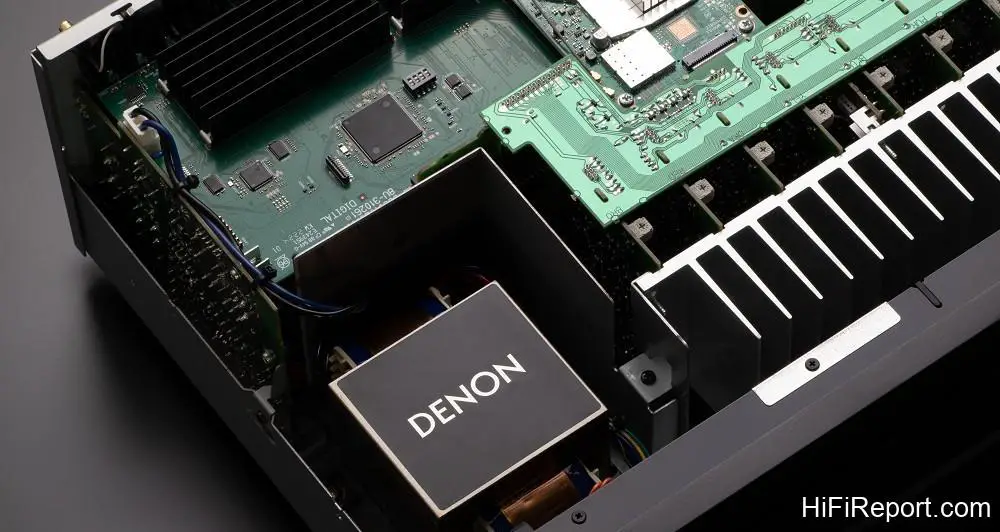
This unit features carefully selected components in the audio circuits (including various internal wiring) and a robust power supply as the foundation for the power amplifier’s strong driving capability. As in previous designs, this unit utilizes separate power supplies for digital and analog circuits. Digital circuits are powered by a switching power supply board, while the audio circuits are powered by a hefty 4.8kg EI transformer (the transformer in the lower-tier X3800H weighs 4.2kg).
The power amplifier circuits are supplied by two custom Denon 15000μF/71V filter capacitors.
Summary of Improvements
Here, I’ll summarize the significant evolutions of the AVR-X4800H compared to the X4700H: Made in Japan, all seven HDMI inputs compatible with 8K, four subwoofers, optional paid Dirac Live room correction, updated DSP chip, integrated DAC and preamplifier circuits, two-channel DACs, mono-block power amplifier construction, and optimized connection between the preamplifier and power amplifier. Achieving better sound quality requires attention to every detail, no matter how small.
The meticulous approach seen in high-end two-channel audio products is evident here.
Other Features
A particularly notable aspect of the AVR-X4800H’s multi-channel processing is its support for IMAX Enhanced (which is timely as Disney+ is starting to offer movies with this audio format) and Auro-3D. For music streaming, Denon’s long-standing HEOS wireless multi-room music function is quite mature. It has built-in dual-band Wi-Fi and can access network streaming music services.
It can play music files from USB storage devices and home network shares, including MP3, WMA, WAV, MPEG-4 AAC, FLAC, Apple Lossless, and DSD files. It supports multi-channel Hi-Res up to 192kHz/24bit and DSD up to DSD128 (5.6MHz).
Connectivity
The AVR-X4800H features bi-directional Bluetooth: it can receive Bluetooth audio from portable devices and also transmit digital audio to wireless headphones.
Test Setup
For this test, I used a 5.1.4 channel speaker configuration. All calibrations were done according to the same standards I used when reviewing the AVR-A1H. This involved careful speaker placement, including using REW to confirm that the left and right speakers and subwoofers already had a reasonably balanced frequency response *without* any room correction applied. This allows me to use the Pure Direct mode to showcase the unit’s best sound quality for music content.
2-Channel Performance
Starting with two-channel music files, in Pure Direct mode, the AVR-X4800H drove the left and right Pioneer S-1EX floorstanding speakers full range, with no other speakers (including subwoofers) active. I believe that in this mode, the unit’s performance with two-channel music is entirely comparable to similarly priced “two-channel” streaming amplifiers. AL32 processing is still active in Pure Direct. Even with CD-quality music files, the resolution and texture sound very much like Hi-Res.
What’s even more valuable is that alongside this high-resolution characteristic, the mid-range (like vocals, cello, saxophone) still retains a warm tone. The high frequencies are refined and gentle. The power supply originally intended for nine amplifier channels is now dedicated to just two. The robust 125 watts per channel (8 ohms) provides the S-1EX floorstanders with a “fast and solid” low frequency performance with excellent control and clear definition.
Spatial Audio Listening
I didn’t spend too much time on two-channel listening because I was eager to hear Apple Music’s Spatial Audio streaming music (played via Apple TV, HDMI output to the unit). I kept the unit in Pure Direct mode, allowing it to directly decode and perform AL32 Multi-Channel processing (without using DRC) to maintain the best possible sound quality.
Classical Spatial Audio
I started with classical music, listening to several albums consecutively. I found that most classical music content’s “spatial audio” was rendered quite naturally, without artificially placing instruments in the rear (placing them overhead would be too exaggerated). The listening experience was like being in a concert hall, with the orchestra and performers on the stage in front.
The AVR-X4800H demonstrated excellent front soundstage depth, creating a rich, dense sound that completely filled the space, much like sitting in the audience.
Listening to Yuja Wang’s “The Vienna Recital” album, I noticed the AVR-X4800H’s ability to reproduce dynamic contrast and its sensitive response to the attack force and timbre changes of piano keystrokes. I could also perceive subtle sound fluctuations within the space. You can certainly see how this demonstrates the advantage of multi-channel over two-channel in creating “three-dimensional soundstage immersion.”
But what surprised me about the AVR-X4800H was the incredibly high level of sound texture and detail, and the massive amount of information in the subtle spatial sounds. I know Apple Music’s Dolby Atmos is compressed audio, but it surprisingly sounded like lossless! This “high-quality multi-channel” significantly increased the realism with which immersive music recreated the live performance environment.
Spatial Movement
Listening to Ryuichi Sakamoto’s “andata,” I not only felt the high density, complex sound, and strong enveloping energy but also clearly heard a section where sound flowed from the rear right, upwards, to the front left, passing overhead. “Theoretically,” a three-dimensional soundstage allows music creators to freely place various sounds (sound objects) anywhere within the listener’s space.
However, the extent to which this can be realized still depends on the multi-channel system’s ability to reproduce it realistically. The multi-channel speakers used in this test were significantly more expensive than the unit itself, and the main channels featured Beryllium tweeter drivers, so the overall realism of the system was determined by the AVR-X4800H’s capability.
Pop Spatial Audio
When playing Apple Music’s Dolby Atmos music, especially pop songs, turning up the volume felt like sitting in the front row near the stage at a concert. The instruments and vocals on stage were direct and vivid, with excellent image size, clarity, and what particularly struck me, a strong sense of “intimacy.” This lifelike realism, feeling incredibly close, is something rarely achieved even by surround receivers in a higher price range.
If your home is well soundproofed, or if you live in a detached house (so you don’t bother the neighbors), the AVR-X4800H can genuinely allow you to experience a concert every day, with a level of detail far exceeding that of PA speakers used in concerts.
Auro-3D Upmixing
In addition to listening to multi-channel music, I also recommend trying the Auro-3D mode for upmixing when streaming two-channel pop music to multi-channel playback. Setting MultEQ XT to Flat and Restorer to Low can enhance the “spice” of the mid-highs and make it feel closer to the stage when played at high volume.
Listening to Peggie Hsu’s “Balloon” on Apple Music, even though it’s just a standard studio two-channel version, listening to it with the unit’s Auro-3D mode converted to multi-channel truly created the spatial feel and sound flavor of a Live House. This shows that even if the native audio isn’t spatial, users can “play with their own spatial audio” and create their own live music space – a joy you simply cannot get from a two-channel audio system.
Movie Performance
When playing movie soundtracks, I recommend using DRC mode. If you’ve purchased Dirac Live, you can set target curves according to your preferences. Boosting the bass for a more impactful sound is certainly possible. If you haven’t purchased Dirac Live, using the unit’s built-in Audyssey is also excellent. I recommend selecting MultEQ XT in Reference mode, which will provide richer bass than the Flat mode.
Hyper-Detailed Sound Effects
I believe the most outstanding aspect of the AVR-X4800H’s movie performance is its almost Hi-Res level, ultra-fine sound effects. It doesn’t need explosive volume to dramatically convey effects. When watching typical dramas or series, it’s easy to feel the air filled with subtle sounds. With a very high density of sound information, it more concretely shapes a highly realistic environment, making you feel present in the scene.
Watching horror films constantly creates a sense of tension, feeling like “something is about to happen” at any moment.
3D Soundstage Mastery
The AVR-X4800H is highly adept at rendering the movement and shape changes of sound objects within the three-dimensional soundstage. Watching episode five of “The Three-Body Problem” (Netflix), “Judgment Day,” after the 47-minute mark, the expansive and open spatial sense, the soundstage extending from near to far, the complete three-dimensional envelopment, and the changing position and form of the “Sophon” in space were remarkable.
Even with eyes closed, the AVR-X4800H, solely through sound, allowed me to perceive a clear and concrete visual sensation.
Flagship Comparison
Using the AVR-X4800H in most family living rooms or dedicated home theater spaces around 10 pings (approx. 33 sqm), it truly functions as a “9.4 channel flagship.” Its performance in sound quality and soundstage is quite close to the “true flagship,” the AVR-A1H. However, I must be honest: when it comes to sheer “wildness and violence” (referring to dynamic impact and power), the AVR-X4800H still doesn’t quite match the A1H, which costs and weighs about 2.5 times more.
For quiet listening, the tranquility, and for high-volume listening, the stability, the kingly A1H still holds an advantage.
Value Proposition
Nevertheless, in terms of value for money, I believe the AVR-X4800H puts pressure on both surround receivers and streaming amplifiers in its price range. Its sound quality level transcends its price bracket and is comparable to “entry-level high-end” (~$3,100+ USD) two-channel streaming amplifiers. More importantly, this is a surround receiver we can buy for under around $3,100 USD that can reproduce Spatial Music with “high-end audio sound texture.”
Therefore, I not only recommend it to home theater enthusiasts but also to the broader audio community. I urge everyone to start by auditioning the AVR-X4800H and experience the joy of Dolby Atmos music.
Specifications
* Type: 9.4 Channel Surround Receiver
* Power Output: 235W (6Ω, 1kHz, THD 10%, 1ch driven), 165W (6Ω, 1kHz, THD 0.7%, 1ch driven), 125W (8Ω, 20Hz–20kHz, THD 0.05%, 2ch driven)
* Frequency Response: 10Hz–100kHz (+1, -3dB)
* Signal-to-Noise Ratio: 102 dB
* Input Terminals: HDMI × 7 (all compatible with HDMI 2.1 8K/60p and 4K/120p), Analog Component × 2, Composite Video × 3, Analog Audio × 5, Phono × 1, Toslink Optical × 2, Digital Coaxial × 2
* Signal Output Terminals: HDMI × 3 (two outputs support 8K/60p and 4K/120p), Analog Component × 1, Composite Video × 2, 11.4 Channel Pre-out × 1, 2 Channel Zone2/Zone3 Pre-out, Headphone × 1
* Other Terminals: USB × 1, Ethernet × 1, Room Calibration Microphone Jack × 1, RS-232C × 1, DC Trigger Out × 2, IR Input/Output × 1 each, Wi-Fi/Bluetooth Antenna Terminals × 2, FM Antenna × 1, AM Antenna × 1
* Dimensions (W×H×D): 434 × 167 × 388 mm
* Weight: 13.1 kg

- ENVELOPING 3D AUDIO FOR LARGER SPACES – Featuring 8K/60Hz pass-through, 9.4-Ch AVR-X4800H (125W X 9) home audio receiver delivers pristine video and smooth motion, Dolby Surround and DTS Neural:X upmixer offer heightened realism for legacy content
- GET THE MOST OUT OF YOUR 8K TV – Enjoy quality 3D audio and video with HDCP 2.3 & eARC support. This 2.1/5.1/7.1 surround sound receiver plus home theater receiver supports video formats like HLG, Dolby Vision, HDR10+, and Dynamic HDR pass-through
- UPGRADE YOUR HOME THEATER – Get surround sound with Dolby Atmos, DTS:X Pro, IMAX Enhanced, Auro 3D on this home theater amplifier with Dolby Height Virtualization and DTS Virtual:X creating overhead sound in a 7.1, 5.1, or 2.1 without height speakers
- CONNECT WITH ANY HD/UHD TV, SUBWOOFER, BLU-RAY PLAYER & TURNTABLE FOR INCREDIBLE STEREO SOUND- The AV home stereo receiver features 10 HDMI ports (7 In/3 Out) with 8K & 4K/120 support, analog digital inputs, phono input, (4) RCA/XLR subwoofer outputs
- EXTEND THE REACH OF YOUR MUSIC TO ANY ROOM – This Denon Receiver stereo receiver with bluetooth lets you create a multi-room surround sound system streaming via built-in HEOS Wi-Fi for Hi-Fi audio around the home with Pandora Spotify TIDAL and more